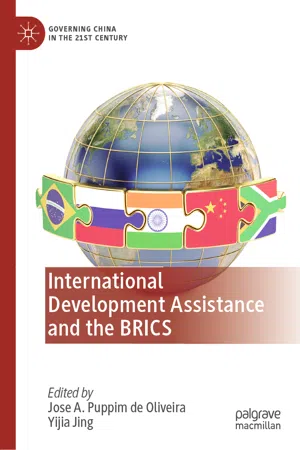
This book aims to bring together a series of analyses on international development assistance in the BRICS, the group of countries that includes Brazil, Russia, India, China and South Africa. The BRICS states comprise approximately 3 billion people (~40% of the World's population) and in terms of GDP account for 16.8 trillion dollars (~22% of the World's economy). Over the last decade the loose coalition has evolved to become a formal partnership on both economic and political fronts. The first formal meeting of the then-four BRIC countries took place in 2006 during the United Nations General Assembly. This was followed in 2009 by the first summit of BRICS' heads of state, an event which has been convened annually ever since. On 3-5 September 2017, the ninth BRICS Summit was hosted in Xiamen, China. This book, an anthology of scholars based in BRICS countries, provides invaluable insights into the emerging global south coalition, and will be of interest to scholars, employeesof NGOs, and China watchers.
eBook - ePub
International Development Assistance and the BRICS
- English
- ePUB (mobile friendly)
- Available on iOS & Android
eBook - ePub
International Development Assistance and the BRICS
About this book
Information
© The Author(s) 2020
J. A. Puppim de Oliveira, Y. Jing (eds.)International Development Assistance and the BRICSGoverning China in the 21st Centuryhttps://doi.org/10.1007/978-981-32-9644-2_11. The BRICS and International Development Assistance: Between the Old and the New
Jose A. Puppim de Oliveira1, 2, 3 and Yijia Jing3
(1)
FGV EAESP, Fundação Getulio Vargas (FGV), São Paulo, Brazil
(2)
FGV EBAPE, Fundação Getulio Vargas (FGV), Rio de Janeiro, Brazil
(3)
Institute for Global Public Policy & School of International Relations and Public Affairs, Fudan University, Shanghai, China
Introduction
The group of countries that includes Brazil, Russia, India, China, and South Africa, or BRICS, has become a major player on the international stage. In 2018, the five BRICS had a combined nominal Gross Domestic Product (GDP) of USD 20.1 trillion, about 24% of the world’s GDP (IMF 2019a), and a combined GDP (PPP) of around USD 44.1 trillion or approximately 33% of world’s GDP PPP (IMF 2019b). The BRICS had an estimated 2018 population of 3.1 billion or approximately 42% of the world’s population (based on UNDESA 2019) (see Tables 1.1, 1.2, and 1.3). Thus, what happens in the BRICS countries has a huge influence on the world’s economic, political, social, and environmental affairs.
Table 1.1
BRICS population
Country | Population (2018 estimates in 1000 inhabitants) | World ranking |
|---|---|---|
Brazil | 209,469 | 5 |
Russia | 145,734 | 9 |
India | 1,352,642 | 2 |
China | 1,427,648 | 1 |
South Africa | 57,793 | 25 |
Total | 3,193,286 | |
World | 7,631,091 | |
Total BRICS/world | 41.8% |
Table 1.2
GDP by country
Country | GDP 2018 (IMF) nominal (millions of USD) | World ranking GDP nominal | GDP PPP 2018 (IMF) (millions of USD) | World ranking GDP PPP |
|---|---|---|---|---|
China | 13,407,398 | 2 | 25,270,066 | 1 |
India | 2,716,746 | 7 | 10,505,288 | 3 |
Brazil | 2,072,201 | 8 | 3,365,343 | 8 |
Russia | 1,630,659 | 11 | 4,213,403 | 6 |
South Africa | 368,135 | 33 | 789,423 | 29 |
Total | 20,195.139 | 44,143,523 | ||
World | 84,740,322 | 135,178,320 | ||
Total BRICS/world | 23.8% | 32.7% |
Table 1.3
GDP per capita by country
Country | GDP per capita nominal (USD) | Ranking IMF | GDP per capita PPP (USD) | Ranking GDP per capita PPP |
|---|---|---|---|---|
China | 9608 | 67 | 18,110 | 73 |
India | 2036 | 142 | 7874 | 119 |
Brazil | 8968 | 73 | 16,154 | 80 |
Russia | 11,327 | 60 | 29,267 | 49 |
South Africa | 6377 | 86 | 13,675 | 89 |
Total (weighted BRICS) | 6379 | 14,075 | ||
World | 11,355 | 16,779 | ||
Total BRICS/world | 56% | 84% |
Over the last decade, the loose BRICS coalition has evolved to become a formal partnership on both economic and political fronts. The first formal meeting of the then-four BRIC countries took place in 2006 during the United Nations General Assembly. This was followed in 2009 by the first summit of BRICS’ heads of state in Russia, an event which has been convened annually ever since. In November 2019, the eleventh BRICS summit is in Brasilia, Brazil.
The alliance of BRICS countries reflects their growing influence worldwide, and the proportional decline of the weight of the developed countries in the world economy. The GDP PPP of the advanced economies (OECD countries with high income) had their proportion of the world’s GDP dropped from 64% to 40% between 1990 and 2018. Emerging economies now comprise of three-fifths of the world’s economy (IMF 2019a), though their per capita income still lags behind those of the rich countries (Table 1.3). In the last three decades, BRICS partners have significantly increased their political, financial, and economic influence worldwide. Some have become important aid donors to developing states and significant investors in both emerging and developed economies. China, in particular, is now one of the leading investors worldwide. In the last Forum on China-Africa Cooperation (FOCAC) in 2018, President Xi Jinping announced a total investment of USD 60 billion in Africa in grants, loans, and direct investments. The BRICS created the New Development Bank (NDB) headquartered in Shanghai and China played a leading role in the establishment of the Asian Infrastructure Investment Bank (AIIB) based in Beijing. China has strategically structured its IDA and other investments in the Belt and Road Initiative (BRI). India has consolidated its approach to international development using its own strategy, with a mix of investments, grants, and technical cooperation (Chaturvedi and Mulakala 2016). There is hope that the BRICS’ investments may assist in transforming the international aid landscape to become more pluralistic and equitable. The BRICS states have also expressed interest in using aid to transfer some of their successful experiences to emerging economies and to exert soft power in stimulating their growth. In pursuit of this objective, BRICS’ agencies and officials are paying considerably more attention to the effectiveness of aid and investment in other countries. On the other hand, while many countries recognize the importance of BRICS in the international aid landscape, concerns have also been expressed about the negative impact of BRICS’ aid on the recipient countries, such as an increase in (unpayable) debt.
However, research on the potential impacts of the flow of international development aid to, from, and between BRICS countries has been limited. Adding complexity to this process, some BRICS states are both recipients of aid and simultaneously donors and confront the dual task of governing the inflows and outflows of aid. The BRICS have increasing, but limited, experience in aid governance, development management, and measurement of the effectiveness of IDA. Therefore, this book aims to explore the varied dimensions of international development aid in the BRICS, particularly the models of development and development assistance disseminated by the BRICS and the joint development organizations (NDB and AIIB). In this chapter, we analyze their theoretical and practical implications for public administration and development.
The Emergence of the BRICS in the IDA Landscape
The emergence of the BRICS as a strong player in the landscape of IDA1 came with many expectations of changes in the way IDA was performed, where the multilateral organizations and Development Assistance Committee (DAC)2 countries had a leading major role in defining and providing development aid. The BRICS IDA follows different procedures and even definition of international aid based on their own interpretations and past experiences with inflows and outflows of IDA.
The relevance of BRICS in the international IDA arena also came along with other changes in the landscape of flows of resources to less developed countries that have some impact on their development in the last decades (Mawdsley 2012; Gu et al. 2016), coined as New Development Assistance—NDA (Jing et al. 2019). Besides the BRICS, other emerging countries, such as Turkey and Gulf states, have increased their efforts in international development and investments in developing countries (OECD 2017). ODA from non-DAC countries amounted more than USD 63 billion in 2014. ODA from Saudi Arabia and United Arab Emirates reached more than 1% of their GDPs in 2016 (OECD 2019). Private donors have also augmented their roles in international development, particularly some large foundations and NGOs, such as the Gates Foundation, which has invested heavily in research and programs in the health sector with focus on diseases that affect poor countries. Moreover, the flow of foreign direct investment (FDI) has played a significant part of the financial flow to developing countries in the last decades with an increasing role of the organizations based in the BRICS and other emerging economies as investors. Finally, there are other flows of financial and technical resources coming with globalization, i.e., the movement of people, information, and resources across countries, such as the international remittances sent by people who emigrated. The World Bank estimates the personal remittances of around 0.7% of the world’s GDP. In some countries, remittances play a key role in development as they reach a significant amount of the country’s GDP (nominal), such as Haiti (32%), Tajikistan (31%), Nepal (27%), The Gambia (15%), Philippines (10%), and El Salvador (20%) (World Bank 2019).
The BRICS’ relevance in the IDA landscape was welcomed with optimism by some scholars and practitioners in the development field...
Table of contents
- Cover
- Front Matter
- 1. The BRICS and International Development Assistance: Between the Old and the New
- Part I. BRICS, Development Models and Development Assistance
- Part II. BRICS and Development Banks
- Correction to: International Development Assistance and the BRICS
Trusted by 375,005 students
Access to over 1.5 million titles for a fair monthly price.
Study more efficiently using our study tools.
Frequently asked questions
Yes, you can cancel anytime from the Subscription tab in your account settings on the Perlego website. Your subscription will stay active until the end of your current billing period. Learn how to cancel your subscription
No, books cannot be downloaded as external files, such as PDFs, for use outside of Perlego. However, you can download books within the Perlego app for offline reading on mobile or tablet. Learn how to download books offline
Perlego offers two plans: Essential and Complete
- Essential is ideal for learners and professionals who enjoy exploring a wide range of subjects. Access the Essential Library with 800,000+ trusted titles and best-sellers across business, personal growth, and the humanities. Includes unlimited reading time and Standard Read Aloud voice.
- Complete: Perfect for advanced learners and researchers needing full, unrestricted access. Unlock 1.5M+ books across hundreds of subjects, including academic and specialized titles. The Complete Plan also includes advanced features like Premium Read Aloud and Research Assistant.
We are an online textbook subscription service, where you can get access to an entire online library for less than the price of a single book per month. With over 1.5 million books across 990+ topics, we’ve got you covered! Learn about our mission
Look out for the read-aloud symbol on your next book to see if you can listen to it. The read-aloud tool reads text aloud for you, highlighting the text as it is being read. You can pause it, speed it up and slow it down. Learn more about Read Aloud
Yes! You can use the Perlego app on both iOS and Android devices to read anytime, anywhere — even offline. Perfect for commutes or when you’re on the go.
Please note we cannot support devices running on iOS 13 and Android 7 or earlier. Learn more about using the app
Please note we cannot support devices running on iOS 13 and Android 7 or earlier. Learn more about using the app
Yes, you can access International Development Assistance and the BRICS by Jose A. Puppim de Oliveira, Yijia Jing, Jose A. Puppim de Oliveira,Yijia Jing in PDF and/or ePUB format, as well as other popular books in Politica e relazioni internazionali & Business internazionale. We have over 1.5 million books available in our catalogue for you to explore.