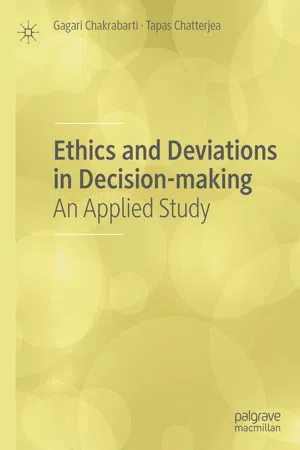
eBook - ePub
Ethics and Deviations in Decision-making
An Applied Study
- English
- ePUB (mobile friendly)
- Available on iOS & Android
eBook - ePub
About this book
This book explores how the ethically inconsistent behaviour in workplaces can be rooted in moral fibers of the decision-makers, and/or in their varying moral foci depending on the philosophical cornerstones, on which those rest. It explores further whether such decisions may be shaped or modified by contextual factors leading, possibly, to bounded ethicality. Based on a primary survey approaching the academicians, administrators, and other service-holders from India and abroad, it analyses the problem, its determinants and variations across socio-economic and demographic factors.
Information
© The Author(s) 2020
G. Chakrabarti, T. ChatterjeaEthics and Deviations in Decision-makinghttps://doi.org/10.1007/978-981-15-0687-1_11. Prologue
Gagari Chakrabarti1 and Tapas Chatterjea2
(1)
Economics Department, Presidency University, Kolkata, West Bengal, India
(2)
Kolkata, West Bengal, India
Gagari Chakrabarti (Corresponding author)
Tapas Chatterjea
Keywords
Ethical decision makingEthical blindnessBounded ethicalityEthical dilemmaCognitive moral developmentMoral fibreNever-ending controversy centres around the issues of (un)ethical decision making in workplaces. The conditions, under which individuals arrive at ethically consistent behaviour and the circumstances when they fail to do so, have remained the concern of not only those who explore the issues from an analyst’s viewpoint but also to those who otherwise remain nonchalant observers of the economy. Ethical behaviours are supposed to be rooted in the moral fibres of the decision-maker and are usually shaped or modified by different contextual factors (Treviño, 1986). The rational underpinning of any such behaviour, however, may still be indubitably noted (Sonenshein, 2007) as each of those may be judged for ethicality from some morality aspects offered by the existing theories of ethics. The underlying theory provides an impartial and objective benchmark against which the decisions may be judged before execution (Hunt & Vitell, 1986). Any professed contradiction or inconsistency among decisions may thus stem not from their incapability to capture the ethical issues properly but, supposedly, because their moral foci differ depending on the philosophical cornerstones, on which they rest. Any attempt to blend different philosophical aspects would be beneficial as different lenses would be available at one’s disposal to look at issues from diverse angles and to assemble those in an effective way in resulting decisions. Sharp-Paine (1997), for example, suggested that any managerial decision should combine the use of the utilitarian lens along with the Kantian ethics and the economic philosophy so that consequences, principles and objectives may be judiciously combined in such decisions. Treviño (1986), however, mentions that any decision, irrespective of its philosophical underpinning, should be embedded in the relevant and binding contexts.
Example may be cited from the literature where individual decisions may be explained from some specific moral point of view or as an ingenious blending of different considerations. Robinson (2002) cited the example of an executive who in his endeavour to become successful seeks to balance between two facets of his workplace responsibilities. He would have to contribute in a constructive manner to the ventures taken by his organisation. Nonetheless, the necessity to maintain a clean image and a reputation for honesty are no less crucial to him. Given that the two cannot be achieved simultaneously, the executive faces a dilemma of whether to remain in a corrupt system and to contribute positively in the proposed venture at the cost of his honesty or to leave it. Apart from the two obvious extremes of leaving the system, or to bear with it, alternatives exist for the person depending on his priorities. He might resign but still make himself available for consultation, or might cling to a corrupt system to make honest contribution in its ventures. In such cases, the executive essentially follows an altruistic but utilitarian principle.
The second situation portrayed by Robinson (2002) is concerned about the dilemma faced by an individual, whose intrinsic motive is to make money out of business. The person apprehends that achieving additional business might require offering of bribes, which in no way is going to add value to her business in the longer run. This would threaten her reputation and jeopardise her basic objective of making money in future. Hence, not all additional businesses can be obtained by paying favours and, strategically, such common practice is to be abandoned if the person has to make largest contribution to her original objective of making money. Her strategy thus is in line with the teleological approach with some element of deontology in it. While paying bribe is not fair, the practice escalates the risk of failing to attain the ultimate objective of the person.
The third case study involved the dilemma of an employee who had been enjoying no executive position in his organisation but nurtured the aspiration to do so in an inherent motive to attain personal goal. He in no way, however, stood ready to compromise with his conscience in such process of climbing the corporate ladder. The dilemma cropped up as he realised that joining the group of executives would require him to resign from the labour union but doing so would involve sacrificing his ideals. The response of the employee to such a dilemma was interesting as his choice was not of one that compares pleasure with regret. The fact that clinging to the union would deprive one of the power, comfort and grandeur associated with the post of executives did not perturb him much. Rather, the most discomforting concern was the possible reactions from his peer and their expectations about him to demonstrate commitment and integrity to the issues and ideals of the labour union. His well-developed sense of integrity restricted him to take any hedonistic or egoistic decision. Further, he was sceptical about any power that his position of advantage would endow him to change the system from within so that his integrity may not be breached. Such scepticism and the intrinsic sense of integrity restricted him to accept the promotion. The consequences followed and he ultimately resigned. The way the dilemma was resolved establishes the person as an altruistic utilitarian whose personal goals are biased by ethical considerations and community expectations.
While cognitive moral development is the critical element in the judgement phase (Jones, 1991) the problem of ethical decision making, however, is not confined to ethical dilemma. The ethical or moral content of any decision may not always be perceptible to the decision maker. As a result, the unethical decisions are often intuitive and automatic (Gigerenzer, 2010; Haidt, 2001; Reynolds, 2006; Sonenshein, 2007) leading to the phenomenon of ethical blindness. Under ethical blindness, unethical decisions are often taken without being aware of their graveness or practicality. The decision-makers are often convinced about the appropriateness of their decisions and, even if they realise the ethical implications at some later stage, scopes for reverting or rectifications are indeed limited. The ethical dimensions of any decision thus often fade away (Tenbrunsel & Messick, 2004) and the reasons behind this may be manifold. People may be boundedly ethical (Chugh, Banaji, & Bazerman, 2005) and unethical decisions may result from moral disengagements that are often driven by individual, situational and institutional forces (Bandura, 1999, 2002). The situation is quite different from the incidents of intentional unethical decision making by self-interested, yet rational, people (Becker, 1968).
Ethical decision making, as is pointed out by Rest (1986), initiates with moral awareness of individuals. Individual trait, specifically the moral fibre, is perhaps the most important factor that should be taken into consideration while explaining one’s unethical behaviour or ethical blindness. As pointed out by McAdams (2009), individual traits tend to moderate how one feels and determine one’s behavioural pattern in a more or less consistent manner. Individuals with negative emotions or with lower emotional intelligence quotients demonstrate greater probabilities to be engaged in counterproductive work behaviour (Berry, Ones, & Sackett, 2007; Chakrabarti & Chatterjea, 2017; Fox, Spector, & Miles, 2001). Moreover , such traits significantly shape and modify the ways in which individuals interpret different contexts and react to those. The social-cognitive models of moral traits attribute the relative differences in individual morality and hence, in moral behaviour, largely to individual differences in possessing moral construct and the ability to draw on it while processing information in social arena (Lapsley & Narvaez, 2004; Narvaez, Lapsley, Hagele, & Lasky, 2006). Intrinsically, the moral individuals are more likely to have ready availability of moral schemata and moral frames that lend hands to them to interpret situations and to act in morally consistent ways that do not lead to any counterproductive work behaviour. Hence, for an individual, who is incapable of comprehending the moral dimensions of a problem, normative evaluation or establishing moral intention to take an ethical decision is difficult, if not impossible. Such moral awareness, however, is often treated as a social sense-making process (Butterfield, Treviño, & Weaver, 2000). Individual rigidity in possessing a broader perspective of ethical dimension of actions, alon...
Table of contents
- Cover
- Front Matter
- 1. Prologue
- 2. Being (Un)Ethical in Workplaces: The Theories and the Empirics
- 3. The System, Intrinsic Dilemma or Inherent Evil: What Drives Us to Be Unethical?
- 4. The Epilogue: Does the So-Called Lucifer Effect Exist?
- Back Matter
Trusted by 375,005 students
Access to over 1.5 million titles for a fair monthly price.
Study more efficiently using our study tools.
Frequently asked questions
Yes, you can cancel anytime from the Subscription tab in your account settings on the Perlego website. Your subscription will stay active until the end of your current billing period. Learn how to cancel your subscription
No, books cannot be downloaded as external files, such as PDFs, for use outside of Perlego. However, you can download books within the Perlego app for offline reading on mobile or tablet. Learn how to download books offline
Perlego offers two plans: Essential and Complete
- Essential is ideal for learners and professionals who enjoy exploring a wide range of subjects. Access the Essential Library with 800,000+ trusted titles and best-sellers across business, personal growth, and the humanities. Includes unlimited reading time and Standard Read Aloud voice.
- Complete: Perfect for advanced learners and researchers needing full, unrestricted access. Unlock 1.5M+ books across hundreds of subjects, including academic and specialized titles. The Complete Plan also includes advanced features like Premium Read Aloud and Research Assistant.
We are an online textbook subscription service, where you can get access to an entire online library for less than the price of a single book per month. With over 1.5 million books across 990+ topics, we’ve got you covered! Learn about our mission
Look out for the read-aloud symbol on your next book to see if you can listen to it. The read-aloud tool reads text aloud for you, highlighting the text as it is being read. You can pause it, speed it up and slow it down. Learn more about Read Aloud
Yes! You can use the Perlego app on both iOS and Android devices to read anytime, anywhere — even offline. Perfect for commutes or when you’re on the go.
Please note we cannot support devices running on iOS 13 and Android 7 or earlier. Learn more about using the app
Please note we cannot support devices running on iOS 13 and Android 7 or earlier. Learn more about using the app
Yes, you can access Ethics and Deviations in Decision-making by Gagari Chakrabarti,Tapas Chatterjea in PDF and/or ePUB format, as well as other popular books in Business & Human Resource Management. We have over 1.5 million books available in our catalogue for you to explore.