Reviews the complex path of development of modern Polish economy in last 200 years
Analyzes the importance of Polish industrialization in the European periphery
Provides extensive socioeconomic historical data of Polish lands
Provides an overview of crucial intellectual debates on modernization of Poland
Analyzes the effects of discontinuity on socioeconomic development
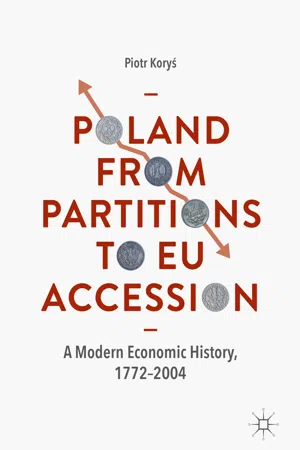
- English
- ePUB (mobile friendly)
- Available on iOS & Android
eBook - ePub
About this book
Information
© The Author(s) 2018
Piotr KoryśPoland From Partitions to EU Accessionhttps://doi.org/10.1007/978-3-319-97126-1_11. Introduction: From the “Little Divergence” to Successful EU Integration: Towards Economic History of Modern Poland
Piotr Koryś1
(1)
University of Warsaw, Warsaw, Poland
Piotr Koryś
With all its peculiarities, Poland is an extremely interesting case of (partially) successful modernization in a hostile environment, as the changes of borders, states, society, policies, ideologies happened there in a much more dramatic way than in Western Europe. Therefore, I do believe that the story of Poland’s development will satisfy the needs not only of economic historians and economists, but of all those interested in the case study of development paths and industrialization that differs from the typical Western experience of stability, continuity, and evolutionary changes. In addition, the reader is provided with the overview of crucial intellectual debates on modernization in Poland. Many of the formerly elaborated ideas and intellectual divisions are still reflected today; thus, it will be much easier for the reader to understand the contemporary political conflicts.
In this book, I analyse the process of the economic development of Polish lands and put it in the context of ideas of modernization and economic policies that aimed at catching up with the West and were organized by the Polish state (or political elites) or designed by the partitioning countries. The starting date of the analysis is the date of the first partition of Poland (the process of partitioning, started in 1772, was finished in the next 20 years and resulted in the collapse of Poland and its disappearance from European maps for the next 123 years); the closing date is the date of Poland’s accession to the European Union.
Polish modernization attempts and modernization policies (i.e. performed by the Polish state and/or on territories inhabited by the Polish ethnic majority) in the last two centuries had a diverse character. They were statist or anti-statist; focused on just building factories or on establishing modern institutions; those which resulted in narrow-minded plans of political elites (to protect their social status); and those established as an indirect effect of social and political revolutions and transitions. Some of them may be interpreted as the emanation of a political will (of the nation or a social group), while others were simply the delayed imitation or application of external solutions. Some notable successes in convergence were/are observed as a result of implementing some of them, while others resulted in failures.
Derek Aldcroft entitled his book on the economic history of European peripheries during the interwar period Europe’s Third World (Aldcroft 2013)—in the nineteenth and twentieth centuries, Poland perfectly fitted this description. Even the contemporary economic success of Poland (as well as many former partial successes and failures) seems to be a good demonstration of the dependency of Polish development in the last 200 years on external circumstances, such as external political and institutional stability. After 1989, the next wave of globalization, European integration, as well as the collapse of the Soviet empire and a long period of the internal and external weakness of Russia resulted in a long period of stability and continuity uncommon in modern Poland’s economic history. The newly established institutions persisted for a relatively long time (at least from the Polish perspective), and Poland became a relatively safe place for FDIs (in fact, for the first time in the last two centuries). The reader interested in long-term growth patterns can pose numerous questions: what had happened before? Why were Polish lands underdeveloped in the last 200 years? Is this the first period of catching-up with the West? And how did discontinuity, fragmentation, and dislocation affect the economic development of Poland? This book provides the answers to these questions. It presents the economic (and social) history of Poland (1772–2004), supplemented with elements of political history and the history of ideas and extensive data.
1 Literature Review—Syntheses of Socio-Economic History of Poland at Glance
The economic history of Poland in the modern age is practically unknown to non-Polish-speaking readership, and there is not a monograph published in English comprising the whole period covered in this book. A certain exception is the collection of papers written by Jacek Kochanowicz (2006), which encompass—though not exhaustively—the whole period, and present many extremely important themes and narratives. The twentieth-century economic history of Poland up to the system transformation is presented in the book by Zbigniew Landau and Jan Tomaszewski (1985).
Recently, an ambitious attempt to analyse Poland’s past was made by an economist, Marcin Piątkowski, who based his research on Daron Acemoglu and James Robinson’s hypothesis on the negative impact of extractive institutions on economic development (Piatkowski 2018). In his interpretation, the Polish institutions up to WWII can be treated as extractive, and it was only after the system transformation that the conditions were conducive to the emergence of inclusive institutions in the egalitarian society (created during the communist period), which explains the nearly three decades of economic growth.
On the other hand, a valuable part of the body of literature on the subject are the comprehensive studies of the political history of Poland, such as the books published by Norman Davies (1986, 2005) and Adam Zamoyski (1987, 2009). An enormous resource of statistical data is a series of publications of the Polish Central Statistical Office History of Poland in Numbers (last editions in Polish includes Wyczański 2003; Kubiczek et al. 2006), including the part in English titled Poland in Europe (Kuklo et al. 2014).
An important addition to the field of Polish economic history is the economic history of the Central and Eastern European region, where Poland plays a significant role. There are few publications on this subject, including the work of Ivan Berend and Gyorgy Ránki, particularly the series of publications presenting the economic history of the region (Berend 1998a, b, 2006) and the research on the industrialization of the European peripheries (Berend and Ránki 1982). The economic history of the region between 1815 and 1989 is also presented by David Turnock (2002, 2004). Derek Aldcroft and Steven Morewood (1995) focused on the twentieth-century economic history of the region. Finally, I need to mention the extremely interesting publication by Henryk Szlajfer, presenting the strategies of state-induced industrialization in Central Europe, particularly Poland, and in South America, from the Industrial Revolution to the outbreak of WWII (Szlajfer 2012). Recently, a synthesis of the political history of the region, including the economic aspect, was published by Wojciech Roszkowski (2015). Another recently published synthesis of the history of Central and Eastern Europe, which includes the socio-economic aspect, was edited by Irina Livezeanu and Arpad von Klimo (2017).
The research on the history of the Polish political and economic thought, including the debate on modernization, has not been presented in many publications, either. The interesting paper by James Pula and James Biskupski concerns the Polish democratic thought from the Renaissance to the Great Emigration after the November Uprising 1830–1831 (Biskupski and Pula 1990). The excellent synthesis by Jerzy Jedlicki presents the nineteenth-century discussions on modernization and the model of the Polish civilization (Jedlicki 1999), and Maciej Janowski outlines the tradition of the liberal thought in the nineteenth century (Janowski 2004). He is also involved in the work on the excellent book presenting the history of ideas in the region, with particular emphasis on the conceptions of modernization (Trencsényi et al. 2016). The history of Polish intelligentsia, the intellectual elite of the nation, is an important addition to intellectual history of Poland (Jedlicki et al. 2014). Until now, only Volume I has been published; it covers the nineteenth century and presents the intellectual trends prevailing in the Polish political thought, placing them in the Eastern European context. Andrew Janos (2000) in his monograph focused on the social, political, and intellectual history of the region. The extremely interesting book by Stefano Bianchini (2015) about the debate on modernization in Eastern Europe in the last two centuries focuses on the former USSR and the Balkans and hardly discusses the Polish intellectual traditions, but it is still valid for the present considerations because it brings up the problems which were a challenge also to the Polish thinkers and the various ways in which those problems were addressed all over the region.
Comprehensive studies published in Polish are far more numerous, including the works of Franciszek Bujak (1925, 1926), Jan Rutkowski (1950, 1953), and Andrzej Grodek and Irena Kostrowicka (1955) from the first half of the twentieth century and Władysław Rusiński (1961); however, here, I focus on the most recent work. The study by Wojciech Morawski (2011) synthesizes the economic history of Poland, and much of his research focuses on the period 1800–2004. The valuable study by Cecylia Leszczyńska and Andrzej Jezierski (2010) comprises the period up to 1989. The research of Janusz Kaliński resulted in a series of publications synthesizing the history of post-war Poland, but also a book co-authored with Zbigniew Landau o...
Table of contents
- Cover
- Front Matter
- 1. Introduction: From the “Little Divergence” to Successful EU Integration: Towards Economic History of Modern Poland
- 2. The View from Afar: The Polish Economy Between the Golden Age and the Partitions (Sixteenth to Eighteenth Centuries)
- 3. The Age of Enlightenment Reforms and Partitions of Poland: Economy and Politics in the Late Eighteenth Century (1772–1795)
- 4. Between the Consolidation from Above and the Fragmentation of the State: Partitions, Duchy of Warsaw and Polish Lands After the Congress of Vienna (1795–1830)
- 5. On the Peripheries of the Modern Western World: Delayed Social Reforms and Unfinished Industrial Revolution (1830–1870)
- 6. The Dawn of Modern Economic Growth: Period of Late Industrialization (1870–1914)
- 7. The Window of Opportunity: Polish Lands During the Great War (1914–1921)
- 8. A Moment of Independence: Reconstruction and Economic Development of the Second Republic of Poland (1918/21–1939)
- 9. Under the Nazi and Soviet Rule: Polish Lands During World War II (1939–1945)
- 10. Communist Modernization? Economic Development of Poland Under State Socialism (1945–1989)
- 11. In Pursuit of the Western World: Poland Between the Transition and the EU Accession (1989–2004)
- 12. Conclusion: Two Centuries of Catching-up to the West
- Back Matter
Trusted by 375,005 students
Access to over 1.5 million titles for a fair monthly price.
Study more efficiently using our study tools.
Frequently asked questions
Yes, you can cancel anytime from the Subscription tab in your account settings on the Perlego website. Your subscription will stay active until the end of your current billing period. Learn how to cancel your subscription
No, books cannot be downloaded as external files, such as PDFs, for use outside of Perlego. However, you can download books within the Perlego app for offline reading on mobile or tablet. Learn how to download books offline
Perlego offers two plans: Essential and Complete
- Essential is ideal for learners and professionals who enjoy exploring a wide range of subjects. Access the Essential Library with 800,000+ trusted titles and best-sellers across business, personal growth, and the humanities. Includes unlimited reading time and Standard Read Aloud voice.
- Complete: Perfect for advanced learners and researchers needing full, unrestricted access. Unlock 1.5M+ books across hundreds of subjects, including academic and specialized titles. The Complete Plan also includes advanced features like Premium Read Aloud and Research Assistant.
We are an online textbook subscription service, where you can get access to an entire online library for less than the price of a single book per month. With over 1.5 million books across 990+ topics, we’ve got you covered! Learn about our mission
Look out for the read-aloud symbol on your next book to see if you can listen to it. The read-aloud tool reads text aloud for you, highlighting the text as it is being read. You can pause it, speed it up and slow it down. Learn more about Read Aloud
Yes! You can use the Perlego app on both iOS and Android devices to read anytime, anywhere — even offline. Perfect for commutes or when you’re on the go.
Please note we cannot support devices running on iOS 13 and Android 7 or earlier. Learn more about using the app
Please note we cannot support devices running on iOS 13 and Android 7 or earlier. Learn more about using the app
Yes, you can access Poland From Partitions to EU Accession by Piotr Koryś in PDF and/or ePUB format, as well as other popular books in Economics & International Business. We have over 1.5 million books available in our catalogue for you to explore.