This book offers an analysis of Putin's approval ratings from the fall of the USSR to the present day. It considers contemporary materials, statistics and a discourse analysis to assess how Putin's approval ratings have stayed so high despite the current economic turndown. Through a comparative analysis with Yeltsin's time in office, the author demonstrates that higher levels of security, a better standard of living, increasingly assertive foreign policy and greater centralization of power led to positive approval ratings for Putin—absent characteristics during Yeltsin's terms—and fostered 'positive national self-esteem' in Russia, a national sentiment that has persisted through current economic difficulties. Recommended reading for academics and students of Russian studies in the field of International Relations, Foreign Policy and Comparative Politics.
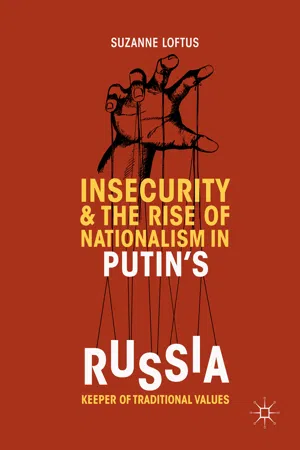
eBook - ePub
Insecurity & the Rise of Nationalism in Putin's Russia
Keeper of Traditional Values
- English
- ePUB (mobile friendly)
- Available on iOS & Android
eBook - ePub
About this book
Information
© The Author(s) 2019
Suzanne LoftusInsecurity & the Rise of Nationalism in Putin's Russiahttps://doi.org/10.1007/978-3-319-97822-2_11. Introduction, Literature Review, Methods, and Organization of the Study
Introduction
During Russian President Vladimir Putin’s current term (2012–2018), the Russian regime has become increasingly authoritarian with heightened media control and reduced civil rights and political liberties, according to Freedom House, a leading agency on freedom in the world (Freedom House 2017). It has also adopted an increasingly aggressive and nationalist foreign policy both in the near and far abroad through its actions such as annexing Crimea, invading eastern Ukraine, and involving itself in a military incursion in Syria. In addition, the economic situation and living standards in Russia have deteriorated following the 2014 fall in the price of oil and the imposition of Western economic sanctions on Russia after its annexation of Crimea (The Economist 2014). Yet, the majority of Russians in 2017 continued to register historically high approval ratings for their leader despite many having rebelled against him in 2011–2012 during the parliamentary and presidential elections.1 In the face of increasing restrictions on freedom, domestic economic instability and a new, active foreign policy that has arguably broken international law, what factors explain Putin’s increased and sustainably high approval ratings?
This study examines both the domestic and foreign policy elements of Putin’s time in office that provide explanations for his popularity today and throughout his tenure. It also examines domestic and foreign policy during Yeltsin’s time in office to present a juxtaposition between the two leaders. There are several potential explanations for Putin’s continued 89% favorability ratings in 2017 (Levada Center, 2017). One possible explanation could be that instability in Russia in the 1990s left Russians with a fear of change and a desire for a strongman ruler to provide them with greater security and stability despite any accompanied civil and political rights abuses. A second explanation could be that Putin has been effective at appealing to Russian aspirations of returning to the great power status Russia once had, challenging the US and NATO and affirming its role in international relations. A third explanation points to Putin’s “amazing ingenuity in adapting to changing, conditions, and a strong desire to stay in power at any cost” (Volkov 2014). Putin uses extraordinary measures to pump up his ratings such as wars and external threats when the economy or other factors threaten to drive them down; in other words, he uses methods to distract and deter the population of Russia from any economic woes they may be experiencing. Though this latter explanation may work to explain short-term bursts of approval ratings, this study seeks to explain Putin’s sharp increase in popularity and the sustainability of that increase. A fourth possibility is that Russia has successfully adapted its foreign policy actions to a changing world and strategically responds to the actions of other states in the international realm and the world’s geopolitical dynamics to the liking of the Russian population. These interests have shifted over time from “Great Power Balancing” to “Pragmatic Cooperation” to “Great Power Assertiveness” to “Russia’s New Vision for Modernization” and finally to “Russia’s Civilizationist Turn” (Tsygankov 2016). A combination of these reasons may also provide the best overall explanation. This study seeks to determine which of these explanations possess the greatest explanatory power in analyzing Putin’s popularity and adds the element of the importance of national identity to the discussion. Through the framework of Social Identity Theory in Social Psychology and the use of “social creativity” as a current identity management strategy (Tajfel and Turner 1979), this study argues that Putin has consolidated a specific national identity that possesses both domestic and international features based on conservatism and sovereignty which represents an opposition to Western values and has allowed Russia to regain positive national self-esteem and re-establish itself as an important international actor.
The main argument is that domestically, Putin represents the father of stability and a proud leader of Russia’s cultural distinctiveness. He has created a safer, more orderly, more stable society through an effective and pragmatic centralization of power, run by a historically traditional authoritarian figure. He has emphasized Russia’s unique identity and unique developmental needs and implemented a specific form of democracy that adheres to those needs and traditional mindset called a “sovereign democracy.” Internationally, Putin is the restorer of Russia’s “Great Power Status” through his bold moves in Ukraine and Syria and through his challenging of the status quo. He has emphasized the importance of conservatism and national sovereignty and has adopted the role of the leader of the anti-Western world. Putin has achieved a symbolic power as the “Keeper of traditional values” and portrays Russia’s conservative, Eurasian and Civilizationist identity as being superior to the West, whose identity he describes as materialist, individualist, imperialist, hypocritical, and possessing a lax sense of self and morality. Both his actions and rhetoric have consolidated a strong and unified sense of national identity and purpose, which has led to a restoration of national pride not seen after the fall of the USSR and therefore a positive national self-esteem.
The analysis presented here draws on elements of International Relations theory and Comparative Politics. While the primary identity-based argument relies on Realist and Constructivist theories in International Relations to explain the importance of order and the social contract and Russia’s historical trajectory prior to its present identity consolidation and current identity management strategies, it is also useful to use theories within Comparative Politics to define the nature of the Russian regime, its development path, how it sustains itself, and what implications this has for similar regimes and the development of democracy. These theories will help explain the roots of Putin’s increased and continuing popularity on both the domestic and international sides of the equation and will support the evidence found in the data collected to form a sound and coherent argument that not only has implications for Russia, but for the development of similar countries as well as for the future of the world order.
Background Literature and Theoretical Framework
The primary theoretical framework used to argue the main points of this study is derived from Realist and Constructivist theories in International Relations. Realism prioritizes the nation state and its self-interest in international relations. It also prioritizes security and relative power. Realists have claimed that this tradition of thought is evident within the history of political thought dating back to antiquity, through the works of Thucydides, Thomas Hobbes, Kautilya, and Niccolò Machiavelli. This study derives its Realist argument from Thomas Hobbes and the idea of the “social contract” (Hobbes 1904) and is applied to Russian domestic politics. Constructivism describes the dynamic, contingent, and culturally based condition of the social world (Adler 2016). Constructivist theories emphasize the role of knowledge and of knowledgeable agents in the constitution of social reality. It is a social theory that should be understood as taking intersubjectivity and social context into consideration and the co-constitution of agent and structure. In International Relations, Constructivism has led to new and important questions about the role of identities, norms, causal understandings, and power in the constitution of national interests, institutionalization, international governance, and about the social construction of new territorial and non-territorial transnational regions. Some well-known Constructivist scholars include Tim Dunne, Peter Katzenstein, Friedrich Kratochwil, Nicholas Onuf, and John Ruggie. Constructivist theories are used in this study not only to analyze Russia’s national identity but also the reasons for adopting its particular foreign policy.
Regime theories in Comparative Politics are also used within this study’s theoretical framework to describe the nature of the Russian regime and to better understand how a Constructivist argument contributes to the existing theories on hybrid and autocratic regime sustainability. The regime theories emphasize the difficulties that certain nations faced while democratizing and underline that instead of reaching democratic consolidation, they have mostly remained in a ‘hybrid’ zone between authoritarianism and democracy (Schedler 2002; Ottaway 2003; Levitsky and Way 2010). The autocratic sustainability theories provide explanations for the endurance of non-democratic regimes upon which this study builds and incorporates the importance of imposing order and stability, as well as the maintenance of a positive national self-esteem in times of threat.
Order and Security and State Centralization
Within Realism, the strengthening of the state is seen as the basic foundation of social order (Hobbes 1904). “Social contract” arguments typically posit that individuals have consented, either explicitly or tacitly, to surrender some of their freedoms and submit to the authority of the ruler in exchange for protection of their remaining rights. It is important to consider that there may be prior needs to be fulfilled before a society can enjoy or even desire liberty. It does not much matter whether threats to security come from within or outside one’s own nation. A victim is just as dead if the bullet that kills him is fired by a neighbor attempting to seize his property as if it comes from an invading army. A citizen looks to the state, therefore, for protection against both types of threats. Security is an absolute value. In exchange for providing it, the state can rightfully ask anything from a citizen save that he sacrifice his own life, for preservation of life is the essence of security.
In the Leviathan, Hobbes states that without security:
There is no place for Industry, because the fruit thereof is uncertain: and consequently no Culture of the Earth, no Navigation, nor use of the commodities that may be imported by Sea; no commodious Building; no Instruments of moving and removing such things as require much force, no Knowledge of the face of the Earth; no account of Times; no Arts; no Letters; no Society; and which is worst of all, continual fear, and danger of violent death; And the life of man, solitary, poor, nasty, brutish, and short. (Hobbes 1904, p. 84)
This study emphasizes the establishment of order and security that Putin provided in Russian society through state centralization and argues this as a major explanation for his popularity. As part of Putin’s centralization project, the “institutionalization of corruption” and the “vertical integration of criminals” permitted Putin’s direct control over organized crime groups, which further contributed to Russia’s increased levels of safety. As Mark Galeotti explains, in the 1990s after the Soviet Union collapsed, organized crime exploded and became stronger than the state itself. This was one of the main reasons why the people and the elite craved a strong leader who could rebuild the authority of the state and restore stability. Russia became a lot safer after Putin, and this was partly due to certain settlements that were reached with organized crime groups. These agreements included not challenging the state or causing chaos in exchange for immunity and following state orders and requests or else face serious consequences (Galeotti 2016). In other words, the corruption that exists in Russia between the elite and organized crime groups has managed to provide more order to the society, despite the controversial manners in which it is being achieved.
The order in the society and the stability of the regime also lie within the fact that the elite in Russia are united and cohesive under Putin due to similar “network” ties and agreements. The Russian regime has been described as a “network” state. In other words, the country appears to be run by interest groups and less formal interactions. The members of the network usually possess high ranking positions within the state apparatus. These networks historically permeated all of Russian politics but today rather shape the relations between the center and the periphery and therefore cut across bureaucratic structures and institutions. Therefore, the Russian state’s national interests are formed by the interests of these private actors (Kononenko 2011).
Karen Dawisha has categorized Russia as a “Kleptocracy.” In other words, Putin transformed an oligarchy independent of and more powerful than the state into a corporatist structure in which oligarchs served at the pleasure of state officials, who themselves gained and exercised economic control both for the state and for themselves. The result is that 110 individuals control 35% of Russia’s wealth. Dawisha states that Putin’s advance to power was not accidental but premeditated by Putin and a group of his followers. He built a system based on massive predation on a level not seen in Russia since the tsars. The oligarchs in Russia have become billionaires and are able to maintain that wealth so long as they do not challenge Putin’s power and bolster the centralized power of the state. In a pluralistic state, the abuse of power of Putin and his associates would bring down the government, but in Russia, this has little effect (Dawisha 2014). Although Dawisha deeply criticizes the regime, this study argues that this structural description of the regime helps to explain its sustainability as it provides a certain form of stability.
Russia in the 1990s suffered high levels of instability due to its lack of a strong governing power in the midst of its transition from authoritarianism. As Samuel Huntington stated, modernization breeds instability while modernity breeds stability (Huntington 1968). In order to transition from one to the other, it is important to have an effective governing body to establish order. Though Russia had already undergone periods of modernization, the 1990s was a period of further modernization as the country transitioned from a communist system to a capitalist system and experienced glasnost and perestroika, or opening and reform. Unlike during the chaotic 1990s under Yeltsin, Vladimir Putin exhibited ...
Table of contents
- Cover
- Front Matter
- 1. Introduction, Literature Review, Methods, and Organization of the Study
- 2. Yeltsin vs Putin (1999–2008)
- 3. Putin’s Leadership 2012–2017
- 4. Main Argument and Theoretical Analysis
- 5. Conclusion, Further Discussion, and Avenues for Future Research
Trusted by 375,005 students
Access to over 1.5 million titles for a fair monthly price.
Study more efficiently using our study tools.
Frequently asked questions
Yes, you can cancel anytime from the Subscription tab in your account settings on the Perlego website. Your subscription will stay active until the end of your current billing period. Learn how to cancel your subscription
No, books cannot be downloaded as external files, such as PDFs, for use outside of Perlego. However, you can download books within the Perlego app for offline reading on mobile or tablet. Learn how to download books offline
Perlego offers two plans: Essential and Complete
- Essential is ideal for learners and professionals who enjoy exploring a wide range of subjects. Access the Essential Library with 800,000+ trusted titles and best-sellers across business, personal growth, and the humanities. Includes unlimited reading time and Standard Read Aloud voice.
- Complete: Perfect for advanced learners and researchers needing full, unrestricted access. Unlock 1.5M+ books across hundreds of subjects, including academic and specialized titles. The Complete Plan also includes advanced features like Premium Read Aloud and Research Assistant.
We are an online textbook subscription service, where you can get access to an entire online library for less than the price of a single book per month. With over 1.5 million books across 990+ topics, we’ve got you covered! Learn about our mission
Look out for the read-aloud symbol on your next book to see if you can listen to it. The read-aloud tool reads text aloud for you, highlighting the text as it is being read. You can pause it, speed it up and slow it down. Learn more about Read Aloud
Yes! You can use the Perlego app on both iOS and Android devices to read anytime, anywhere — even offline. Perfect for commutes or when you’re on the go.
Please note we cannot support devices running on iOS 13 and Android 7 or earlier. Learn more about using the app
Please note we cannot support devices running on iOS 13 and Android 7 or earlier. Learn more about using the app
Yes, you can access Insecurity & the Rise of Nationalism in Putin's Russia by Suzanne Loftus in PDF and/or ePUB format, as well as other popular books in Política y relaciones internacionales & Historia de Europa del Este. We have over 1.5 million books available in our catalogue for you to explore.