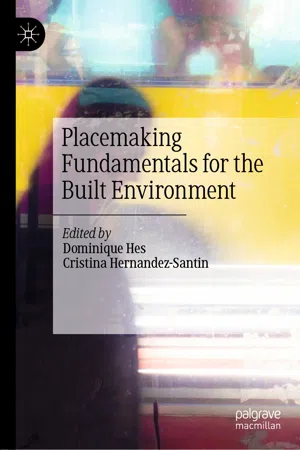
This book is for all those actively working in the built environment. It presents the latest theory and practice of engaging with stakeholders to co-design, develop and manage thriving places. It starts from the importance of integrating design of nature into practice built on a foundation of First Nations understanding of place. The art of engagement of community, government and the development industry is discussed with reference to case studies and best practice techniques. The book then focuses on the critical role placemaking has in supporting resilience and adaptability of communities and looks at issues of leadership and governance. Building on these steps for placemaking, the last parts of the book address economics, evaluation, digital and art based tools and approaches to support projects that aim to create an engaged, contributive, collaborative and active citizen.
eBook - ePub
Placemaking Fundamentals for the Built Environment
- English
- ePUB (mobile friendly)
- Available on iOS & Android
eBook - ePub
Placemaking Fundamentals for the Built Environment
About this book
Information
© The Author(s) 2020
D. Hes, C. Hernandez-Santin (eds.)Placemaking Fundamentals for the Built Environmenthttps://doi.org/10.1007/978-981-32-9624-4_11. Fundamentals of Placemaking for the Built Environment: An Introduction
Dominique Hes1 , Iderlina Mateo-Babiano1 and Gini Lee1
(1)
Faculty of Architecture, Building and Planning, University of Melbourne, Parkville, VIC, Australia
Keywords
Placemaking benefitsGentrificationPlace washPlace maskingIntroduction
This chapter sets the scene for this book by introducing placemaking through its (hi)story, outlining the benefits and the issues faced by a practice of engaging people in creating places. Specifically, it looks at the issues of place masking and place wash, where ‘engagement’ and community consultation is used to just drive development without long-lasting benefits. It also presents and discusses the aspect of placemaking that can result in gentrification. Lastly, it concludes by listing the social, ecological and economic benefits of engaging in placemaking practices.
The Story Behind Making Places
This section will explore the most common definitions and frameworks used to conceptualise placemaking, including its limitations and propose the four dimensions of place framework as opportunities to identify the relationships necessary to achieve long-term impact.
What Is Placemaking?
Spaces shape us, yet we also contribute to the shaping of these spaces through placemaking. Placemaking is fundamentally a continuous process. It is a way of shaping spaces to create meaningful experiences (in, of and for) people (Wyckoff, 2014). Indeed, Lefebvre in his seminal work The Production of Space posits that space is produced and reproduced through people’s intentions in how they plan to live (Lefebvre & Nicholson-Smith, 1991). Therefore, at the individual level, placemaking is a mundane way of asserting our claim on everyday life (Lefebvre, 1996). This is evident in how activities manifest in our daily spatial practices, and reflecting who we are as individuals, such as the way we arrange our furniture (Marcus & Francis, 1998). Yet Harvey (2003) argues that the claim to a (city) space should go beyond the individual, and in fact is a collective exercise to reshape space. So, beyond the four walls of our home, we claim the right to space through the social interactions that we make in public spaces; it is also played out in political struggles for space, revealing who is ‘in-place’ and who is ‘out-of-place’ (Cresswell, 1992); or even the way street traders ply their wares on the footpath to appropriate space. Yet no matter how many times we assert our claim to space, each time that we do, we embed our own unique pattern in creating a rhythm of life, which Lefebvre (2004) refers to as rhythmanalysis. These rhythms ultimately contribute to the way we humanise space, which is core to placemaking (Friedmann, 2007).
The Placemaking (Hi)story
Placemaking or the shaping of places is guided by people’s needs and aspirations, and so, is vital to our existence and our culture. Although the shaping of places is as old as time, it was only in the 1970s that the term placemaking came into vogue and was used mainly by practitioners and those who theorised about place. Placemaking is said to have evolved from the Urban Design discipline (Carmona, 2019), yet placemaking as a movement was mainly a response to the monotony of modernist design and architecture for public space. Modernism was perceived to be more concerned with the form of these spaces rather than how these spaces were being used. Many perceived that most design approaches have resulted in buildings and places that were isolating rather than connecting.
The Project for Public Spaces (PPS) is known to have played an important role in advancing the placemaking movement in the United States, and more recently, globally. Spearheaded by Fred Kent, along with Kathy Madden and Steve Davies, PPS started as a three-year demonstration project in 1975. The trio transformed public spaces into places for people, to show the vital role of spaces in creating thriving public life in cities such as New York. But more importantly, their collaborative projects advocating awareness-raising engagement and capacity-building activities over the past forty years were instrumental to expose placemaking dialogue to the global stage, making place and placemaking a key component in the New Urban Agenda. Adopted in 2016 during the Habitat III in Quito, Ecuador, the New Urban Agenda represents a shared vision among cities and nations to create a better and more sustainable future for people.
Placemaking as a movement in the United States has been inspired by concepts introduced by Jane Jacobs (1992) such as her ‘eyes on the street’, William Whyte’s (1980) the need to shape ‘social life in our public spaces’ and then later with Jan Gehl’s claim that cities should first have ‘…life, then spaces, then buildings, as the other way would not work’ (see Gehl 2004a, 2004b, 2010). These urban thinkers played an instrumental role in stirring alternative ideas for urban designers, planners, landscape architects and architectures to design public spaces that primarily cater for the needs of people, arguably over the needs of non-human participants.
Placemaking as a discipline is often referred to as a concept that grew from some Western societies, yet the shaping and making of places are also very much present in the design and planning of places in Eastern societies such as Edo period Tokyo. For instance, the concept of Artful naturalness was used in the design of gardens during the Edo period. This garden design approach imitated the natural environment by borrowing scenery or shakkei (Pregill & Volkman, 1999). Employing vistas such as distant rolling mountains adds to the impression of a natural landscape (Wada, Sadao, & Miho, 2003) as clearly displayed in the design of the sixteenth-century Katsura Imperial Villa in Kyoto (Pregill & Volkman, 1999). Also, the concept of view planning or the way streets are designed and oriented to align in the direction of natural elements and landmarks reflect the importance of natural elements in (Edo period) Tokyo’s public life. This was a common planning practice during the Edo period where streets in the Shitamachi area or the commoner’s district were oriented towards the famous Mount Fuji, the Sumida River, Mount Tsukuba, among others. Indeed, natural views virtually became synonymous with the Edo townscape (Jinnai, 2004). Edo period Japan believed in the sacredness of nature, articulating the key role of the natural environment in creating and recreating the sociology of street life. Nature had been part and parcel of the Japanese psyche, an element which is often limited if not outright lacking, in the current narrative about place and placemaking.
Australia’s placemaking story began in the early 1990s when design professionals and community groups started to engage in the activation of under-utilised public spaces to create better places. At the helm of the placemaking movement was Village Well, a creative placemaking firm launched in 1992 by its founder Gilbert Rochecouste. Village Well contributed significantly to the activation of Melbourne’s now-iconic laneways (Village Well, n.d.) through blueprints that helped revive inner-city activities laneways. At that time, organising a festival was an important placemaking initiative which brought like-minded individuals together and empowered them to advocate for change in Melbourne’s laneways, mobilising a series of actions and bringing placemaking to a strategic level of engagement. The ‘people’ element is core in the placemaking process. At around the same time, Penny Coombes collaborated with PPS to setup People for Places and Spaces, a firm which transforms places to enhance city liveability (PPS, 2016). It also began placemaking masterclasses delivered by PPS in collaboration with several placemaking professionals, including David Engwicht and his Creative Communities and Kylie Legge of Place Partners. Like Village Well, Place Partners also recognised that community participation is crucial to shaping great places. Beyond ‘people’, Place Partners espoused two other key goals; place character and economic revitalisation (Legge,...
Table of contents
- Cover
- Front Matter
- 1. Fundamentals of Placemaking for the Built Environment: An Introduction
- 2. People in Place: Placemaking Fundamentals
- 3. Nature in Place: Placemaking in the Biosphere
- 4. There’s No Place Like (Without) Country
- 5. Community Engagement: What Is It?
- 6. Local Governments and Developers in Placemaking: Defining Their Responsibilities and Capacities to Shape Place
- 7. Design for Change: An Adaptive Approach to Urban Places in Transformation
- 8. Economics of Place
- 9. Project Implementation
- 10. Leadership in Placemaking
- 11. The Systems of Place Agency: Adaptive Governance for Public Benefit
- 12. DigitalXPlace
- 13. Place Evaluation: Measuring What Matters by Prioritising Relationships
- 14. The ART of Engagement Placemaking for Nature and People in Cities
- Correction to: Place Evaluation: Measuring What Matters by Prioritising Relationships
Trusted by 375,005 students
Access to over 1.5 million titles for a fair monthly price.
Study more efficiently using our study tools.
Frequently asked questions
Yes, you can cancel anytime from the Subscription tab in your account settings on the Perlego website. Your subscription will stay active until the end of your current billing period. Learn how to cancel your subscription
No, books cannot be downloaded as external files, such as PDFs, for use outside of Perlego. However, you can download books within the Perlego app for offline reading on mobile or tablet. Learn how to download books offline
Perlego offers two plans: Essential and Complete
- Essential is ideal for learners and professionals who enjoy exploring a wide range of subjects. Access the Essential Library with 800,000+ trusted titles and best-sellers across business, personal growth, and the humanities. Includes unlimited reading time and Standard Read Aloud voice.
- Complete: Perfect for advanced learners and researchers needing full, unrestricted access. Unlock 1.5M+ books across hundreds of subjects, including academic and specialized titles. The Complete Plan also includes advanced features like Premium Read Aloud and Research Assistant.
We are an online textbook subscription service, where you can get access to an entire online library for less than the price of a single book per month. With over 1.5 million books across 990+ topics, we’ve got you covered! Learn about our mission
Look out for the read-aloud symbol on your next book to see if you can listen to it. The read-aloud tool reads text aloud for you, highlighting the text as it is being read. You can pause it, speed it up and slow it down. Learn more about Read Aloud
Yes! You can use the Perlego app on both iOS and Android devices to read anytime, anywhere — even offline. Perfect for commutes or when you’re on the go.
Please note we cannot support devices running on iOS 13 and Android 7 or earlier. Learn more about using the app
Please note we cannot support devices running on iOS 13 and Android 7 or earlier. Learn more about using the app
Yes, you can access Placemaking Fundamentals for the Built Environment by Dominique Hes, Cristina Hernandez-Santin, Dominique Hes,Cristina Hernandez-Santin in PDF and/or ePUB format, as well as other popular books in Social Sciences & Human Geography. We have over 1.5 million books available in our catalogue for you to explore.