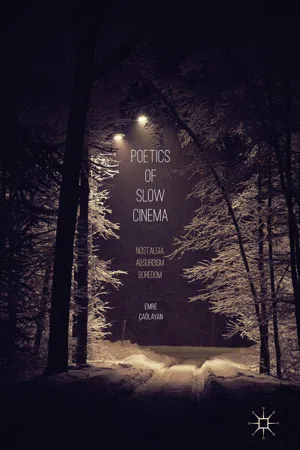
This book discusses slow cinema, a contemporary global production trend that has recently gained momentum in film theory and criticism. Slow films dispense with narrative progression in favour of a contemplative mood, which is stretched out to the extreme in order to impel viewers to confront cinematic temporality in all its undivided glory. Despite its critical reputation as an oblique mode of film practice, slow cinema continues to attract, challenge and provoke audiences. Focusing on filmmakers Béla Tarr, Tsai Ming-liang and Nuri Bilge Ceylan, this book identifies nostalgia, absurd humour and boredom as intrinsic dimensions of slow cinema and explores the ways in which these directors negotiate local filmmaking conventions with the demands of a global cinephile niche. As the first study to treat slow cinema both as an aesthetic style and as an institutional discourse, Poetics of Slow Cinema offers an illuminating perspective on the tradition's historical genealogy and envisions it with a Janus-faced disposition in the age of digital technologies—lamenting at once the passing of difficult, ambiguous modernist film and capitalizing on the yearning for its absence.
- English
- ePUB (mobile friendly)
- Available on iOS & Android
eBook - ePub
About this book
Information
Subtopic
Film & Video© The Author(s) 2018
Emre ÇağlayanPoetics of Slow Cinemahttps://doi.org/10.1007/978-3-319-96872-8_11. Slow Cinema in Context
Emre Çağlayan1
(1)
School of Arts and Cultures, Newcastle University, Newcastle Upon Tyne, UK
Emre Çağlayan
In the April 2010 issue of Sight & Sound, the journal’s editor Nick James set in motion a polemic that was later referred to as the Slow Cinema Debate. In his editorial piece, James outlined Slow Criticism and Slow Cinema as acts of passive aggression mounted against the Hollywood domination of the film industry. For James, the Slow Criticism Project, a series of critical workshops and publications initiated by the Dutch critic Dana Linssen of Filmkrant, represented “one response to the growing redundancy of so much tipster consumer reviewing of films” (2010a, 5). The other response, according to James, was slow cinema, a strand of international art films renowned for their sluggish narrative pace, oblique storytelling and minimalist aesthetics. James argued that both of these acts, though on the surface rebellious against the mainstream, were nevertheless passive forms of resistance. Despite their being in vogue with marginal audiences, James saw a fundamental problem with the slow cinema trend: the seemingly radical nature of the films gradually became a cliché in its own right and eventually “offer[ed] an easy life for critics and programmers” since the films were “easy to remember and discuss in detail because details [were] few” (2010a, 5). Because many of these films were commissioned by the same festivals that exhibited and distributed them, James suggested what looked like a conspiracy theory, in which films opposing the politics of mainstream consumerism were deliberately commissioned by festival professionals, mass produced by art cinema directors and shallowly reviewed by film critics. Explicitly referring to that year’s Golden Bear winner Honey (2010), James wrote, “there are times, as you watch someone trudge up yet another woodland path, when you feel an implicit threat: admit you’re bored and you’re a philistine. Such films are passive-aggressive in that they demand great swathes of our precious time to achieve quite fleeting and slender aesthetic and political effects” (2010a, 5). In other words, James was dubious about the minimalist aesthetics at work in these films and hesitant in ascribing a political value to the films for their passive functions.
James’s provocative argument was immediately picked up and scrutinized by a certain Harry Tuttle, the author of the blog Unspoken Cinema, at the time an Internet haven for slow cinema aficionados. Tuttle’s characterization of the editorial as “anti-intellectual banter”, his accusations of a misunderstanding of “Contemporary Contemplative Cinema” (the label he uses for slow cinema, for reasons explained later) and his urging of critics to deal with the matter “frontally” (2010a) sparked a host of critical debates regarding the cultural and aesthetic value of slow cinema, though diffused across various media channels. Steven Shaviro sided with James by suggesting that slow cinema was “nostalgic and regressive”, missing the “daringness and provocation” so prevalent in the older contemplative works of Michelangelo Antonioni and Chantal Akerman, which today’s contemplative works seem to imitate (2010). Critic Vadim Rizov likewise argued that apart from a few odd “premiere practitioners”—Tarr, Reygadas and Tsai—the “second-tier wave of the films […] simply stagnate in their own self-righteous slowness” (2010). From critic-bloggers to journalists and academics, the spring of 2010 saw an entire Internet culture on film-writing engage in stimulating debates about contemporary slow cinema—what it was, where it came from, and how one could evaluate it. And this renewed critical impetus moved not through periodic print publications but via a brisk succession of blog comments and discussion boards, in anathema to the slowness deliberated by the films.
Weeks later, Nick James reiterated his position. “This loose cultural tendency,” he wrote, “is in danger of becoming mannerist, and that the routine reverence afforded to its weaker films by a largely worshipful critical orthodoxy is part of the problem” (2010b, 5). The second part of James’s editorial foregrounds the ways in which boredom, as both an everyday experience and an aesthetic value, relates to contemporary cinema and culture and James emphasizes how defenders of art cinema regard the use of the word with antipathy. While letters from readers sporadically surfaced in Sight & Sound and Tuttle continued his fierce attacks, a similar debate focusing on boredom resurfaced in the New York Times in an article penned by Dan Kois. In a series of personal and tongue-in-cheek anecdotes, Kois admits his naive belief in “view[ing] aridity as a sign of sophistication” and eventually identifies consuming “slow-moving films” with “eating cultural vegetables” (2011). The broader point that Kois refers to is the odd belief that we keep watching films that we do not thoroughly enjoy because we think we should—in other words, we feel that consuming such high-brow products somehow increases our cultural and social status. New York Times critics Manohla Dargis and A. O. Scott (2011) responded to Kois by defending the virtues of boredom and Kent Jones (2011) wrote a scathing critique of Kois’s arguments. Having secured a wider readership through more traditional media outlets, the slow cinema debate continued its evolution, up to the point at which it was revisited by a panel of filmmakers and critics as part of the AV Film Festival As Slowly As Possible in Newcastle in March 2012, while the conceptual questions within and beyond the debate culminated in an academic symposium titled “Fast/Slow” at Anglia Ruskin University, Cambridge, on April 4 and 5, 2013. In addition to several research projects dedicated to the subject (including my own), the following year saw a number of academic studies of slow cinema, published in unusually rapid succession as if to consciously put an end to the cliché associated with the slow progress of humanistic inquiry.
A number of theoretical and historical questions arise from the slow cinema debate. First, the debate itself presents the question of whether these films are in fact politically or aesthetically engrossing, or just self-conscious, complacent artworks made-to-order for cultural elitists. The pace at which the debate developed and its effortless reappearance on various Internet sites, social media platforms, blogs, forums and online discussion boards bears witness to how digital technologies and the new media meddle so swiftly in our affairs with cultural productions and intellectual matters. Furthermore, the debate demonstrated the global reach of films, some of which were made under very localized conditions, and emphasized the films’ ability to transcend borders (national, cultural and aesthetic) and speak to a cosmopolitan audience that shared a similar cinephile sensibility. As perhaps the most exciting art cinema current in the twenty-first century, however, the slow cinema debate also engaged with the critical discourse that was probing what it meant to write about art cinema in the wake of mainstream blockbuster dominance. It created wide-ranging scholarly consideration both of international film festivals as “cultural gatekeepers” (de Valck 2012, 26) and their trend-setting, powerful agendas within the cinema industry. In this respect, slow cinema as a critical discourse operated at an intersection where vital questions into cultural research were born and accommodated with ease. These concerns ranged from generic inquiries into the nature of transnational art cinema, film history and aesthetics, matters of taste and value, film spectatorship and cinephilia to very specific and complex questions regarding the negotiations, appropriations and exchanges between global networks of production, exhibition and distribution and local articulations of native traditions. In short, slow cinema and its critical debate were, to put it simply, a treasure house charged with an abundance of potential avenues for cultural research.
But what exactly is this thing called slow cinema, and what were the conditions and circumstances that led to its critical and discursive currency? From what film-historical genealogy did it emerge and what were its art-historical influences? To what extent was slow cinema a new practice and in what sense was it a radical—or to use James’s phrase, a “passive aggressive”—movement? What stylistic techniques did the filmmakers use, what were their aesthetic effects, and how did audiences make sense of the films? These are some of the questions that the current literature on slow cinema has attempted to answer.
1.1 Defining Slow Cinema
Even when the debate was at its peak, film commentators were puzzled about what exactly slow cinema meant. Jonathan Romney first coined the term in his review of a tendency within art cinema that overtly surfaced during the 2000s. Romney’s article was published as part of Sight & Sound’s tribute to the first decade of twenty-first-century cinema that included a list of 30 films, numerous of which belonged to the slow cinema tradition. Romney described slow cinema in a much-cited passage as a “varied strain of austere minimalist cinema that has thrived internationally over the past ten years”. Its primary mission, according to Romney, was “a certain rarefied intensity in the artistic gaze, […] a cinema that downplays event in favour of mood, evocativeness and an intensified sense of temporality” (2010, 43–44). Referring to contemporary auteurs as varied as Béla Tarr, Pedro Costa, Lisandro Alonso, Tsai Ming-liang and Carlos Reygadas, Romney pinpoints slow cinema as a particular branch of art cinema, one that has almost become synonymous with cinephilia in the wake of the diminishing and ever self-recycling mainstream industry. Elsewhere, James Quandt summarizes this “international art-house formula” as:
adagio rhythms and oblique narrative; a tone of quietude and reticence, an aura of unexplained or unearned anguish; attenuated takes, long tracking or panning shots, often of depopulated landscapes; prolonged hand-held follow shots of solo people walking; slow dollies to a window or open door framing nature; a materialist sound design; and a preponderance of Tarkovskian imagery. (2009, 76–77)
In many ways slowness functions as a significant descriptive factor and refers to the ways in which these art films oppose, resist or deliberately rebel against the dominance of fast-paced, largely formulaic industrial pro...
Table of contents
- Cover
- Front Matter
- 1. Slow Cinema in Context
- 2. Béla Tarr: A Nostalgia for Modernism
- 3. Tsai Ming-Liang: Less Is Absurd
- 4. Nuri Bilge Ceylan: An Aesthetics of Boredom
- 5. Epilogue: The Future of Slow Cinema
- Back Matter
Trusted by 375,005 students
Access to over 1.5 million titles for a fair monthly price.
Study more efficiently using our study tools.
Frequently asked questions
Yes, you can cancel anytime from the Subscription tab in your account settings on the Perlego website. Your subscription will stay active until the end of your current billing period. Learn how to cancel your subscription
No, books cannot be downloaded as external files, such as PDFs, for use outside of Perlego. However, you can download books within the Perlego app for offline reading on mobile or tablet. Learn how to download books offline
Perlego offers two plans: Essential and Complete
- Essential is ideal for learners and professionals who enjoy exploring a wide range of subjects. Access the Essential Library with 800,000+ trusted titles and best-sellers across business, personal growth, and the humanities. Includes unlimited reading time and Standard Read Aloud voice.
- Complete: Perfect for advanced learners and researchers needing full, unrestricted access. Unlock 1.5M+ books across hundreds of subjects, including academic and specialized titles. The Complete Plan also includes advanced features like Premium Read Aloud and Research Assistant.
We are an online textbook subscription service, where you can get access to an entire online library for less than the price of a single book per month. With over 1.5 million books across 990+ topics, we’ve got you covered! Learn about our mission
Look out for the read-aloud symbol on your next book to see if you can listen to it. The read-aloud tool reads text aloud for you, highlighting the text as it is being read. You can pause it, speed it up and slow it down. Learn more about Read Aloud
Yes! You can use the Perlego app on both iOS and Android devices to read anytime, anywhere — even offline. Perfect for commutes or when you’re on the go.
Please note we cannot support devices running on iOS 13 and Android 7 or earlier. Learn more about using the app
Please note we cannot support devices running on iOS 13 and Android 7 or earlier. Learn more about using the app
Yes, you can access Poetics of Slow Cinema by Emre Çağlayan in PDF and/or ePUB format, as well as other popular books in Media & Performing Arts & Film & Video. We have over 1.5 million books available in our catalogue for you to explore.