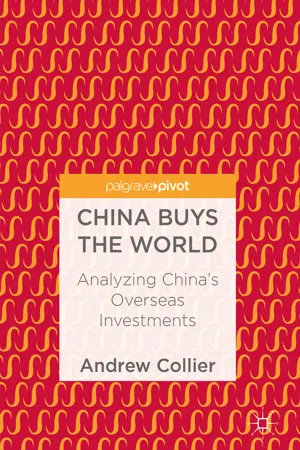
This book discusses the strategies that will define China's overseas expansion in the coming years. China is spending billions of dollars acquiring overseas companies and assets, from the Chicago Mercantile Exchange to the Hinkley Point nuclear station. Will this corporate buying binge continue? In this book, Collier argues that state control will occur only among certain strategically key acquisitions while many of the corporate acquisitions will be done by smaller, private firms. However, China's rising debt load may restrict the ability of many firms to obtain capital, including from China's shadow banking sector. A key to understanding China's strategy is to look at how the state intervenes in private business. Collier ably brings clarity to the "gray area" between state and private economic activity in this complex landscape. As the West faces China's growing investments abroad, this book will be required reading for executives and decision makers, journalists, and policy makers.
- English
- ePUB (mobile friendly)
- Available on iOS & Android
eBook - ePub
About this book
Information
Topic
CommerceSubtopic
Commerce international© The Author(s) 2018
Andrew CollierChina Buys the Worldhttps://doi.org/10.1007/978-981-10-7494-3_11. Introduction
Andrew Collier1
(1)
Orient Capital Research, Hong Kong, Hong Kong
Abstract
In this chapter, we outline the trends in China’s global acquisitions. China made $225 billion of deals in 2016, more than double the pace of the previous year. Outbound investment grew from $19.8 billion in 33 deals in 2005 to $215.2 billion in 342 transactions by 2016. That was an average annual growth of 24.2 percent—significantly above China’s GDP growth. We analyze the close but complex relationship between the levels of government and corporations that determine global investing outcomes. We also provide an overview of the themes of the book, focusing on the relationship between the state and private activity, and the potential for a shortage of capital that will slow the pace of outbound transactions.
Keywords
StrategiesInvestmentState GridCNOOCRegionChemChinaSyngentaA few years ago, I was sitting in my office in the Bank of China in New York when the phone rang. It was one of our bankers calling from Beijing. She was traveling to the United States and had something to discuss. Intrigued, I said sure. At the time, I was the president of the Bank of China’s investment bank. We didn’t make loans—that was the job of our much larger brother down the street—but we handled stock sales and distributed research on China to American investment funds. This call sounded different.
A week later, we met in my office in Rockefeller Center. She was a rather wild-eyed Chinese woman, dressed in high style with a Gucci bag and expensive shoes. She sat down and, in a rambling speech, told me she had a client—a prospective client—who was interested in buying an American company. Could I help?
There wasn’t a lot of Chinese money coming into the United States at the time. But my job was to act as the local agent for the huge parent company in China. I politely said I would be happy to assist. What was the client looking for? “He is a property developer who wants to buy movie theaters.” That sounded odd to me. Operating film theaters is a very different skill than building a row of high-rise apartment blocks. I also knew that many property developers in China were expert at convincing local governments to give them good prices on land and coax banks to make loans, but generally did not have talents beyond that.
We encountered a similar reaction when we visited a personal friend who is a top New York banker with a well-known boutique investment firm. He heard our story but clearly thought we were a bit off our rocker. At the time, there was little overseas buying of companies by the Chinese apart from oil, gas, and commodities, mainly in Africa , Canada, and South America. Why would this Chinese buyer be interested in something so esoteric as the film business?
Little did we know. In 2012, the Dalian Wanda Group, the world’s largest property developer, bought AMC Theaters for $2.6 billion, followed in 2016 by film studio Legendary Entertainment, for another $3.5 billion. My colleague did not reveal the name of the bank’s client, but it was likely to have been Wanda. The Chinese corporate ball was rolling. And not just in the media industry. In 2016, China National Chemical Corporation agreed to buy Swiss seed giant group for $43 billion, turning a formerly small chemical Chinese company into a global giant. China General Nuclear received permission from the UK government to build an $18 billion nuclear plant in Hinckley Point, Britain, the country’s first since 1995. There are many other examples.
China’s engagement with the world has played out over decades, starting in 1979 with the economic revolution fostered under former leader Deng Xiaoping following the death of Chairman Mao Zedong in 1976 and China’s entry into the World Trade Organization (WTO) in 2001. But in just a few short years that commitment has increased manyfold. Although ChemChina’s $43 billion purchase was large and audacious, it was joining a growing tide of Chinese capital that was flooding the globe looking for an outlet, like a river overflowing into the adjacent floodplains. China made $225 billion of deals in 2016, more than double the pace of the previous year. Outbound investment grew from $19.8 billion in 33 deals in 2005 to $215.2 billion in 342 transactions by 2016. That was an average annual growth of 24.2 percent—significantly above China’s GDP growth. Although there was a hiccup in 2017 due to domestic political considerations, over the span of a decade the world has witnessed Chinese purchases of mines in Africa, steel mills in Brazil, media companies in America, auto and chemical companies in Europe—all industries have become fair game for China’s giant global merger and acquisition drive (Scissors 2016).
Creating Global Champions
What has caused this outward movement of Chinese companies? After all, China has been known since its membership in the WTO in 2001 as a destination for foreign firms to plant the flag. At the time of China’s WTO entry, foreign investors salivated over the prospect of accessing a market with more than 1 billion customers. China offered an eager and inexpensive workforce, a government generally (with some exceptions) willing to provide subsidized land and tax breaks, and a friendly regulatory system, all designed to coax foreign firms to set up shop in China. Inward investment skyrocketed from less than $40 billion in 2001 to $124 billion in 2010 (IMF 2014). This flood of capital—which was a painful move pushed through by the powerful prime minister Zhu Rongji —revolutionized China’s economy by forcing Chinese companies to adapt to new competition from sleek, global multinationals. This time, though, the game was different. China was bringing its own brand of state capitalism to bear on the world’s markets—not the other way around.
But China’s corporate expansion has not occurred without costs. There is opposition among many nations to China’s acquisition binge. Westerners and citizens of other countries alike are concerned about the impact of China’s global purchases on their corporations, consumers, and even their governments. These concerns include the following:
- Government Control. Political leaders are worried that many purchases are not commercial but are done at the behest of Beijing. China’s economy is dominated by state-owned companies. These issues make a difference if a country is deciding whether to hand over control of a company with large market share to what may be a state-owned Chinese conglomerate. However, there is some disagreement about what constitutes a state firm. Is it share ownership? Political control? Source of capital? I will discuss this in more detail.
- Cheap Capital . Loans are often subsidized by the Chinese government. These cheap loans can make it easy for a Chinese company to quickly grab market share at the expense of local competitors. This is important if you run a foreign steel company facing a flood of low-priced imports. Once again, these are complex issues. What exactly is a subsidy? Is a local government the same as Beijing? Is a public company with a government investor the same as a government company?
- Security Issues. Are these deals driven by commercial issues or military and security goals? This goes back to the question of the “hidden hand” of government. For example, Huawei is a competitor to Cisco Systems in the important business of networking equipment. Huawei has had military backing. Is it just an arm of the government? Should Western governments be worried about granting access to key security equipment to a foreign power?
- Ailing Infrastructure. Many countries lack water, power, transportation, and other infrastructure, such as in Africa , or have aging infrastructure, as in Europe and the United States. In all these cases, Chinese capital is attractive. But many countries are reluctant to hand over control of key infrastructure, particularly energy and power, to one of the world’s most powerful nations.
- The Power of the Purse. China is making many loans to less well-off countries, loans from banks and the country’s policy banks . There is a concern that these loans will be used over time to give China either ownership of key assets or influence.
Most important, there is widespread anxiety about the Chinese state’s involvement in economic activity. A prime example is a comment by America’s US-China Economic and Security Review Commission, established by Congress in 2000 to examine the national security implications of bilateral trade and economic relations with China. As the commission noted in a 2016 report:
The Chinese government continues to play an important role in the Chinese economy, including in promotion and approval of outbound FDI . This prompts questions about the extent to which Chinese FDI in the United States could be motivated by the pursuit of Chinese government’s objectives rather than economic interest…Because the Chinese government continues to exert significant influence in the sectors it views as strategic (e.g., telecommunications and autos), this leaves open the possibility that a Chinese company, even a nominally-private one, may be making an investment to further the government’s goals. (Gloudeman 2016; emphasis mine)
This argument about state-backed intervention was articulately expressed by Henry Levine, a long-time former State Department official and American Shanghai Consul General. He noted the “frustration” about China’s entry into the global corporate world. It’s worth quoting his remarks in full:
Frustration over China’s use of industrial policies to promote Chinese companies that can compete with, and replace, foreign high-tech companies has grown substantially in recent years among US companies in those sectors and policymakers. It is compounded by the fact that Chinese companies have almost unfettered access to the US market while US companies face so many obstacles in the China market (aimed at giving Chinese companies the edge). The frustration, even anger, is real and pretty widespread.
But he added that because of the importance of the Chinese market, the American government has been reluctant to tackle these issues:
Note that President Trump has backed away from designating China as a currency manipulator, dropped discussion of a 45 percent across the board tariff on Chinese products, postponed a decision on the 232 cases on steel and aluminum (not solely aimed at China but involving them heavily) and taken only a very timid decision a few days ago merely requesting “a study” to see if a 301 investigation of Chinese forced tech transfer policies is warranted. Not the path of a President who really felt the US was in a life or death economic struggle with China would be likely take……And, by the way, the same companies that are so (justifiably) unhappy with Chinese policies (also justifiably) do not want a trade war or ratcheting up of tensions that would put their current (usually profitable) operations in China in jeopardy. Further, there are lots of non-high tech US companies operating in China that are not feeling the impact of Chinese industrial policies and that don’t want to get hurt in the crossfire of a trade war. And finally, there are the US exporters (agricultural sector among others) that are profiting mightily from trade with China and which worry that an unreasonably tough US position toward China could result in Chinese retaliation at their expense. Trade/investment relations with China are not a simple story. (Levine 2017)
Where Does the State End?
Levine’s concerns are all quite legitimate.
However, what is missing from many of the analyses of these issues is a more sophisticated understanding of why the Chinese are buying foreign companies. It is easy to fall back on platitudes like “government control” or “market share.” Some books even rely on government websites in Beijing for an explanation of Chinese motives. Others merely fall back on casual statements about “Chinese expansionism.” What is tougher is detailing more precisely who and what is behind this mountain of Chinese cash—and how these internal Chinese motivations will play out on the world stage. Here, we intend to dig a little deeper.
To that end, this book will attempt to clarify the underlying motivations of China’s international corporate push and the actors behind it. This includes the following.
- The corporations, private and public, and their leaders, conducting these transactions.
- The governmental agencies responsible for regulating offshore transactions.
- The financial institutions, including banks and shadow banks, that provide the financing.
- The leadership that sets the overall policy for China’s overseas drive.
This is not an easy task. China has an opaque political and financial system. Government bureaucracies, such as the country’s ruling State Council , do not trumpet their decisions. Nor is there a parade of investors that companies must solicit for their approval before embarking on a major international acquisition, opening the door to the decision making that outside analysts can delve into.
One of the key points I make in the book is that often there is no “China” that is behind a transaction. It’s a melting pot of competing interests. Many of these deals are the result of intense jockeying between a number of corporate, governmental, and financial institutions, each with their own agenda. These internecine battles are rarely public. This competition is not often discussed in the context of China’s international operations.
The same is true in the West—but to a much smaller degree. When Google buys a company, it will enlist investment banks as consultants, along with lawyers, and accountants and will eye its competition before announcing the proposed takeover. Outsiders are not privy to these discussions. However, Western transactions are made public and relevant documents are filed with government regulators. The US government rarely gets involved unless the proposed acquisition runs up against a few key national rules, such as anti-monopoly regulations or those pertaining to national security.
This brings us to our other main point. We will also examine the nature of state interjection into the economy. In China, the government is always involved in one way or a...
Table of contents
- Cover
- Front Matter
- 1. Introduction
- 2. The Setting
- 3. The Dealmakers
- 4. State or No State?
- 5. China’s Global Tentacles
- 6. The Money Behind the Deals
- 7. Will China Take over the World?
- Back Matter
Trusted by 375,005 students
Access to over 1.5 million titles for a fair monthly price.
Study more efficiently using our study tools.
Frequently asked questions
Yes, you can cancel anytime from the Subscription tab in your account settings on the Perlego website. Your subscription will stay active until the end of your current billing period. Learn how to cancel your subscription
No, books cannot be downloaded as external files, such as PDFs, for use outside of Perlego. However, you can download books within the Perlego app for offline reading on mobile or tablet. Learn how to download books offline
Perlego offers two plans: Essential and Complete
- Essential is ideal for learners and professionals who enjoy exploring a wide range of subjects. Access the Essential Library with 800,000+ trusted titles and best-sellers across business, personal growth, and the humanities. Includes unlimited reading time and Standard Read Aloud voice.
- Complete: Perfect for advanced learners and researchers needing full, unrestricted access. Unlock 1.5M+ books across hundreds of subjects, including academic and specialized titles. The Complete Plan also includes advanced features like Premium Read Aloud and Research Assistant.
We are an online textbook subscription service, where you can get access to an entire online library for less than the price of a single book per month. With over 1.5 million books across 990+ topics, we’ve got you covered! Learn about our mission
Look out for the read-aloud symbol on your next book to see if you can listen to it. The read-aloud tool reads text aloud for you, highlighting the text as it is being read. You can pause it, speed it up and slow it down. Learn more about Read Aloud
Yes! You can use the Perlego app on both iOS and Android devices to read anytime, anywhere — even offline. Perfect for commutes or when you’re on the go.
Please note we cannot support devices running on iOS 13 and Android 7 or earlier. Learn more about using the app
Please note we cannot support devices running on iOS 13 and Android 7 or earlier. Learn more about using the app
Yes, you can access China Buys the World by Andrew Collier in PDF and/or ePUB format, as well as other popular books in Commerce & Commerce international. We have over 1.5 million books available in our catalogue for you to explore.