This book explores the textures of women's narratives of patriarchal oppression of female sexuality. Postcolonial feminist scholars in Africa highlight the importance of moving beyond Westernised lenses of 'African' women's powerlessness, towards a focus on women's culturally-specific sexual agency. However, few studies explore women's psychological experiences of sexual oppression/agency in real depth. Narrative Landscapes of Female Sexuality in Africa traces the narratives of heterosexual migrant women from Zimbabwe, Kenya and Congo. The book offers insight into women's experiences 'back home,' travelling through border posts in Africa, and life in current post-apartheid South Africa. Through a unique collectively-based methodology and a feminist poststructuralist lens, the author examines narrative strategies used by the women to manage and psychologically resist harmful discourses surrounding female sexuality and women's bodies. The book offers rich exploration of the intersections of gender and sexuality, class, race and citizenship situating the narratives within the wider context of poverty and migration in sub-Saharan Africa. These vectors of oppression are illuminated throughout the text via integrated threads of the researcher's positionality in relation to the women narrators.
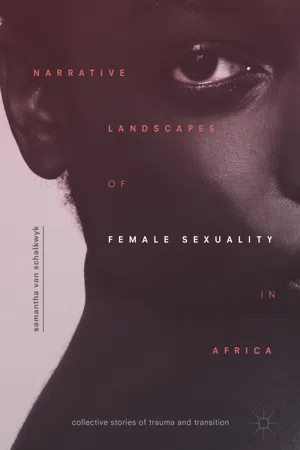
eBook - ePub
Narrative Landscapes of Female Sexuality in Africa
Collective Stories of Trauma and Transition
- English
- ePUB (mobile friendly)
- Available on iOS & Android
eBook - ePub
Narrative Landscapes of Female Sexuality in Africa
Collective Stories of Trauma and Transition
About this book
Information
© The Author(s) 2018
Samantha van SchalkwykNarrative Landscapes of Female Sexuality in Africahttps://doi.org/10.1007/978-3-319-97825-3_11. Narrative Landscapes of Female Sexuality: Introduction
Samantha van Schalkwyk1
(1)
Stellenbosch University, Stellenbosch, Western Cape, South Africa
Samantha van Schalkwyk
Introduction
In countries, like South Africa, where violence is an ever-present part of life, where babies and old women are raped on a daily basis, where young girls’ maimed bodies are found dumped on empty fields, women have to face these images and try to deal with them in their own way. Women have to make sense of such violence and what it suggests for their own body and sense of value in the world. Living within such violence, whether one has experienced direct physical force on the body or not, shapes women’s subjectivities in powerful ways. It is of critical importance to examine what it means psychically to inhabit a female body in such contexts.
Sexual violence is a core strategy to control women and maintain patriarchal order. The underlying function of such violence is to communicate to all women that they are worthless, to strip them of their subjectivity and render them inferior (Hydѐn 1994). Many women internalise misogynistic messages that shape the meanings that they attach to their sexualised bodies (Bakare-Yusuf 2011). This is exactly how patriarchal oppression of female sexuality works. How then can women break free from such negative internalisations and claim a positive sense of self in the world? What are the potentials for studying women’s agency within contexts where social resources are scarce and poverty a harsh reality of life? What alternative understandings about the self can women create, and claim, in the face of harmful oppressive discourse, and what would such strategies look like? This book addresses these complex questions by focusing on the sexual dimension of women’s collective responses to the oppression of female sexuality in Africa.
Postcolonial feminist scholars have highlighted the importance of moving away from Westernised lenses of African women’s powerlessness, towards a focus on women’s culturally specific sexual agency (see Bakare-Yusuf 2013; Mohanty 1991). However, few studies explore women’s psychological experiences of sexual oppression/agency in any real depth. This book contributes knowledge about the ways in which women from Africa experience patriarchal oppression of female sexuality and how they may resist this oppression in multiple and creative ways. This book is about the experience of patriarchal oppression of female sexuality as a very particular kind of ‘everyday’ continuous form of trauma that women face. This trauma is often ‘invisible’ and is textured around ongoing and persistent fear and degradation of the self. In many African contexts, the expression of female sexuality is silenced and rendered taboo (Kambarami 2006). In South Africa, there exists a deep silencing and shaming around female sexuality. Women who do not keep ‘in line’ with patriarchal prescriptions of ‘good’ sexuality are blamed and shamed. Often women are subject to severe violence on their bodies (Gqola 2015). Sexual violence in a country that has been dubbed the ‘rape capital’ of the world is a mode for controlling female sexuality and maintaining patriarchal order. The effects of living in constant threat of violence and control are devastating and constitute a form of trauma in itself.
Westernised language of trauma, in turn, does not ‘speak’ to the textured and often ‘invisible’ everyday life experiences of women (Rajiva 2014). Limited and decontextualised meanings around ‘victim’ and ‘trauma’ silence women because they do not offer a language through which to express the complexity of experience (Lamb 1999). Much of women’s experience related to gender, race, class, and citizenship constitute ‘everyday’ traumas which have been naturalised to such an extent that it is necessary to ‘excavate’ them in order to see them as social traumas (Forter 2007). However, such experience works subtly and pervasively to erode the human spirit (Root 1992). There is no language through which women can express the complexity of their experiences. The narratives presented in this book ‘speak’ to a much broader conceptualisation of trauma than what is currently imagined. This book is about the ‘invisible’ violence that accompanies the oppression of female sexuality—the violence to the self and soul which mutates/silences women’s knowledge about their sexual subjectivities and bodies (McFadden 2003). It is also about how women may collectively disrupt patriarchal power in creative ways and find a language through which to preserve a sense of humanness and worth.
Colonial imagination has consistently constructed African sexuality as dangerous, exotic, and morally lacking (see Arnfred 2004). Such discursive elements linger on in current postcolonial settings. Meanings around female sexuality are fuelled by deep-seated patriarchy, racism, and xenophobia, which construct certain people as different and inferior in relation to Westernised models. Such meanings shape the manifestations and textures of patriarchal oppression of female sexuality —the ways in which violence is enacted onto women’s bodies and minds and the ways in which women experience such violence. It is important to add here that I do not aim to generalise about ‘Africa’ or ‘African experience’ acknowledging that Africa is a continent that encompasses a vast array of cultures and people with different personal histories (de Vos 2015; Mohanty 1991). Rather, I base my analysis on one specific group of women, a micro-context which serves as a rich case study.
I draw on a three-year project with a support group for abused women based in South Africa. All the women had travelled from their home countries in Africa to South Africa in search of a better life with more employment opportunities. The support group consisted of a varied group of heterosexual women from many different countries—Zimbabwe, Kenya, Rwanda, Congo (DRC), and local South African women. As the book title suggests, I examine the textures of the women’s narrative landscapes of female sexuality. The plural attests to the multiple geographical and psychological landscapes the women have travelled through. The focus is on three central motifs identified in the women’s collective narratives traced through their stories of their memories of ‘back home’ in Africa; travelling through border posts, or physical entry points between African countries; and their current experience living in post-apartheid South Africa. The book is structured around these central motifs in Chaps. 4, 5, and 6 respectively.
I trace and unpack the narrative landscapes which were generated collectively within the research setting, focusing on the creative design, the substance, the linguistic and discursive elements and the silences of these women’s talk. Through a feminist poststructuralist and social remembering lens (Weedon 1987; Davies 1991; Haaken 1999), I explore these women’s narratives and what they tell us about their experiences of patriarchal oppression of female sexuality. A crucial element is a focus on the narrative strategies used by these women to manage and psychologically resist harmful discourses surrounding female sexuality and women’s bodies. This focus on women’s collective agency provides a fresh approach for the study of women’s experience that moves away from standard Westernised scripts of women’s static powerlessness.
A core contribution of this book is the unique collective methodology through which I utilised creative means (drama, visual memory work , ongoing dialogue) in ways that opened space for the expression of previously ‘unspeakable’ aspects of experience and for the women to tell their stories in their own ways drawing strength from their shared narratives. The book offers rich insights into these women’s experiences living as foreigners in South Africa and the intersections of gender and sexuality, class, race and citizenship, situating the narratives within the wider context of poverty and migration in sub-Saharan Africa. As such, it contributes to the rich body of work which draws on the concept of intersectionality (see Crenshaw 1991). Throughout the text, I illuminate these vectors of oppression through integrating threads of my own positionality as a white woman researcher and feminist, adding another layer of analysis which enriches knowledge about gender violence research in Africa.
In what follows I set the scene for the research project. I discuss the research setting and my motivations for engaging in the work. I then outline the unique collective and longitudinal methodology used to explore women’s experience of patriarchal oppression of female sexuality . This is accompanied by an overview of the theories of the self utilised for making sense of women’s voices—the language of agency which has informed my interpretation of their narratives. I end with a brief summary of the chapters to follow.
Exploring Collective Narratives of Female Sexuality
My motivation to engage in such a book project emerged from my years of work with women who have experienced gender violence in many communities in South Africa. Throughout my work, I have been struck by the challenges which women face and the disastrous lack of support for these women from government sources. I realised that so many women ‘fall through the cracks’ and do not have their stories heard. They do not have any support systems through which to give voice to their experiences.
This book is based on extensive volunteer work and research with a support group for abused women based in Cape Town, South Africa. For this book, I draw on selected focus group discussions from phase 2 of the broader research project. These are discussions which best illuminated women’s experiences of, and resistance to, patriarchal oppression of female sexuality . These discussions consisted of only migrant women from Zimbabwe, Congo (DRC), and Kenya who were and still are living in South Africa. Scholarly research on gender and oppression globally and in Africa has not focused sufficiently on the experiences of migrant/refugee women living in Africa—a stance perhaps reflective of wider discourses about social worth and whose experiences are worth documenting. Migrant women living in South Africa have not been given much voice in mainstream psychological research and their voices stand as what Macleod (2006, p. 368) calls the ‘absent trace’ in relation to Weste...
Table of contents
- Cover
- Front Matter
- 1. Narrative Landscapes of Female Sexuality: Introduction
- 2. Patriarchal Oppression of Female Sexuality in Africa: Textures of Violence and Theorising Agency
- 3. Collective Biography: A New Chapter for Exploring Agency in the South African Context
- 4. Mubobobo: Memories of the Past, Metaphors for the Current Self
- 5. Crossing Borders in Africa: Collectively Narrating the ‘Foreigner’ Within
- 6. Psycho-Social Borders and Imagining the South African Female ‘Other’
- 7. Narrative Landscapes of Female Sexuality in Africa: Concluding Thoughts
- Back Matter
Trusted by 375,005 students
Access to over 1.5 million titles for a fair monthly price.
Study more efficiently using our study tools.
Frequently asked questions
Yes, you can cancel anytime from the Subscription tab in your account settings on the Perlego website. Your subscription will stay active until the end of your current billing period. Learn how to cancel your subscription
No, books cannot be downloaded as external files, such as PDFs, for use outside of Perlego. However, you can download books within the Perlego app for offline reading on mobile or tablet. Learn how to download books offline
Perlego offers two plans: Essential and Complete
- Essential is ideal for learners and professionals who enjoy exploring a wide range of subjects. Access the Essential Library with 800,000+ trusted titles and best-sellers across business, personal growth, and the humanities. Includes unlimited reading time and Standard Read Aloud voice.
- Complete: Perfect for advanced learners and researchers needing full, unrestricted access. Unlock 1.5M+ books across hundreds of subjects, including academic and specialized titles. The Complete Plan also includes advanced features like Premium Read Aloud and Research Assistant.
We are an online textbook subscription service, where you can get access to an entire online library for less than the price of a single book per month. With over 1.5 million books across 990+ topics, we’ve got you covered! Learn about our mission
Look out for the read-aloud symbol on your next book to see if you can listen to it. The read-aloud tool reads text aloud for you, highlighting the text as it is being read. You can pause it, speed it up and slow it down. Learn more about Read Aloud
Yes! You can use the Perlego app on both iOS and Android devices to read anytime, anywhere — even offline. Perfect for commutes or when you’re on the go.
Please note we cannot support devices running on iOS 13 and Android 7 or earlier. Learn more about using the app
Please note we cannot support devices running on iOS 13 and Android 7 or earlier. Learn more about using the app
Yes, you can access Narrative Landscapes of Female Sexuality in Africa by Samantha van Schalkwyk in PDF and/or ePUB format, as well as other popular books in Psychology & Mind & Body in Philosophy. We have over 1.5 million books available in our catalogue for you to explore.