The book sheds light on trade policies of developing economies that joined the multilateral trading system after establishment of the World Trade Organization (WTO) in 1995, once known as the recently acceded members (RAMs). Its detailed case studies on Georgia, the People's Republic of China, Viet Nam and Ecuador examine their engagement in accession and Doha Round negotiations and, where relevant, dispute settlement at the WTO. Using the economic theories of trade agreements and negotiations as a guide for intellectual inquiries, this book assesses motivations accounting for the RAMs' evolving behaviors in the multilateral trading system. The first two chapters present background and overview, followed by four chapters on country-specific case studies. The book is concluded with the last chapter that provides one possible explanation of why the Doha Round has been faced with deadlocks while accession and dispute settlement have been working effectively.
eBook - ePub
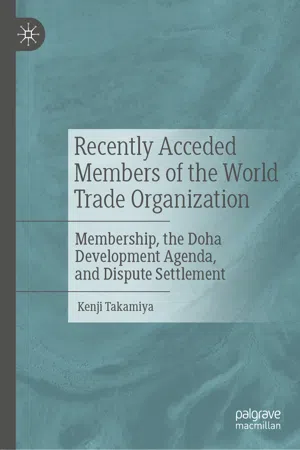
Recently Acceded Members of the World Trade Organization
Membership, the Doha Development Agenda, and Dispute Settlement
- English
- ePUB (mobile friendly)
- Available on iOS & Android
eBook - ePub
Recently Acceded Members of the World Trade Organization
Membership, the Doha Development Agenda, and Dispute Settlement
About this book
Information
© The Author(s) 2019
Kenji TakamiyaRecently Acceded Members of the World Trade Organizationhttps://doi.org/10.1007/978-981-13-9159-0_11. Background and Theoretical Framework
Kenji Takamiya1
(1)
Manila, Philippines
1 Background
Countries that acceded to the World Trade Organization (WTO) since its establishment in 1995 generally made substantial commitments as part of the membership negotiations, often beyond what were previously required for the incumbent members at the equivalent stage of development. Article XII of the Marrakesh Agreement Establishing the World Trade Organization (WTO Agreement ), which came into effect in 1995 and provides rules on accession to the multilateral trading system, reads that an applicant may accede “on terms to be agreed between it and the WTO” (WTO, 1995a, p. 15), without further elaboration of what these terms are. The absence of pre-defined conditions for membership left determination of terms of accession to tough negotiations between each applicant and incumbent members. While the earlier General Agreement on Tariffs and Trade (GATT) 1947—a predecessor of the present WTO—also had a similar provision on accession (Article XXXIII),1 it allowed newly independent territories (former colonies of the incumbent GATT contracting parties) to exercise a privilege of semi-automatic accession without making substantial membership commitments (Article XXVI: 5(c)). The differential treatment created a substantial gap in the depth and scope of trade policy commitments made between many developing countries that acceded under the old GATT system (and became founding members of the WTO) and the more recently acceded members (RAMs) that joined the WTO after 1995.2
The RAMs’ commitments made in their terms of accession, in excess of what were required for incumbent developing members, took two forms: deeper and wider market access commitments and so-called WTO-plus and WTO-minus obligations. Under terms of accession, the RAMs bound their tariffs at an average rate of 10.75% for industrial products—or non-agricultural market access (NAMA) in the WTO jargon—and 17.07% for agricultural products, substantially lower than the level committed by other developing countries (28.9% for NAMA and 60.95% for agriculture). Their binding coverage amounted to 100% of tariff lines. While the RAMs made these extensive market access commitments, all they received from incumbent members in return was essentially a consolidation of existing market access on the permanent most-favored nation (MFN) basis (GATT Article I ),3 mostly without reciprocal and incremental tariff cuts. At the same time, some of the RAMs had to accept the so-called WTO-plus (obligation beyond the existing multilateral rules) and WTO-minus (exceptions to the current multilateral rules, including those applicable on the side of the incumbent members4) in their terms of accession.5 While all WTO members, old and new, had accepted the single undertaking of the WTO Agreement (including most of its annexes on multilateral trade agreements, dispute settlement understanding, and the trade policy review mechanism 6) in principle, WTO-plus and minus provisions were designated aside from this general requirement7 and were imposed uniquely upon the RAMs through their accession processes. In particular, some of the WTO-minus provisions mostly took the form of time-bound allowance for the incumbent members to exercise targeted discrimination against a number of RAMs continuously from the pre-accession period. Thus, while the RAMs joined the multilateral trading system that supposedly functions on the basis of the non-discrimination principle, some forms of discrimination targeted to them remained in the post-accession period.
Typically, WTO accession is depicted as a process of developing and transition countries’ integration to a globalizing market economy through multilateral trade liberalization (see Lanoszka, 2001). In a statement entitled “26 years of accession experience and best practices” in 2012, Pascal Lamy, then WTO’s Director-General, remarked:
WTO accessions are key elements in strengthening trade multilateralism. It is the WTO trade pathway to domestic reforms, competitiveness and growth. It is a uniquely WTO approach to development… For acceding governments, benefit of WTO membership is obvious. It provides new opportunities for trade, attracts investments and sustains economic growth.8
Ironically, however, some elements of these earlier terms of accession appear to have backfired in the post-membership phase. In the course of market access negotiations of the Doha Round launched in 2001, also known as the Doha Development Agenda (DDA),9 a coalition10 among the 19 RAMs took a position that, given the substantive commitments they had already made at the time of accession negotiations , only a moderate (or no) liberalization on their part should be required for both NAMA and agriculture. As a coalition, the RAMs collectively submitted the negotiating proposals on market access following this hardened line, which read as follows:
(I)n the process of accession the RAMs assumed extensive level of commitments in all WTO areas, distinguishing thereby the group from the rest of the membership. In this regard, RAMs consider that the aim of this development round should not be to deepen already existing discrepancies between developing members, or to disadvantage those that have done their share in contributing extensively to the world trading system. Instead, members should pursue an approach that takes into account different realities which exist among their schedules and envisages more balanced outcome. (WTO, 2007a, p. 1; 2007b, p. 1)
There is probably little doubt that a majority of the post-1995 RAMs effectively used terms of WTO accession for consolidating their efforts of integration to the global economy, as reflected in the market access commitments at the time of membership. However, at least on the surface, they are now pointing to the same accession commitments as a source of difficulty to their continuous engagement in multilateral trade liberalization at the post-membership stage. Observing China’s 11 performance in the Doha Round, for instance, Lim and Wang (2010) comment that the country’s negotiating position has been hardened for this reason. However, this change of policy orientation, before and after accession, is somewhat puzzling. If the RAMs pursued international economic integration through accession on the premise that it would serve their own economic benefits, there should be no obvious reason to discontinue the liberalization efforts at the Doha Round in the post-accession period.
In contrast to their defensive positions at the DDA market access negotiations, a number of RAMs have been proactively utilizing WTO’s dispute settlement mechanism in relation to their terms of accession, as have actually been observed for China and Viet Nam. Th...
Table of contents
- Cover
- Front Matter
- 1. Background and Theoretical Framework
- 2. The RAMs’ Accession and Post-membership Activities: An Overview
- 3. Georgia
- 4. People’s Republic of China
- 5. Viet Nam
- 6. Ecuador
- 7. Conclusion
- Back Matter
Trusted by 375,005 students
Access to over 1.5 million titles for a fair monthly price.
Study more efficiently using our study tools.
Frequently asked questions
Yes, you can cancel anytime from the Subscription tab in your account settings on the Perlego website. Your subscription will stay active until the end of your current billing period. Learn how to cancel your subscription
No, books cannot be downloaded as external files, such as PDFs, for use outside of Perlego. However, you can download books within the Perlego app for offline reading on mobile or tablet. Learn how to download books offline
Perlego offers two plans: Essential and Complete
- Essential is ideal for learners and professionals who enjoy exploring a wide range of subjects. Access the Essential Library with 800,000+ trusted titles and best-sellers across business, personal growth, and the humanities. Includes unlimited reading time and Standard Read Aloud voice.
- Complete: Perfect for advanced learners and researchers needing full, unrestricted access. Unlock 1.5M+ books across hundreds of subjects, including academic and specialized titles. The Complete Plan also includes advanced features like Premium Read Aloud and Research Assistant.
We are an online textbook subscription service, where you can get access to an entire online library for less than the price of a single book per month. With over 1.5 million books across 990+ topics, we’ve got you covered! Learn about our mission
Look out for the read-aloud symbol on your next book to see if you can listen to it. The read-aloud tool reads text aloud for you, highlighting the text as it is being read. You can pause it, speed it up and slow it down. Learn more about Read Aloud
Yes! You can use the Perlego app on both iOS and Android devices to read anytime, anywhere — even offline. Perfect for commutes or when you’re on the go.
Please note we cannot support devices running on iOS 13 and Android 7 or earlier. Learn more about using the app
Please note we cannot support devices running on iOS 13 and Android 7 or earlier. Learn more about using the app
Yes, you can access Recently Acceded Members of the World Trade Organization by Kenji Takamiya in PDF and/or ePUB format, as well as other popular books in Business & International Business. We have over 1.5 million books available in our catalogue for you to explore.