This book deals with the events leading up to the 1936 Popular Olympics which would have united the Popular Front in opposition to the Berlin Olympics. It also discusses the days after the outbreak of the Spanish Civil War which began on the same day the games were due to start. Using a variety of primary and secondary sources, the book traces the biographies of several Popular Olympians who would go on to volunteer in the Spanish Civil War. The book also examines the planned events and locations for the Popular Olympics as well as the international funding that the games secured. The book argues that the events were a departure from Workers' Sport as well as the IOC's Olympic games and represented an important cultural manifestation of the Popular Front.
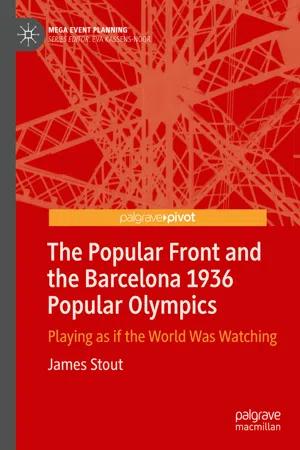
eBook - ePub
The Popular Front and the Barcelona 1936 Popular Olympics
Playing as if the World Was Watching
- English
- ePUB (mobile friendly)
- Available on iOS & Android
eBook - ePub
The Popular Front and the Barcelona 1936 Popular Olympics
Playing as if the World Was Watching
About this book
Information
© The Author(s) 2020
J. StoutThe Popular Front and the Barcelona 1936 Popular OlympicsMega Event Planninghttps://doi.org/10.1007/978-981-13-8071-6_11. Spain and Sport in the 1930s
James Stout1
(1)
San Diego Mesa College, San Diego, CA, USA
James Stout
Abstract
The Popular Olympics are often characterized as a part of the Workers’ Sport Movement; however, this overlooks the unique circumstances that created a united Popular Front which supported and would have attended these games. This chapter outlines the Spanish and Catalan political situations as well as approaches to sport and nationalism which made it possible to host a global mega-event with less than three months to prepare. Concepts of popular sport, the Popular Front, and Catalan nationalism are explained, and a brief narrative of the history of the Spanish Second Republic will acquaint the reader with the various parties and crises leading up to July 1936.
Keywords
OlympicsCataloniaPopular FrontPopular sportSpainBarcelona in 1936 was a city alive with tension. Take a wrong turn off the Ramblas and you might find yourself in any one of a dozen different utopias in the making, or merely relieved of your wallet. The Catalan capital was enjoying a period of relative alignment with Madrid, but this did not mean that civil unrest was uncommon. Police, anarchists, and the military all carried arms and had no qualms about using them against each other or anyone else who crossed their path to a vision of a new Spain or Catalonia. Unions and parties could mobilize huge numbers of people and frequently for rallies, protests, and strikes. They did this so often that it was said that Barcelona’s paving stones were never fully affixed to the ground as they were merely covering the streets while they waited to be repurposed into another set of barricades.
Those paving stones would be pulled up on the night of July 19, 1936, and they would remain as barricades for the next three years as Barcelona became a battleground between democracy, utopia, and dictatorship in Spain’s brutal Civil War (1936–1939). The world engaged with this war too little and too late to stop the coup. Democracies quickly hid behind non-intervention, and the fascist powers quickly mobilized their troops and military hardware. But, for a group of dedicated young people in Barcelona’s city park of Montjuïc, none of this would come as a surprise. The anti-fascists, socialists, communists, Jews, people of colour, and political exiles who were gathered in the Hotel Olympic had watched as the world failed to stand up to fascism in the lead up to the Berlin games, and they decided to take a stand. They were in Barcelona to reclaim the spirit of solidarity and brotherhood for the Olympics, and when the time came for rifles to replace running shoes, many of them stood in solidarity there as well. From the very first moments of Spain’s conflict, there were inter-national volunteers standing alongside the defenders of the Republic and its flawed but hopeful brand of democracy.
The streets may have been a contested space in the 1930s, but Catalonia’s stadia were not. Throughout Spain’s Second Republic (1931–1939), Catalonia maintained a left-Republican government under the Esquerra Republicana de Catalunya (ERC) that used social policy, charismatic leadership, and physical culture to unite the working and middle classes behind its idea of a nation. From the hard left to the Catholic right, Catalans came to know each other through physical culture. Although this project would never reach its full potential due to the conflict, the short period of its existence saw Catalonia reap the rewards of popular sport and begin its attempts to share this sporting fraternity with other anti-fascist nations around the world.
A major element of the platform of the ERC was popular sport, a form of cross-class physical culture that removed the de facto barriers to entry which existed in sport at the time. Bourgeois sport prized amateurism, civility, and exclusivity. Its adherents dressed fashionably and voted for parties on the right. The Workers’ Sport Movement aimed to use sport to teach the working-class solidarity and promote health and strength in working-class youth. Its adherents dressed in overalls and saw barricades, not ballot boxes, as the key to their political liberation. By 1935, the Workers’ Sport Movement as a whole contained 4 million members, but nearly half of those were members of clubs in Germany that were prohibited by the Nazis.1 Bourgeois or elite sport was expensive, and the cost of equipment, membership, and transport often made it inaccessible to the working classes. Workers’ Sport was explicitly political and open to only those who shared its Marxist ideology.
As Pujadas and Santacana2 have shown, Catalan sport grew up outside of an allegiance to inter-national governing bodies or political movements. Sport in Catalonia grew in the inter-war period and lagged behind its neighbours to the north. This meant that inter-national competition was eschewed; instead, Catalan sport was played in and between existing cultural associations, educational institutions, workplaces, professional organizations, unions, labour exchanges, and neighbourhood groups. This sporting practice united classes and ideologies on the playing fields and played a role in the growing sense of cross-class national identity that grew before and during the Republic. With the arrival of the Republic and the installation of a progressive left-Republican government in Barcelona, this sporting practice gained a name, an organizational structure, and an ideology; popular sport aimed to bring together bourgeois and working-class athletes, promote public health, and foster a sense of shared identity that saw a national and progressive identity overcome class and political divisions.
To paraphrase Rogers Brubaker,3 identity is not a thing in the world but a perspective on the world. The perspective on the world that the ERC created was one of optimism for a future when Catalonia and Spain, and the other nations of the world, could coexist in democratic fraternity. It is the creation of this perspective that I shall seek to explain in this chapter. Governments across the world engaged in the process of “nationalizing” the masses in the early twentieth century. The use of competitive sport and non-competitive physical culture to serve the end of nationalizing the masses and to forge a cross-class shared identity was by no means unique to Catalonia, or the Second Republic, but it did meet with great success there. In the years between Primo de Rivera’s military dictatorship (1923–1930) and Spain’s descent into war in 1936, the national ambitions of the Catalans were founded on and exhibited in the sporting world as much as the political one. This chapter will investigate how this Catalan sporting nation developed, and how Catalonia planned to share that sporting solidarity with the rest of the world through the Popular Olympics.
The Second Republic
In the spring air of 1931, Spain’s town halls were filled with the new Republican tricolours and its citizens filled with a sense of hope for the future. Following municipal elections in April, King Alfonso XIII had fled the country. Just a year before, the monarch and the military had withdrawn their support from the dictatorship of General Primo de Rivera. With the removal of political authority, Spain had to decide how it wished to engage with itself and the world. Very quickly it became clear that beneath the Republic’s flag were two Spains with mutually incompatible ideas. Catalonia’s politics was very much tied to the left-Republican conception of a Spain that embraced the secular Republic and the ideals of liberty, equality, and fraternity that it had inherited from its predecessors. The other Spain strongly opposed Catalan autonomy, agnostic politics, and the socially progressive agenda that united much of the centre and left. In many cases, the so-called accidentalist right also saw the Republic itself as a means, not an end. This conflict about what Spanishness meant was to characterize and destroy the Republic.
Our opinions of the Second Republic have changed as we have changed the perspective from which we view it. In the Franco era, it was constructed as a chaotic time of left-wing maximalism that placed revolutionary ideology above the rights of the people and the day-to-day running of the country. In Spain’s post-dictatorship, the Republic has come to be seen as a more well-intentioned experiment in social democracy, albeit one that lacked the support of large sectors of society.
The Republic and its governments can be split into three two-year periods, generally known as the First (or reformist), Second (or “black”), and Third Biennia (the Third Biennium is also known as the Popular Front government). Each one of these periods was defined by a change in government and ideology and a vastly different idea about Spain’s future.
Hours before the Second Republic was proclaimed in Madrid, Catalan hero and president-to-be Francesc Macià proclaimed the Catalan Republic, within a confederation with the other peoples of Spain. Although Macià’s confederation would not last long, Catalonia gained much autonomy under the Republican constitution that was later approved and was able to work on the left-Republican goals of education, land reform, an agnostic state, and improvements in the “condition of the people” for five years before Spain’s military rose against its government.
Catalonia’s regional government, the Generalitat , and Spain’s national government, the Cortes , were elected on different cycles with elections at least once per year for the first three years of the Republic (June 1931, November 1932, and November 1933). This resulted in instability and a constantly changing relationship. Catalonia remained stable, thanks to the “big tent” of the ERC which united a broad range of groups on the left of the Republic. Long before the Spanish left came together in the Popular Front of 1936, the ERC formed a catch-all alliance that proved insurmountable in the Generalitat, gaining the most Catalan votes in all three Catalan elections. There was a considerable fluctuation in votes for the more conservative Catalanist party the Lliga Regionalista de Catalunya . Indeed, the Lliga gained one more seat than the ERC in the 1933 Spanish general election. However, the Lliga could not repeat this result in the Generalitat, where the ERC held a tight grip throughout the Republic.
In Madrid, politics showed a lot less unity. The 1931 election was swept by groups on the left of the Republic in both Spain and Catalonia and gave rise to a liberal constitution which upheld the rights of the citizen and reduced the special rights that the Catholic Church had come to expect. The first government was formed of a Liberal-Socialist coalition that focused on a social democratic, reformist, and an anti-clerical agenda. Education was a key goal and an important tool of this government; they aimed to remove the religious bent of instruction and to offer a Republican education that would “consolidate a class divided nation.”4
The church had been so closely tied to Spanishness that it was “not so much a religion as a culture”5; for some on the religious right, the church and the nation were inseparable. For legislators who held this belief, the policies of the First Biennium were not just disagreeable, they were sacrilegious. Sadly, national consolidation and many of the other goals of the first government did not come as rapidly as promised. Landowners and the church felt alienated by rapid change, whilst the working classes were often angered by the slow pace of promised reforms. Both those opposed to and supporting the regime seemed happy to place results ahead of rules in their attempt to assert their own vision of the Spain they wanted. On the left, there was working-class protest and clamour for a more equitable distribution of land and profits; this met with a swift and often violent government response. The authoritarian policing techniques favoured by the new regime led to it being dubbed the “Republic of order” and alienating many of the working classes who preferred to take their chances at the barricades than vote for a different set of people to mete out the same violence and poverty they had known for generations.
The year 1933 saw voters elect a government that had a dramatically different vision of Spain. Many on the left called for workers to boycott the vote altogether. One newspaper proclaimed “Parliament… is a filthy house of prostitution.”6 Dissatisfaction with the pace of reform on the left and anger at the previous administration on the right heralded the beginning of the Re...
Table of contents
- Cover
- Front Matter
- 1. Spain and Sport in the 1930s
- 2. The Berlin Games and the Boycott
- 3. Funding and Organizing an Alternative
- 4. The Participants
- 5. The Events
- 6. After the Games
- 7. Conclusions
- Correction to: The Popular Front and the Barcelona 1936 Popular Olympics
- Back Matter
Trusted by 375,005 students
Access to over 1.5 million titles for a fair monthly price.
Study more efficiently using our study tools.
Frequently asked questions
Yes, you can cancel anytime from the Subscription tab in your account settings on the Perlego website. Your subscription will stay active until the end of your current billing period. Learn how to cancel your subscription
No, books cannot be downloaded as external files, such as PDFs, for use outside of Perlego. However, you can download books within the Perlego app for offline reading on mobile or tablet. Learn how to download books offline
Perlego offers two plans: Essential and Complete
- Essential is ideal for learners and professionals who enjoy exploring a wide range of subjects. Access the Essential Library with 800,000+ trusted titles and best-sellers across business, personal growth, and the humanities. Includes unlimited reading time and Standard Read Aloud voice.
- Complete: Perfect for advanced learners and researchers needing full, unrestricted access. Unlock 1.5M+ books across hundreds of subjects, including academic and specialized titles. The Complete Plan also includes advanced features like Premium Read Aloud and Research Assistant.
We are an online textbook subscription service, where you can get access to an entire online library for less than the price of a single book per month. With over 1.5 million books across 990+ topics, we’ve got you covered! Learn about our mission
Look out for the read-aloud symbol on your next book to see if you can listen to it. The read-aloud tool reads text aloud for you, highlighting the text as it is being read. You can pause it, speed it up and slow it down. Learn more about Read Aloud
Yes! You can use the Perlego app on both iOS and Android devices to read anytime, anywhere — even offline. Perfect for commutes or when you’re on the go.
Please note we cannot support devices running on iOS 13 and Android 7 or earlier. Learn more about using the app
Please note we cannot support devices running on iOS 13 and Android 7 or earlier. Learn more about using the app
Yes, you can access The Popular Front and the Barcelona 1936 Popular Olympics by James Stout in PDF and/or ePUB format, as well as other popular books in Politics & International Relations & Political History & Theory. We have over 1.5 million books available in our catalogue for you to explore.