eBook - ePub
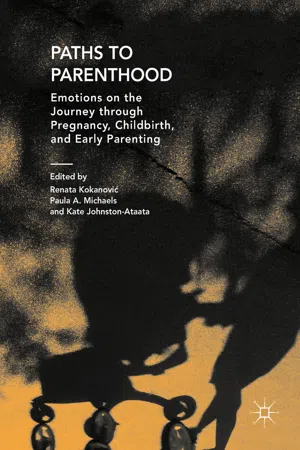
Paths to Parenthood
Emotions on the Journey through Pregnancy, Childbirth, and Early Parenting
- English
- ePUB (mobile friendly)
- Available on iOS & Android
eBook - ePub
Paths to Parenthood
Emotions on the Journey through Pregnancy, Childbirth, and Early Parenting
About this book
This interdisciplinary book explores the affective dimensions of becoming a parent, traversing the life-cycle journey of pregnancy, childbirth, and early parenting. Bringing together researchers from sociology, history, feminist studies, cultural studies, general medicine, and psychiatry, Paths to Parenthood analyses rich narratives that represent a diverse cross-section of parents, including migrants, same-sex couples, and single parents.
Information
© The Author(s) 2018
Renata Kokanović, Paula A. Michaels and Kate Johnston-Ataata (eds.)Paths to Parenthoodhttps://doi.org/10.1007/978-981-13-0143-8_11. The Complex and Contradictory Emotional Paths to Parenthood
Paula A. Michaels1 and Renata Kokanović2, 3
(1)
School of Philosophical, Historical, and International Studies, Faculty of Arts, Monash University, Clayton, VIC, Australia
(2)
Social and Global Studies Centre, RMIT University, Melbourne, VIC, Australia
(3)
Monash Centre for Health Research and Implementation (MCHRI), Monash Public Health and Preventative Medicine, Monash University, Clayton, VIC, Australia
Keywords
PregnancyChildbirthParenthoodEmotionsNarrativeMotherhoodFatherhoodWithin ten months of her wedding, Ayesha’s life had been turned upside down. Arriving as a migrant to Australia from her native Afghanistan, she was eight months pregnant. She found the thought of giving birth in a clean, safe hospital reassuring, but, longing for her family, cried throughout her labour. An adverse reaction to the epidural anaesthesia and haemorrhaging compounded her emotional upheaval after the birth of her twin daughters. Less than a year later, Ayesha was pregnant again. Fearful that she would not be able to cope, she considered having an abortion, but ultimately decided against it. She gave birth to a boy, vowing to wait before having her fourth and final child. Five years later, she bore another son. When he was 18 months old, Ayesha sat down for an interview as part of a study on pregnancy, childbirth, and early parenting experiences. She attests to being ‘very happy,’ but strains under the physical, emotional, and financial burdens of rearing four small children a long way from her extended family, with only her husband for support. Asked what she would advise other migrants from Afghanistan, she shrugs off her own struggles with hard-won laughter and says, ‘be fairly strong because it is hard far away from your family.’
Relative privilege and proximity to family are no guarantee of smooth sailing for a new parent. Born and raised in Australia, 37-year-old Brett is a middle-class, white, heterosexual man. At first glance, he would seem to have little in common with Ayesha, but their stories overlap in a few respects. He, too, became a parent within a year of partnering. They experienced a miscarriage eight weeks into their first pregnancy but, like Ayesha, Brett now has a young family, with children ages four, two, and a mere 12 weeks old at the time of his interview. With their third child, his partner had a ‘textbook’ quick, easy labour; given his partner’s prior experiences with postnatal depression (PND), Brett expresses obvious relief in her immediate bonding with their youngest son. She is ‘just thoroughly smitten with him and it’s—it’s just awesome.’ The couple’s adaptation to their rapidly expanding family has been crucial, as he and his partner have not been able to lean on Brett’s family for any kind of consistent support. They live in the same state, but Brett’s brother, diagnosed with schizophrenia, requires his parents’ continuous care and support.
Neither Brett nor Ayesha has extended family to which they can turn. With this fact as one consideration, they have had to make choices about how many children to have and how to space them. As parents to young children, they struggle with the many demands of parenting, while also having a clear sense of its joys. But for all this common ground, there are, of course, major differences in their experiences. Most obviously, for Ayesha becoming a mother was a deeply embodied experience, as she carried and birthed her babies. Perinatal medical complications compounded the physical strains that are common in pregnancy, labour, and delivery. Fathers, too, go through significant trials as they adapt to their new roles and work to support their partners; Brett bore witness to his partner’s struggle with PND. But the physical reality for mothers is distinctly different. As an at-home mother, Ayesha did not share in Brett’s struggle to reconcile the competing obligations of work and home. She faced other hurdles. A new migrant with limited English language skills, she grappled with social isolation. Ayesha wishes she could study further, which would help her to move about more freely and easily in her new country, but childcare is prohibitively expensive. With a well-paying job, Brett and his family live with none of the financial precariousness that Ayesha experiences, though he nonetheless frets about providing adequately compared to others in his social circle.
This book explores some of the complex and contradictory emotions that women and men weather on the journey through pregnancy, childbirth, and early parenthood. Ayesha’s and Brett’s narratives illustrate just a few of the varied factors—gender, migration status, education level, mental and physical well-being—that contour these experiences. At first glance, reproduction appears to be a universal biological process. Across time and space, humans have coupled, fallen pregnant, and birthed children. Those of a traditionalist bent might assert that nothing could be more natural than the desire for and process of procreation. But for both social and technological reasons, the reality of that process is—and always has been—more complex. Human reproduction is a biosocial experience. The path to parenthood cannot be traversed independent of the social, cultural, economic, and legal contexts in which it takes places. Those structures condition gender roles that find expression in courtship, marriage, family life, and work. While it is and always has been true that the norms arising from these institutions and practices shape pregnancy, birth, and parenting, the last century has witnessed imbricated social and technological changes that have given rise to unprecedented possibilities and unforeseen tensions. Most recently, assisted reproductive technologies (ART) have expanded the possibilities of who can become a parent and how. For some heterosexual couples facing fertility challenges, ART has opened the doorway to parenthood. These same advances have also enabled single individuals, including single men, as well as same-sex attracted people to become parents.
Older norms prove remarkably resilient, if only as a cultural backdrop, rather than the lived reality of pregnancy, birth, and parenthood for most women and men in today’s developed world. Many of us carry with us the image of the heterosexual dyad in the suburban idyll, even as we live a different life, whether by our own choice or not. We experience a sense of rupture between what is and what ‘should’ be. Feminist scholar Sarah Ahmed argues that ‘feelings might be how structures get under our skin’ (Ahmed 2010, p. 216) and perhaps at no other juncture in life are the mix of feelings so complex and contradictory as when we reproduce. The disjuncture between the norms of traditional structures and our lived experiences contributes to an array of emotions. There are, of course, love, passion, attachment, and devotion; but there are also guilt, shame, uncertainty, stress, and anger. In the journey to parenthood, women and men experience deeply ambivalent feelings that need to be acknowledged. Recognition of the full range of emotions that can accompany the joys and challenges of pregnancy, childbirth, and early parenting normalises them and undermines the power of sociocultural expectations that for many are unattainable.
Narrating the Journey
In 2013 and 2014, Renata Kokanović, co-editor of this volume and co-author of this chapter, led a team of qualitative health researchers, including editorial associate Kate Johnston-Ataata, in conducting narrative interviews with 48 parents in the Australian states of Victoria and New South Wales. A key aim of the original research was the creation of an online resource on Healthtalk Australia, a web-based repository of narrative accounts of health, illness, and associated experiences. This resource was developed to support and inform new parents, their families, and members of their social networks about emotional experiences of expecting a baby, labour and birth, and early parenthood (http://research.healthtalkaustralia.org/early-parenthood/overview ). Participants included a diverse cross section of parents in terms of socio-economic background, cultural, and religious heritage, sexual orientation, marital status, migration status, and a range of other factors (see Appendix 1). Interviewees included 38 women and 10 men, aged 18–48 years old. Thirty-three participants were born in Australia and self-identified as being from a range of European ethno-cultural backgrounds. The 15 interviewees born overseas hailed from countries in Europe, North America, South Asia, Africa, and Oceania; some migrated as youths and others in adulthood. Forty interviewees were partnered (27 married and 13 in cohabiting relationships), and eight were single, including five who were separated or divorced. Ten participants were in a relationship with someone born in a different country. Three of the four same-sex attracted interviewees were in cohabitating relationships. The number of children interviewees had ranged from one to six, but the average was two. Interviewees’ domestic arrangements were diverse, including nuclear, sole parent, blended, step, large, and multi-generational families. Parents narrated embodied experiences of conception, in vitro fertilisation (IVF), miscarriage, pregnancy, stillbirth, surrogacy, and adoption, and a range of birthing experiences, from home births to deliveries by caesarean sections. Our interlocutors attested to their adjustment to early parenthood, including experiences of emotional distress, changes to relationships, and the balancing act between parenthood and paid work.
Paths to Parenthood makes a unique methodological intervention in the diverse literature of medical humanities by approaching a single dataset from a range of disciplinary perspectives. The tools of sociology, history, feminist studies, cultural studies, general medicine, and psychiatry are brought to bear on the interpretation of these rich narratives in an effort to probe the sometimes common, sometimes unique affective experiences. Lines between these disciplines are not always sharp. Historians Paula Michaels and Charlotte Greenhalgh, in Chapters 4 and 10, respectively, are not alone in their attention to change over time. Though Camille Nurka (Chapter 2) examines the experience of ART p...
Table of contents
- Cover
- Front Matter
- 1. The Complex and Contradictory Emotional Paths to Parenthood
- Part I. Journeys into Pregnancy and Childbirth
- Part II. Journeys into Early Parenthood
- Back Matter
Trusted by 375,005 students
Access to over 1.5 million titles for a fair monthly price.
Study more efficiently using our study tools.
Frequently asked questions
Yes, you can cancel anytime from the Subscription tab in your account settings on the Perlego website. Your subscription will stay active until the end of your current billing period. Learn how to cancel your subscription
No, books cannot be downloaded as external files, such as PDFs, for use outside of Perlego. However, you can download books within the Perlego app for offline reading on mobile or tablet. Learn how to download books offline
Perlego offers two plans: Essential and Complete
- Essential is ideal for learners and professionals who enjoy exploring a wide range of subjects. Access the Essential Library with 800,000+ trusted titles and best-sellers across business, personal growth, and the humanities. Includes unlimited reading time and Standard Read Aloud voice.
- Complete: Perfect for advanced learners and researchers needing full, unrestricted access. Unlock 1.5M+ books across hundreds of subjects, including academic and specialized titles. The Complete Plan also includes advanced features like Premium Read Aloud and Research Assistant.
We are an online textbook subscription service, where you can get access to an entire online library for less than the price of a single book per month. With over 1.5 million books across 990+ topics, we’ve got you covered! Learn about our mission
Look out for the read-aloud symbol on your next book to see if you can listen to it. The read-aloud tool reads text aloud for you, highlighting the text as it is being read. You can pause it, speed it up and slow it down. Learn more about Read Aloud
Yes! You can use the Perlego app on both iOS and Android devices to read anytime, anywhere — even offline. Perfect for commutes or when you’re on the go.
Please note we cannot support devices running on iOS 13 and Android 7 or earlier. Learn more about using the app
Please note we cannot support devices running on iOS 13 and Android 7 or earlier. Learn more about using the app
Yes, you can access Paths to Parenthood by Renata Kokanović, Paula A. Michaels, Kate Johnston-Ataata, Paula A. Michaels,Kate Johnston-Ataata,Renata Kokanović in PDF and/or ePUB format, as well as other popular books in Social Sciences & Anthropology. We have over 1.5 million books available in our catalogue for you to explore.