eBook - ePub
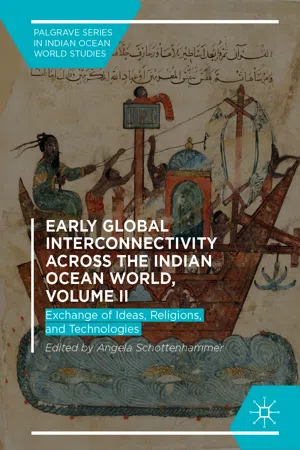
Early Global Interconnectivity across the Indian Ocean World, Volume II
Exchange of Ideas, Religions, and Technologies
- English
- ePUB (mobile friendly)
- Available on iOS & Android
eBook - ePub
Early Global Interconnectivity across the Indian Ocean World, Volume II
Exchange of Ideas, Religions, and Technologies
About this book
This volume investigates the emergence and spread of maritime commerce and interconnectivity across the Indian Ocean World—the world's first "global economy"—from a longue durée perspective. Spanning from antiquity to the nineteenth century, these essays move beyond the usual focus on geographical sub-regions or thematic aspects to foreground inter- and trans-regional connections. Focusing on the role of religion in the expansion of commerce and exchange across the region, as well as on technology and knowledge transfer, volume II covers shipbuilding and navigation technologies, porcelain production, medicinal knowledge, and mules as a commodity and means of transportation.
Information
© The Author(s) 2019
Angela Schottenhammer (ed.)Early Global Interconnectivity across the Indian Ocean World, Volume II Palgrave Series in Indian Ocean World Studieshttps://doi.org/10.1007/978-3-319-97801-7_11. Introduction
Angela Schottenhammer1, 2
(1)
University of Salzburg, Salzburg, Austria
(2)
Research Director of the Indian Ocean World Centre (IOWC), McGill University, Montreal, Canada
This publication is dedicated to the spread and exchange of ideas, religions, knowledge and technologies in the Indian Ocean World (IOW). The conventional Eurocentric view holds that Asian religions or socio-religious systems, notably Islam , Hinduism or Confucianism, suppress or impede economic development and progress. This idea requires a substantial reassessment. Religions, as will be shown in this volume, were, on the contrary, very conducive to a further interconnectivity of countries and regions across the IOW. Preliminary investigations of trans-oceanic monsoon sail indicate that the foundations for the IOW global economy were laid before the BCE/CE changeover—much earlier than is conventionally assumed—and Africa, for example, played a key role in its creation.1 By 1000 CE at the latest, Africa, the Middle East, South Asia, Southeast Asia and the Far East were linked together in a system of long-distance maritime exchanges that was so regular and sophisticated that it can be termed the first “global” economy.
In the early centuries of the first millennium CE, we have proof that religious networks, both Buddhist and Hindu, were also active factors of change, through the agency of itinerant religious entrepreneurs, of merchants or adventurers. And in China during the Song dynasty (960–1279), a dynasty that is otherwise well known for its Neo-Confucian reorientation and the predominant role of morality in state ideology, China became the economic motor of the entire macro-region; in other words, contemporary Confucianism did not impede the development of trade and commerce, the government rather wanted to profit from trade and actively also sponsored maritime commerce .2
Buddhism played a major role in the interactive processes throughout the early IOW. Liu Xinru has argued that the transmission of Buddhism to China was the result of an interdependent and reciprocal relationship between Buddhist monks and merchants who travelled between India and China. Merchants met the increasing demand for ritual items and actively financed monastic institutions and proselytizing activities. They regularly assisted the growing number of Buddhist monks journeying across the overland and maritime routes to China . The Buddhist monk Faxian 法顯 (337/342–c. 422) is a famous example. Buddhist monks and monasteries , in turn, fulfilled the spiritual needs of the itinerant merchants and helped introduce new items into the stream of commodities traded between India and China .3 The spread and propagation of Buddhism , as with other religions, were of course complex processes and we have to distinguish between various schools or doctrines and specific networks that all possessed their own characteristics. But it is clear, as the authors of this volume show, that the major religions on the IOW played a very positive role in the development of commerce across the macro-region.
Buddhist religion, culture and commodities gradually came to dominate much of especially the south and eastern parts of the IO.4 Buddhist texts, sutras and artefacts ranged highly among the products exchanged. Especially from the approximately second to the tenth centuries, we can observe a continuous upswing of private commercial interaction in which Buddhism as both religious and cultural element played a predominant role. In Chapter 2, Tansen Sen demonstrates how the spread of Buddhism through maritime routes was closely linked with commercial activities, and how these networks were different from overland routes. Sen also provides a survey on early India–China networks and introduces the activities of Buddhist monks and the importance of Śrīvijayan rulers and their contribution to the maritime spread of Buddhism. In the second part, he discusses the role of Sri Lanka and the Bay of Bengal networks in the maritime distribution of Buddhism . He shows that Buddhism spread in various forms and that “the transmission of Buddhist doctrines, images, and texts from one cultural zone of Asia to another was a complex process that was undertaken by itinerant monks, traders, and other travellers”.
In Volume I, we have addressed questions of Iranization and later Arabization, of Sinicization and Europeanization more extensively. Reflecting the importance of South Asia and its culture in the IOW, we have also discussed the Indianization 5 of the macro-region. In this volume, Indianization and Islamization are addressed and examined particularly in Chapters 3 and 7.
In Chapter 3, Pierre-Yves Manguin introduces the spread of Vaiṣṇava cults to Southeast Asia and the circumstances behind the adoption of Brahmanical cults across the Bay of Bengal . In the wake of the Gupta state sectarian, devotional forms of Vaiṣṇavism spread over the western part of Southeast Asia and attracted newly urbanized citizens of developing states, giving these people a sense of belonging to a larger community of thought. Sectarian Vaiṣṇavism appears to have locally provided a powerful instrument for assimilating and adjusting Southeast Asian rulers and their people into the new Brahmanical social order.
The Indian Ocean is famous for its well-documented Jewish and Islamic diaspora trade of the Middle Ages. On the other hand, trade diasporas as an institutional answer to the challenges of cross-cultural trade have a much longer history in the region. The great distances covered by merchants and the seasonality of the monsoons left few alternatives aside from staying away for prolonged periods of time, and shipwreck, piracy and slave trade caused people to end up on coasts far away from home. Trade diasporas depend on a degree of social cohesion, which Islam and Judaism could clearly offer, but how was this obtained by Indian Ocean diasporas in the pre-Islamic period? Chapter 4 by Eivind Heldaas Seland briefly draws up the map of pre-Islamic diaspora trade in the Western Indian Ocean, before discussing different ways of establishing necessary trust as encountered in the source material including ethnicity , religion, profession and geography. The chapter particularly focuses on the question of why religion and trade were so linked to each other, and why religion seems to have followed in the wake of trade. Religion not only fostered cohesion within merchant networks, so his argument advances, but also facilitated interaction among trading partners in general. Against this background also Jewish communities and the well-known Geniza documents are discussed.
Islam spread across the IOW via both overland and maritime routes. Geoff Wade argues that the spread of Islam is perhaps less visible or at least more difficult to track than that of Buddhism , Saivism or Vaiṣṇavism , especially because of the lack of iconography which accompanied the religion.6 But archaeological evidence —from wrecks with Islamic objects on board up to tombstones and funerary inscriptions —as well as references in Chinese texts, attest to Islam’s significance over the macro-region as well as the role of Muslims in early East Asian maritime commerce. In Volume I, I have introduced the terms Iranization and Arabization for the long-distance trade of Iranian and later Arab merchants, or “Persian Gulf traders”, with China, because it was they who first connected such distant places and port cities as Malindi , Zanzibar , Sīrāf , Melaka , Canton 廣州 or Yangzhou 揚州. But after the introduction of Islam and the advent of more and more Islamic traders in China, the commercial networks also became probably more and more Islamized. This is definitely a chapter of maritime history that still deserves further research in the future.
Islamic or Muslim merchants definitely played a significant role in the extension of commercial networks across the IOW. Patricia Risso has even argued that “Islam made possible a commercial hegemony in the Indian Ocean region. Muslim networks became so successful that they pushed aside older patterns of trade”.7 A parallel process of acculturation and Islamization has, for example, been operating in various parts of Southeast Asia over the centuries.8
In this context, Chapter 5 examines the transmission of Islam by sea along the trading networks, which extended from the Arab world through the ports of South Asia and Southeast Asia to the southern extensions of the Chinese world in the East China Sea. The chapter focuses on the maritime expansion of Islam across the Indian Ocean and the South China Sea until circa 1500 in various areas, investigating both textual and archaeological evidence and patterns of distribution, religious conversion and Islamic networks. The chapter is conceptually divided into two parts. The first part surveys the spread of Islam from the Arab world to South Asia, including Gujarat , Malabar , Sri Lanka and the Coromandel Coast . The second part extends this story into Southeast Asia and Southern China , suggesting that the Islamization of Southeast Asia was stimulated more by southward movement of Muslims from Southern China than by influences from the West.
Part II surveys shipbuilding traditions—the conditio sine qua non—across the Indian Ocean space, and ships as transportation vehicles. Whereas in the western Indian Ocean, Roman and Arab ships dominated trade from Egypt to India , in the eastern Indian Ocean most of the trade from India to China was carried out by Malay, Indonesian and Indian ships. Until the tenth to eleventh centuries, the Chinese, for example, rarely sailed the high seas in their own ships—although they had already early on developed a shipbuilding industry. But the majority of their ships were used in river and coastal transportation. Shipbuilding techniques for overseas vessels engaged in long-distance trade were basically introduced by foreigners, coming from Southeast Asia, India and Sri Lanka as well as from the Middle East, from Iranian (“Persian”) and Arab sailors. The people of insular Southea...
Table of contents
- Cover
- Front Matter
- 1. Introduction
- Part I. Religions in the Indian Ocean World
- Part II. Shipbuilding Technologies and Transportation
- Part III. Transfer of Knowledge and Technologies
- Back Matter
Trusted by 375,005 students
Access to over 1.5 million titles for a fair monthly price.
Study more efficiently using our study tools.
Frequently asked questions
Yes, you can cancel anytime from the Subscription tab in your account settings on the Perlego website. Your subscription will stay active until the end of your current billing period. Learn how to cancel your subscription
No, books cannot be downloaded as external files, such as PDFs, for use outside of Perlego. However, you can download books within the Perlego app for offline reading on mobile or tablet. Learn how to download books offline
Perlego offers two plans: Essential and Complete
- Essential is ideal for learners and professionals who enjoy exploring a wide range of subjects. Access the Essential Library with 800,000+ trusted titles and best-sellers across business, personal growth, and the humanities. Includes unlimited reading time and Standard Read Aloud voice.
- Complete: Perfect for advanced learners and researchers needing full, unrestricted access. Unlock 1.5M+ books across hundreds of subjects, including academic and specialized titles. The Complete Plan also includes advanced features like Premium Read Aloud and Research Assistant.
We are an online textbook subscription service, where you can get access to an entire online library for less than the price of a single book per month. With over 1.5 million books across 990+ topics, we’ve got you covered! Learn about our mission
Look out for the read-aloud symbol on your next book to see if you can listen to it. The read-aloud tool reads text aloud for you, highlighting the text as it is being read. You can pause it, speed it up and slow it down. Learn more about Read Aloud
Yes! You can use the Perlego app on both iOS and Android devices to read anytime, anywhere — even offline. Perfect for commutes or when you’re on the go.
Please note we cannot support devices running on iOS 13 and Android 7 or earlier. Learn more about using the app
Please note we cannot support devices running on iOS 13 and Android 7 or earlier. Learn more about using the app
Yes, you can access Early Global Interconnectivity across the Indian Ocean World, Volume II by Angela Schottenhammer in PDF and/or ePUB format, as well as other popular books in History & Asian History. We have over 1.5 million books available in our catalogue for you to explore.