- English
- ePUB (mobile friendly)
- Available on iOS & Android
eBook - ePub
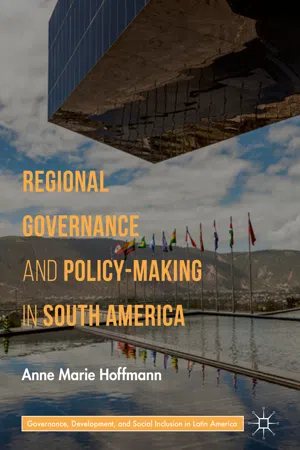
Regional Governance and Policy-Making in South America
About this book
This book analyzes Latin American regional integration with a novel conceptual approach grounded in extensive field research. Using the UNASUR (Unión de Naciones Suramericanas) as a case study, the author investigates the process of policy-making in regional public policy fields in South America. The project focuses on intergovernmental structures of regional organizations as an institutional framework for a variety of independent processes in regions. It also challenges the perspective of democratic states as unitary actors and seeks to analyze the factors which favor or obstruct regional processes in different policy-fields. This work will appeal to researchers, graduate students and anyone interested in Latin American politics and policy-making.
Information
© The Author(s) 2019
Anne Marie HoffmannRegional Governance and Policy-Making in South AmericaGovernance, Development, and Social Inclusion in Latin Americahttps://doi.org/10.1007/978-3-319-98068-3_11. Introduction: Regional Governance in South America
Anne Marie Hoffmann1
(1)
Hamburg University of Applied Sciences, Hamburg, Germany
Anne Marie Hoffmann
On May 23, 2008, the presidents of all 12 independent South American nations signed the Constitutive Treaty of a newly created organization. The UNASUR , Unión de Naciones Suramericanas, the Union of South American Nations, was meant to strengthen the “political dialogue among Member States to guarantee a space for agreement in order to reinforce South American integration” (UNASUR 2008, 3). At this third presidential summit in the Brazilian capital Brasilia, the by then acting presidents of the South American nations agreed on building a “South American identity and citizenship” (UNASUR 2008, 1) and strengthening common regional policies beyond the economic and political dimensions.
Only ten years later, on April 20, 2018, their successors are confronted with the suspension of membership of six member states. Argentina, Brazil, Chile, Colombia, Paraguay, and Peru, representing half of all UNASUR members, decided to withdraw temporarily from UNASUR . The reasons for this suspension, according to the respective member states, are rooted in the inability to find a General Secretary. Since the mandate of the former Secretary Ernesto Samper ended in January 2017, the UNASUR member states were not able to designate a new candidate. The reasons for this inability are manifold. National problems, economic crises and fiscal austerity, unhealthy ideological alliances, and a missing long-term orientation of governments all contribute to this situation, in which UNASUR appears to be unable to act.
It is not the objective of this book to explain why presidents cannot agree on a Secretary and keep vetoing possible candidates. Instead, the objective is to look behind the scenes of presidential politics and to understand the patterns and pitfalls of the regional organization UNASUR . In fact, the organization worked most of the time without actual leadership. From its very beginning, finding a General Secretary was a difficult task to undertake. Although UNASUR made major progress with Ernesto Samper, it was not inoperative before or after his mandate. In many different organs, policies have been developed and pursued. This book will focus on these regional public policies and seeks to understand how these processes of policy-making work in different UNASUR organs.
The suspension of membership of half of UNASUR ’s member states is a good opportunity to ask which effects presidential disputes have on regional policy-making, what the objectives of UNASUR organs are, and, finally, if UNASUR really is unable to act. According to the withdrawing governments, the Union came to deadlock. Yet, this interpretation runs short the variety of processes taking place in the ambit of UNASUR .
In the past, UNASUR has often been misinterpreted. But, what is UNASUR really about? Three interpretations until today dominate the discussions around the organization. First, UNASUR was analyzed as the convergence of the southern common market Mercosur (Mercado Común del Sur) and the also economically oriented Andean Community CAN (Comunidad Andina). Yet, UNASUR does not involve a market or trade agreement. The Union is political in nature. There is no economic primacy, and, hence, an economically oriented analysis of UNASUR does not make sense. In it’s second common interpretation, UNASUR raised attention as “conflict solver” in its first years of existence. Presidents and Ministers of Foreign Affairs got involved in diverse regional and national conflicts and offered solution in the name of UNASUR . However, this form of involvement is no organizational feature of the organization but rather a product of successful summitry. It is only a snapshot of UNASUR ’s institutionality. Third, in particular, academia tended to judge UNASUR as ideologically motivated leftist project. Although the creational track offers good reasons for this interpretation, it would be an abridged judgment. The project has been planned for more than three decades, long before the so-called turn to the left gained ground in South America. Liberal, conservative, and leftist presidents contributed to the development of UNASUR . Moreover, regional tensions and frictions also characterized the creation of the Union. What differentiates today from 2008 is the simple willingness of governments to cooperate at the regional level and to develop a long-term perspective.
UNASUR represents a political compromise. It is a political space that acknowledges the relevance of common public policies for regional development. It is progressive in the sense that it seeks to establish a regional public sphere via the emplacement of several regional public policies. The most impressive and astonishing about UNASUR is the ability to provide the space for a variety of policy fields to act and interact at the regional level. This major characteristic of the organization is at the same time the most unseen one. Ex-General Secretary Ernesto Samper in our interview told me without any doubt or ambiguity that UNASUR is all about regional public policies. According to him, its objective is to “identify public policies” (Samper 2014).
The misinterpretation of UNASUR is to a large extent a conceptual problem. There is no concept of regional public policy-making, and, as a consequence thereof, no understanding of it. This book sets new grounds for the analysis of this level of interaction and therewith opens space for new analytical approaches to regions.
Its comprehensive analysis contributes to the series “Governance, Development, and Social Inclusion in Latin America,” with an in-depth understanding of the processes of regional public policy-making. In line with the approach of the series, which reaches beyond the traditional analysis of regions along economic trade or presidential agreements, this title emphasizes the relevance of regional cooperation in a variety of public policy fields. It directs attention to the diverse and multifaceted processes that actually take place in regions, which still keep being unseen or even disregarded by academic research.
The book argues that regional governance, understood as an institutional form, needs to provide the space for policy-makers to interact independently and in a process of collective action to develop a common regional perspective. This regional perspective is based on shared experiences and challenges. Being the most unequal region in the world, South American policy-makers particularly in social policy fields are aware of the necessity to cooperate. The development of regional public policies, to them, is a precondition to long-term sustainable development. Pragmatically, the founding fathers of the Union stressed the necessity of “social and human development with equity and inclusion to eradicate poverty and overcome inequalities in the region” (UNASUR 2008, Constitutive Treaty, Art.3.b).
With regard to the political agenda, scholars used to interpret the creation of the South American Union as indicative of the prolonged process of regional transformation in South America. Especially the proponents of a post-hegemonic regionalism (Riggirozzi and Tussie 2012) argue that social development is increasingly important in regional cooperation (Riggirozzi and Grugel 2015). New organizations are constructed concerning the experiences of older organizations. As a result, various agreements, differing in range and scope as well as in their time of existence, today constitute the regional landscape of South America. Several new agreements have been signed in the last two decades and complement the existing organizations of Mercosur , CAN , and ALADI (Asociación Latinoamericana de Integración). ALBA (Alianza Bolivariana para los Pueblos de Nuestra América) was created in 2004, CELAC (Comunidad de Estados Latinoamericanos y Caribenos) in 2010, and Alianza del Pacifico in 2011.
In comparison to other regional organizations, the institutional flexibility of UNASUR appears to be supportive of different policy-making processes. UNASUR managed to provide the space for cooperation in these different policy fields. By analyzing and comparing five of them, this book seeks to understand the mechanisms of regional public policy-making and to reveal the conditions to effective policy formulation. These are the South American councils of health, social development, infrastructure, culture, and science. In total, UNASUR comprises 12 sectoral councils, ranging from security over education to culture. The case study of UNASUR investigates how flexible structures allow policy fields to develop their own working procedures. This strict intergovernmental working mode in combination with the flexible institutional structure of UNASUR allows analyzing factors influencing collective action in different groups. It permits an understanding of how processes in policy fields developed differently from each other. The case of UNASUR proves that the flexible intergovernmental structure supports dissimilar processes within the same formal structure.
By doing so, UNASUR is not only empirically an interesting case, but also conceptually. Its institutional flexibility allows analyzing patterns of regional public policy-making in comparative perspective and challenges the traditional interpretation of regional integration and regional institutions.
The quest for explanations as to why supranationality is f...
Table of contents
- Cover
- Front Matter
- 1. Introduction: Regional Governance in South America
- 2. Public Policies in Regional Integration Theory
- 3. Policy Studies and Regional Public Policy-Making
- 4. The Case of UNASUR
- 5. Regional Organizations in South America
- 6. Regional Public Policy-Making in Sectoral Councils
- 7. Policy-Making in UNASUR Councils: Comparative Analysis
- 8. Conclusion: Regional Governance in South America
- Back Matter
Trusted by 375,005 students
Access to over 1.5 million titles for a fair monthly price.
Study more efficiently using our study tools.
Frequently asked questions
Yes, you can cancel anytime from the Subscription tab in your account settings on the Perlego website. Your subscription will stay active until the end of your current billing period. Learn how to cancel your subscription
No, books cannot be downloaded as external files, such as PDFs, for use outside of Perlego. However, you can download books within the Perlego app for offline reading on mobile or tablet. Learn how to download books offline
Perlego offers two plans: Essential and Complete
- Essential is ideal for learners and professionals who enjoy exploring a wide range of subjects. Access the Essential Library with 800,000+ trusted titles and best-sellers across business, personal growth, and the humanities. Includes unlimited reading time and Standard Read Aloud voice.
- Complete: Perfect for advanced learners and researchers needing full, unrestricted access. Unlock 1.5M+ books across hundreds of subjects, including academic and specialized titles. The Complete Plan also includes advanced features like Premium Read Aloud and Research Assistant.
We are an online textbook subscription service, where you can get access to an entire online library for less than the price of a single book per month. With over 1.5 million books across 990+ topics, we’ve got you covered! Learn about our mission
Look out for the read-aloud symbol on your next book to see if you can listen to it. The read-aloud tool reads text aloud for you, highlighting the text as it is being read. You can pause it, speed it up and slow it down. Learn more about Read Aloud
Yes! You can use the Perlego app on both iOS and Android devices to read anytime, anywhere — even offline. Perfect for commutes or when you’re on the go.
Please note we cannot support devices running on iOS 13 and Android 7 or earlier. Learn more about using the app
Please note we cannot support devices running on iOS 13 and Android 7 or earlier. Learn more about using the app
Yes, you can access Regional Governance and Policy-Making in South America by Anne Marie Hoffmann in PDF and/or ePUB format, as well as other popular books in Politics & International Relations & American Government. We have over 1.5 million books available in our catalogue for you to explore.