
eBook - ePub
Survival to Growth
About this book
Survival to Growth explores human nature and illustrates how occupational goals and objectives can be achieved by applying a basic organizational approach while upgrading the skill level of each company employee.
Information
1
Survival: Simple, Curious, and Interested
Keep it simple. Ask the right questions. Move fast. Learn. Get it done. Being an expert in international trade is different from possessing expertise in design or in some other trade, and yet similarities exist that we can compare. It is important to define the elements we are seeking. Focusing on individuals in the selection process is a key factor in how the future can be shaped. First, we need to analyze the job and the people to be trained: We should ask what people need to know to perform well on the job. How much relevant prior knowledge do they each have? What is each person’s motivation? What is the perceived value of their training?
Each job description comprises its own set of requirements in terms of knowledge, skill, and level of ability. Since we document knowledge in terms of concepts, principles, procedures, and examples that address issues at hand, how then do we raise intellectual capital?
In terms of the mechanisms that will support and demonstrate our goals and objectives, how do we transfer technology? Moreover, what practice and feedback procedures are to be employed and what questions remain? How do we conduct an evaluation of design and an effective business plan? Finally, how do we carry the message in terms of media selection: live, Web-based, or video?
The answer is a natural selection—a gradual, nonrandom process by which traits become more or less common as a function of differential characteristics over time and exhibit variability. Variation exists within every process. This occurs partly because random causes of change can occur, but they can also be normalized and controlled. Throughout the process of personal interactions within a specific environment, causes of variations are observed. This includes individuals who possess certain variants of traits, some of whom may survive and produce more than individuals with other variants. It becomes an evolving process of selectivity, the strongest of whom will survive and flourish.
Observable characteristics in each individual offer productive advantages that become more apparent over time in a particular group or population. This process can result in groups of people who specialize in a particular niche, and which may eventually end in the emergence of an entirely new method or system. In natural selection, the environment acts as a sieve through which only certain variations can pass.
Natural variation occurs among individuals of all groups of people, and, in many instances, these differences do not affect survival (such as differences in eye color). Conversely, some differences may improve an individual’s chance of survival. Take, for example, a rabbit that runs faster than others and may be more likely to escape its predators. Likewise, the individual (or company) with stronger qualifications will surpass their contenders in tasks that places them ahead of those competing for the same or similar positions. Just as algae, which are more efficient at extracting energy from sunlight, grow faster than plants of the same species that are less energy efficient. Whatever increases the chances of an individual’s survival also affects their rate of productivity. Although sometimes there’s a trade-off between survival and current production, what matters ultimately is the total lifetime production of the individual. Therefore, natural selection appears to be the most important mechanism for creating complex adaptations.
The comparison between political and emotional intelligence team leaders is meant to focus on the realities of these behavioral approaches insisting upon a particular approach as the correct one. It is merely meant to reflect on observations of two different styles of management that are practiced in organizations. Some of the greatest intimidators that face a team organizer or sponsor are based on subtle observations. We hear a lot of praise for emotionally intelligent, even humble, leaders. Nevertheless, change is perceived by some followers as scary, and followers sometimes appear to respond to scary leaders to steer them through the issues. Those with bold political intelligence can creatively push followers to excel in their performance. Therefore, team initiators need to do their homework. They appear to work harder and tend to laugh at the team members’ antics. By earning members’ respect and calling their bluff, they ensure keeping their perspective and commitment to sticking around. While leaders with social intelligence use empathy and soft power to build bridges, politically intelligent leaders use intimidation and hard power to exploit the anxieties and vulnerabilities they detect.
The selection of how and what kinds of teams are developed within an organization will determine the level of success and health of a company. Traditionally, many organizations selected teams based on employees’ availability, emphasizing credulity, ensuring consensus, and trumping creativity in favor of efficiency with a focus on reaching the average customer base. On the other hand, adept organizations might focus their teams on skill, innovation, and sophistication, targeting select or maybe elite customers. Tables 1.1 and 1.2 illustrate these two team concepts: curiosity to know and constant search for excellence.
Table 1.1 Teams’ Selectivity
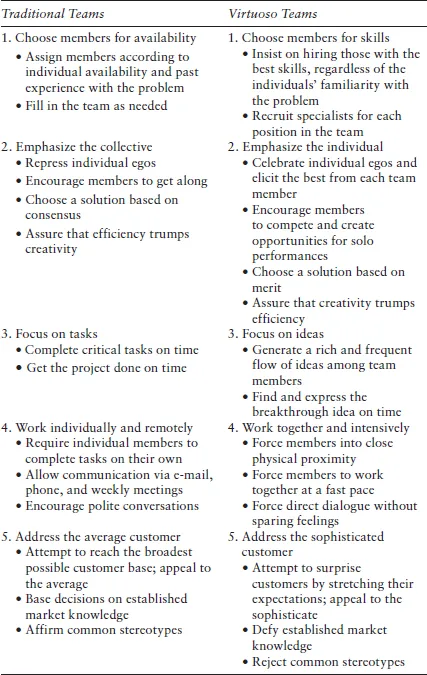
Table 1.2 Types of Organization
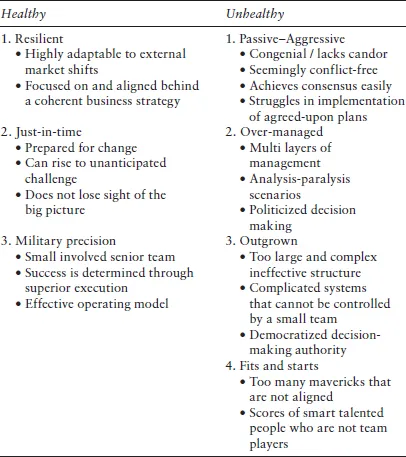
Regardless of how a specific industry is trending, a company might be doing great because of its own behavior. On the other hand, if an employee’s healthy impulses to learn and share, and to achieve, are not encouraged, damaging adaptive conduct will gradually take over. Misunderstandings, and misrepresentation, about who has control over decisions are frequently the first signs that an organization is slipping into passive–aggressive territory.
Scanning the Periphery
As organizations build their marketing campaigns to meet customer requirements by creating an edge to their products and services, they also must remain alert through competitor analysis and to survey the different fronts on which they are competing in the market place. Therefore, scanning the periphery of their operations and the scope of their work is imperative to their future continuity and survival. The following will illustrate the significance of keeping an eye on competition.
When an order from the top management is necessary to organize for scanning the periphery, whose responsibility is it to question the authority of such a mandate? As part of the organization, an effort is made to assign accountability to an existing functional group, such as corporate development, competitor intelligence, market research, or technology forecasting. However, assigning a midlevel group is not risk-free. Especially, if the assigned groups limit themselves to their usual resources, using data from domains they know rather than scanning broadly and conveying to others about what they have learned. The overseer might want to mobilize ad hoc issue groups to assure the level of data collection, and then a management committee can identify the most important questions. Separate task forces should be enforced to pursue each question. This process would establish a scenario analysis to identify key uncertainties that would be studied and monitored to create a high-level lookout. The management committee would have the responsibility of putting a team in place to scan topics, such as customer diversity and collaborative networks at the periphery. This team should rise above all functional and product blinders while the team leader shares his insights with the top management. They are the ones who act as lookouts for new discoveries and dangerous liaisons.
Before embarking on any new initiative, the management committee focuses its attention on the periphery (e.g., Royal Dutch-Shell Game Changer program, 1996). It charters to envision and test its hypotheses regarding new opportunities beyond the core, and then screens ideas and identifies technologies before getting to work on them. These technologies would be commercialized and new businesses created. Next, the management committee would recommend investing in start-up ventures, or pool capital to invest in start-ups. The investments might be modest, but would open a clear window of prospective emerging technology and new markets. A management committee might subcontract by employing consultants, who would be responsible for predicting the factors needed to transform a business and incorporate the insights of these “private eyes” into strategic decision making.
“Extraordinary insights often come from uncommon perspectives”
—Harvard Business Review, November 2005.
Go on. Be a tiger!
2
Leadership? Who?
Humility and willpower shape the highest-level leader. According to Jim Collins, in his book Good to Great: Why Some Companies Make the Leap . . . and Others Don’t, good leadership is determined by the person who attends to the people first and strategy second. “Get the right people on the bus, move the wrong people off,” says Collins. “Usher the right people to the right seats. Figure out where to drive the bus.”
According to Collins (2001), top-level leaders possess the following attributes: personal humility and professional will. Personal humility is a consistent demonstration of a compelling modesty, which always comes across as natural and never boastful. This type of leader always acts with a quiet, calm determination. He/she relies principally on standards, and not charisma, to influence stakeholders. These leaders focus on ambition for the goodwill of the company’s longer-term goals and growth.
On the other hand, the professional will displayed by these leaders focuses on results irrespective of challenges to emphasize longer-term gains. Always acknowledge others along the road of achievements; never apportion blame, external factors, or bad luck!
Since the essence of self-management is controlling, providing employees the opportunity to control their own jobs, self-efficacy is a critical link in making self-management work. From a leadership perspective, it refers enhancing individual and team self-efficacy. Self-management is defined here as the set of strategies a person uses to influence and convert perceived obstacles into opportunities. Ultimately, the term “super leadership” describes the process of directing others to lead themselves.
Conscious use of positive models, setting goals focused on employee self-development, encouragement from the leader, guidance for exercising self-leadership, and appropriate rewards/reprimands are key factors in developing super leadership. The new leadership paradigm emerges in finding a balance of cognitive–behavioral perspectives. Managers act to ensure a positive influence on employee behavior. In addition, a manager attempts to influence the employee’s pattern of thought (emphasis on cognition).
Leadership theory, which is based on trait, behavioral approach, the contingency model, and the shift to transactional and transformational leadership, is all about influencing others. The act of motivating and influencing others is illustrated through the following styles of leadership:
1.strong man, typifying a physical characteristic-based model;
2.behavior of a trans-actor corresponding to reinforcement and goal-setting approach in which the leader evokes performance by using variations of the carrot-and-stick model of professional management;
3.the visionary hero: here, followers are primarily dependent on the leader through inspiration and vision;
4.super leader: guides his employees to lead themselves.
In comparison, the super leader emphasizes building self-efficacy on the part of followers. Super leadership emphasizes teamwork, initiating self-managed teams, and super leadership is the applied manifestation of social cognitive theory. For example, contingent reward is an important part of super leadership, especially when reinforcing self-leadership to their followers; and, goal setting—based on strong self-efficacy—is perhaps the single most important ingredient for followers to learn from super leadership.
The pragmatic prioritization of how to succeed in influencing others can best be determined by a leader who can establish a vision and overall direction by entertaining long-term decision making in regard to the domain in which the organization competes. Goals would be consistent with the overall direction—written, specific, challenging, and yet realistic and measurable. Employees are reinforced for good performance, and their managers—when necessary—are authorized to employ the use of constructive contingent reprimands. In addition, they need to be able to manage and facilitate change as the field evolves with newer and better technology. The challenge for the management rests on their ability to enhance their employees’ sense of self-efficacy, create positive mental attitudes, and teach them how to accept mistakes as learning opportunities rather than failures.
Our position in creating an environment of super leadership is based on mastering and modeling self-leadership as a set of skills for effectively influencing our own behavior and thinking. This is the key component to achieving the level of high performance for which we aspire. The most dramatic results of super leadership are realized through the transition of followers to self-leadership.
Yoshio Ishizaka, presid...
Table of contents
- Cover
- Title
- 1 Survival: Simple, Curious, and Interested
- 2 Leadership? Who?
- 3 It Is the How?
- 4 What and Where?
- 5 Facts and Faith?
- 6 Discipline and Goal Setting
- 7 Growth: Sustainable, Repeatable, Fast, and Well Trained
- 8 Innovation versus Invention
- 9 Freestyle and Movement
- 10 Momentum and Continuity
- 11 Conclusions and Future Recommendations
- Glossary
- References
- Index
Trusted by 375,005 students
Access to over 1.5 million titles for a fair monthly price.
Study more efficiently using our study tools.
Frequently asked questions
Yes, you can cancel anytime from the Subscription tab in your account settings on the Perlego website. Your subscription will stay active until the end of your current billing period. Learn how to cancel your subscription
No, books cannot be downloaded as external files, such as PDFs, for use outside of Perlego. However, you can download books within the Perlego app for offline reading on mobile or tablet. Learn how to download books offline
Perlego offers two plans: Essential and Complete
- Essential is ideal for learners and professionals who enjoy exploring a wide range of subjects. Access the Essential Library with 800,000+ trusted titles and best-sellers across business, personal growth, and the humanities. Includes unlimited reading time and Standard Read Aloud voice.
- Complete: Perfect for advanced learners and researchers needing full, unrestricted access. Unlock 1.5M+ books across hundreds of subjects, including academic and specialized titles. The Complete Plan also includes advanced features like Premium Read Aloud and Research Assistant.
We are an online textbook subscription service, where you can get access to an entire online library for less than the price of a single book per month. With over 1.5 million books across 990+ topics, we’ve got you covered! Learn about our mission
Look out for the read-aloud symbol on your next book to see if you can listen to it. The read-aloud tool reads text aloud for you, highlighting the text as it is being read. You can pause it, speed it up and slow it down. Learn more about Read Aloud
Yes! You can use the Perlego app on both iOS and Android devices to read anytime, anywhere — even offline. Perfect for commutes or when you’re on the go.
Please note we cannot support devices running on iOS 13 and Android 7 or earlier. Learn more about using the app
Please note we cannot support devices running on iOS 13 and Android 7 or earlier. Learn more about using the app
Yes, you can access Survival to Growth by S. Hout in PDF and/or ePUB format, as well as other popular books in Business & Business Ethics. We have over 1.5 million books available in our catalogue for you to explore.