- English
- ePUB (mobile friendly)
- Available on iOS & Android
eBook - ePub
About this book
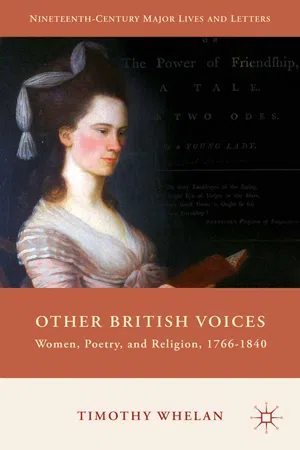
This volume discusses the lives and writings of five nonconformist women who comprised the heart of a vibrant literary circle in England between 1760 and 1840. Whelan shows these women's keen awareness and often radical viewpoints on contemporary issues connected to politics, religion, gender, and the Romantic sensibility.
Information
C h a p t e r 1

A Nonconformist Women’s Literary Tradition
The Women Writers of the Steele Circle, 1720–1840
Other British Voices presents the lives and writings of four women who comprised the heart of the second generation of what is now known as the Steele circle. This circle of nonconformist (primarily Baptist) women writers originated in the West Country of England in the early 1700s and eventually stretched to Bristol, Southampton, London, and Leicester. The first generation was led by the diarist Anne Cator Steele (1689–1760), wife of William Steele III (1685–1769), Baptist minister at Broughton, Hampshire; she was joined by her talented stepdaughter and poet, Anne Steele (1717–78), who published Poems on Subjects Chiefly Devotional in 1760 under the nom de plume “Theodosia,” and another daughter, Mary Steele Wakeford (1724–72), also a gifted poet. The central figure in the second generation was Mary Steele (later Dunscombe) (1753–1813), Anne Cator Steele’s granddaughter and Anne Steele’s niece, author of Danebury: or The Power of Friendship, A Tale. With Two Odes, which appeared anonymously in 1779. The younger Steele’s reputation as a poet, though eclipsed by (and later confused with) that of Anne Steele, was sufficient to sustain her own coterie of literary friends, including Mary Scott (later Taylor) (1751–93) of Milborne Port; Somerset, author of the poems The Female Advocate (1774) and Messiah: A Poem (1788); Jane Attwater (later Blatch) (1753–1843) and her sister, Marianna Attwater (later Head) (1742?–1832), of Bodenham, near Salisbury—the former a prolific diarist and the latter a clever poet; and Elizabeth Coltman (1761–1838) of Leicester, Mary Steele’s closest literary friend after the death of Mary Scott and who was herself a poet, periodical writer, and author of moral and political tracts between 1799 and 1820. The third generation centered upon the poet Maria Grace Andrews Saffery (1772–1858) and her sister Anne (1774–1865). They moved to Salisbury from London in the early 1790s and, through their marriages, became friends and relations of the Steele and Attwater families. Maria Grace, the second wife of John Saffery (1763–1825), Particular Baptist minister at Salisbury, published Cheyt Sing (1790), a narrative poem composed when she was 15; The Noble Enthusiast (1792), a Minerva Press novel; and Poems on Sacred Subjects (1834).1
Most of the writings of the Steele circle have remained in manuscript, preserved by their descendants for more than two centuries. Among these manuscripts are their “signature poems,” to use Paula Backscheider’s term, “acts of self-definition” that reveal, through a variety of prose forms, both formal and informal, their “strong individual voices” as women writers (16). Women’s manuscripts of the eighteenth century have occasionally been “(re)discovered in attics, library cupboards, or behind wallpaper” (Grundy 185), a statement that rings true for the Steele circle, since much of the Reeves, Saffery, Whitaker, and Attwater Collections now residing at Oxford were found in an attic (Reeves, Sheep Bell 36–41, 92). Informal writings, like those of the Steele circle,
teach us something of how it felt to live as a woman in a culture (so different from our own, yet sharing so much with it) in which the inferiority and subordination of women was utterly taken for granted. They can teach us something important, too, about the impulse to literature—the sources of poems, stories, and so on—something of how to read the work of those who broke into literature from the outside, who in taking up the pen were claiming a privilege which in general was denied to them. (Grundy 185)
Such writings—whether published anonymously, under a nom de plume, or left as a manuscript—became the primary artifacts of a religious and literary culture that, despite its constraints, promoted a competence and independence in its women writers that belies “inferiority” or “subordination.” As nonconformist women, their “impulse to literature” does not seem to have emerged from their desire to claim “a privilege which in general was denied to them.” On the contrary, their writings were valorized within their culture as if they were a popular literary gazette; only in this instance, these women served as the gazette’s subjects as well as its editors and archivists. The primary audience was the circle itself, but men are frequent participants and eager readers. Other British Voices presents four women writers who, though representatives of a narrow segment of eighteenth-century society, speak forcefully from a perspective of faith and culture to the universal issues of women’s lives.
The women of the Steele circle, because of their allegiance to certain theological and ecclesiastical doctrines, lived outside the established Church of England.2 As nonconformists, their religious culture was marked by distinctive church policies, educational practices, business enterprises, and attitudes toward literature, the arts, and social and political reform. Dissenting congregations, established by church “covenants,” existed as “gathered communities” united by their adherence to scripture over church traditions, an individual faith rather than a historic creed.3 Among Independent and Particular Baptist congregations, Calvinism remained the primary doctrinal position for much of the eighteenth century, doctrines previously codified in the Westminster Confession and Catechism (1647–48) and the London Baptist Confession (1689).4 The women of the Steele circle emerged primarily from these two denominations, both agreeing in doctrine but differing in the sacrament of baptism. Independents were paedobaptists (baptizing infants), whereas Particular Baptists were immersionists, practicing what became known as “believers’ baptism,” which generally occurred after the individual, whether male or female, had reached adolescence or adulthood. More important than age, however, was the spiritual maturity of the applicant, for in order to become a member of either denomination, an applicant had to give a satisfactory “account” of his or her conversion experience and profession of faith. Anne Steele gave hers before the Baptist congregation at Broughton when she was 15 and Jane Attwater at Salisbury in her early twenties. Mary Steele, however, delayed hers until she was 42, though she attended faithfully at Broughton her entire life.5
Manuscript poetry and various forms of life writing central to the Steele circle have long been marginalized by historians of British nonconformity who have privileged church records and pastoral biographies over informal sources pertaining to the laity, especially women. The result has been a history largely told by “men and about men” (Smith, “Beyond Public” 87). By incorporating a variety of sources popular with eighteenth-century women, such as diaries, autobiographies, letters, poetry (especially hymns), and even novels, religious historians can finally “move beyond public and private spheres,” as Karen Smith proposes, and integrate women’s accomplishments and influence within denominational history (87).6 Other British Voices utilizes an array of manuscript and print sources to recreate the literary and cultural life of a group of devoted nonconformist women who, as conscious literary artists, valued the act of recording their lives on paper, even when the audience consisted only of close friends and family or, in some cases, no one at all, merely the privacy of their own closet. As teenagers, Mary Steele, Mary Scott, Elizabeth Coltman, and Maria Grace Saffery had already imbibed from their families the belief that literary talents should be encouraged in women even at the expense of domestic duties. In the Steele home at Broughton, for instance, education was a requirement, along with a devotion to reading and composing poetry. The poetry of Milton, Pope, and Watts was to these women as close to divine expression as was humanly possible; it was genteel, decorous, and the most elegant form of subjective expression and sensibility.7 James Fordyce argued that properly domesticated and educated women could still use their imaginations, especially in composing poetry, “where a strict regard is paid to decorum” and “where Nature, Virtue, [and] Religion, are painted and embellished with all the beauty of a chaste yet elevated imagination.” “What a field is here opened,” he declares, “within the reach and adapted to the turn of female faculties!” (1: 278). The women of the Steele circle would have welcomed Fordyce’s praise of poetry and “female faculties,” though it is unlikely they would have agreed with all his strictures on women.8 As Mary Scott writes in the dedicatory epistle to The Female Advocate, “It is a duty absolutely incumbent on every woman whom nature hath blest with talents of what kind soever they may be, to improve them; and that that is much oftener the case than it is usually supposed to be” (NWW 4: 30).9
Improving their literary “talents,” however, did not always enhance their marriageability. Coltman never married; Steele, Scott, and Attwater all postponed marriage—Steele marrying at 43, the other two at 37. Apparently none of the women had suitors during their teenage years, but by the mid-1770s each would be sought by an ardent lover, only to postpone marriage for many years—Scott until 1788, Attwater 1790, and Steele 1797. What did improve their literary ability and, more importantly, their sociability were the intense friendships they formed in their youth, all emanating from within tightly woven familial, social, and literary communities. Paula Backscheider and Catherine Ingrassia assert that it is impossible to understand eighteenth-century “women’s social interaction, literary bonds, and, ultimately, poetic production” without a knowledge of how female friendship “profoundly shaped their conception of a personal and poetic self” (303). Aside from providing rare access to the “private” world of eighteenth-century women, friendship poems nurtured “independence, identity formation, and imaginative self-realization” at the same time that they served as “a site from which to resist society’s increasing gendering pressures” (Backscheider xxiv). Female friendship dominates the poetry and correspondence of Mary Steele, Mary Scott, Jane Attwater, and Elizabeth Coltman between 1766 and 1814. Steele’s Danebury and Scott’s The Female Advocate both developed from conversations between the two teenage friends in the mid-1760s. By 1768 Steele had composed her poem about a friendship between two young women in which one sacrifices her life for the other, only to be miraculously restored to life, and Scott had by that time conducted much of her research for her poem, a historical account of intellectual and artistic achievements by 50 women. The friendship poems that passed between Steele and Scott and the other members of the Steele circle reflect the personal exposure, mutual nurturing, and, to a degree, societal resistance indicative of this genre of women’s poetry in the last half of the eighteenth century, though, for all four women in this study, their resistance to domesticity would give way by their late thirties to more typically gendered roles within their nonconformist communities.
The Beginnings of a Tradition of Nonconformist Women Writers
The women of the Steele circle were keenly aware of their place within a tradition of West Country nonconformist women poets that began with Elizabeth Singer Rowe of Frome (Reeves 19–25).10 Rowe (1674–1737), who published as “Philomela,” was the daughter of an Independent minister from Ilchester (and later Frome), Somerset; at 36 she married Thomas Rowe (1687–1715), an Independent minister and educator from London and 13 years her junior. Inspired by a coterie of friends and correspondents (including several aristocrats, prominent writers, and nonconformist ministers such as Isaac Watts), Rowe’s writings reveal an extensive literary knowledge and devotion to piety that tied her to her nonconformist roots.11 Shortly before her death, however, another nonconformist woman writer emerged. Anne Dutton (1691/92–1765) was not from the West Country (she was born in Northampton), but she was, like Rowe, a prolific writer, first among the Independents and later, after her second marriage to Benjamin Dutton, among the Baptists at Great Gransden, Huntingdonshire. A modern edition of her complete writings runs to six volumes (Watson, Selected Spiritual Writings), placing her, with Rowe, among the most published nonconformist women writers of the seventeenth and eighteenth centuries. Most of her writings are in prose and often, like Rowe, in the form of letters, but in 1734 she published A Narration of the Wonders of Grace in Verse (a High Calvinist version of Mary Scott’s Unitarian poem, Messiah), which also included “A Poem on the Special Work of the Spirit in the Hearts of the Elect” and a collection of 61 hymns. The first hymn, “The Mystery of the Trinity reveal’d in Christ,” with its stilted phrasings and awkward syntax, bears little relation to the hymns of Anne Steele, Mary Scott, or Maria Saffery, though thematically and doctrinally Dutton continues a Calvinist, Trinitarian line that runs from Anne Bradstreet through the Steele circle (except for Scott’s later poems).12 Dutton also wrote a defense of her right as a Baptist woman to publish her thoughts on certain matters of Calvinist doctrine and church practice,13 many tenets of which were echoed by Jane Attwater in several of her prose pieces c. 1774–90 (NWW 8: 117–38) as well as by the London Baptist poet and polemicist Maria de Fleury (1752/53–92) in An Answer to the Daughter’s Defence of her Father, Addressed to her Father Himself (1788).14
The practice of nonconformist women writing from within a Calvinist tradition, whether Baptist or Congregational, did not originate with Rowe in the West Country of England during the early decades of the eighteenth century; it is part of a legacy that began in the mid-seventeenth century with three women—Anna Trapnel (fl. 1630–54), Katherine Sutton (1630–63), and Anne Bradstreet (1612–72). The first two were English Baptists, the latter a Puritan Congregationalist born in England but whose writings originated from America. Trapnel was a Fifth Monarchist whose The Cry of a Stone appeared in London in 1654, a collection of prayers and “spiritual songs” that, though coming from the pen of a visionary prophetess, nevertheless served as a prototype of the hymnody that such Baptist figures as Hanserd Knollys (d. 1691) and Benjamin Keach (1640–1704) would soon champion as suitable for public worship.15 At some point in the 1650s, Sutton became a member of Knollys’s congregation (probably during his time in Lincolnshire) and immigrated with him and other members of his congregation to Rotterdam in 1660. Knollys returned to England in 1664, but not before assisting Sutton in publishing A Christian Woman’s Experiences of the Glorious Working of God’s Free Grace, Published for the Edification of Others, a spiritual autobiography interspersed with a small collection of hymns, what she describes as extemporaneous, spirit-led effusions, a term Mary Steele, Jane Attwater, and Elizabeth Coltman will also employ a century later. Knollys wrote the Introduction to Sutton’s work, noting that her words had been the “effectual means of the conversion of many” (Ar), a public avowal of her self-professed gifts of singing, prayer, and prophesy. Trapnel and Sutton, along with Bradstreet’s American contemporary Anne Hutc...
Table of contents
- Cover
- Title
- Introduction
- 1 A Nonconformist Women’s Literary Tradition
- 2 Mary Steele (1753–1813) and the Call to Poetry
- 3 Mary Steele as West Country Woman-Poet
- 4 Mary Scott (1751–93)
- 5 Jane Attwater (1753–1843)
- 6 Elizabeth Coltman (1761–1838)
- Notes
- Bibliography
- Index
Trusted by 375,005 students
Access to over 1.5 million titles for a fair monthly price.
Study more efficiently using our study tools.
Frequently asked questions
Yes, you can cancel anytime from the Subscription tab in your account settings on the Perlego website. Your subscription will stay active until the end of your current billing period. Learn how to cancel your subscription
No, books cannot be downloaded as external files, such as PDFs, for use outside of Perlego. However, you can download books within the Perlego app for offline reading on mobile or tablet. Learn how to download books offline
Perlego offers two plans: Essential and Complete
- Essential is ideal for learners and professionals who enjoy exploring a wide range of subjects. Access the Essential Library with 800,000+ trusted titles and best-sellers across business, personal growth, and the humanities. Includes unlimited reading time and Standard Read Aloud voice.
- Complete: Perfect for advanced learners and researchers needing full, unrestricted access. Unlock 1.5M+ books across hundreds of subjects, including academic and specialized titles. The Complete Plan also includes advanced features like Premium Read Aloud and Research Assistant.
We are an online textbook subscription service, where you can get access to an entire online library for less than the price of a single book per month. With over 1.5 million books across 990+ topics, we’ve got you covered! Learn about our mission
Look out for the read-aloud symbol on your next book to see if you can listen to it. The read-aloud tool reads text aloud for you, highlighting the text as it is being read. You can pause it, speed it up and slow it down. Learn more about Read Aloud
Yes! You can use the Perlego app on both iOS and Android devices to read anytime, anywhere — even offline. Perfect for commutes or when you’re on the go.
Please note we cannot support devices running on iOS 13 and Android 7 or earlier. Learn more about using the app
Please note we cannot support devices running on iOS 13 and Android 7 or earlier. Learn more about using the app
Yes, you can access Other British Voices by T. Whelan in PDF and/or ePUB format, as well as other popular books in Literature & European Literary Criticism. We have over 1.5 million books available in our catalogue for you to explore.