- English
- ePUB (mobile friendly)
- Available on iOS & Android
eBook - ePub
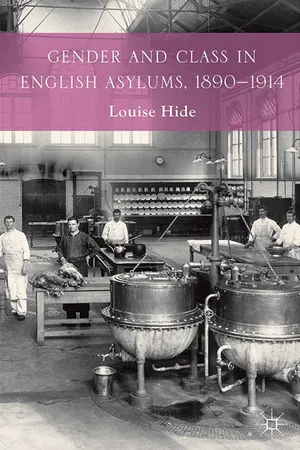
Gender and Class in English Asylums, 1890-1914
About this book
An unprecedented number of people were sent to 'lunatic asylums' in the nineteenth century. But what was life like inside? How was order maintained? And why were so many doctors on the verge of a breakdown themselves? This book provides a glimpse into the lives of patients and staff inside two London asylums at the turn of the twentieth century.
Information
1
The Making of the Patient Population
On 5 April 1877, The Times reported an episode from the Dorset Quarter Sessions. Addressing the problem of overcrowding in the local asylum, a former magistrate was reported to have commented that ‘if the [sic] lunacy continued to increase as at present the insane would be in the majority, and, freeing themselves, would put the sane in asylums’.1 He was expressing the underlying sense of alarm concerning the rise in lunacy that had become a national preoccupation. The situation did not improve. By 1909, while the country’s population had approximately doubled in 50 years, the number of people who were institutionalised for being of unsound mind had quadrupled over the same period.2 Many feared that madness was becoming endemic within a society that was spinning out of control and, even worse, that they themselves might be detained in an asylum against their will.
In the 1890s, the Commissioners in Lunacy set out to discover whether or not a ‘true increase of that disease’ had occurred, or if the rise could be attributed to other causes. Drawing on the opinions of 62 superintendents of county and borough asylums in England and Wales, they published their findings in the Special Report of the Commissioners in Lunacy to the Lord Chancellor on the Alleged Increase of Insanity.3 In their final analysis, they concluded that the growth in the asylum population was not so much due to an actual increase in the incidence of insanity, but in the redistribution and accumulation of mentally disordered people. This, they argued, could be attributed to a number of causes. The first was ‘greater accuracy of registration’ brought about by admitting to asylums many of the insane poor who were previously treated in their own homes or in other institutions, such as workhouses.4 Also contributing to the increase were, the Commissioners believed, ‘extended views as to what constitutes insanity requiring confinement’, a factor Scull interpreted as ‘an expansion of the boundaries of the mad’ by the medical profession, which bred a growing social intolerance of deviant or eccentric behaviour.5 The Commissioners also referred to the social changes brought about by growing populations in large towns, where space was at a premium and family members were required to go out to work or to school, making it more difficult to look after relatives suffering from ‘less severe forms of insanity’ at home, resulting in the need for institutionalisation. Furthermore, asylums were admitting an increasing preponderance of ‘old, and broken down cases’ and people with ‘temporary attacks of alcoholic insanity’, while the numbers being discharged were diminishing. The opening of new asylums, providing new institutionalised spaces to which the insane could be ‘redistributed’ and in which they ‘accumulated’ was, therefore, a major factor in the growth of lunacy.6
Broadly speaking, historians agree with these reasons. However, some more radical critics like Scull have contended that motives underpinned by social control and medical imperialism were paramount, whereas others such as Porter and Melling have suggested that a far more diverse and nuanced group of needs and interests were at play. In some respects, Scull was right when he claimed that doctors bore a significant share of the responsibility for the rise in lunacy by medicalising a growing number of human conditions and behaviours.7 But David Wright is one historian, among several, who has challenged Scull, pointing out that medical professionals were not allowed free rein to commit people to asylums as and when they saw fit. Committal procedures were instead monitored and controlled by a number of agencies especially Poor Law authorities, who were ever mindful of the cost of asylum care, as well as patients’ families, who would decide whether or not to send one of their own to an institution or, indeed, to apply for their discharge.8 ‘Ironically,’ Wright wrote, ‘over the course of the nineteenth century, power over certification devolved away from the so-called experts in the asylums to non-resident medical practitioners and the lay public’.9 His monograph on the Earlswood Asylum shows how the asylum was only one of several support options for ‘idiot’ children during the nineteenth century, with the family remaining the ‘primary locus of care’.10
Although the growth of lunacy in proportion to the general population was not as out of control as had been feared, lunacy numbers did grow at an alarming rate due mainly to the certification of people who were believed to suffer from chronic and incurable conditions. Because asylums were highly stigmatised and invariably a place of last resort, many did not arrive until their disorder had reached an advanced stage – much to the frustration of alienists who were concerned about the impact of poor recovery rates on the reputation of their sub-discipline. The 1890 Lunacy Act did not help matters by tightening up admission procedures and thus preventing patients from entering the asylum on a more informal basis without certification.11 Another major contributor to growing lunacy rates was poverty, particularly among females who, as explained below, were more likely to seek Poor Law relief. Those who were believed to present symptoms of insanity might first be sent to a workhouse where parsimonious Poor Law authorities preferred to keep them because it was cheaper than the asylum. It was only when these individuals became too troublesome, violent or hopeless to stay in the workhouse that they might be transferred to a mental institution.
The perceived rise in lunacy, the expansion of the asylum network and the increasingly pervasive reach of the ‘mental sciences’ as a medical discipline were inseparable during the nineteenth century. There appears to have been two distinct phases of asylum development during this period: during the first half of the century, new epistemological discourses began to feed into the understanding and treatment of insanity, which broadened the asylum system and brought about the establishment of early psychiatry. The second stage took place during the latter decades of the century when lunacy numbers grew rapidly and the massive Victorian asylums were built to house those deemed mentally disordered.12
The rise in lunacy: 1800–70
Before the establishment of the nineteenth-century asylum system, lunatics tended to be incarcerated on the basis of their physical manageability.13 Depending on their behaviour and circumstances, those who were not looked after by friends or family might be locked up in jails or bridewells. Others were sent to private madhouses, some of which were well run, while others offered their inmates very little in the form of treatment yet provided their proprietors with a lucrative source of income. Small charitable hospitals offering treatment as well as ‘care’ began to open during the second half of the eighteenth century. These included Bethlem (founded in 1247) and St Luke’s in London, as well as institutions in Manchester, Liverpool, Leicester, Exeter and York.14 Driving the establishment of publicly funded asylums from the 1830s was the growing involvement of the state in individual affairs, together with the bureaucratisation of social agencies and their institutions. A number of important acts were passed that set into motion the treatment of insanity. In 1808, the County Asylums Act sanctioned the use of public funds for building asylums. But it was twenty years later with the introduction of the 1828 Madhouse Act that a powerful symbiotic relationship between the state and medicine began to be forged. Medical attention for all patients became mandatory and institutions containing more than 100 patients were compelled to employ a resident medical superintendent.15 It was at this point that women began to be excluded from the treatment of insanity because they were forbidden from studying medicine,16 even though some had formerly been proprietors of madhouses, which they may have inherited on the death of a father or husband. Apart from nursing duties, women had little authority concerning the actual treatment of mental disorder and were pushed to the margins of care.17 The Act also brought about the establishment of a commission that was initially set up to regulate lunatic asylums in the metropolitan area.18 This was extended in 1845 by the Lunatics Act which decreed that members of a reformed body, the Lunacy Commission, should regularly inspect all institutions that looked after lunatics in England and Wales and report their findings to the Lord Chancellor.19 In that same year, the Asylums Act required every county and borough to build its own asylum for the treatment and care of pauper lunatics.20 In comparison to the vast institutions of the late nineteenth century, these earlier establishments were relatively small: in 1850 there were 7,140 patients living in 24 county and city asylums, each containing an average of 297 patients.21 This was also the era when alienists began to move away from attempting to control lunatics through the use of mechanical restraints and adopted more humanitarian methods that came under the umbrella term of ‘moral treatment’, which, they believed, could restore a patient to sanity through corrective training. This approach, discussed in more detail in Chapter 4, had some success. But it required close relationships to be formed between the staff and patients, and became increasingly difficult to apply to burgeoning asylum populations. As a result, the earlier aspirations to provide ‘care and treatment’ were replaced by an approach that was based on the ‘management’ of large numbers of mentally distressed individuals.
The shifting landscape: 1870–1914
Social and economic change
In 1860, 15,845 patients, twice the number recorded just a decade earlier, were distributed across 41 publicly funded county and city asylums, each of which contained an average of 386 patients. By 1910, 97,580 patients were housed in 91 asylums across England and Wales, each with, on average, over 1,000 patients.22 It was, therefore, the latter decades of the nineteenth century that saw the erection of vast sprawling asylums across the country. This took place against a backdrop of widespread socio-economic change, threatening traditional class and gender structures, as well as giving rise to new medical ideologies – all of which played a significant role in the lives of those who were either committed to asylums or who worked in them.
Economic migration, usually from rural to urban or industrialised areas, had a far-reaching effect on the country’s mental health and asylum populations. The second half of the nineteenth century saw a massive population movement sweep across the country, and by the mid-1880s, almost half of London’s inhabitants ...
Table of contents
- Cover
- Title
- Introduction
- 1 The Making of the Patient Population
- 2 Medical Officers
- 3 Attendants and Nurses
- 4 The Asylum Regime
- 5 From Asylum to Mental Hospital
- 6 Ward Life
- Conclusion
- Notes
- Sources and Select Bibliography
- Index
Trusted by 375,005 students
Access to over 1.5 million titles for a fair monthly price.
Study more efficiently using our study tools.
Frequently asked questions
Yes, you can cancel anytime from the Subscription tab in your account settings on the Perlego website. Your subscription will stay active until the end of your current billing period. Learn how to cancel your subscription
No, books cannot be downloaded as external files, such as PDFs, for use outside of Perlego. However, you can download books within the Perlego app for offline reading on mobile or tablet. Learn how to download books offline
Perlego offers two plans: Essential and Complete
- Essential is ideal for learners and professionals who enjoy exploring a wide range of subjects. Access the Essential Library with 800,000+ trusted titles and best-sellers across business, personal growth, and the humanities. Includes unlimited reading time and Standard Read Aloud voice.
- Complete: Perfect for advanced learners and researchers needing full, unrestricted access. Unlock 1.5M+ books across hundreds of subjects, including academic and specialized titles. The Complete Plan also includes advanced features like Premium Read Aloud and Research Assistant.
We are an online textbook subscription service, where you can get access to an entire online library for less than the price of a single book per month. With over 1.5 million books across 990+ topics, we’ve got you covered! Learn about our mission
Look out for the read-aloud symbol on your next book to see if you can listen to it. The read-aloud tool reads text aloud for you, highlighting the text as it is being read. You can pause it, speed it up and slow it down. Learn more about Read Aloud
Yes! You can use the Perlego app on both iOS and Android devices to read anytime, anywhere — even offline. Perfect for commutes or when you’re on the go.
Please note we cannot support devices running on iOS 13 and Android 7 or earlier. Learn more about using the app
Please note we cannot support devices running on iOS 13 and Android 7 or earlier. Learn more about using the app
Yes, you can access Gender and Class in English Asylums, 1890-1914 by L. Hide in PDF and/or ePUB format, as well as other popular books in History & Social History. We have over 1.5 million books available in our catalogue for you to explore.