- English
- ePUB (mobile friendly)
- Available on iOS & Android
eBook - ePub
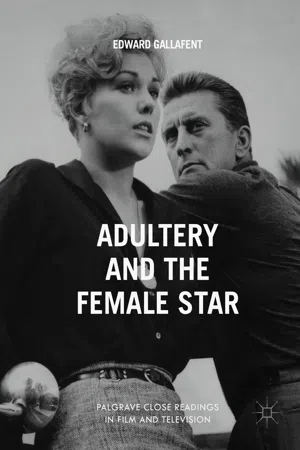
Adultery and the Female Star
About this book
This book provides an in-depth study of Bette Davis, Joan Fontaine, Kim Novak and Meryl Streep, and the treatment of adultery in their films. It avoids the near-impossible challenge of writing about the sheer volume of adultery in film by focusing on specific periods in the work of these four major Hollywood actresses who have each performed roles that share some features but also contain points of difference. The periods discussed cover Davis's work in 1937 to 1943, Fontaine's work between 1939 and 1950, Novak in 1954 to 1964, and finally Streep's work between 1979 and 1985. Closely analysing both established classics and lesser known films, Edward Gallafent explores the work of a broad range of directors including Alfred Hitchcock, Max Ophüls, Sydney Pollack and Billy Wilder. Adultery and the Female Star explores topics such as motherhood, the significance of place, censorship, and adaptation, and is the first book of its kind to take on the topic of adultery in relation to these four actresses. It ultimately argues that our understanding of the adultery narrative is tightly bound up with our understanding of the Hollywood stars that depict it.
Information
© The Author(s) 2018
Edward GallafentAdultery and the Female StarPalgrave Close Readings in Film and Televisionhttps://doi.org/10.1057/978-1-137-35224-8_11. Introduction
Edward Gallafent1
(1)
Department of Film and Television Studies, University of Warwick, Coventry, UK
The treatment of adultery in Hollywood film in the middle years of the last century is the subject of this book. I am looking at a period that begins with Bette Davis’s role in That Certain Woman, released in the autumn of 1937 and ends with Meryl Streep’s role in Out of Africa, which premiered around forty-eight years later, a few days before Christmas 1985. And my approach is to explore specific passages in the work of the Hollywood stars that are the focus of my next four chapters: Bette Davis, Joan Fontaine, Kim Novak, and Meryl Streep.
Why these stars in particular? While adultery figures more centrally in some of these star careers than in others and in some of their films more than in others, in each case the best known and most admired work invokes it; Davis as the mistress and mother in Now, Voyager, Fontaine as the adulterous wife in Letter from an Unknown Woman, Novak pretending to be an adulterous wife in Vertigo, Streep’s relation to the role of mistress in both the past and the present in the two worlds of The French Lieutenant’s Woman. These films are not exceptions; in each case they are part of a group of dense and successfully achieved films where thinking about marriage and adultery is both appropriate and productive, and where exploring it in one film helps us to read the others. My argument is that adultery is a kind of narrative where our understanding of the role cannot be detached from an exploration of the persona of the star in question. All four of these stars play the role of mistress, but they bring to it very different qualities, as different as the expectations that we bring to their performances.
There is also a simple and practical reason. Looking at these compelling films permits a coherent selection from a huge amount of material. Anyone familiar with Hollywood production will be aware of the number of films, from the well-known to the most obscure, which involve, invoke, or turn on matters of adultery. The subject is spread through (I suspect) every identifiable genre and mode, and it persists from the earliest filmmaking to the present. To attempt to give a narrative history of it would be more or less a slanted recapitulation of the history of Hollywood cinema. To survey it, even with relative thoroughness, would amount to a list that would be useful and unhelpful in the ways that lists must be.
Taking as the object of study something that need not initially be thought of in connection with adultery, namely a specific period in a star’s career, we can explore how adultery appears there, when it is more and when less present, and in what ways, and when it is absent. The approach also generates a range of films in each case, from melodrama to comedy, from the hit to the flop, from the acknowledged masterpiece to the forgotten or ignored, and the mass of films which are not quite any of these. And of course the choice of films is determined by the complex amalgam of forces that operated in the stars’ careers.
This will—I hope—be seen as offering a different view of some films which have been the subject of extensive discussion in other terms. For example my route to Vertigo is not via Hitchcock, or James Stewart, but by way of the films Kim Novak had already made, and those she was to go on to make. Part of the thinking behind this is to attempt to return us to something a little bit closer to the position of the films’ original audiences. I mean those who did not know that they were seeing a masterpiece when they sat down to watch Vertigo, but were happy to bring their expectations of Novak (and Stewart, and Hitchcock) to the entertainment.
One feature of this approach is that the studies that comprise the body of this book move directly from films that have become canonical texts in academic film studies to the less well known. This movement is not random, but dictated by the order of production in the filmography in question. With a couple of exceptions, ones when it seemed sensible to vary it slightly to look at two related films together, I have followed the careers chronologically.
My approach also involves not attempting to mount comprehensive discussions of the literature surrounding the canonical films, and I am mostly leaving aside scholarship which is not directly relevant to the topic of adultery. To do otherwise would I think fatally imbalance the studies, and return the book to being weighted towards a few famous titles. This may be regarded as a grievous sin, but I hope that readers will look for insights in what follows rather than concentrating on its limitations.
The mixture of the well-known and the obscure also has implications in terms of my reliance on the reader’s knowledge. Where it is appropriate I have tried to outline the narratives of the films, but in a number of more well-known cases I have assumed knowledge of plot, character and incident. In each of these I have made the position clear in the opening of the discussion in question.
Background
Films addressing adultery draw on a huge and formidable historical body of material in western thought and culture, vast in terms both of timespan and different types of work. 1 To list just a few contexts: the Old and New Testaments, and works springing from these sources such as the various artworks of ‘Christ and the Woman Taken in Adultery’, 2 or the work of John Milton. Then there is Greek myth, opera, song and other music, Arthurian and other romances, classical theatre and particularly some works of Shakespearean drama. Approaching the modern period there is the nineteenth and early twentieth century novel and the theatre of the same period. The list of those forms of major artwork which have not at some point invoked the subject of adultery might be a rather shorter one. And this leads to the discussions of adultery prompted by the primary texts, the work of thinkers such as Denis de Rougemont and René Girard. 3 Then there are other major writers whose thought bridges the divide between adultery in art and its presence in human society; Freud and those who have followed his work, and the contributions of anthropologists and philosophers.
The most comprehensive and illuminating introduction to the subject that I am aware of is the long introductory chapter of a seminal book on the subject, Tony Tanner’s Adultery and the Novel. 4 Tanner touches on a number of the contexts listed above, and he makes the argument that it is the nineteenth century novel that has marriage and adultery, not just as a topic, but as its central subject:
Marriage, to put it at its simplest for the moment, is a means by which society attempts to bring into harmonious alignment patterns of passion and patterns of property… The bourgeois novelist has no choice but to engage the subject of marriage in one way or another, at no matter what extreme of celebration or contestation.
Tanner concludes that adultery is ‘the main, if the undescribed, topic for the bourgeois novel’. 5 By the bourgeois novel he means roughly the novel after Daniel Defoe and before D. H. Lawrence, the period which gave rise to the group of European novels which we think of as some of the canonical texts of adultery: Madame Bovary, Anna Karenina, Cousin Bazilio, Effi Briest. 6 It is outside the scope of this book to discuss this further, but I shall be drawing particularly on Tanner’s work at intervals in what follows.
How Do We Define Adultery?
Like other configurations in our understanding of sexual lives, this feels like a question with a deceptively easy answer which immediately appears in need of complication. It is possible to attempt to categorise variants of the plot of adultery—to map adultery—by looking at who is committing an act or thinking of one. We might start by saying that what is called for are two relations, that between a man and a woman who are married to each other, and that between one of these two and a third party, who might be married, or single. 7 We should not lose sight of this, as it is certainly the core which defines the canonical examples that come to mind. But as Tanner has pointed out, the linguistic root of this group of words (adultery, adulterate, adulterator, adulterer, adulteress) carries an implication of admixture, of the mixing up of elements that are different to each other. 8 So at the heart of the matter is something about confusion of qualities (and individuals and roles) that ought to be, or have been, separate. This is not unique, as can be seen from a parallel example: Richard Dyer’s discussion of the term Pasticcio, in his very helpful summary of different types of mixture in art and culture. 9 If we accept that adultery emerges from this feeling of mixing up, it is perhaps the more reasonable that we should not expect our encounters with it to fall into a set of neatly bounded categories.
Let us return for the moment to the central cast of adultery, a married couple and a lover. By a lover I mean someone who expresses love outside the social arrangements we make for it, but not someone who necessarily expresses that love by undertaking any particular physical act. We will certainly recognise adultery in narratives that tell of, or show us, a sexual encounter taking place between a lover and a figure who is the husband or wife of another. But there are many narratives in which either nothing that could be called a physical adulterous act takes place, or the act itself has only a marginal status, referred to but not foregrounded. Such storylines nonetheless depend on our knowledge of adultery and its meaning, and would be reduced to nonsense if we tried to understand them without reference to it. 10 The adulterous act may turn out to be less important for us or for the players in the drama than other elements such as the thought of adultery, or the consequences of it. This leads to a distinction, or rather a polarity: from adultery texts in which adultery is physically and repeatedly enacted, to the opposite end of the scale, those in which it is impossible to imagine it taking place. 11
Critical Approaches
This distinction is reflected in the critical writing on adultery, particularly on the eighteenth and nineteenth century novel, where most of the scholarship is concentrated. The position taken by Bill Overton in his The Novel of Female Adultery is to define adultery using the criterion that voluntary sexual intercourse has to take place between the adulterous partners. Justifying this, Overton states that the primary focus of his study is ‘adultery as a social, an ideological, and a legal fact’, and elsewhere he dismisses texts which show us ‘relationships which are not in fact adulterous’. 12 A contrasting position is that adopted by Tanner, in which adulterous desire is a sufficient criterion, and indeed the literature of rejected, postponed or unconsummated adultery is as significant, or possibly in some respects more significant, as the work in which physical acts of adultery do take place. 13
My position in what follows is to observe when adultery is a fact, but to understand it also as a fantasy, involving memory, imagination and desire. In some cases I will be looking at films which acknowledge the concept of adultery and the adulterous, its presence in the minds both of those involved (even when the word adultery itself is never used) and in the viewer. So what we are exploring are worlds in which adultery matters, ones in which it has an immediate purchase on the lives in the film, whatever acts do or do not occur.
Adultery and Absence
Adultery can have to do with absences as much as what is present. An exemplary literary case is ‘The Adulterous Woman’, a short story by Albert Camus. It is told from the point of view of Janine, the...
Table of contents
- Cover
- Front Matter
- 1. Introduction
- 2. Bette Davis: 1937 to 1943—Motherhood
- 3. Joan Fontaine: 1939 to 1950—Devotion
- 4. Kim Novak: 1954 to 1964—The Stranger
- 5. Meryl Streep: 1979 to 1985—The Present and the Past
- 6. Conclusion
- Back Matter
Trusted by 375,005 students
Access to over 1.5 million titles for a fair monthly price.
Study more efficiently using our study tools.
Frequently asked questions
Yes, you can cancel anytime from the Subscription tab in your account settings on the Perlego website. Your subscription will stay active until the end of your current billing period. Learn how to cancel your subscription
No, books cannot be downloaded as external files, such as PDFs, for use outside of Perlego. However, you can download books within the Perlego app for offline reading on mobile or tablet. Learn how to download books offline
Perlego offers two plans: Essential and Complete
- Essential is ideal for learners and professionals who enjoy exploring a wide range of subjects. Access the Essential Library with 800,000+ trusted titles and best-sellers across business, personal growth, and the humanities. Includes unlimited reading time and Standard Read Aloud voice.
- Complete: Perfect for advanced learners and researchers needing full, unrestricted access. Unlock 1.5M+ books across hundreds of subjects, including academic and specialized titles. The Complete Plan also includes advanced features like Premium Read Aloud and Research Assistant.
We are an online textbook subscription service, where you can get access to an entire online library for less than the price of a single book per month. With over 1.5 million books across 990+ topics, we’ve got you covered! Learn about our mission
Look out for the read-aloud symbol on your next book to see if you can listen to it. The read-aloud tool reads text aloud for you, highlighting the text as it is being read. You can pause it, speed it up and slow it down. Learn more about Read Aloud
Yes! You can use the Perlego app on both iOS and Android devices to read anytime, anywhere — even offline. Perfect for commutes or when you’re on the go.
Please note we cannot support devices running on iOS 13 and Android 7 or earlier. Learn more about using the app
Please note we cannot support devices running on iOS 13 and Android 7 or earlier. Learn more about using the app
Yes, you can access Adultery and the Female Star by Edward Gallafent in PDF and/or ePUB format, as well as other popular books in Social Sciences & Film & Video. We have over 1.5 million books available in our catalogue for you to explore.