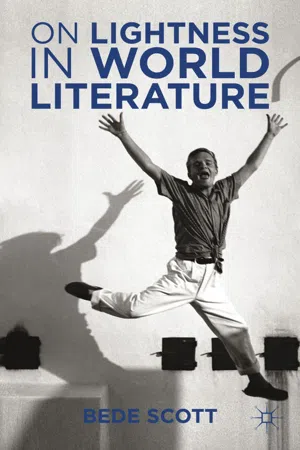
Despite the apparent ubiquity of light literature, and despite the greater cultural prestige it has been afforded in recent decades, very little has been written on the adjective that actually defines this category. What, precisely, does it signify, and what are some of the key strategies by which the effect of lightness is achieved within literary discourse? In this original and engaging study, Bede Scott explores the aesthetic quality of lightness as demonstrated by a diverse range of narratives – spanning four different centuries and five different countries. In each case, he focuses on a specific 'type' of lightness, whether it be the refined triviality of Sei Shonagon's Pillow Book, the ludic tendencies of Joaquim Maria Machado de Assis' Posthumous Memoirs of Brás Cubas, or the 'exhilarating and primitive vitality' of Voltaire's Candide. By bringing together such disparate sources, Scott makes a strong case for the universality of this particular aesthetic value, while also subjecting its underlying structural features to close critical scrutiny.
- English
- ePUB (mobile friendly)
- Available on iOS & Android
eBook - ePub
On Lightness in World Literature
About this book
Information
Chapter 1
Superficiality
Truman Capote’s Breakfast at Tiffany’s
I
In September 1916, an interview with a visiting Chinese scholar by the name of Hain Jou-Kia appeared in the New York Times. Before coming to the United States, the newspaper’s readers were told, Hain had spent several years studying “social conditions” in Japan. As his interests were “chiefly literary,” however, he had also “made a careful study of Japanese literature, and [had] arrived at some interesting conclusions on the subject.” These conclusions were as follows:
Japanese literature differs from Chinese literature chiefly in that it is not concerned, as Chinese literature is, with morals and philosophy. Japanese literature is light. One thousand years ago there were published in Japan two famous books, Genji-Monogatari and Ise-Monogatari. These are the origins of Japanese literature as we know it today. They are very famous. They deal merely with the times of their authors, with the surface of things, manners, customs, gossip. They do not deal with the great basic things of life, with morals and philosophy. These books are studied in the Japanese schools and universities, and their influence is responsible for the lightness of modern Japanese literature . . . You see the same thing in Japanese paintings. The thing which interests the Japanese painter, however skillful he may be, is the thing that he sees—the superficial and momentary thing . . . Japanese poetry, especially the Japanese songs, is [also] very light—so light that it is sometimes almost impossible to discover its meaning. (qtd. in Kilmer)
Four decades later, writing in the same newspaper, William Goyen would criticize Truman Capote’s Breakfast at Tiffany’s (1958) for demonstrating these very qualities. It, too, focused on “over-glaze[d]” surfaces, refusing to engage with more serious (or “weighty”) themes; and in place of morality and meaning, it, too, offered insubstantial fripperies—the kind of thing that might have appealed to the “Colony set” or the “El Morocco crowd.” Goyen was also particularly critical of the novel’s playful tone and “vaudevillian” tendencies, objecting to the “doll-like glee” with which it was written and accusing its author of “creating and dwelling in a doily story-world entirely of [his] own tatting” (Goyen). Although Capote would later describe this review as an act of treachery (Too Brief 445), in many ways Goyen was quite right. The novel does feature a large cast of implausible caricatures—Salvatore “Sally” Tomato, for instance, the elderly Sicilian gangster, or Rutherfurd “Rusty” Trawler, the Nazi-sympathizing millionaire playboy—and in numerous places the narrative itself challenges our credulity. As I shall argue, however, these qualities need not be regarded as literary-aesthetic failings. On the contrary, they are all strategies that contribute, in one way or another, to the success of the novel’s underlying aesthetic project, bringing it as close as possible to a state of complete superficiality.
The correspondences between the aforementioned critiques, despite the intervening decades, are striking. In fact, what we see emerging in each case is essentially the same conflict of literary values. On the one hand, we have the belief that literature ought to be composed of a certain density, engage with “the great basic things of life,” and use “substantial” language in order to produce tangible meaning. On the other hand, we have an aesthetic typically associated with light literature—an aesthetic founded on the principles of superficiality, insubstantiality, and the attenuation of meaning. As suggested in the introduction, this disagreement has a long and distinguished genealogy. Throughout the centuries, to cite Italo Calvino once more, “two opposite tendencies have competed in literature.” One tries to give language “the weight, density, and concreteness of things, bodies, and sensations,” while the other tries to make it into “a weightless element that hovers above things like a cloud or better, perhaps, the finest dust or, better still, a field of magnetic impulses” (Six Memos 15). My point here, essentially, is that we should understand the lightness of Breakfast at Tiffany’s not as an aesthetic failing, nor as mere “cuteness” or “whimsy” (Goyen), but as the articulation of a particular aesthetic sensibility—one that deliberately privileges style over substance, the “superficial and momentary thing” over the dead weight of profundity and permanence.
Although Capote himself rarely discussed such matters, a short essay written three years before the publication of Breakfast at Tiffany’s does give us some idea of his aesthetic affinities. In this essay, he celebrates the “Japanese sense of style,” reserving particular praise for the “luminous” purity of classical Japanese literature and the ornate gestural vocabulary of Kabuki theater: “[W]hen the curtain rises on a performance of the Kabuki dancers, a premonition of the entertainment, the frisson it will ultimately achieve, is already there in the severely rich patterns of color, [the] exotically solemn postures of the dancers kneeling in their robes like porcelain figurines . . . It is all a ceremony of Style, a phenomenon that seems to rotate, in a manner quite separate from emotional content, on absolute style alone” (“Style” 355–56). This is as good a description as any of the lightness that so often characterizes Capote’s own writing and as such is probably the best place to begin our discussion of Breakfast at Tiffany’s. But precisely what kind of lightness do we find in the novel, what are some of its defining characteristics, and what are the key strategies by which this effect is produced? In the following pages, I shall argue that the lightness of Breakfast at Tiffany’s is primarily achieved through a comprehensive diminution of its symbolic and hermeneutic codes. With regard to the first of these codes, I will be discussing the narrative’s readability, its deliberate attenuation of supplementary meaning, and its linguistic transparence. This transparence, I would like to suggest, ultimately impedes our standard interpretative procedures, frustrating any attempt to reinstate (plausible) symbolic meaning. Turning to the hermeneutic code, I shall then address in greater detail the “depthlessness” of the discourse, its emphasis on surfaces and immediate legibility. Ordinarily the hermeneutic code is responsible for creating a series of “obstacles, stoppages, [and] deviations” (Barthes, S/Z 75) whose purpose it is to defer narrative closure. In Breakfast at Tiffany’s, however, Capote does everything he can to minimize these hindrances, thus ensuring that the narrative’s “true” meaning can be located without difficulty or delay. Finally, I shall offer an analysis of Holly Golightly herself, making the argument that as a character she shares (and indeed determines) many of the novel’s lighter qualities: attaching supreme value to “the surface of things,” privileging the signifier over the signified, and actively pursuing the freedom and mobility of nonmeaning. As will become obvious, I have found the work of Roland Barthes especially useful in exploring some of these issues, and over the course of the chapter, I shall be referring to S/Z and Empire of Signs (both published in 1970) with particular frequency. The former study frames my structural analysis of the novel’s semiotic codes, while the latter, through its engagement with Japanese culture, provides a clearer understanding of the transparence and superficiality that are such salient features of Capote’s narrative.
II
I would like to begin by discussing the diminution of the symbolic code in Breakfast at Tiffany’s and the sense of lightness this retreat from meaning generates.1 Rather than pursuing nonmeaning through an assault on language and narrative, however, Capote manages to achieve this objective within the confines of a “perfectly readerly discourse” (Barthes, Empire 81). Indeed, it is the novel’s very readability, the dominance of its primary or literal meaning (what Holly calls “the story part” [24]), that enables it to shed its potential supplementary meanings with such ease.2 And any attempt to restore these discarded meanings, I shall argue, would be to exceed the level of interpretation that the novel itself clearly encourages. On this level—that of the purely denotative—Breakfast at Tiffany’s tells a simple story. After moving into a new apartment in Manhattan’s East Seventies, the unnamed narrator, an aspiring writer, becomes acquainted with one of his neighbors, a young socialite known as Holly Golightly. Over the next year or so, he passes “many hither and yonning days” (54) with Holly, bears witness to her various romantic misadventures, and does his best to unravel the mystery of her true identity. Finally, having been unjustly implicated in a drug scandal, she flees to Rio de Janeiro, and that, we are led to believe, is the last the narrator will ever see of her. In due course, a postcard arrives, and several years later there is an unconfirmed sighting of Holly in a remote African village, but otherwise “she’s gone . . . [j]ust gone” (15).
It is one of the central ironies of Breakfast at Tiffany’s that the narrator’s struggle to “read” Holly Golightly should itself be so eminently readable. None of the hermeneutical difficulties he encounters are transmitted to the reader, and nothing is allowed to disrupt the effortless eloquence (and clarity) of the sentences he produces. Throughout the novel, the narrator attempts to gain a better understanding of Holly by studying the various accretions of language that have built up around her. He begins with the name card she has left outside her apartment (“Miss Holiday Golightly, Travelling” [30]), before turning to other written sources: notes, newspaper articles, telegrams, and letters. By “observing the trash-basket outside her door,” he discovers that Holly’s regular reading consists of “tabloids and travel folders and astrological charts,” that she smokes “an esoteric cigarette called Picayunes,” and that her “varicoloured hair [is] somewhat self-induced.” He also learns that she receives a vast quantity of army-issue V-letters, which are subsequently torn into thin strips and discarded. “I used occasionally to pluck myself [one] in passing,” he says of these strips. “Remember and miss you and rain and please write and goddamn were the words that recurred most often . . . those, and lonesome and love” (20). Here, suddenly, the discourse appears to be in danger of losing its characteristic transparence; yet this momentary rupture of meaning is carefully contained by the narrator, and at no point does it come close to disturbing the novel’s overall semantic clarity. Having registered this temporary hermeneutical impasse, he immediately moves to reassert the dominance of the legible: “Also, she had a cat and she played the guitar” (20). The threat of syntactical disjuncture thus passes, and the narrative’s readability, its serene fluency, is once again reaffirmed. Susan Sontag has argued that transparence of this kind is the “highest, most liberating value in art,” for it “means experiencing the luminousness of the thing in itself, of things being what they are” (“Against” 13). And this, I would like to suggest, is exactly what the transparence of Breakfast at Tiffany’s achieves. It assures the reader that there is no deeper supplementary meaning to be found “behind” its language or discourse. What we see is what we get—and what we get takes place right there, on the narrative’s elegantly filigreed surface.
Before discussing this transparence in greater detail, though, I should probably take a moment to clarify my description of Breakfast at Tiffany’s as “meaningless.” I am not proposing, of course, that Capote’s narrative achieves a complete suspension of meaning. That would be impossible, for as Barthes quite rightly observes, “there is no literature without a sign, and no sign without a signified” (“Last Word” 200). In other words, “everything in [a narrative] signifies . . . Even were a detail to appear irretrievably insignificant, resistant to all functionality, it would nonetheless end up with precisely the meaning of absurdity or uselessness” (Barthes, “Introduction” 261). What I am suggesting, however, is that Breakfast at Tiffany’s works toward an attenuation of meaning, a “thinning out” of the symbolic code, so that the narrative might be relieved of as much supplementary weight as possible. It is this drive to limit the production of connotative meaning that serves to distinguish the “nonmeaning” of Capote’s novel from that of other, more “weighty” narratives. In Albert Camus’s The Stranger, for instance, the absence of meaning carries a quite profound meaning: it signifies absurdity. Every opacity the novel produces, every cryptic gesture it delineates, is filled with an ontological significance that we as readers are encouraged to recognize and somehow arrange into a philosophy.3 The distinction to be made here, then, is twofold. First, the absence of meaning in Breakfast at Tiffany’s has no meaning; it tells us nothing about the “gentle indifference” (Camus 122) of the universe or the absurd and arbitrary nature of our lives. And second, this absence of meaning never becomes a source of ontological anxiety for the reader—or, indeed, for the characters who have been made to occupy this “empty” universe. Instead, it promotes a sense of weightlessness and autonomy: the “buoyancy of a bird” (Capote, Breakfast 52), one might say, or the blissful inconsequentiality of a girl “spin-dancing . . . over the cobbles under the El” (20). In this respect, it perhaps comes closer to the kind of meaninglessness we find in the work of Alain Robbe-Grillet, who writes that “[t]he man of today . . . feels no sense of deprivation or affliction at [the] absence of meaning” (“Nature” 71). Like Capote, Robbe-Grillet discourages the “induction of poetic meaning” (Barthes, “Last Word” 198) by focusing our attention on surfaces, on outsides rather than insides, and like Capote he forgoes “transcendent” signification for the “immediate signification of things” (Robbe-Grillet, “From Realism” 166). But here, too, there are some crucial differences. There is an objective, analytical quality to Robbe-Grillet’s writing that we don’t find in Capote. Robbe-Grillet’s emphasis on the materiality of the physical world also gives his writing a density that distinguishes it from the refined ethereality of Capote’s prose style. And whereas Robbe-Grillet attempts to suspend meaning by “break[ing] the fascination of narrative” (Barthes, “Last Word” 198), by disrupting its intelligibility, Capote does precisely the opposite—despite the underlying similarity of his objectives.
So just what kind of meaninglessness are we talking about here? For Capote, as we have seen, intelligibility is everything—an intelligibility so complete that it purges the narrative of all traces of the esoteric or the obscure. In S/Z, Barthes argues that “the classic text is pensive”: even as it concludes, “it still seems to be keeping in reserve some ultimate meaning, one it does not express but whose place it keeps free and signifying.” According to Barthes, if a story such as Balzac’s “Sarrasine” has “nothing more to say than what it says, at least it attempts to ‘let it be understood’ that it does not say everything.” This allusion to meaning, he suggests, is “coded by pensiveness, which is a sign of nothing but itself: as though having filled the text but obsessively fearing that it is not incontestably filled, the discourse insist[s] on supplementing it with an et cetera of plenitudes” (S/Z 216–17). Not so Breakfast at Tiffany’s. In Capote’s novel, there is no implied supplementary meaning, no “et cetera of plenitudes,” in fact no latency of any kind. There is only one meaning, the most obvious, and it offers itself up to the reader with alacrity. Unlike “Sarrasine,” Breakfast at Tiffany’s does not let us know that it has not said everything; instead it lets us know, quite clearly, that there is nothing more to say. Its dominant narratorial tone, in other words, is not one of pensiveness but one of candor and volubility.4 For Barthes, the final line of Balzac’s story (“And the Marquise remained pensive” [qtd. in Barthes, S/Z 254]) functions as a sign of its plenitude, gesturing toward these hidden reserves of meaning, and one could argue that at a certain point in Breakfast at Tiffany’s, Holly assumes a similarly emblematic status. In this case, however, she becomes a sign of the narrative’s guilelessness—a sign whose purpose, here at least, is to reassure the reader that there are no hidden reserves of meaning. “The morning light seemed refracted through her,” the narrator remembers. “[A]s she pulled the bed covers up to my chin she gleamed like a transparent child: then she lay down beside me” (29).
It is this commitment to legibility that ultimately brings about the diminution of the novel’s symbolic code, for if there is never anything behind or surrounding the thing described, if it produces neither latent nor “transcendent” meaning, then the potential for symbolic substitution is reduced to a minimum. And whatever symbolism does survive this reduction of meaning itself becomes severely attenuated in the process. Take Holly’s cat, for instance, the one she refuses to name “until he belongs to somebody.” “We just sort of took up by the river one day,” she says. “[W]e don’t belong to each other: he’s an independent and so am I. I don’t want to own anything until I know I’ve found the place where me and things belong together” (40). The equivalence here between Holly and her cat is so direct, so obvious, indeed so literal, that it loses all symbolic resonance. “[H]e’s an independent and so am I”—what more is there to say? Consider, too, the birdcage Holly gives the narrator as a gift: “a palace of a birdcage, a mosque of minarets and bamboo rooms yearning to be filled with talkative parrots” (19). Holly, we are told, doesn’t like cages, and when she offers this one to the narrator, she makes him promise that he will “never put a living thing in it” (57). Again the symbolism is unambiguous: the cage’s function here is to represent the captivity, the immobility, to which Holly is so averse. But symbolism of this kind is hardly symbolism at all; in fact, symbolism thus proclaimed barely rises above the level of metaphor. And this depletion of symbolic meaning in turn serves to complicate any sustained critical engagement with Breakfast at Tiffany’s, all but foreclosing the possibility of commentary or close reading. For how is one supposed to decipher a narrative that so readily decodes itself, offering no resistance whatsoever to our understanding? If the pensive qualities of a story like “Sarrasine” appear to invite critical analysis, then the candor of Breakfast at Tiffany’s does just the opposite: encouraging a literal (or semantic) interpretation, while actively repelling the attention of the critical reader.5
In “Against Interpretation,” an essay first published in 1966, Susan Sontag argues that “a great deal of [modern] art may be understood as motivated by a flight from interpretation”—by a desire to proclaim its own nonmeaning. One way of achieving this objective, she says, is to produce “works of art whose surface is so unified and clean, whose momentum is so rapid, whose address is so direct that the work can be . . . just what it is.” She offers as one of several examples the “liberating anti-symbolic quality” of old Hollywood movies, adding that “[i]n good films, there is always a directness that entirely frees us from the itch to interpret” (11). In Empire of Signs, Barthes makes a similar argument with regard to the traditional Japanese ha...
Table of contents
- Title Page
- Copyright Page
- Dedication
- Contents
- Acknowledgments
- Introduction
- Chapter 1: Truman Capote’s Breakfast at Tiffany’s
- Chapter 2: Joaquim Maria Machado de Assis’s Posthumous Memoirs of Brás Cubas
- Chapter 3: Voltaire’s Candide
- Chapter 4: P. G. Wodehouse’s The Code of the Woosters
- Chapter 5: Sei Shonagon’s Pillow Book
- Notes
- Works Cited
Trusted by 375,005 students
Access to over 1.5 million titles for a fair monthly price.
Study more efficiently using our study tools.
Frequently asked questions
Yes, you can cancel anytime from the Subscription tab in your account settings on the Perlego website. Your subscription will stay active until the end of your current billing period. Learn how to cancel your subscription
No, books cannot be downloaded as external files, such as PDFs, for use outside of Perlego. However, you can download books within the Perlego app for offline reading on mobile or tablet. Learn how to download books offline
Perlego offers two plans: Essential and Complete
- Essential is ideal for learners and professionals who enjoy exploring a wide range of subjects. Access the Essential Library with 800,000+ trusted titles and best-sellers across business, personal growth, and the humanities. Includes unlimited reading time and Standard Read Aloud voice.
- Complete: Perfect for advanced learners and researchers needing full, unrestricted access. Unlock 1.5M+ books across hundreds of subjects, including academic and specialized titles. The Complete Plan also includes advanced features like Premium Read Aloud and Research Assistant.
We are an online textbook subscription service, where you can get access to an entire online library for less than the price of a single book per month. With over 1.5 million books across 990+ topics, we’ve got you covered! Learn about our mission
Look out for the read-aloud symbol on your next book to see if you can listen to it. The read-aloud tool reads text aloud for you, highlighting the text as it is being read. You can pause it, speed it up and slow it down. Learn more about Read Aloud
Yes! You can use the Perlego app on both iOS and Android devices to read anytime, anywhere — even offline. Perfect for commutes or when you’re on the go.
Please note we cannot support devices running on iOS 13 and Android 7 or earlier. Learn more about using the app
Please note we cannot support devices running on iOS 13 and Android 7 or earlier. Learn more about using the app
Yes, you can access On Lightness in World Literature by B. Scott in PDF and/or ePUB format, as well as other popular books in Literature & Literature General. We have over 1.5 million books available in our catalogue for you to explore.