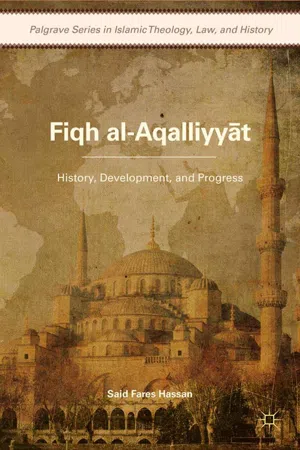
This book examines the development of a contemporary internal debate among Muslim minorities living in Western Europe and North America to establish a specific form of Islamic jurisprudence. Fiqh al-aqalliyyat attempts to strike a balance between Muslim's religious commitments and their civic identity as citizens in Western liberal states.
- English
- ePUB (mobile friendly)
- Available on iOS & Android
eBook - ePub
About this book
Information
Chapter 1
Between Text and Context
The Impact of Textual Literalism and Puritan Ideology on the Life of Muslim Minorities
In the last three decades of the twentieth century, Western Europe and North America witnessed an influx of unprecedented numbers of Muslim immigrants. These Muslim immigrants put down roots by building community institutions such as Islamic centers, schools, and businesses. As they struggled to get established in the new land, they looked for moral, social, and financial support from their ethnic/religious communities and from philanthropic Islamic societies. Furthermore, many Muslim countries and organizations sought to establish contacts and relationships with Muslim immigrants. These contacts were established on various grounds: ideological, religious, social, and political. In fact, there was a rivalry among certain Muslim countries and institutions over who would win the hearts and minds of these immigrants. Cesari argues that the 1980s witnessed an outbreak of an authority war among the Saudis, the Iranians, and the Pakistanis over the domination of the Muslim world in general and the Muslim minorities in particular.1 They massively funded mosques, schools, and Islamic organizations. The objective of this interest in the conditions of Muslim minorities was not only to maintain the immigrants’ loyalty to and affiliation with the home country in order to defend its political and economic interests, but also to improve the status of the country in question as a representative of the Muslim world. Given this dynamic interaction between Muslim immigrants and their home countries, religion factors in as a key player. In their search for venues to preserve their cultural identity, tradition, and religion in their lives, Muslim immigrants sought fatwas and guidance from religious authorities, mainly those living in the country of origin or those affiliated with the heartland institutions of Islam, such as al-Azhar, Egypt, or the Holy Mosque of Mecca, Saudi Arabia. This fatwa-search or guidance-quest comprises more than a search for simple answers to mundane questions. It involves ideological and political interests on both sides, that of the fatwa-seeker and that of the mufti. The seeker tries to prove the legality of his condition, to find justification for his practices, to strengthen his connection to his home country, and to show his concerns of the Muslim community. The mufti wants to demonstrate his authority, the credibility of his school, and the supremacy of his state. This fatwa-search mechanism, when combined with the host country’s modern liberal social structure, the immigrants’ aspirations of good life, and the ummah’s expectations of Muslims defending its causes, has eventually led to positions that, over the course of time, developed into trends and discourses. As demonstrated earlier, three of these trends became influential in this process: the puritan-literalists, the traditionalists, and the renewalists. This chapter examines the position of the puritan-literalist trend, the ideology of its proponents and the extent to which it impacts Muslim minorities.
The puritan-literalist trend looks at the present-day Muslim minorities through the lens of medieval jurists and traditional manuals of fiqh, without taking into account the difference of the historical moment or the necessities of the present time. The proponents of this trend tend to belong to the traditional literalist school that emphasizes literal readings of religious legal texts over their context and the wisdom behind them.2 They continue to treat Muslim minorities today as did the early and medieval jurists who regarded residents of non-Muslim lands as subject to non-Muslim rule and laws. They presume that those Muslims will eventually reemigrate back to Muslim countries, and that, in the meantime, they must protect their religious and cultural identity by isolating themselves from their host societies.3
The literalist discourse is best represented by many of the Wahhābī 4-Saudi-affiliated institutions and muftis. The impact of this discourse cannot be ignored in shaping the lifestyle of Muslim immigrants in its formative stage from the early 1970s up to the late 1990s. Till date its impact is felt in some Muslim circles in the West. However, a point of caution here should be noted: not all Saudi imams, scholars, or institutions belong to this trend. There are a number of Saudi-based, or educated, imams and scholars whose discourse and contributions can be placed on a different point of the spectrum of the legal debate on the jurisprudence of Muslim minorities.
The focus here, however, is on the official Saudi religious institutions, and their endorsed muftis and fatwa collections. Specifically, the focus here is on the fatwas and publications of the Ministry of Islamic Affairs, Endowments, Daʿwah and Guidance, the General Presidency of Research and Iftaʾ Administrations, and the Permanent Committee for Scientific Researches and Iftaʾ.
The Saudi Impact: Traveling Money and Ideology
The Wahhābī-Saudi’s relations with Muslim minorities date as far back as the 1960s. However this relationship reached its peak between the late 1970s and the 1990s, particularly after oil revenues began to generate real wealth for the Kingdom of Saudi Arabia, through which it “could fulfill its ambitions of spreading the word of Islam to every corner of the world, of assisting Muslim countries less well endowed economically and of alleviating the suffering of Muslim minorities wherever they might live.”5 The Saudi government and individuals generously supported Muslim minorities. They donated billions of dollars to help minorities build mosques, establish Islamic schools, and organize Islamic work. They provided them with tutors and imams. They funded projects for translation and publication of religious materials to be distributed to minority communities. In 1980, for example, the Department of Islamic Affairs, then affiliated with the Ministry of Treasury, donated around 37 million Saudi riyals for various Muslim minority communities.
The Saudi government established a number of educational institutions as well, such as King Fahd Academy in London, 1985; Islamic Academy in Washington, 1984–85; King Fahd Academy in Moscow, 1992; and King Fahd Academy in Bonn, 1995. It also funded departments and chairs of Islamic studies in a number of European and North American universities such as Harvard, Oxford, Duke, Johns Hopkins, American University of Colorado, American University in Washington, Santa Barbara, School of Oriental and African Studies (SOAS), Institute of the History of Arab and Islamic Science in Frankfurt, Germany, etc. It also funded, either fully or partially, the establishment of a number of mosques and Islamic centers such as the Fresno Mosque in California; the Islamic Center in Columbia, Missouri; the Islamic Center of East Lansing, Michigan; the Islamic Center in New York; the Islamic Cultural Center in Chicago; the King Fahd Mosque in Los Angeles; the Islamic Center in Geneva, Switzerland; the Islamic Center of London; the Islamic Center of Rome; the Islamic Center of Madrid, etc. The funds given by the Saudi authorities and organizations amounted to enormous sums of money in some countries: in London, 43 million riyal, in Rome, 50 million dollars, in Munich, 350 thousand sterling, etc.6
The constitution of the Saudi Ministry of Islamic Affairs, Endowments, Daʿwah and Guidance, established in 1993, stresses the Saudis’ concern for the conditions of Muslim minorities. This concern developed into a working plan executed by the ministry’s various departments. According to recent sources and statistics, the department of Daʿwah and Guidance has 2 offices spread in various world cities. This department dispatched dāʿiyah, that is, preachers, to more than 90 countries throughout the years until 1994. In addition, the Department of Printing and Publishing translated 77 books and distributed them, for free in some cases, to Islamic schools and institutions all over the world.7
The Saudi government led initiatives to establish a number of international Islamic organizations. In 1962, it established, along with 22 other Islamic countries, the Muslim World League (MWL), whose main tasks include supporting Muslim minorities and helping to resolve their problems. The MWL has 32 offices in the Muslim world countries, in addition to six offices in Europe. Moreover, the MWL has a special department devoted to preparing Islamic educational curricula for Muslim minorities. It also awards fellowships for Muslim minority students to study in the Saudi kingdom or in other Islamic institutions. In 1994, there were 891 fellowships granted to students from 63 countries. In 1972, the World Assembly of Muslim Youth (WAMY) was established mainly through the funds of the Saudi government. WAMY helps establish mosques and other Islamic institutions. Every year it organizes youth camps in various parts of the world. In 1982, for example, they had at least 8 youth camps in Argentina, Gambia, Holland, France, Sudan, Cyprus (Turkish side), and the Philippines.8
Given such significant contributions and funds to Muslim minorities and the symbolic role of the Kingdom of Saudi Arabia as the guardian of Muslim holy places, the center to obtain Islamic knowledge and guidance gradually shifted toward Saudi-Wahhābī religious institutions and muftis. This can be confirmed through a review of the official fatwa collection of the Saudi Ministry of Islamic Affairs. The 13-volume collection contains a considerable number of fatwas relevant to Muslim minorities and their interaction with wider non-Muslim societies.
The ministry received questions coming from almost every country in the world, including Belgium,9 Bangladesh,10 and Thailand.11 They also received numerous questions from London,12 America,13 Canada,14 France,15 Germany,16 and Bengal.17 It also received questions from Australia,18 Singapore,19 Brazil,20 India,21 Russia,22 Denmark,23 Ireland,24 and Africa25 among others. The questions dealt with virtually all aspects of life: immigration, citizenship, rituals, marriage, divorce, education, food, dress, interacting with non-Muslims, interfaith dialogue, etc.
The reference to Wahhabism in relation to the Saudi influence on Muslim minorities stems from a number of reasons. First, Wahhabism or, as commonly called by the Saudi institutions themselves, Salafism, is the state religious ideology that it attempts to promote and export to other Muslim communities.26 Second, the fatwas, under study in this ch...
Table of contents
- Cover
- Title
- Introduction
- 1 Between Text and Context: The Impact of Textual Literalism and Puritan Ideology on the Life of Muslim Minorities
- 2 Voice of Tradition: Muslim Minorities and Application of Islamic Law
- 3 Yūsuf al-Qaraḍāwī: An Ideologue for Muslim Minorities
- 4 Ṭaha Jābir al-ʿAlwānī: Fiqh al-Aqalliyyāt, a Model of Islamization of Knowledge
- 5 Fiqh al-Aqalliyyāt: A Debate on World Division, Citizenship, and Loyalty
- Conclusion
- Notes
- Bibliography
- Index
Trusted by 375,005 students
Access to over 1.5 million titles for a fair monthly price.
Study more efficiently using our study tools.
Frequently asked questions
Yes, you can cancel anytime from the Subscription tab in your account settings on the Perlego website. Your subscription will stay active until the end of your current billing period. Learn how to cancel your subscription
No, books cannot be downloaded as external files, such as PDFs, for use outside of Perlego. However, you can download books within the Perlego app for offline reading on mobile or tablet. Learn how to download books offline
Perlego offers two plans: Essential and Complete
- Essential is ideal for learners and professionals who enjoy exploring a wide range of subjects. Access the Essential Library with 800,000+ trusted titles and best-sellers across business, personal growth, and the humanities. Includes unlimited reading time and Standard Read Aloud voice.
- Complete: Perfect for advanced learners and researchers needing full, unrestricted access. Unlock 1.5M+ books across hundreds of subjects, including academic and specialized titles. The Complete Plan also includes advanced features like Premium Read Aloud and Research Assistant.
We are an online textbook subscription service, where you can get access to an entire online library for less than the price of a single book per month. With over 1.5 million books across 990+ topics, we’ve got you covered! Learn about our mission
Look out for the read-aloud symbol on your next book to see if you can listen to it. The read-aloud tool reads text aloud for you, highlighting the text as it is being read. You can pause it, speed it up and slow it down. Learn more about Read Aloud
Yes! You can use the Perlego app on both iOS and Android devices to read anytime, anywhere — even offline. Perfect for commutes or when you’re on the go.
Please note we cannot support devices running on iOS 13 and Android 7 or earlier. Learn more about using the app
Please note we cannot support devices running on iOS 13 and Android 7 or earlier. Learn more about using the app
Yes, you can access Fiqh al-Aqalliyy?t by S. Hassan in PDF and/or ePUB format, as well as other popular books in Politics & International Relations & Middle Eastern History. We have over 1.5 million books available in our catalogue for you to explore.