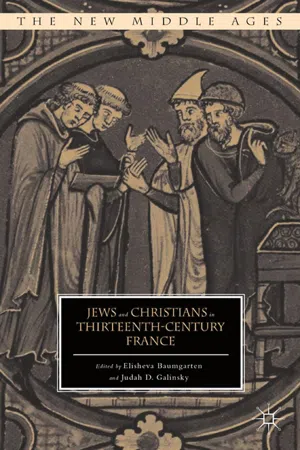
A period of great change for Europe, the thirteenth-century was a time of both animosity and intimacy for Jewish and Christian communities. In this wide-ranging collection, scholars discuss the changing paradigms in the research and history of Jews and Christians in medieval Europe, discussing law, scholarly pursuits, art, culture, and poetry.
eBook - ePub
Jews and Christians in Thirteenth-Century France
- English
- ePUB (mobile friendly)
- Available on iOS & Android
eBook - ePub
Jews and Christians in Thirteenth-Century France
About this book
Information
PART 1
LEARNING, LAW, AND SOCIETY
CHAPTER 1
CONTINUITY AND CHANGE IN THE STUDY OF THE BIBLE: THE TEN COMMANDMENTS IN CHRISTIAN EXEGESIS
Lesley Smith
Given that the Latin text of the Bible remained, broadly speaking, constant in the period covered by this volume, it must be reasonable to ask why we might expect there to be anything other than continuity in the Bible and its interpretation in the thirteenth century, why there should be change. In order to address this question, we need also to step back and consider the antecedence of “the thirteenth century” of this volume; that is, a period of development and consolidation that sets thirteenth-century France as the stage on which a new and important play will be enacted. For each of the different topics dealt with in this book, the key points at which change happens, or the spread of time over which we can see a sustained change occurring, will be different; for each, there is a different point—beyond the literal—where this conceptual thirteenth century begins. For scholars of the Bible and exegesis, it is impossible to consider the situation at the beginning of the thirteenth century without keeping in mind the innovations of what is generally described as the twelfth-century renaissance.1 Indeed, it is tempting to begin the “biblical” thirteenth century around 1110 and to run it forward till around 1340; and, although we will resist that temptation, nevertheless, we cannot ignore the twelfth-century changes altogether.
Why Expect Change?
The first part of an answer as to why we might expect change in the study of something as comparatively static as the Bible is that there was a contextual change in who was making exegesis, where they were doing it, and who they were working for, that is to say, what audience they were expecting. During the twelfth century, the cutting edge of biblical exegesis (though, obviously, not all exegetical activity) moved from a monastic setting to a world of secular schools (that is, non-monastic, but necessarily clerical classrooms). Initially, these were schools attached to cathedrals and mostly presided over by a single scholar, but, as the century drew on, the constellation of schools in Paris coalesced into something appreciably more solid than the classes offered by individual teachers; they became the proto-university of Paris. Paris, indeed, became the European center of academic work on the Bible and theology, drawing in scholars from across the continent, and the place where popes came for academic advice.2
Moving the center of biblical scholarship from monasteries to cathedral schools to a fledgling university meant more than a change of place: it signaled also a change in who was doing exegesis and for whom they were working. Crudely put, this was a movement from monks working for themselves (contemplatively?) and for fellow monastics; to clerics working for fellow clerks in (often the lowest of) holy orders, who may or may not have been intending to continue pursuing a scholarly life; and finally to university teachers who (increasingly during the thirteenth century) were mendicant friars working for fellow friars whose vocation was centered on work among the laity. Whereas monastic study could be unstructured, schools and universities required (again, increasingly over the thirteenth century) a syllabus, examinations, and qualifications that recognized achievement of a certain standard. Students had to produce work that followed set models in order to be considered qualified.
The second major reason we might expect to see change in biblical interpretation is more solidly rooted in the thirteenth century—the influence of the Fourth Lateran Council of 1215, one of the aims of which was to provide for the education of both clergy and (indirectly) the laity.3 Lateran IV and the new mendicant Orders had a symbiotic relationship because the mendicants provided the personnel for the Lateran reforms; and there was symbiosis, too, in the relationship between the Paris schools and the Lateran Council. Without the need for a more educated clergy and the encouragement of the mendicants, the proto-university at Paris might well not have thrived as it did; without the financial underpinning that the mendicants (ironically) provided, the theology faculty might not have attracted enough students to survive, since in 1219 the university had been forbidden by Honorius III from teaching the money-spinning subject of civil law.4 For the mendicants who increasingly made up the body of teachers and students at Paris, the schools were a preparation for work outside academia and, in response to this, the sorts of material that mendicant scholars produced broadened and diversified the traditional mode of biblical commentary.
Manifest Changes
Against this background—even drawn as sketchily as we have had to here—it should be clearer why, even in a subject such as the interpretation of the Bible, which might appear to be a conservative activity, reliant upon authority and tradition, we might indeed expect to encounter change. But how do we see such change manifest in the thirteenth century? We can highlight three areas in which change in the study of the Bible can be seen to have given rise to a practical effect.
The first is a change in the Bible as a physical object. Throughout its Jewish and Christian history, the Bible had seldom been copied as a single text (a “pandect”), but rather as a series of volumes (whether in codex or scroll format), each containing a group of biblical books.5 From about the middle of the twelfth century, the comprehensive biblical commentary, known as the Gloss (Latin Glossa or Glossa ordinaria), became the Bible of choice for scholars, who were much more likely to want a copy of a glossed biblical book than of a plain, uncommented text.6 Because the Gloss combined the complete scriptural text with a relatively substantial exposition, the Bible as a physical object grew and grew, so that a typical set of Glossed biblical books could run to 20 volumes. With even an unglossed text running into half a dozen or so volumes, for the peripatetic mendicants of the thirteenth century the Bible was impossibly unwieldy. They commissioned pandect, hand-sized “pocket” Bibles in large numbers. The Dominican community at St Jacques in Paris was at the forefront of thinking about the types of materials the Order needed to go about its work.7 Their need to use the Bible on the hoof, outside the classroom, the monastery, or the parish church, further impelled these mendicant scholars to create or utilize a series of aids for finding and interpreting the text, such as indexes, concordances, and a version of Jerome’s interpretation of Hebrew names that became a standard addition to most pocket Bibles. Concern with the accuracy of the text produced lists of corrections to the standard circulating version.8 Instead of—or rather, as well as—a text to be pored over slowly in preparation for contemplative meditation, this mendicant Bible became a ready-reference edition, made for quick consultation and use in the world outside the convent.9
There was also change in the form in which biblical exegesis was presented. The thirteenth century has been characterized as the century of the summa, that is to say, a work which gives comprehensive coverage of a thematically arranged subject, where explanation proceeds by questions, rather than being ordered around a single text such as a biblical book. There is much to be said for this observation, but the summa by itself is not the whole story of thirteenth-century scholarship. The base material for the compilation of theological summae is generally biblical exegesis, so the commentary form did not disappear from the scene. In addition, the twelfth century had its own summae, in the form of ordered collections of sententiae—“sentences” or opinions on debated issues. The most famous of these was Peter Lombard’s Four Books of Sentences, but there were a number of others.10 Lastly, exposition of single biblical books continued throughout the thirteenth century. The relative obscurity of thirteenth-century biblical commentary as it appears today is, at least in part, a result of the priorities of modern scholarship. Most of the material that has been edited and studied is taken from summae or individual treatises, rather than from more rambling, less immediately involving commentaries. But the commentaries are there, and commentary work done in the thirteenth-century classroom was the foundation of the new forms of treatise.
Finally, there is change in the form of an expansion of the focus of biblical exegesis. A common narrative of the arc of medieval commentary portrays interest as moving from the spiritual senses of scripture to a literal and historical interpretation of the text. To an extent, such a shift is observable, but it is not exclusive: interpretation that includes the spiritual senses never disappears. Moreover, the change takes place over a much longer period than the thirteenth century alone. It also involves an expansion of the definition of the literal sense to include some of what were once thought of as spiritual meanings. The possible reasons for such a change are multifarious, and too complex to go into here; but I would no...
Table of contents
- Cover
- Title
- Introduction: Jews and Christians in Thirteenth-Century France
- Part 1 Learning, Law, and Society
- Part 2 Polemics, Persecutions, and Mutual Perceptions
- Part 3 Cultural Expressions and Appropriations: Art, Poetry, and Literature
- Index
Trusted by 375,005 students
Access to over 1.5 million titles for a fair monthly price.
Study more efficiently using our study tools.
Frequently asked questions
Yes, you can cancel anytime from the Subscription tab in your account settings on the Perlego website. Your subscription will stay active until the end of your current billing period. Learn how to cancel your subscription
No, books cannot be downloaded as external files, such as PDFs, for use outside of Perlego. However, you can download books within the Perlego app for offline reading on mobile or tablet. Learn how to download books offline
Perlego offers two plans: Essential and Complete
- Essential is ideal for learners and professionals who enjoy exploring a wide range of subjects. Access the Essential Library with 800,000+ trusted titles and best-sellers across business, personal growth, and the humanities. Includes unlimited reading time and Standard Read Aloud voice.
- Complete: Perfect for advanced learners and researchers needing full, unrestricted access. Unlock 1.5M+ books across hundreds of subjects, including academic and specialized titles. The Complete Plan also includes advanced features like Premium Read Aloud and Research Assistant.
We are an online textbook subscription service, where you can get access to an entire online library for less than the price of a single book per month. With over 1.5 million books across 990+ topics, we’ve got you covered! Learn about our mission
Look out for the read-aloud symbol on your next book to see if you can listen to it. The read-aloud tool reads text aloud for you, highlighting the text as it is being read. You can pause it, speed it up and slow it down. Learn more about Read Aloud
Yes! You can use the Perlego app on both iOS and Android devices to read anytime, anywhere — even offline. Perfect for commutes or when you’re on the go.
Please note we cannot support devices running on iOS 13 and Android 7 or earlier. Learn more about using the app
Please note we cannot support devices running on iOS 13 and Android 7 or earlier. Learn more about using the app
Yes, you can access Jews and Christians in Thirteenth-Century France by E. Baumgarten, J. Galinsky, E. Baumgarten,J. Galinsky in PDF and/or ePUB format, as well as other popular books in Literature & Medieval & Early Modern Literary Criticism. We have over 1.5 million books available in our catalogue for you to explore.