eBook - ePub
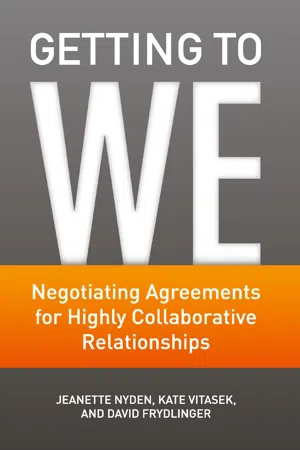
Getting to We
Negotiating Agreements for Highly Collaborative Relationships
- English
- ePUB (mobile friendly)
- Available on iOS & Android
eBook - ePub
Getting to We
Negotiating Agreements for Highly Collaborative Relationships
About this book
Drawing on best practices and real examples from companies who are achieving record results, Getting to We flips conventional negotiation on its head, shifting the perspective from a tug of war between parties to a collaborative partnership where both sides effectively pull against a business problem.
Information
CHAPTER 1
WHAT ARE YOU G-E-T-T-I-N-G TO?
For more than thirty years, businesses have been indoctrinated with the idea that the prize in negotiation is to get the deal. The deal is the focus. Hundreds of books have been written to teach negotiation, from Getting to Yes, Geting Past No, Getting More to even the virtues of Start with No. The focus of these works is transactional in nature and has readers concentrating on the strategies and tactics for negotiating the deal. Negotiation is about “this deal,” “this time,” and under “this set of business and legal terms.” Negotiators think, “Get a signature, and you are done.” It is a done deal, and the deal is the deal.
Here lies the systemic problem: Transactions are quick, short-term exchanges. The deals they create are static, but of course a business environment is not. And static deals often lose equilibrium, where the deal is no longer perceived as fair by one or both parties. Business headlines are littered with stories of good deals gone bad. Law firms bill hundreds of millions of dollars in fees each year as companies battle over what went wrong, who is to blame, and how to balance out the losses when the deal was the focus in the negotiation. At a minimum, the individuals involved have increased frustration and companies are burdened with increased transaction costs. When this happens parties find themselves back again at the negotiating table under new circumstances. What a waste of precious time and money better spent on creating innovation and growth for the parities.
What if negotiations for a business relationship were viewed through a different lens? A lens where the purpose of the negotiation is to lay down the crucial foundational elements of the relationship itself, rather than negotiate the specific scope and terms and conditions for the transaction at hand?
Think about that. The relationship as the focus of the deal. The specifics of how the parties will manage the relationship become the vade mecum (in essence the basic guidebook) for the relationship outlining how the business parties can work together successfully in a dynamic business environment of constant change, increasing risk, and uncharted opportunities.
Does that make sense? Or more appropriately: why wouldn’t it make sense?
Most organizations have at least a handful of highly strategic business relationships or partnerships that have a direct impact on a company’s bottom line; even more important, they have a direct impact on customer satisfaction and therefore on market share. And these highly strategic relationships typically involve much more than a one and done transaction. Some good examples are:
•supply chain service providers who manage the day-to-day distribution of products directly to a company’s customers
•customer service and technical support providers who act on a company’s behalf to take customer orders or answer customer complaints or solve problems
•information technology partners who provide the critical IT backbone to make a company run
•business process outsourcing firms that perform key internal functions, such as finance operations/accounting or human resources support
•facilities and real estate management service providers who are deeply embedded in the day-to-day running of the physical assets of the business
In the cases above, there can easily be hundreds or even thousands of transactions each day. The classic approach is to negotiate a rigid scope of work and price—to ensure that the deal in question is “fair.”
The problem is that business is highly dynamic and in the midst of a massive digital and social transformation. The new normal is that there is no “normal” and constant change is the status quo. A fair negotiation today is likely to not be fair tomorrow when circumstances change—and they will. Business assumptions will likely not remain static: volumes change, work mix changes, uncontrollable costs can have erratic swings impacting profitability. The switching costs to change service providers are very high, often costing companies tens to hundreds of thousands of dollars. And the costs of operational risk and nonperformance can be staggering or can even lead to a reputation risk that could cause the downfall of the company.
Getting to We is a book about negotiating. It is not, however, a typical negotiation book when compared to the hundreds of current books on this topic. Existing negotiation books focus on explaining best practices on how to get a deal or how to get a better deal. Getting to We is a book that opens the way to developing a new mindset and process for negotiating business relationships where the success of the relationship actually matters. Getting to We teaches:
•Why negotiating the very nature of the relationship is as important as negotiating the specifics of the deal.
•How to establish a common set of principles or relationship norms that drive and support collaboration.
•The rules, strategies, and tactics for negotiating highly collaborative relationships.
•How to create long-term mutually beneficial value for all parties by allocating risks and rewards in a fair and balanced manner.
•How following the common principles as the relationship strives to achieve its vision is critical for continued success.
Getting to We is the negotiation process and strategy for Vested relationships. As covered in the introduction, Vested is a mindset, methodology, business model, and movement for highly collaborative relationships that create mutual value through innovation. Vested is based on award-winning research conducted by the University of Tennessee.1
Getting to We embraces the philosophical mantra what’s-in-it-for-we (WIIFWe) and includes a simple process for creating the social norms of a Vested relationship. With both the mindset and the process, companies develop highly collaborative and sustainable business relationships. The process of Getting to We forms the architecture for a collaborative and trusting endeavor. Business giants like Procter & Gamble, Jones Lang LaSalle, McDonald’s, Microsoft, Accenture, Dell, GENCO ATC, and the joint venture Kaiser-Hill have embraced a Vested WIIFWe approach, and the long-term results are astounding. By negotiating the relationship, these companies achieved new levels of opportunity and innovation, uncontested market share, efficiency, and untethered problem solving—for them and the companies they work with. It started with a WIIFWe mindset.
As Vested is adopted by global companies and organizations, we have codified how to achieve the goal of negotiating relationships. Learning to work together not just in the present, but also planning for the future, parties build understanding, comfort, and trust. Sufficient understanding enables each to prosper, regardless of the inevitable changes ahead. In Vested, negotiators and leaders are taught that the secret to a good deal is not getting to a deal or even getting the best deal at a particular point in time, but negotiating the foundational principles of a relationship that can sustainably deliver a competitive advantage for all the parties long after the deal is signed.
Whether or not an agreement or partnership evolves from the Vested WIIFWe mindset to Vested’s business model for highly collaborative relationships, negotiating relationships to create the mindset of WIIFWe has the power to deliver a competitive advantage for the parties long after the deal is signed.
Ongoing strategic business relationships should strongly consider embracing a WIIFWe mindset and following the Getting to We process outlined in this book.
IS GETTING TO WE REALLY DIFFERENT?
The difference between negotiating a deal and a relationship starts with the goal of the negotiation and continues with the process and tactics that are used during the negotiation. Learning to negotiate the essential nature of the relationship is about getting to the mindset of long-term success for the benefit of the partnership and each partner.
Let’s first examine the classic negotiating mentality. At a recent procurement trade conference a commercial contracting employee from a Fortune 100 company was sharing his version of negotiation and contracting best practices. The company representative told the packed room, “My job is to make sure that my deals are profitable for my company and my company alone.”2 This WIIFMe mindset fuels modern negotiation strategy and tactics. In fact, it is so ingrained in today’s business culture that many organizations may even tie bonuses to how much a buying company can save or a service provider can gain in a negotiation.
What has led to this mindset? One could argue that it is the nature of capitalism itself dating back to Adam Smith’s “invisible hand” theory of economics. Smith published his theories in 1776 in The Wealth of Nations.3 The underlying assumptions, which are still prevalent today, are that when each business strives for its own interest, even at the expense of its partner’s interests, the resulting agreement must be fair. The logic is that in a free market society, companies have the choice to enter into agreements, and therefore they would not agree to something that works against their self-interest. Thus, each business’s striving for its self-interest balances the interests of the others.
While negotiation tactics and contract law have evolved over time, the basic approach has stayed pretty much the same over the years: People enter contracts at arm’s length to pursue material ends, and risks are negotiated and assigned at the time of the contract. While either party has the ability to walk away from a business deal, the party with the most power or negotiating skills usually gets the better deal.
Getting to We is different. It is not focused on getting the best deal today—or even on getting a deal at all. It is a philosophical mantra and process for creating a strong foundation where parties can fluidly adjust to business needs and risks as they arise and do so in a harmonious and productive manner. The premise is that by agreeing to the foundational nature of the relationship itself, the organizations can get to a fair and balanced deal not only for the present, but for any circumstances in the future as well. Getting to We is about negotiating the guiding principles of the relationship first and then and only then negotiating the specific aspects of the transaction(s).
CULTURAL NORMS GUIDE
One might ask, “Why should I care about the sustainability of a business relationship. It’s about the profitability of the deal, isn’t it?” That is a question that academics from all walks of life around the world ask themselves as well.
Ronald Dworkin, a professor of philosophy and law who wrote extensively about ethics, morality, equality, justice, and the unity of value, was renowned for his research into the importance of establishing social norms in relationships. Much of his work emphasizes the role social norms play in regulating society and producing fair outcomes. By connecting economic and political theory, Dworkin offered fresh insights on how to effectively develop a partnership environment.
Dworkin argued the (often unwritten and unspoken) principles partners choose have the power to change the very essence of how they work together. Specifically, the principles (or social norms) have the power to drive behaviors and thus have a cause and effect that can dictate certain outcomes. For example, if partners choose to follow principles that are fair, outcomes will also be fair. If they choose to be short-sighted and opportunistic, the nature of their relationship will be short-sighted and opportunistic.
One of the most fascinating research projects on opportunism and collaboration comes from Robert Axelrod. Axelrod, a professor of political science and public policy, wanted to understand the power of cooperation. He invited game theorists to compete in a computerized tournament to see who could devise a strategy to win in a classic game known as the Prisoner’s Dilemma.4
The game shows why two individuals might not cooperate even if it appears that it is in their best interests to do so.5 All purely rational self-interested prisoners would remain silent, but instead what often happens is that each prisoner betrays the other prisoner (“defects”) by implicating the other prisoner in the crime, resulting in stiff sentences for each of them. The irony of the Prisoner’s Dilemma game is that both prisoners actually get the best outcome if they both remain silent (“cooperate”).
To cooperate or not to cooperate? This is a simple yet profound question.
Axelrod invited game theorists to play the Prisoner’s Dilemma game over four rounds with each player having four opportunities to either cooperate or defect. His findings were seminal: The...
Table of contents
- Cover
- Title
- Introduction
- Chapter 1. What Are You G-e-t-t-i-n-g To?
- SECTION I STEP 1: ESTABLISH A FOUNDATION OF TRUST, TRANSPARENCY, AND COMPATIBILITY
- SECTION II A SHARED VISION AND COMMON GUIDING PRINCIPLES
- SECTION III STEP 4: NEGOTIATING AS WE
- SECTION IV LIVING AS WE
- Acknowledgments
- Notes
- Index
Trusted by 375,005 students
Access to over 1.5 million titles for a fair monthly price.
Study more efficiently using our study tools.
Frequently asked questions
Yes, you can cancel anytime from the Subscription tab in your account settings on the Perlego website. Your subscription will stay active until the end of your current billing period. Learn how to cancel your subscription
No, books cannot be downloaded as external files, such as PDFs, for use outside of Perlego. However, you can download books within the Perlego app for offline reading on mobile or tablet. Learn how to download books offline
Perlego offers two plans: Essential and Complete
- Essential is ideal for learners and professionals who enjoy exploring a wide range of subjects. Access the Essential Library with 800,000+ trusted titles and best-sellers across business, personal growth, and the humanities. Includes unlimited reading time and Standard Read Aloud voice.
- Complete: Perfect for advanced learners and researchers needing full, unrestricted access. Unlock 1.5M+ books across hundreds of subjects, including academic and specialized titles. The Complete Plan also includes advanced features like Premium Read Aloud and Research Assistant.
We are an online textbook subscription service, where you can get access to an entire online library for less than the price of a single book per month. With over 1.5 million books across 990+ topics, we’ve got you covered! Learn about our mission
Look out for the read-aloud symbol on your next book to see if you can listen to it. The read-aloud tool reads text aloud for you, highlighting the text as it is being read. You can pause it, speed it up and slow it down. Learn more about Read Aloud
Yes! You can use the Perlego app on both iOS and Android devices to read anytime, anywhere — even offline. Perfect for commutes or when you’re on the go.
Please note we cannot support devices running on iOS 13 and Android 7 or earlier. Learn more about using the app
Please note we cannot support devices running on iOS 13 and Android 7 or earlier. Learn more about using the app
Yes, you can access Getting to We by J. Nyden,K. Vitasek,D. Frydlinger in PDF and/or ePUB format, as well as other popular books in Business & Business Strategy. We have over 1.5 million books available in our catalogue for you to explore.