- English
- ePUB (mobile friendly)
- Available on iOS & Android
eBook - ePub
About this book
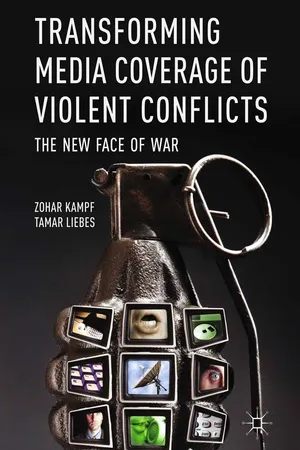
What links the interviews with Saddam Hussein and Mahmoud Ahmadinejad on British and American TV, the chase of journalists following mega-terrorists, and the new status conferred on ordinary people at war? Transforming Media Coverage of Violent Conflicts offers a timely and original discussion on the shift in war journalism in recent years.
Information
Subtopic
Film et vidéoPart I
Giving Voice to New Actors
1
Performer Journalists: The Latest Phase in the Profession
In the Introduction, we described the adventurous trip of Sky news Chief Correspondent Stuart Ramsay to the mountains of the Kunar Province in Afghanistan in 2010. Ramsay took on an exceptional, highly risky mission. Instead of joining the British troops as an embedded journalist (a risky mission in its own right) he had, in the dead of night, joined a Taliban unit on its way to lay a deadly trap for Western troops. This case, we argued, exemplifies the ever-changing role of journalists at times of war and terror. Instead of acting as observers from a distance, at present they may step into the scene of action, sometimes positioning themselves as actors, by accompanying the armed forces of the nation they represent; in other cases, however exceptional, as in that of Ramsay’s journey, they may join the armed forces of their nation’s enemy.
In this chapter we argue that with the move from print to broadcasting, the practice of war journalists changed dramatically as it adapted itself to the visual, moving, ‘live’ technology. Whereas a lot of attention is given to the effects of technology, commercialism and globalism on the quality of public discourse, not enough is given to the way in which journalistic work is conducted in this televisual environment (Montgomery, 2001). In this chapter, we take a step in this direction by mapping contemporary journalistic and quasi-journalistic practices, and characterize the ensuing new genres that thrive in their wake. The coverage of war, we argue, has become a central experimental arena for trying out new types of journalism; one that challenges the traditional role of media at war, moving journalists onto center stage.
Looking at what current journalistic practices have in common, we entitle this new mode of reporting ‘performance’, that is, stories in which the journalist performs as an active agent in the field, often positioning himself as the protagonist in the narrative. By the concept of “performance”, we refer to Erving Goffman’s initial work on dramaturgy (1956), on which he perceives everyday life as a stage in which actors perform, that is, manage their image vis-a-vis various types of audiences. Half a century later, Goffman’s terms have become part of the theoretical infrastructure in media studies, partly thanks to the ways in which Joshua Meyrowitz uses the distinction between ‘front stage’ and ‘back stage’ (1985). Here, we adopt these terms in order to account for changes over the years in the positioning of journalists vis-a-vis their human subjects, that is, the figures they cover, on various scenes of actions. In the context of journalistic practices, the meaning of ‘front stage’ and ‘back stage’ could be demonstrated by Michael Schudson’s historical account of the development of the journalistic profession (1988: 234). At the outset of the 20th century, the distinction between participants and journalists was blurred. Journalists, as expressed in the work of Lincoln Steffens, aspired to be at ‘the center of the world attention, soar beyond what others have done’. However, several decades later, in the years entitled by Schudson the ‘mature period’ of the profession, the distinction between journalist and subject was well established. Harrison Salisbury is a prominent example of this period. It seems that the contemporary performer journalist restores some of the elements of the earlier period. In what follows, we demonstrate how, instead of reporting the deeds of others, and positioning oneself at the back stage, the performer journalist ventures into the field, sometimes creating his/her own drama, and narrating it in first person. Goffman assists us also in understanding how journalists act in the field. ‘Impression management’ is useful in considering how war correspondents perform onstage as the main actors of their own stories, as well as possibly affecting the lives of their audiences.1
We demonstrate the performer mode of reporting by pointing out the inter-related subgenres of ‘performance journalism’ – embeddedness with ‘our’ troops or ‘their’ militants, and chasing after terrorists. All modes of backpack journalism (Tumber and Webster, 2006), that is, joining fighters on either side or visiting terrorists in their hideouts, consist of reporting from the field via the use of the latest communication technological affordances. Moreover, in contradiction to the accepted perception according to which embedding is patriotic and talking to the enemy is subversive, we claim that at present all subgenres are indifferent to the traditional dichotomy of patriotism versus professionalism. Our argument unfolds in four stages: We (1) point out the historical transformation of the established journalistic models following the replacement of the printed press by broadcast media as the main source of public information2; (2) characterize the new model of TV journalism; (3) demonstrate how the new practices transform the ways in which journalists cover violent conflicts; and (4) propose the reasons for their emergence and evaluate the transformation in the normative practices of the profession.
Our focus on war in characterizing what we define as the new journalistic model is twofold: First, we see the media’s representation of terrorists as an extreme example, encapsulating practical and ethical issues inherent in the journalistic vocation, particularly on broadcast media. Second, terror attacks and their aftermaths are the moments in which audiences are most vulnerable, anxious and eager to watch (Liebes, 1998). Performer journalists, and their stories, become the talk of the day, often catching headlines on other news platforms, thereby arousing public debate over the ethical ‘red lines’ for journalists in wartime.
The change in journalistic models: A telegraphic chronology
Understanding performance as a link in a chain of journalistic models, we start by examining the evolution of the profession, beginning with the classic model of objectivity. Within this frame, the journalist was positioned only as a passive spectator, a bystander in Bell’s (1998) terms, often in charge of turn-taking, acting as a facilitator of public deliberation. One central accepted methodology of the profession then was the balancing between two (sometimes more) different views present in public discourse. This position ensured the appearance of professionalism, allowing the journalist to maintain a distance from the issue at hand (Schudson, 1995).
The central genre at this stage was the news, and, from the editor’s point of view, also the op-ed pages, giving voice to a range of opinions in the public debate. The main purpose of journalism then was to facilitate deliberation over social and political issues on the public agenda of the time, in order to assess and clarify societal values. At times of war, or unrest, such an issue might be the clash between the value of the public’s right to know and the risk of causing damage to national security. Therefore, journalists in wartime had to balance between the values of professional journalism, the rhetoric of objectivity, and their loyalty to the nation and the morale of the public. The outcome was that journalism at war looked at the broader picture (illustrated from ‘our’ national perspective), pushing aside individual tragedies. According to Bell, traditional journalism ‘concerned itself more with the circumstances of war – military formations, tactics, strategies and weapon systems – than with people who provoke them, the people who fight them and people who suffer from them’ (Bell, 1998: 15–16).
The critique of objectivity as a strategy that tends to serve the government and the powerful rather than the public at large led gradually to an alternative model. This time round, journalists were freed from the position of neutrality. Abandoning the stance of uninvolved, low-profile facilitators, some chose the position of a more socially committed advocacy journalism, with an agenda of giving a voice to weak and marginal social groups. A parallel complementary model is the undertaking of investigative reporting to clean up ‘rot at the top’. The aim of this course of action was to expose government corruption in order to ensure that it conducts itself according to the rules. The motivation behind both investigative and advocacy journalism is to protect the public from the misuse of power by its governments (Molotch and Lester, 1974; Ettema and Glasser, 1998).
Investigative reporting demands the investment of far more time and resources on the part of journalists and their financing organizations, giving the product the prestige of journalism at its best. Both advocate and investigator journalists share a commitment to social justice. Instead of reporting from a press conference organized by a politician (most prestigiously, the president), investigator journalists expose ‘back stage’ information, one that the politician would rather keep under cover (Meyrowitz, 1985). The advocate journalist, by the same token, informs the public on discrimination, prejudice and social inequality. This model deviates from objectivity as journalists, involved with their subjects, take a stand in order to describe (hopefully, to amend) injustice. The hope is that they thereby contribute to public awareness of the need for a just society. In the context of war reporting, Bell (1998) suggested the term ‘Journalism of Attachment’, in order to describe the practice of journalists who take the side of the weak. According to Bell, journalism of attachment ‘cares as well as knows, is aware of its responsibilities, and will not stand neutrally between good and evil, right and wrong, the victim and oppressor’. He admits that journalists have a part to play in the world as they ‘exercise certain influence’ … that can be ‘for better or for worse’.
Whereas the move from objectivity to social involvement developed in the era in which journalism’s main home was the printed press, the gradual but unstoppable move to television had a massive impact on the profession in other directions. It did not take long for journalists to understand that the order of the day has become authenticity, live action and drama (Coupland, 2001; Scannell, 2001), all of which have contributed to creating a new model, a development of ‘journalism of attachment’, one that we entitle ‘performance journalism’.
In the new work environment, ‘liveness’ (true or false; see Bourdon, 2000), the moving image and the penetrating voice replace the printed word. It is an environment of images, not of letters; of stories, not of issues; of people, emotions and actions, not of cognitive analysis. Whereas the written word (a purely arbitrary sign) cannot be perceived by viewers as an immediate, authentic depiction of reality, the iconic nature of television inadvertently causes us believe that what we see is real, not mediated.3 Particularly troublesome is the fact that all the consecutive stages of television production – the selection of one particular story and character(s), the choice of camera angle, the excising out of materials – are erased, leaving us viewers with the illusion that we are looking at an authentic, complete picture of reality as it is. Moreover, it leaves us with no unequivocal answer to the question of where to draw the line between legitimate and illegitimate video editing (Liebes, 2000).4
This type of journalist diverges significantly from journalists of attachment, in their specific mode of emotional engagement with reality. Journalists of attachment are involved emotionally in the events they cover, and this type of engagement stems from their moral inclinations and responsibilities. In contrast, performer journalists play with emotions with the aim of creating a dramatic effect, involving audiences with the actions of the protagonists, and creating a growing suspense as to what will happen next.
Performance journalism: Media, practices and genres
Whereas our concern in this chapter is limited to performer journalists at war, we have to emphasize that the battlefield is only one context in a much broader picture. We see evidence for the new journalistic strategies in the various news, and quasi-news TV genres – docu-activism, ‘spontaneous’ studio chats among journalists, and in-depth interviewing of stars, quirky people, criminals and terrorists – that share (to various degrees) some traits with those of reality TV (see Corner, 2002; Tolson, 2006). All types of performance journalism are the product of the advance in communication technologies coupled with the growing trend of commercialism, in which various channels compete for the most unique, dramatic and immediate story. Our attempt to characterize this model indicates that it gradually conquers primetime broadcasting, pushing aside traditional news genres – including the practices of objectivity, investigative and advocacy journalism – to the margins of primetime and to niche channels (Williams and Liebes, 2003).
Typically, these on-screen televisual products position a star journalist as a front stage actor who takes part in the action, often in the role of protagonist. The new celeb-journalist may be the persona in the studio or, alternately, s/he may move out of the studio into the ‘real’ world not only to document and report on the action but, more important, to perform, that is, to take a leading role in the plot; sometimes, even to create it. S/he may assist in putting right an injustice by initiating his own plan of action or by impersonating a potential victim in order to catch crooks. Examples of this type of journalism can be found in Michael Moore’s docu-activism in which he surprises those whom he considers the most dangerous villains of our time – the owners and managers of mega-corporations – involving us viewers in the dramatic moment of exposure. Likewise, Israeli TV journalist Michael Rosenthal chases villains – ranging from big-business tycoons to local neighborhood gangsters. One program, demonstrating the latter category, shows him taking the risk of being physically attacked while chasing gangsters who have taken over the profitable business of collecting building waste, emptying their goods into private backyards. In another show, Rosenthal led a parade of elderly women, living under impossible conditions, to City Hall, as a modern version of the pied piper of Hamelin. Rosenthal is a perfect example of a performer journalist, a bona fide established professional (formally the deputy editor of Israel’s most popular broadsheet, Yediot Acahronot) who, in a fit of frustration, decided to leave the print media and move into TV in order to have an impact in the ‘field’.
These new practices of performance deviate to various degrees from the logic and aims of the previous two models, created and developed in the print press. The generic products of the performance model are situated somewhere between traditional journalistic genres, focusing on reporting and commenting on political and social realities, and the televisual and cinematic world of fiction. Rather than appeal to viewers’ cognitive judgment by dealing in a balanced manner with issues of justice and responsibility, these hybrid genres exploit the intensity of the visual iconic medium to show what is perceived as an authentic human drama, playing before our eyes in real time, with (supposedly) no mediation, no direction, no editing, and with the journalist acting as participant. Whereas traditional models position the social, moral and structural issues upfront, for the new performer journalist, the path to such an issue (if any) leads through an individual story built on action, drama, tragedy or all three combined. We, the viewers, are situated as witnesses to a human story, arousing feelings ranging from empathy to identification and anger, and sometimes disgust. Debate over issues of society and state in the press and early TV has given way to the camera that turns to individual, personal expressions of the current state of affairs, which flash in front of our eyes.
Common to the range of practices in which the journalist acts as performer is the attempt to create authenticity. It is almost superfluous to mention that the idea of authenticity on TV is paradoxical by definition (Liebes, 2001). Authenticity indicates sincere, spontaneous, unplanned behavior, leading viewers to believe that they touch a genuine person on screen. The fact that planning and authenticity are mutually exclusive, and that everything we see on screen is pre-planned and/or edited (at various levels), means that on television, authenticity has to be manufactured. And indeed, the new genres, specifically those in which the journalist leaves the studio for the field outside, make use of strategies for producing authenticity. Live reporting from the field is one way of looking for the ‘authentic’, real world, the place in which reality and action play out. Once in the field, journalists also direct people to act in what looks like a real, authentic, genuine manner. Moreover, as the protagonist of his report, the journalist himself has to ‘do authenticity’. This means that the qualities now in demand for hiring professionals are the ability to talk rather than write, to improvise rather than read aloud, and to shed a tear at the sight of an injured baby rather than analyze the political situation.
Performance journalism in the context of war and terror
As we have argued, the chaotic, borderless scene of fighting terrorists offers ideal conditions for performer journalists. Since the 1990s, journalists have adopted practices which tended to break the traditional template of reporting in wartime.5 Three subgenres have risen to prominence in the coverage of asymmetrical conflict in the last decade or so. They have emerged out of the practices of journalists moving from the studio to the field, in search of drama, action and authenticity. Interestingly, both represent conflicting ideas of patriotism and professionalism. They may either mobilize to the effort (in the case of embedded journalists in the Iraq war) or challenge, possibly embarrass, the political establishment, for instance, by initiating negotiation with an enemy leader that the government has given up on (Gilboa, 2005; see also Chapter 3). Even more adventurous is the performer journalist maneuvering his way (sometimes with eyes bandaged), in order to confront the terrorist in-chief in his hiding place, or – Stuart Ramsay style – joining enemy militants, out to carry out a special operation with the aim of targeting as many armed Western forces as they can. In all the subgenres, the journalist acts as the hero in the plot, sometimes even risking his life.6
These subgenres may be positioned on a continuum, ranging from complete loyalty to the nation to practices that may be perceived as aligned with the enemy’s interests. However, none of these subgenres are part of traditional journalism. In contrast to performer journalists who focus on the ‘here and now’, in past wars, journalists, mobilized as they were, could also offer the public a broader perspective on the current state of a...
Table of contents
- Cover
- Title Page
- Copyright
- Contents
- Acknowledgments
- Introduction: New Personae in Media Coverage of Violent Conflicts
- Part I: Giving Voice to New Actors
- Part II: Downgrading Traditional Actors
- Conclusion: New Characters – New Challenges
- Notes
- References
- Index
Trusted by 375,005 students
Access to over 1.5 million titles for a fair monthly price.
Study more efficiently using our study tools.
Frequently asked questions
Yes, you can cancel anytime from the Subscription tab in your account settings on the Perlego website. Your subscription will stay active until the end of your current billing period. Learn how to cancel your subscription
No, books cannot be downloaded as external files, such as PDFs, for use outside of Perlego. However, you can download books within the Perlego app for offline reading on mobile or tablet. Learn how to download books offline
Perlego offers two plans: Essential and Complete
- Essential is ideal for learners and professionals who enjoy exploring a wide range of subjects. Access the Essential Library with 800,000+ trusted titles and best-sellers across business, personal growth, and the humanities. Includes unlimited reading time and Standard Read Aloud voice.
- Complete: Perfect for advanced learners and researchers needing full, unrestricted access. Unlock 1.5M+ books across hundreds of subjects, including academic and specialized titles. The Complete Plan also includes advanced features like Premium Read Aloud and Research Assistant.
We are an online textbook subscription service, where you can get access to an entire online library for less than the price of a single book per month. With over 1.5 million books across 990+ topics, we’ve got you covered! Learn about our mission
Look out for the read-aloud symbol on your next book to see if you can listen to it. The read-aloud tool reads text aloud for you, highlighting the text as it is being read. You can pause it, speed it up and slow it down. Learn more about Read Aloud
Yes! You can use the Perlego app on both iOS and Android devices to read anytime, anywhere — even offline. Perfect for commutes or when you’re on the go.
Please note we cannot support devices running on iOS 13 and Android 7 or earlier. Learn more about using the app
Please note we cannot support devices running on iOS 13 and Android 7 or earlier. Learn more about using the app
Yes, you can access Transforming Media Coverage of Violent Conflicts by Z. Kampf,T. Liebes in PDF and/or ePUB format, as well as other popular books in Médias et arts de la scène & Film et vidéo. We have over 1.5 million books available in our catalogue for you to explore.