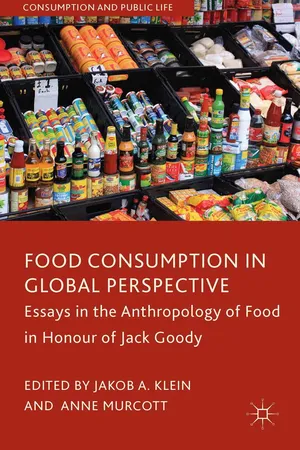
With studies of China, India, West Africa, South America and Europe, this book provides a global perspective on food consumption in the modern world. Combing ethnographic, historical and comparative analyses, the volume celebrates the contributions of Jack Goody to the anthropology of food.
eBook - ePub
Food Consumption in Global Perspective
Essays in the Anthropology of Food in Honour of Jack Goody
- English
- ePUB (mobile friendly)
- Available on iOS & Android
eBook - ePub
Food Consumption in Global Perspective
Essays in the Anthropology of Food in Honour of Jack Goody
About this book
Information
1
Introduction: Cooking, Cuisine and Class and the Anthropology of Food
In a review essay discussing Jack Goody’s (1982) Cooking, Cuisine and Class: A Study in Comparative Sociology, the anthropologist Sidney Mintz describes the book as ‘a pioneering work, because it looks broadly at the many-sided relationship between food and the rest of culture’ (Mintz 1989: 185). Later, Mintz and Christine Du Bois (2002) argue that the publication of Cooking, Cuisine and Class in 1982 marked a ‘turning point’ in the development of the anthropology of food and eating. By the time of their writing in 2002, they assert that the field had ‘matured enough to serve as a vehicle for examining large and varied problems of theory and research methods’ (Mintz and Du Bois 2002: 100). Since then, the anthropology of food has continued to prosper and mature. This is evidenced by a growing number of academic conferences, research centres, university course modules and postgraduate programmes and by the proliferation and growing sophistication of publications in the anthropology and wider social science of food, including dedicated journals (e.g., Food, Culture and Society; Food and Foodways; Gastronomica; Food and History), readers (e.g., Watson and Caldwell 2005; Counihan and Van Esterik 2013) and handbooks (e.g., Murcott, Belasco and Jackson 2013; Pilcher 2012; Watson and Klein forthcoming).1
Goody’s contributions to the anthropology of food have not been sufficiently acknowledged, however, despite the fact that many of the questions raised in Cooking, Cuisine and Class (hereafter CCC) continue to attract a great deal of academic attention. It is in recognition of the enduring significance of Goody’s seminal work that the editors have brought together these essays by scholars of food working in the disciplines of anthropology, sociology and history, following on from a small symposium at the Food Studies Centre of the School of Oriental and African Studies (SOAS), London, held in 2012, to coincide with the thirtieth anniversary of the publication of CCC.
CCC is an ambitious book. Its author sets out to challenge the kind of symbolic analyses that had come to dominate social anthropological approaches to the study of food during the 1960s and 1970s, which were characterized by the search for underlying ‘cultural logics’ that could be understood independently of material factors, social stratification or historical change. Goody, by contrast, sets out to combine the material and the symbolic in a more holistic analysis. His approach is explicitly historical and comparative, and centrally concerned with social hierarchies. Goody seeks to explain why it is that differentiated cuisines emerged in pre-industrial Europe and Asia, ‘Eurasia’ in his terminology, but not in sub-Saharan Africa. In the latter societies, which he terms ‘hieratic’, chiefs and their households enjoyed ‘more of everything’ than others, but they did not ‘develop different styles of life’ (Goody 1982: 67). By contrast, a number of Eurasian ‘hierarchical’ societies – as far-flung as Ancient Rome, Medieval England, Abbasid Baghdad and Song (Sung) Dynasty China – all developed elaborate high cuisines. These were marked, among other things, by the use of complex cooking methods, utensils and flavourings; by the incorporation of imported delicacies and other expensive ingredients and condiments; and by the quality of being prepared by specialist, usually male cooks. The ability to partake of and display knowledge of high cuisine was key to distinguishing elite groups from the lower orders, whose food typically was reliant on regional ingredients, especially grains and pulses, and was prepared by domestic, female cooks deploying a narrower range of methods.
Goody’s explanation for the broad differences he identifies between Africa and Eurasia rests, firstly, on an analysis of the modes of food production: in contrast to the use of the plough or irrigation systems typical of the intensive agriculture practised throughout much of Eurasia, the hoe-based, shifting cultivation of Africa did not create sufficient surplus for the emergence of differentiated cuisines. Secondly, Goody’s explanation highlights differences in what he calls ‘modes of communication’: the use of the written word in Eurasia was crucial to the development of greater culinary complexity. In the context of restricted literacy, written recipes encoded a core set of culinary practices that could be studied, further elaborated and circulated among the kitchens of the social elites.
Goody’s discussion of Africa draws on his own, mostly ethnographic, research in northern Ghana, conducted over a period of three decades, while his account of Eurasia relies primarily on secondary sources. The monograph is a treasure trove of information and thought-provoking musings on the social histories of the food and drink of the ‘Old World’. Goody observes, for example, that societies with hierarchically differentiated cuisines also tend to spawn religious moralities of asceticism and abstinence as inversions of the excesses of haute cuisine (see Zubaida, this volume). He also notes that this moral critique of gastronomic indulgence tends to be upheld by secular revolutionary regimes, at least initially (1982: 147).
In the final quarter of the book, Goody makes an important deviation from his initial question to introduce a new set of topics: he describes the development, especially since the nineteenth century, of ‘industrial foods’ and their spread through the ‘world system’ and investigates in European and African contexts how these have had an effect on and interacted with pre-existing patterns of food consumption, including the uses and non-uses of food and drink to express social differentiation. These topics, often glossed under the rubric of food ‘globalization’, have proven to be particularly enduring in the anthropology of food (e.g., Grew 2000; Phillips 2006; Nützenadel and Trentmann 2008; Inglis and Gimlin 2009; Wilk 2006; Bryant, Bush and Wilk 2013) and are central to the present volume.
Invariably, CCC raised many more questions than could adequately be addressed by a single author in a text of fewer than 300 pages. This was made evident in the ‘Symposium Review on Cooking, Cuisine, and Class’ published as a special issue of Food and Foodways in 1989 (Vol. 3, No. 3), in which a number of prominent social scientists not only celebrate Goody’s ambitious undertaking but also question several of his findings and approaches. The authors of the present volume are similarly both indebted to and critical of various aspects of Goody’s work. In any case, our objective here is not a comprehensive evaluation of CCC. While Goody engages in grand comparisons between Africa and Eurasia and his historical perspective is that of the longue durée, the chapters here are concerned with more recent historical developments and focus on smaller ethnographic entities or on comparisons within regions. Thus, rather than tackle all of the questions raised in CCC, the contributors engage with core themes in that book which have been important in their own research, recognizing both Goody’s own insights and subsequent discussions in these areas. In so doing, the authors pay homage to the role played by Goody in shaping the anthropology of food today, while at the same time take stock of developments over the last three decades in key areas in this still rapidly growing field.
Three core themes in CCC and in this volume’s substantive chapters are addressed in the following sections of this chapter. The first section deals with the relationship between ‘production’ and ‘consumption’ in the study of food habits. The second section concerns the links between social stratification and culinary practices. The third section discusses the use of comparison in the study of food habits, particularly in the context of ‘globalization’. These three sections, of course, overlap to a considerable degree. In exploring these themes and the relationships between them, the chapters in this volume contribute to discussions around a set of questions raised in CCC, which remains central in the contemporary anthropology of food: how should we approach the relationship between changes and continuities in food consumption habits, on the one hand, and changes in social boundaries, roles and relations, on the other? And in what ways is our understanding of the social dynamics of food consumption in specific localities, especially in recent decades (the focus of most chapters in this book), illuminated by comparative perspectives and an attention to wider, even ‘global’ processes? Collectively, the chapters in this book build on CCC to further the development of a framework for addressing the social dynamics of food consumption in global perspective.
Consumption and production
The emphasis in this volume is on food practices, including shopping, cooking and eating, that are often glossed under the term ‘consumption’. To an extent, then, these chapters are part of the rise of consumption studies seen across the social sciences since the 1970s (Campbell 1987; Miller 1995; Trentmann 2013). In recent anthropology, including studies of food, consumption has often been analysed more or less independently of production and distribution (e.g., Miller 1998; Watson 2006). There is much to be gained from this approach in the anthropology of food, not least because it takes seriously the rise of mass consumption emerging from processes of urbanization, industrialization and globalization. As they become more and more enmeshed in cash economies, expanding cities and migration processes, many of the people whose lives we study, even in rural and food-producing areas, have become heavily reliant on purchased, packaged and pre-prepared food and drink for everyday eating, festive meals and ritual practices. This is vividly illustrated in this volume in the chapters by Watson, Clark, Staples, Abbots and Pottier (Chapters 2–5 and Chapter 8). However, rather than viewing the meanings of these goods as determined by food supply chains and businesses, be they transnational corporations or roadside vendors, much of the anthropology of food consumption has shown how such goods become ‘re-appropriated’ (Friedman 2004) by ‘consumers’ through social practices including shopping, gifting, preparing, eating and even talking about food (Watson 2006; Caldwell 2004; Jung 2009). From this perspective, consumption is not passive but involves a wide range of practices that are potentially creative and, indeed, (re)productive of social relations and material forms.
In this volume, Abbots demonstrates the value of this approach to consumption in her account of ‘local’ foods in Cuenca in the Ecuadorian highlands. She emphasizes the ways in which notions of ‘global’ foods and ‘typical’ Cuencano foods shifted according to context and among different social classes. For example, she contrasts the fears of cultural loss brought about by North American fast food chains, expressed by members of the Cuencano middle class, to the views of fast food customers themselves. The latter, mostly members of the lower class who have recently become relatively affluent through remittances sent by family members working in the United States, visit these restaurants as a leisure practice and view their arrival as evidence of Ecuador’s and Cuenca’s improved standing in the global economy. Some customers also argued that to be successful, North American fast food chains must adapt their menus to Cuencano meal patterns.
Of course, food anthropology must not neglect the study of subsistence farming and foraging, including their interrelationship with shopping and other modes of food provisioning. But as Goody points out in CCC, and as Abbots and others in this volume reinforce, scholars of food cannot afford to disregard (or simply nostalgically critique) the important and multifaceted roles that the consumption of ‘industrial food’ has come to play in people’s lives.
Studies that treat consumption practices as partially autonomous from production have shed important light on the meanings of food and drink commodities in social life at particular moments and places, including their use in the construction of individual and group identities along the lines of gender, class and ethnicity. These ‘inside meanings’ (Mintz 1985) are never wholly determined by the material practices and power-laden social arrangements through which food is produced, stored and distributed. Yet by neglecting the latter, contemporary consumption studies are open to the same criticisms that Goody levels against their ‘structuralist’ and ‘culturalist’ antecedents of the 1970s, which stressed the ‘symbolic’ at the expense of the ‘material’; they are of limited use in explaining how culinary practices and food tastes come about, how they come to be socially differentiated (or not) or why these practices, tastes and differentiations endure or change over time (see also Mintz 1985; Weismantel 1999).
In CCC, then, Goody insists that the study of cuisine must always be understood as part of a wider ‘process of providing and transforming food’ (1982: 37). In Goody’s scheme, this process involves five phases: production (the growing of food), distribution (including allocating and storing), preparation (cooking), consumption (eating) and disposal. It is noteworthy that Goody was one of the very few social scientists in the 1980s to recognize the importance of the ‘disposal’ phase, although he does not discuss it much in CCC. Indeed, disposal has only belatedly been taken up, as the ‘problem’ of food waste has moved up the political agenda (see, e.g., Alexander, Gregson and Gille 2013; Evans, Campbell and Murcott 2013).
In this volume, the importance of linking cooking and eating to a wider ‘productive process’ is brought out in several of the chapters. In Staples’ chapter on small town South India, for example, the development of new styles of eating and hosting, associated with emerging middle-class and youth cultures, has been inseparable from the intensification of food production brought about by the Green Revolution of the 1960s, from the opening up since the 1990s of the Indian economy to the increased flow of outside goods and from the expansion outside the major cities of the electricity infrastructure and growing access to freezers (Chapter 4). Sabban, in her chapter on the growing interest in milk in late nineteenth- and early twentieth-century China, describes how the particular Chinese preference for powdered milk emerged in part as a response to constraints of production (Chapter 9). These constraints included the perishability and susceptibility to dangerous microorganisms of fresh milk and the limited availability of pasture in an agricultural system dominated by intensive crop farming.
Like Goody, then, several of the authors here situate changes and continuities in culinary practices within the wider productive process. But they add to this a closer attention than did Goody to the meanings to actors themselves of such changes and continuities. Watson, for instance, documents the changing meanings of pork in the villages of Hong Kong’s New Territories. Prior to the 1960s, pork was a luxury good, the consumption of which contributed to hierarchical divisions between rich and poor and between men and women. Pork was also a central ingredient in community banquets, known as ‘eating from the common pot’, which defined village insiders from outsiders. And the offering of pork to the ancestors and division of pork among lineage members were crucial to annual tomb rites, marking lineage membership and distinguishing rich lineages from poor ones. Forty years later, with greater economic prosperity, access to imported meat and the ubiquity of freezers and refrigerators, pork has become an everyday food, and it has lost much of its former power to mark social differences. Yet if eating por...
Table of contents
- Cover
- Title Page
- Copyright
- Contents
- List of Figures
- Foreword by Jack Goody
- Notes on Contributors
- 1. Introduction: Cooking, Cuisine and Class and the Anthropology of Food
- 2. Meat: A Cultural Biography in (South) China
- 3. From Fasting to Fast Food in Kumasi, Ghana
- 4. Civilizing Tastes: From Caste to Class in South Indian Foodways
- 5. The Fast and the Fusion: Class, Colonialism and the Remaking of Comida Típica in Highland Ecuador
- 6. The High and the Low in the Making of a Portuguese National Cuisine in the Nineteenth and Twentieth Centuries
- 7. Indigestion in the Long Nineteenth Century: Aspects of English Taste and Anxiety, 1800–1950
- 8. Eating Out Bangladeshi-Style: Catering and Class in Diasporic East London
- 9. The Taste for Milk in Modern China (1865–1937)
- 10. Drink, Meals and Social Boundaries
- Index
Trusted by 375,005 students
Access to over 1.5 million titles for a fair monthly price.
Study more efficiently using our study tools.
Frequently asked questions
Yes, you can cancel anytime from the Subscription tab in your account settings on the Perlego website. Your subscription will stay active until the end of your current billing period. Learn how to cancel your subscription
No, books cannot be downloaded as external files, such as PDFs, for use outside of Perlego. However, you can download books within the Perlego app for offline reading on mobile or tablet. Learn how to download books offline
Perlego offers two plans: Essential and Complete
- Essential is ideal for learners and professionals who enjoy exploring a wide range of subjects. Access the Essential Library with 800,000+ trusted titles and best-sellers across business, personal growth, and the humanities. Includes unlimited reading time and Standard Read Aloud voice.
- Complete: Perfect for advanced learners and researchers needing full, unrestricted access. Unlock 1.5M+ books across hundreds of subjects, including academic and specialized titles. The Complete Plan also includes advanced features like Premium Read Aloud and Research Assistant.
We are an online textbook subscription service, where you can get access to an entire online library for less than the price of a single book per month. With over 1.5 million books across 990+ topics, we’ve got you covered! Learn about our mission
Look out for the read-aloud symbol on your next book to see if you can listen to it. The read-aloud tool reads text aloud for you, highlighting the text as it is being read. You can pause it, speed it up and slow it down. Learn more about Read Aloud
Yes! You can use the Perlego app on both iOS and Android devices to read anytime, anywhere — even offline. Perfect for commutes or when you’re on the go.
Please note we cannot support devices running on iOS 13 and Android 7 or earlier. Learn more about using the app
Please note we cannot support devices running on iOS 13 and Android 7 or earlier. Learn more about using the app
Yes, you can access Food Consumption in Global Perspective by J. Klein, A. Murcott, J. Klein,A. Murcott in PDF and/or ePUB format, as well as other popular books in Social Sciences & Social History. We have over 1.5 million books available in our catalogue for you to explore.