- English
- ePUB (mobile friendly)
- Available on iOS & Android
eBook - ePub
About this book
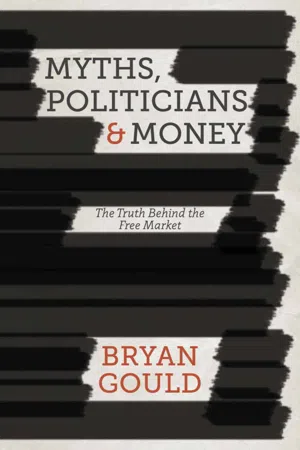
Bryan Gould draws on his experience as a leading British politician and as a lawyer, academic, diplomat and television journalist to explain why the political and economic doctrines that have dominated the western world for three decades have meant that western countries have found that their democratic governments no longer serve them well.
Information
Chapter 1
The Triumph of the ‘Free Market’
The individual versus the state
The global history of the past three decades, during which the western world’s comparative standing and fortunes have plummeted, has seen the widespread propagation and acceptance in the western world of a number of significant and game-changing ideas – about how economies should be run, how societies should function, and how the relationship between the individual and the state should be managed. It has been a period that has seen a conclusive victory for doctrines that, until quite recently, were dismissed as the preserve of a small and extreme minority on the fringes of politics, economics and philosophy.
In many ways, it was the unexpected coming together of initially somewhat disparate and unrelated ideas – in philosophy, economics and politics – that eventually created and underpinned a victory that proved to be so comprehensive and decisive. The ideas that came to prevail over this period across the whole spectrum were consistent with and reinforced each other; and that interlinking consistency established such a comprehensive orthodoxy across the board, supported not only by intellectual argument but also by the realities of economic power, that any dissent was virtually stifled at birth. In any assessment of what has happened over this period, it is that recently established orthodoxy that must take centre stage.
Perhaps the starting point for that assessment is to consider the revival of a philosophical doctrine that, emerging in a new and more extreme form, has underpinned much that has happened in wider economic and social policy over the last thirty years. For much of the twentieth century, and long before that, it had been recognised that societies were more than collections of atomised individuals, that their strength and cohesion were the result of a collective effort, and that it was that effort which allowed individuals – enjoying the support provided by many others – to flourish.
This belief came increasingly under attack, however, from a group of writers that included Friedrich Hayek and Robert Nozick, to say nothing of Ayn Rand, who were thought to argue that the individual was the only entity that mattered, and that any attempt to constrain individual freedom of action was anathema to any proper concept of liberty and free expression.
Hayek’s The Road to Serfdom was primarily intended as a wartime critique of central planning, and is not quite the rallying cry for laissez-faire that it is often claimed to be;1 indeed, Hayek explicitly rejects that doctrine. But, in an increasingly familiar process, his message has been simplified and sharpened so that he has been recruited to a cause that he almost certainly would not have fully endorsed.
There can be less ambivalence about Nozick’s argument for a severely limited role for government:2 he argued that government should limit itself to the defence of the realm, the maintenance of internal law and order, and defending the value of the currency; and even less about Rand’s glorification of the individual,3 her condemnation of any attempt to shackle individual advancement and her dismissal of any need to consider the wider common interest. These writers and thinkers, and others, popularised the idea that the claims of society, and even more, therefore, of government, to constrain the pursuit of individual claims in the wider interest must be resisted if the individual was to enjoy the freedom which alone would allow the highest peaks of human achievement to be scaled; and society itself, if it existed at all, would be best served by allowing individuals to pursue their individual destinies without let or hindrance.
As politicians such as Ronald Reagan and Margaret Thatcher came to power in the early 1980s, these theories about the relationship of the individual citizen with the state and the belief that it was the individual, not society, who held the key to human progress became widely discussed and increasingly accepted.
Margaret Thatcher was an enthusiastic devotee of Hayek. Her famous dictum that ‘there is no such thing as society’ and Ronald Reagan’s equally memorable assertion that ‘government is not the solution – government is the problem’ were quickly adopted as mantras by many, and particularly by those who considered themselves as the new wave of enlightened intelligentsia.
These new doctrines at times reached extreme proportions. For some, government (and by extension any organised form of society) was, by definition, an affront to a proper social order and to individual freedom. Consistent with this view, taxation could only be regarded as theft, and should be resisted; the purposes to which taxation was put were, accordingly, illegitimate.
The role of the state, such people believed, was – at most – simply to hold the ring so as to allow an unfettered competition in which the strongest, cleverest, richest, most privileged or luckiest individuals could make their advantages count and would accordingly prevail. The winners in that competition would rightly claim the rewards, which no one else should resent, since their achievements were a proper recognition of their worth and would benefit society as a whole. And, because society would be stronger, even the losers – the vast majority – would be carried forward to benefits they could never hope to gain by their own efforts.
Human progress was seen to depend on the achievements of a few outstanding individuals. It was essential, therefore, that those individuals should be allowed the freedom to pursue their destinies. If weaker individuals could not stay the course, they could have no complaint. And since it could not be predicted which individuals were potentially capable of joining that elite group, it followed that every single person was entitled to the same freedom from restraint.
The significance and value, even existence, of social organisation and collective or community action were ignored or denigrated as factors in advancing human progress. The contributions, large and small, made by literally billions of people over the whole of history and from every corner of the globe to the infrastructure on which modern society was based, and from which each individual member of society benefited, were given no value. There was increasingly little understanding of the importance of a healthy, integrated, united society, a mutually supportive society in which all individuals could flourish and share in the benefits of living in society, not just economically, but creatively, culturally and in every other way.
There was no recognition of the fact that in today’s world no single individual – however clever, strong, rich, privileged or lucky – could hope, unaided, even to make the shirt on his back. That even an apparently small-scale achievement like that is unavoidably a social enterprise, relying on the contributions, technical, physical, intellectual, economic, entrepreneurial, of literally the whole of society over the whole of human history – and that what is true of that simple feat is also true of the whole of human progress – was ignored or denied.
It became the accepted wisdom instead that, if economic success rested almost entirely on the achievements of a few successful individuals, no reward was too great if they were to be properly recognised and encouraged to achieve even more. In the era of the huge salaries, bonuses and share issues for business leaders that preceded the global financial crisis in 2008, influential journals (such as The Economist) argued that, provided they were sanctioned by the market, there was literally no limit to the riches that could and should be paid to the most highly rewarded individuals.
The perception that huge rewards were appropriate for people of exceptional talents was, of course, encouraged by the adulation heaped by the popular media (about which more later) upon pop stars, film actors and sports champions – all occupations requiring particular abilities that attracted enormous popular attention (if only for a time) and therefore warranted exceptional rewards. Persuading an adoring public that disproportionate wealth for such people is appropriate was much easier than persuading the same (but on this issue sometimes more cynical) public that similar rewards for business leaders were justified.
While these doctrines were advanced in the name of individual freedom, there was no acknowledgement of the fact that excessive wealth and power (and therefore freedom) for a few inevitably meant that the majority had less freedom or ability to choose, and that – on the basis that the true measure of the degree of freedom in any society is arguably the degree of freedom enjoyed on average by all citizens or even by the least free – the net result was that society as a whole became less free, even while a few individuals celebrated their liberation from normal constraints.
Whereas historically, in most western countries, social organisation in general and democratic politics in particular had had the intended effect of dispersing power and restricting privilege, the newly reinvigorated doctrine of the sanctity of the individual, combined with an assertion of the market’s infallibility, provided a blueprint for a quite different kind of society – one in which the concentration of that power in a few hands was legitimised by the market, and accordingly represented as a matter for celebration rather than concern. So it was, as we shall see, that the fundamental values of a western democracy were undermined.
The ‘infallible’ market
The economic and social context in which the individual was best able to flourish, it was argued, was the ‘free’ or unfettered market – that is, the market allowed to operate without any intervention from government or anyone else. This, it was thought, provided the only guarantee of the best outcomes. The market was not only essential as an allocator of scarce resources but possessed an almost moral force and authority in deciding the appropriate distribution of rewards to those who succeeded in manipulating it to their advantage. This supposedly dispassionate, objective and value-free mechanism for rewarding the successful was the key to encouraging the innovation on which economic success, it was said, depended.
The market’s infallibility was akin to a force of nature, and – like nature – the market was often ‘red in tooth and claw’. There was no point in bemoaning the fact that the market produced losers as well as winners; in that respect the market was an evolutionary force, jettisoning the weak while rewarding and preserving the strong.
There was little point in governments or anyone else attempting to second-guess the market, since any divergence from the outcomes it would normally produce would be literally counterproductive. Economic models showed that the market operated with perfect fairness and efficacy, and ensured that each actor in the marketplace was perfectly informed; if decisions were made on the basis of imperfect information, this deficiency on the part of the individual market operator would be appropriately punished, so that the best informed operators would, as was desirable, prosper and guide the market to new heights.
The market was a mechanism that was constantly seeking equilibrium in any case without any need for intervention – and when it moved away temporarily from that equilibrium, it was naturally self-correcting. It therefore provided its own antidote to any threat of monopoly or imperfect competition.
The risk that a dominant position in the marketplace could be used to entrench and intensify that advantage was dismissed. The market would automatically restrain such long-term imbalances because it would constantly allow and encourage new entrants, new ideas and new products, to restore equilibrium.
For all of these reasons, it could remain largely unregulated – and if by any chance regulation was seen as required, it could either be self-regulation or, at worst, ‘light-handed’ regulation, neither of which would unduly trouble the delivery of normal market outcomes.
If the outcomes produced by the market were the best that could be obtained, it also became accepted, or at least plausibly argued, that to counteract the market by altering the outcomes it produced ex post facto would be to jeopardise the very benefits that the market economy was best able to produce. The dice must be allowed to lie where they fell. Otherwise, the full and beneficial effects of market incentives – as spurs to even greater innovation, profitability and growth – would be lost.
So, for example, redistributive taxation (and, by necessary implication, the public spending that depended for funding on tax revenue) could not be supported. Tears need not be shed over this, however, since those who might feel that they would benefit from any such redistribution were in fact wrong. Their best bet was not to look for ‘hand-outs’ but to allow market forces to run their course without interference; in that way, economic benefits would be maximised not only for those who succeeded in the marketplace but for everyone else as well. Everyone would prosper, in other words, if the successful were able to keep their gains, since these would eventually be spent in the economy; and that spending would generate more and better-paid jobs for everyone. The good fortune of the successful would ‘trickle down’ to everyone else; there would be no losers, only winners, though winners to widely varying degrees. And if, however fast the trickle flowed, the gap between the rich and poor widened, that was the price that had to be paid if the successful were to be properly rewarded.
The market was such a perfect and self-correcting mechanism that, far from introducing countervailing measures to correct or modify its outcomes, policy should be directed at removing any factors that might inhibit its unfettered operation. So, for example, ‘labour market rigidities’, by which was meant the power that a unionised workforce might use to protect jobs, and conditions such as health and safety at work, were attacked, and labour laws generally were significantly redrafted in favour of employers.
In most countries, as a result, union membership was discouraged, the right to strike was weakened, and employers were given new rights to hire and fire as they chose. The goal was to treat the labour market as being no different from the market in any other commodity; an efficient market had no place for the kind of sentimentality that might tempt employers to treat workers as people rather than as factors of production.
Similar arguments could be used to address other issues. The shortage of affordable housing – an increasingly pressing problem in a number of countries? The fault was not that of the ‘free market’, but of ‘rigidities’ such as the restraints on development imposed by planning law and the processes insisted upon by local government. The remedy was to encourage developers (whose profits were not seen as a problem but rather as a proper recognition of their efforts), by removing the rigidities and protecting and even extending the tax advantages they enjoyed.
Environmental issues – such as the pollution of air or water, or the exhaustion of finite resources, or global warming? Rather than outlaw undesirable activities, the correct market approach would be to regulate or restrain them by selling the right to undertake them to the highest bidder; this use of the market or price mechanism would be more elegant and effective, and in the end fairer, than any solution imposed by regulation or restriction. The consequence that the richest and most powerful people might be able to use their wealth to buy exemption from constraints that were seen as essential in the general interest was ignored.
The allocation of scarce resources? The market was again the best way of deciding, painlessly and automatically, who should get what, by allowing the price mechanism to identify the most deserving bidder – the one willing to pay the highest price for the use of the resource. Those who lost out in the bidding, which meant the great majority, would derive a benefit from the fact that the scarce resources were efficiently exploited, as witness the profits made by the exploiters, profits which again, it was asserted, would ‘trickle down’ to the rest of the community.
A further feature of orthodox ‘free-market’ doctrine was the supposed need to ‘externalise’ costs, and the propriety of doing so. Accounting practice ensured that the only costs that appeared in the accounts of an individual company were those which had a quantifiable market value that could be directly and uniquely attributed to the operations of that company – in other words, costs incurred through payments made to other market operators. Anything else – adverse impacts on air or water quality, for example, or on the remaining store of scarce resources – were not the concern of individual companies but were to be ‘externalised’, that is, excluded from the cost of market transactions and passed on to some other unidentified person, which usually meant to the community as a whole. The bottom line would, in other words, always trump the concerns of wider society. To do otherwise, it was held, would distort the market and reduce economic, that is profit-seeking, efficiency and activity.
These convictions about the infallibility of the market and its sacrosanct nature were treated with almost religious zeal as articles of faith by true believers. There was a sense that scales had dropped from people’s eyes, and that what had always been true had at last been revealed. What was surprising was that there was no understanding that these doctrines ha...
Table of contents
- Cover
- Title
- Copyright
- Contents
- Foreword
- Introduction
- 1 The Triumph of the ‘Free Market’
- 2 Globalisation
- 3 Stepping Stones to a ‘Free-Market’ Global Economy
- 4 The Political Response
- 5 Democracy Surrendered
- 6 The Shift in the Balance of Power
- 7 Everything Has a Price: Or Businessmen Know Best
- 8 Mismanaging Our Economies: The Rise of Monetarism
- 9 Mismanaging Our Economies: The International Dimension
- 10 The Rise of Powerful Rivals and Other Models
- 11 Mismanaging Our Economies: Ignoring the Evidence
- 12 Hubris and Nemesis: The Global Financial Crisis
- 13 Our Leaders Are Ignorant of How Our Economy Works
- 14 The Role of the Media
- 15 Widening Inequality and Social Problems
- 16 Misreading the Non-Western World
- 17 The Anglo-American Model
- 18 Conclusion: What Can Be Done?
- Notes
- Index
Trusted by 375,005 students
Access to over 1.5 million titles for a fair monthly price.
Study more efficiently using our study tools.
Frequently asked questions
Yes, you can cancel anytime from the Subscription tab in your account settings on the Perlego website. Your subscription will stay active until the end of your current billing period. Learn how to cancel your subscription
No, books cannot be downloaded as external files, such as PDFs, for use outside of Perlego. However, you can download books within the Perlego app for offline reading on mobile or tablet. Learn how to download books offline
Perlego offers two plans: Essential and Complete
- Essential is ideal for learners and professionals who enjoy exploring a wide range of subjects. Access the Essential Library with 800,000+ trusted titles and best-sellers across business, personal growth, and the humanities. Includes unlimited reading time and Standard Read Aloud voice.
- Complete: Perfect for advanced learners and researchers needing full, unrestricted access. Unlock 1.5M+ books across hundreds of subjects, including academic and specialized titles. The Complete Plan also includes advanced features like Premium Read Aloud and Research Assistant.
We are an online textbook subscription service, where you can get access to an entire online library for less than the price of a single book per month. With over 1.5 million books across 990+ topics, we’ve got you covered! Learn about our mission
Look out for the read-aloud symbol on your next book to see if you can listen to it. The read-aloud tool reads text aloud for you, highlighting the text as it is being read. You can pause it, speed it up and slow it down. Learn more about Read Aloud
Yes! You can use the Perlego app on both iOS and Android devices to read anytime, anywhere — even offline. Perfect for commutes or when you’re on the go.
Please note we cannot support devices running on iOS 13 and Android 7 or earlier. Learn more about using the app
Please note we cannot support devices running on iOS 13 and Android 7 or earlier. Learn more about using the app
Yes, you can access Myths, Politicians and Money by B. Gould in PDF and/or ePUB format, as well as other popular books in Politics & International Relations & Macroeconomics. We have over 1.5 million books available in our catalogue for you to explore.