eBook - ePub
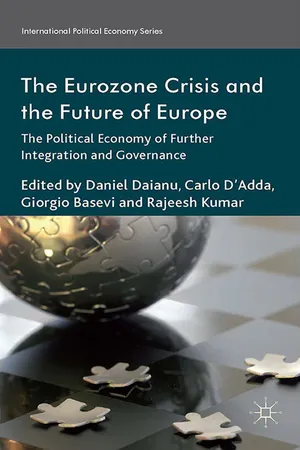
The Eurozone Crisis and the Future of Europe
The Political Economy of Further Integration and Governance
- English
- ePUB (mobile friendly)
- Available on iOS & Android
eBook - ePub
The Eurozone Crisis and the Future of Europe
The Political Economy of Further Integration and Governance
About this book
The authors uncover the roots of the eurozone crisis, focusing on how this can be solved against the backdrop of a very deep financial and economic crisis and its strong social impact. Looking at the impact of the financial crisis on the eurozone, they explore the European Union's recent and future developments.
Information
1
Introduction
Daniel Dăianu and Rajeesh Kumar
The Great Recession of 2007–2009 and its persistent and powerful effects will be recorded in economics textbooks both for their dramatic consequences on the real economy and the proven inability of the dominant economic theory to help solve this crisis. Among the numerous side effects of the Great Recession, one was of particular importance to the Euro area: the Great Recession exposed in full light the deep seated institutional and policy flaws of the Euro project, which threaten to bring it to an end.
Facing major financial distress, Euro area governments realized the fragile features of their economies, inefficient tax systems, and excessively high unit labour costs. The banking sector was fragile because it depended too much on debt and was poorly regulated, with prudential norms being country specific and particularly opaque. On top of these, the European Central Bank had no legal room to support distressed governments, and key policy arrangements are inadequate in the Euro area.
The period 2010–2013 will probably be seen as a milestone in the Euro area’s development. For the first time, Europeans had to answer a fundamental question: what sacrifices they are willing to make in order to rescue the single currency, and what benefits they can reap due to it. The political nature of the question has made the decision-making process extremely messy. Germany has emerged as the leader of this process and has, almost inevitably, managed to impose its crisis Weltanschauung and policy approach on the other Euro member countries.
Since the Euro crisis erupted, it has become increasingly clear that European economies are not as robust as leading politicians and policy makers believed or wanted their citizens to think, and that, finance-wise, they are afflicted by the same basic flaws as the US economy. In addition, the current financial crisis has unveiled congenital weaknesses of the Eurozone design; and it has created a formidable challenge for policy makers since the issue at stake is of an existential nature – as European statespersons have not shied from pointing out. This clarifies why the EU, and the Eurozone in particular, have become an economic area of major concern to countries the world over. And this concern is not only because the EU is the largest trading bloc in the global economy, but also because it is the site of many globally operating banks, financial institutions, and, not least, since, together with the US, it has been behind the globalization drive of the past decades. A financial disaster here, in Europe, would put not only the European project in peril; it would have wide ranging implications for the world economy.
Today skies are clearer in the Euro area. Greece, the country that epitomizes most policy sins, and also has required the most dramatic adjustment, has for the first time got a modest primary budget surplus in 2013; and the interest rates on its treasury bonds are finally declining to acceptable levels, even its economic growth rate might turn positive in the not too distant future. Portugal and Ireland can borrow again in the financial markets, and Italy and Spain seem to be slowly recovering too. Some of the Euro area difficulties seem to have eased.
However, it would be a great mistake to consider that the Rubicon has been crossed in dealing with the Euro area crisis. Some shy progress in diminishing its fragility to major shocks has been made, but there is still a long and uncertain way toward a really well functioning single currency area. This reality lies behind this volume, which has two major aims. First, it is an attempt to establish a clear account of the multiple dimensions of the Euro area crisis and, by so doing, to identify major factors of risk for crisis management and policy reform. Second, the authors suggest various ways through which the functioning of the Euro area could be improved. Likewise, implications for the future of the Euro area, and of the EU in general, are explored.
By inviting authors who live in different Euro-area countries and even outside the EU, the editors aimed to provide a multidimensional perspective on the Euro area crisis. It is precisely one goal of the book to allow for different, sometimes colliding viewpoints. The construction of the Euro project is first and foremost a matter of harmonizing differences. Respect for diversity underpins the Euro project construction and should also be present in all policy analyses.
Yet there are some dimensions of the Euro crisis and its cure on which the authors tend to agree. First is the thesis that the fate of the Euro area conditions the future of the European Union, and disarray at the core of the EU puts strong destabilizing forces into motion. Second, there is validity in the line of reasoning that budget profligacy is far from explaining the depth of the crisis in the Euro area, against the backdrop of the global financial crisis. Budget discipline, a consistent implementation of the Stability and Growth Pact (SGP) would have not prevented tensions rising in the single currency area. For, a flawed design and inadequate policy arrangements, which have invited rising imbalances among EU member states, are no less important in explaining the plight of and the disaffection in the Euro area. In this regard, it is remarkable that, after a period of procrastination, which is partly rooted in its constitutional mandate and opposition from powerful voices on its Council, the ECB decided to act as close as possible to a lender of last resort and did its utmost to save the Eurozone. Mario Draghi’s famous statement in London in July 2012 that the ECB would do ‘whatever it takes to save the euro’ seems to have produced a wonder, at least for the time being. With the benefit of hindsight, one can say that the ECB has rescued the single currency area, so far. But, arguably, much more is needed to reach a happy destination. It may be that the Banking Union project will provide a definitive solution to enhancing the cohesiveness of the Eurozone. However, there are still important technicalities and sequencing problems that need clarification in this respect – and the sooner the better. Finally, another rallying view is that there are other needed policy arrangements, which go beyond the operations of a banking union, in order to make the Euro area, and the EU, function properly.
The bottom line is that the Eurozone crisis is one of deep financial integration when proper institutional and policy arrangements are missing. Fiscal rectitude is necessary, but it is not sufficient for rescuing this area. There might be a need of deeper fiscal coordination, of tools for dealing with country-specific shocks (such as insurance for unemployed people via the EU budget), and of stronger means for fostering economic convergence. The concept of fiscal capacity, as enunciated by the president of the European Council, Herman van Rompuy (2012), encapsulates and covers these requirements. It is justified to decry, as some do, the insufficient size of resources the EU budget assigns to R&D-based activities, to innovation, as a means to help EU member states cope with the challenges posed by the emerging economic powers. But it is also wrong to underestimate the impact on the Euro area, on the EU in general, of growing economic cleavages among member states. And EU structural and cohesion funds have a major role to play in diminishing development gaps. That, often, such resources are wasted and, in not a few countries, pervasive corruption brings the use of such funds into disrepute, is not an argument for terminating them. It is worthy to notice that a Mezzogiornification of the southern fringe of the Euro area was anticipated years before its inception, with possibly deleterious effects. But Paul Krugman (1991) put it in benign terms, with specialization taking place according to comparative advantages and Germany, in the main, at the centre of the industrial core of Europe. Whereas now, one sees that unless institutional and policy arrangements are adequate, rising imbalances among EU member states, especially in the Euro area, can bring about havoc and lead to its demise.
An understanding of the dynamics of the Euro area crisis begs a scrutiny of the causes of the current financial crisis. Therefore, this volume pays attention to the impact of the financial crisis on the Euro area crisis as well. Not only because the financial crisis complicates the mission of undertaking institutional and policy repair in the EU, and of producing lasting economic recovery, but also since, for economies to start to grow again on a sustainable basis and create jobs, there is a need for a sound financial intermediation system. It is necessary to bring the financial system ‘back to reason’, to make it shed as much as possible of its speculative and destabilizing nature. Claudio Borio (2012) and others highlight the importance of a ‘financial cycle’ at work, which has much lower frequency than business cycles. Related to this, the observation that the financial cycle depends critically on policy regimes is of enormous relevance. For, although cycles can hardly be precluded in a real economy, the amplitude of boom and bust dynamics is influenced by policies, as it is by the size of the financial industry – which is currently much oversized in not a few advanced economies. It is indisputable that the deregulation waves in the financial sector, of the past decades, have magnified systemic risks and have invited the Great Recession. The gross abuse of securitization, the promotion of a wide range of exotic (this is a euphemism) financial products that were hardly tradable and frequently of lousy value, the reckless short-termism in maximizing profits and a blatant neglect of risks have turned major components of high finance into an inbuilt destabilizer. At the time these words are written the expanding Libor scandal and the rigging of various commodity and financial markets give more salience to the wrongdoing in an industry which has, or is supposed to have, many features of public utilities.
Taming financial markets is, therefore, a must so that future deep crises can be, or better dealt with. The way financial markets have functioned in recent decades is not a given. Public policy can and should change it, as it did after the Great Depression and after the Second World War. The reform of the financial industry is badly needed in order to bring back a sense of fairness in society, which is critical for the functioning of democracy. Finance has to assist economies to recover and prosper again and not, instead, extract undue rents from and destabilize them. In the same vein one can reason when it comes to the Eurozone design and policy arrangements; these condition the functioning and performance of national policies, as the latter impact on the state of the Eurozone in their turn.
The analyses gathered in this book try to blend theoretical insights with policy-oriented approaches and case studies. The current crisis is so deep and worrisome that such a combination makes sense to us. The structure of the volume and its content embody a vision on the origin of this crisis and the belief that policies have to shed fundamentalism and be pragmatic, commonsensical.
An overview, co-authored by Giorgio Basevi and Carlo D’Adda, aims at providing an analytical framework to understanding the Euro area crisis. This chapter distinguishes between populist and growth-oriented policies, which underlie the performance rift in the Euro area between a competitive North and Mediterranean laggard economies. The two authors remark that the reconstruction of the ‘euro area building’, of its policy arrangements, is perhaps the main institutional and, hopefully, positive result of the international financial crisis and its repercussions in the EU. Part I, ‘Economic Imbalances and the Euro Area Crisis’ is made up of four chapters. As its name tells eloquently, it focuses on the dynamics of imbalances in the Euro area and their role in triggering its crisis. Jerome Stein’s ‘The Diversity of Debt Crises in Europe’ explores the causes of the Euro area crisis by using the Natural Real Exchange Rate (NATREX) model of the equilibrium exchange rate and external debt – the endogenous variables. This model shows inter-country differences that lie behind the debt crisis. Stein remarks that the government sector was its main source in Greece and Portugal, while the private sector (private debt) was the main source in Ireland and Spain. Julius Horváth and Martin Šuster’s chapter, ‘European Sovereign Debt Crisis and the Euro’, examines the evolution of the Euro area crisis and asks questions about the future of the European Union. The authors voice their own concerns regarding the European monetary integration and the growing cleavage inside the Euro area in terms of competitiveness; they stress that the EU leaders are under time pressure to advance with the banking union project and decide about further fiscal integration. In ‘Economic Policies and the Debt/GDP Constraint: The European Challenge’, Radu Vranceanu also examines the causes of the Euro area crisis and underlines that in the absence of a genuine lender of last resort, no country with a large debt-to-GDP ratio can be fully insulated from the risk of illiquidity. He stresses that the financial stability of the single currency area hinges, largely, on political decisions. One thing is sure, says Vranceanu: the debt-powered growth is over. Karlhans Sauernheimer’s ‘Current Account Imbalances in the Eurozone: Causes, Remedies and the Role of the ECB’ is highly critical of the current arrangements in the EMU. He says that the ECB has eliminated the market as a controller of current account balances and that the principle ‘No taxation without representation’ is the basic reason why the ECB was constructed in the Maastricht Treaty as a pure monetary agent, without any fiscal authority. He goes further and notes that ‘whereas in pre-EMU times the creditor was free to lend, at which conditions to lend or not, now, in EMU times, the debtors decide, with the help of the ECB, how much target claims the creditors have to accept’.
Part II focuses on ‘Crisis Management in the Euro Area: The Interplay between Politics and Economics’ and is made up of five chapters. These chapters examine the relationship among creditor and debtor nations in the Euro area, from various political and economic angles. Jonathan Story’s ‘The Euro Crisis and German Primacy’ makes a blunt statement: that the Euro is first and foremost a diplomatic creation, and that the Eurozone crisis has revealed its structural flaws. He also argues that a federal Europe implies fiscal sharing of tax revenues, that there can hardly be a monetary union without an effective government. And here, the role of Germany’s inclinations is crucial. One rediscovers herein a sort of a German Question in the EU policy realm. The author shows how big countries in the EU interact with each other, the interplay between high politics and economics in the Euro area. Brigitte Young’s ‘The Power of Ordoliberalism in the Eurozone Crisis Management’ remarks that it is one of the great misnomers to name the current Eurozone debt crisis a sovereign debt crisis, since much of the latter started when private debt was turned into public debt. Her chapter argues that the much blamed Eurozone crisis management is the result of an ideological difference between economic doctrines that are conditioned by varieties of capitalism; German ordoliberal doctrine sees the solution to the debt crisis in an anti-Keynesian, ‘export-led monetarist rule-based’ model, while other European countries reject this ‘rigid’ approach. There are two explicit case studies in the volume; one focuses on a large economy (Italy) and the other on a small economy (Greece). Carlo D’Adda’s ‘Italy and the Euro’ stresses that the period 2000–2011, which is approximately the first Euro decade, has not been good for Italy; production has been languishing, and labour productivity declined. D’Adda compares Italy’s performance to Germany’s and says that another decade without growth will be very disruptive. As the author says, ‘society can react angrily and anti-European feelings may surge’. There is need for a rethinking of Euro policies argues the same author. Kuibert Raffer’s ‘Turning a Small Problem into Catastrophe: The Case of Greece’ posits that this country’s plight is an example of how rescue efforts can transform a problem into outright catastrophe. The IMF officials’ acknowledgements that mistakes were made in formulating the program for Greece appear to vindicate such a stern assertion. Raffer advocates a fair and Rule of Law-based state insolvency mechanism, showing that this would combine perfectly with the no bail out clause of the Lisbon Treaty – though one could argue that such a solution underestimates contagion effects. Pradumna B. Rana and Michael R. Blomenhofer’s ‘The Eurozone Crisis: A Perspective from and Impact on Asia’ prods us to distinguish, when trying to deal with a financial crisis, between its proximate and root causes and to focus rather on the latter. The authors remark that both public and private sector overspending, with differences among countries, are root causes against the backdrop of a poorly functioning financial system. This chapter shows how the Euro area crisis affects non-European emerging (Asian) economies through three major channels: trade, finance, and remittances; it also brings value by showing how the Euro area crisis is perceived by outsiders.
Part III, ‘The Euro Area: Looking into the Future’ has four chapters. Bodo Herzog’s ‘The EMU Is No One-Way-Street: Back to the Roots!’ observes that the Euro area crisis has multi-dimensional roots, which it has turned into a big crisis of confidence over time. Herzog stresses that the re-design of the institutional framework requires both the strengthening of rules and more integration of economic policies. Anton Hemerijck’s ‘Changing Welfare States and the Euro Crisis’ notes, first, that for the EU member states, where collective coverage of modern social risks is extensive, the global financial crisis marks a serious stress test, which shows up in growing unemployment, especially among young people. Hemerijck says that the causes of the global financial crisis originate in the behavioural excesses in deregulated financial markets. The author also remarks that the EU’s original sin of pushing for rapid markets and currency integration, to let the social-political-institutional underpinnings of European integration catch up later, is in dire need of correction. The key European policy challenge in the wake of the Euro crisis is to make long-term social investments and short-term fiscal consolidation mutually supportive. Francesco Nicoli and Fabian Zuleeg’s chapter is ‘The Long Term Implications of the Euro Crisis for European Integration: A Deeper Union of Fragmentation?’. This chapter examines the European crisis by identifying endogenous and exogenous causes and potential solutions. The authors present three potential scenarios on the way out of the current crisis, and implications for the governance and economic and societal conditions. The three scenarios are a ‘permanent deadlock’ that paralyses the decision-making process and may entail the exit of some countries from the Eurozone; a ‘long transition’, featuring occasional and limited improvements of the institutional setting, that entails major risks and may push back the Eurozone to the first scenario; and a ‘comprehensive approach’. Daniel Dăianu’s chapter advocates a thorough redesign of the institutional and policy arrangements in the Euro area, which should tackle its birth flaws. Attention paid to the increasing fractures in the EU is also necessary. Finally, all endeavours in the EU have to be complemented by a reform of financial intermediation, by a new regulatory and supervisory regime. The author sees the waves of deregulation of recent decades as the primary cause of the current mess. Taming financial markets is, argues Dăianu, a must in order to make them serve economies and reduce the likelihood and amplitude of financial crises. Since the crisis is ongoing, and making a conclusion may not be factual. Here the ‘Afterward’ evaluates the chapters presented in this volume and looking into the possible future of Eurozone.
This volume targets a wide range of readers. We very much hope that students of international and European affairs, of international business, and interested readers of all walks will find the information and pieces of analysis in this volume not redundant.
2
Overview: Analytics of the Euro Area Crisis
Giorgio Basevi and Carlo D’Adda
1 Real aspects
In order to provide a guide to the readers of this book we think it worthwhile to offer them a sketch of the way the Euro is expected to work as a single currency area. This chapter should therefore be seen as a theoretical guide rather than an additi...
Table of contents
- Cover
- Title
- 1 Introduction
- 2 Overview: Analytics of the Euro Area Crisis
- Part I Economic Imbalances and the Euro Area Crisis
- Part II Crisis Management in the Euro Area: The Interplay between Politics and Economics
- Part III The Euro Area: Looking into the Future
- References
- Index
Trusted by 375,005 students
Access to over 1.5 million titles for a fair monthly price.
Study more efficiently using our study tools.
Frequently asked questions
Yes, you can cancel anytime from the Subscription tab in your account settings on the Perlego website. Your subscription will stay active until the end of your current billing period. Learn how to cancel your subscription
No, books cannot be downloaded as external files, such as PDFs, for use outside of Perlego. However, you can download books within the Perlego app for offline reading on mobile or tablet. Learn how to download books offline
Perlego offers two plans: Essential and Complete
- Essential is ideal for learners and professionals who enjoy exploring a wide range of subjects. Access the Essential Library with 800,000+ trusted titles and best-sellers across business, personal growth, and the humanities. Includes unlimited reading time and Standard Read Aloud voice.
- Complete: Perfect for advanced learners and researchers needing full, unrestricted access. Unlock 1.5M+ books across hundreds of subjects, including academic and specialized titles. The Complete Plan also includes advanced features like Premium Read Aloud and Research Assistant.
We are an online textbook subscription service, where you can get access to an entire online library for less than the price of a single book per month. With over 1.5 million books across 990+ topics, we’ve got you covered! Learn about our mission
Look out for the read-aloud symbol on your next book to see if you can listen to it. The read-aloud tool reads text aloud for you, highlighting the text as it is being read. You can pause it, speed it up and slow it down. Learn more about Read Aloud
Yes! You can use the Perlego app on both iOS and Android devices to read anytime, anywhere — even offline. Perfect for commutes or when you’re on the go.
Please note we cannot support devices running on iOS 13 and Android 7 or earlier. Learn more about using the app
Please note we cannot support devices running on iOS 13 and Android 7 or earlier. Learn more about using the app
Yes, you can access The Eurozone Crisis and the Future of Europe by Rajeesh Kumar, Daniel Daianu,C. D'Adda,G. Basevi in PDF and/or ePUB format, as well as other popular books in Politics & International Relations & Finance. We have over 1.5 million books available in our catalogue for you to explore.