- English
- ePUB (mobile friendly)
- Available on iOS & Android
eBook - ePub
About this book
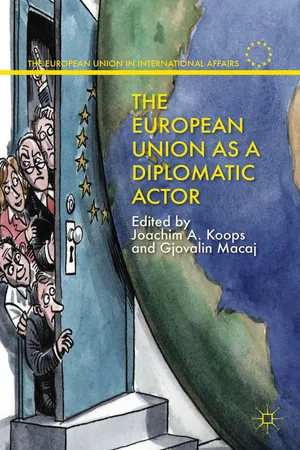
This collection brings together leading scholars and practitioners to assess the processes, institutions and outcomes of the EU's collective diplomatic engagement in the fields of security, human rights, trade and finance and environmental politics. It analyzes successes and failures in the EU's search for global influence in the post-Lisbon era.
Information
1
Introduction: The European Union as a Diplomatic Actor
Joachim A. Koops and Gjovalin Macaj
The European Union’s (EU’s) nature, policies and impact as an international actor have been the subject of analytical scrutiny and a wide range of conceptual and empirical case studies since the early 1970s (Allen and Smith, 1990, 1998; Bretherton and Vogler, 2006; Cosgrove and Twitchett 1970; Galtung, 1973; Jupille and Caporaso 1998; Ginsberg, 2001, 1999; Hill, 1993; Koops, 2011; Sjöstedt, 1977). In parallel, scholars also began to reflect on the European Community’s (EC) activities, role and presence in international diplomacy and examined the EU’s emerging ‘diplomatic persona’ distinct from its own member states (Hill and Wallace, 1979, p. 47; see also Cosgrove and Twitchett, 1970, p. 44; Sjöstedt, 1977, p. 20). However, it was not until the late 1990s and early 2000s that the ‘EU as a diplomatic actor’ has become a more extensively studied subject in its own right (Bátora, 2005; Bruter, 1999; Duke, 2002; Keukeleire, 2003; Keukeleire et al., 2009). While these studies focused mostly on the EU’s newly created Common Foreign and Security Policy (CFSP) – and hence on the EU’s ‘CFSP diplomacy’ (Keukeleire, 2003, p. 36) – the recent surge of interest in and studies of the EU as a diplomatic actor has been a result of the Treaty of Lisbon’s innovation of the European External Action Service (EEAS) (Bicchi, 2012; Carta and Duke, 2014; Duke, 2009; Smith, 2013; Spence, 2009; Vanhoonacker and Reslow, 2010) and the deliberate build-up of the EU’s diplomatic capacity in the post-Lisbon era (Carta, 2011, 2013; Hocking and Bátora, 2009; Mahncke and Gstohl, 2012; Neumann, 2011).
While the literature on the EU’s role in international diplomacy has thus grown significantly during the last four decades, there are still relatively few studies that analyse the processes, policies and outcomes of the EU as a diplomatic actor across key foreign policy fields. With this volume, we seek to provide our contribution to fill this gap, gradually.
This edited volume assesses the EU as a diplomatic actor in key policy fields in the post-Lisbon era. We examine the main players, processes and outcomes of the EU’s collective diplomatic engagement in the fields of security, human rights, trade and finance and environmental politics. In addition, this book also analyses institutional developments and the EU’s responses to major internal and external challenges in the context of international politics and global diplomacy. This volume’s main aim is to provide a comprehensive overview of the scope, nature and impact of the EU’s growing role as a diplomatic actor. By taking stock of the successes and failures of EU diplomacy, we also seek to identify the main internal and external conditions that shape the EU’s influence in global affairs.
Common analytical framework: the European Union as a diplomatic actor
In this volume, we adopt a multi-level and multi-actor perspective (Keukeleire and Delreux, 2014; Koops, 2011) of the EU as a diplomatic actor. This means that contributors are encouraged to assess the role and impact of key actors at the individual, organisational, member state and international levels when considering the overall impact of EU diplomacy. Thus, the ‘EU as a diplomatic actor’ perspective focuses on the EU’s capacity to engage authoritatively in the core processes of negotiation, representation and communication in order to influence third parties. This perspective also includes an awareness of the (sometimes contradictory) interplay between the EU’s institutions themselves (Council, Commission, Parliament and the EEAS) as well as between those institutions and the policies of (a coalition of) key EU member states (Hocking and Spence, 2002). Thus, this volume also seeks to open the ‘black-box’ of the EU and to examine the relevant actors, their competences and negotiating mandates in the specific policy-fields. Thereby, it aims to uncover how power constellations, institutional processes and inter-institutional relations affect the diplomatic performance of the EU. An important, but often neglected aspect of diplomatic engagement also lies at the level of the individual: personal skills, relations with other diplomats and the reputation/standing of a certain negotiator considerably influence overall outcomes (Cosgrove and Twitchett, 1970, p. 40). In this light, our understanding of the EU as a diplomatic actor also seeks to uncover cases in which the skills of individual diplomats proved to be decisive (see chapters by Guimarães and Tolksdorf in this volume). Furthermore, the contributors in this volume are asked to shed light on the different ways in which the EU adapts to different negotiating partners and fora – be they bi-lateral, multilateral or inter-organisational.
Overall, by analysing the EU’s impact as a diplomatic actor, this volume also highlights how the EU shapes both the institution and practice of diplomacy, while at the same time, it is being shaped by the changing nature and domains of modern diplomacy itself (see Michael H. Smith’s chapter in this volume). Indeed, diplomacy has traditionally been conceived of as essentially a dialogue between states or, as Watson (1982, p. xvi) put it, ‘(…) the process of dialogue and negotiation by which states in a system conduct their relations and pursue their purposes by means short of war’. More concretely, diplomacy is an extension and implementation of foreign policy goals and objectives of states. However, the growing role of the EU as a diplomatic actor – particularly in the post-Lisbon era – has challenged the state-centric nature of diplomacy itself (Bátora, 2005; Jönsson and Hall, 2005). At a basic level, the existence of EU diplomacy necessarily implies some sort of non-state or collective agency to promote collective diplomacy. Since the opening of the first European Commission delegation in London in 1955, the EU has been engaged in diplomatic activity even if it has not been considered or recognised as such (see Michael H. Smith’s chapter in this volume). The deliberate emphasis in the Treaty of Lisbon of 2009 on building an (at least in theory) inter-institutional diplomatic service has been seen as a major ‘diplomatic turn’ in the EU’s evolution as an international actor (Carta, 2011). Recent successful initiatives, such as Catherine Ashton’s mediation in the Serbia-Kosovo dispute (Blockmans, 2013) as well as the small but encouraging break-through in the nuclear negotiations with Iran (see Sauer’s chapter in this volume), have raised not only the profile of the EEAS but also the general interest in the EU’s role as a diplomatic actor more generally. Thus, the contributors to this volume have been asked to weigh up the scope and nature of the EU as a diplomatic actor in the light of successful and failed initiatives in the post-Lisbon era.
Outline of this volume’s contributions and key findings
The book brings together leading scholars and practitioners in order to examine historical, institutional and policy aspects of the EU’s growing role in global diplomacy. The first three chapters provide the theoretical tools and historical context for understanding and assessing the EU’s growing role in global diplomacy. Thereafter, Chapters 5 and 6 provide an assessment of the role of the ‘individual’ in the practice of diplomacy. Finally, Chapters 7–11 assess in detail the EU’s policies, processes and performance as a diplomatic actor in the fields of security, finance, development and trade, human rights promotion and climate change.
In Chapter 2, Michael H. Smith provides a comprehensive outline of the emergence of the EU as a diplomatic actor in the wider context of the evolution of the nature and practice of diplomacy itself. He argues that many of the long-standing activities of the EU (e.g. trade) are diplomatic in nature and that the EU constitutes a diplomatic system in and for itself. Yet the EU continues to struggle with issues of representation, coherence and consistency even after the entry into force of the Lisbon Treaty. The intense internal coordination efforts continue to affect the effectiveness and adaptability of the EU in the world of contemporary diplomacy. In this context, Smith argues that the changes brought about by the Lisbon Treaty were more of a response to internal problems and the desire to see the EU more effectively represented in the international arena, rather than being a response to the external demands in a changing environment. The chapter offers succinct conceptual clarifications of the ‘hybrid’ nature of the EU’s diplomatic actorness and analyses the extent to which the EU is able to respond to the new range of diplomatic actors, contexts and power shifts in the global arena.
In Chapter 3, Knud Erik Jørgensen looks ahead and examines the creation of the EEAS and situates the politico-diplomatic challenges it faces within the wider changing context of the future of multilateralism and global governance. The chapter provides a critical perspective on issues of institutional design and the diplomatic potential of the EEAS. Jørgensen calls for more political and strategic thinking beyond a culture of legal thinking and formal representation. In addition, the chapter argues for a more differentiated approach in EU diplomacy that embraces, rather than avoids, issues of high politics in order to prevent the EEAS from slipping into bureaucratic irrelevance. Jørgensen argues that the future success of the EEAS and the EU in global diplomacy hinges on a more pragmatic support of and approach to multilateral processes and institutions in global politics.
In Chapter 4, Yvonne Kleistra and Niels van Willigen explore the conceptual and analytical debates on how to evaluate EU diplomacy and its wider impact on global affairs. By drawing on a variety of theoretical approaches, the authors explore the extent to which existing evaluation tools in foreign policy can be applied to EU diplomacy. Both authors underline the challenge of this endeavour, given the EU’s multi-level and multi-stakeholder nature. The authors make a clear distinction between concepts of effectiveness, performance and impact as well as input, output and outcome in order to differentiate and capture the effects of EU diplomacy and degree of success in the external environment. Despite the understandable urge among scholars and the policy-oriented community to inquire into what precisely EU diplomacy achieves in practice, the authors warn against evaluating EU diplomacy at the aggregate level. Given its multi-level and pluralistic nature, the authors opt instead for opening the EU ‘black-box’ in order to disentangle the multiple actors and to trace and attribute specific outcomes to specific actors and to evaluate their performance separately. The authors acknowledge the difficulty of identifying the cause and effect of specific actions, especially in multilateral settings, but this should not discourage researchers from tracing the impact of specific actors in the EU as well as the member states’ overall influence. While the difficulties associated with evaluating EU diplomacy are not just specific to the EU, but apply to every foreign policy actor, the authors acknowledge that the EU’s complexity makes the task of systematically evaluating its impact all the harder.
In Chapter 5, the first of two chapters dealing with the ‘individual level’, Dominik Tolksdorf examines the role and impact of the EU Special Representatives (EUSRs) in the broader context of EU diplomacy. The chapter first offers an account on the specific mandates and appointments of the EUSRs in light of the changes introduced by the Lisbon Treaty. It then assesses their specific roles as coordinators, negotiators and mediators in advancing the EU’s objectives, especially in relation to state-building processes. The author places particular emphasis on the importance of EUSRs in implementing specific objectives of EU foreign policy in the field of state-building. The chapter highlights how EUSRs have played a crucial role in coordinating the often disparate actions of different EU players and institutions as well as the relation between the EU and other international actors involved in the field. Finally, the chapter identifies the main characteristics and the extent of diplomatic skills of various EUSRs in the context of successfully advancing EU diplomacy. Thus, the chapter serves as a reminder that the success of EU diplomacy hinges not only on effectiveness and coherence at the inter-institutional and national levels but also on the skills and impact of core senior individuals.
In a similar vein, Fernando Andresen Guimarães provides, in Chapter 6, an extensive reflection on the successful diplomatic outreach campaign in the context of attaining an ‘enhanced observer status’ at the United Nations General Assembly. At the outset, the chapter provides an overview of the EU’s first unsuccessful attempt at
attaining the necessary support and votes for its resolution in 2010 and examines the reasons for failure. In the second part of the chapter, the author provides a practitioner view on the diplomatic ‘global outreach campaign’ behind the subsequent successful attempt of getting the resolution passed in 2011. The chapter provides an instructive case study of the internal and external factors that can constrain EU influence and diplomatic success in multilateral settings and offers useful lessons for an integrative, flexible and pragmatic approach to diplomacy. The chapter highlights both the difficulties and importance of ‘diplomatic outreach’ and makes a strong case for the value-added of the EEAS led by the High Representative of the Union for Foreign Affairs & Security Policy/Vice-President of the European Commission (HRVP) in providing a well-defined strategy, coordination and effective negotiation. Finally, the case study also highlights the EU’s ability to learn from past mistakes and for adapting to an external environment that is not naturally inclined towards specific EU negotiation positions.
In Chapter 7, Tom Sauer examines the effect of coercive EU diplomacy in relation to the international diplomatic attempts to stop Iran’s nuclear programme. By analysing the different rounds of negotiations from 2003 until November 2013, the author assesses the role of EU diplomacy in light of internal divisions among EU member states and institutions as well as external differences with global actors like the United States in addressing the Iranian nuclear issue. In light of the diplomatic agreement in November 2013, the chapter provides arguments for cautious optimism. While the chapter’s analysis of EU diplomacy vis-à-vis the Iran’s nuclear programme sheds light on the role the EU can play in resolving international security problems, it also highlights its continuing limitations. Tom Sauer stresses the challenge of mobilising a complex diplomatic system to deal with a complex international security issue, especially in light of diverging views among member states. However, despite strategic disagreements over whether to employ hard or soft instruments to solve the issue, the author argues that the EU was nevertheless able to adapt to the behaviour of Iran: intransigent behaviour was matched by a harder approach (including sanctions). This shows a level of flexibility and adaptability of EU diplomacy to the negotiating environment, something that is often seen as lacking. The author also calls for a better understanding of Iran’s security concerns and negotiating behaviour, underlining the importance of a balanced approach to both ‘empathising’ with the negotiating partner’s position as well as applying coercive diplomacy through sanctions.
In Chapter 8, the first of two chapters on the EU’s diplomatic impact in the area of trade, finance and development, Peter Debaere examines the EU’s role and performance within the Group of 20 (G20) in the field of finance and development. The chapter provides important insights into how the EU institutions tried to carve out their own role within the G20 and a new global environment in the wake of the financial crisis. The author outlines some of the key challenges the EU faces, alongside competing interests from core EU member states, in the club-like ‘minilateral’ environment of the G20. By focusing on two case studies in the area of finance and development, Peter Debaere argues that the EU’s diplomatic behaviour depends more on the mode of interaction within the G20 than on internal EU factors, such as the allocation and distribution of competences. The chapter also argues that the strategy of speaking with a single voice
is not always appropriate and outlines the conditions when this strategy might or might not work.
In Chapter 9, Frank Hoffmeister offers a comprehensive and fresh analysis of the legal foundations of the EU’s policy-making in the field of international trade after the entry into force of the Lisbon Treaty. With the help of concrete cases involving bilateral trade diplomacy (e.g. the EU-Korea trade agreement), plurilateral diplomacy (e.g. the Anti-Counterfeiting Trade Agreement) and multilateral diplomacy (the WTO and Doha process), the chapter provides a detailed account of the EU’s influence in trade diplomacy. The chapter places particular emphasis on the impact of internal coor...
Table of contents
- Cover
- Title
- Copyright
- Contents
- List of Figures and Tables
- Foreword by Pierre Vimont, Secretary-General, European External Action Service, European Union
- Acknowledgements
- Notes on Contributors
- List of Abbreviations
- 1 Introduction: The European Union as a Diplomatic Actor Joachim A. Koops and Gjovalin Macaj
- 2 The EU as a Diplomatic Actor in the Post-Lisbon Era: Robust or Rootless Hybrid? Michael H. Smith
- 3 EU Diplomacy in Global Governance: The Role of the European External Action Service Knud Erik Jørgensen
- 4 Evaluating the Impact of EU Diplomacy: Pitfalls and Challenges Yvonne Kleistra and Niels van Willigen
- 5 Diplomacy at the Individual Level: The Role of EU Special Representatives in European Foreign Policy Dominik Tolksdorf
- 6 Speak Up! Getting the EU a Voice at the UN General Assembly Fernando Andresen Guimarães
- 7 The EU as a Coercive Diplomatic Actor? The EU-3 Initiative towards Iran Tom Sauer
- 8 The EU’s Role and Performance within the G20 in the Area of Finance and Development Peter Debaere
- 9 The European Union as an International Trade Negotiator Frank Hoffmeister
- 10 The EU as a Diplomatic Actor in the Field of Human Rights Karen E. Smith
- 11 The European Union’s Climate Change Diplomacy Simon Schunz
- Index
Trusted by 375,005 students
Access to over 1.5 million titles for a fair monthly price.
Study more efficiently using our study tools.
Frequently asked questions
Yes, you can cancel anytime from the Subscription tab in your account settings on the Perlego website. Your subscription will stay active until the end of your current billing period. Learn how to cancel your subscription
No, books cannot be downloaded as external files, such as PDFs, for use outside of Perlego. However, you can download books within the Perlego app for offline reading on mobile or tablet. Learn how to download books offline
Perlego offers two plans: Essential and Complete
- Essential is ideal for learners and professionals who enjoy exploring a wide range of subjects. Access the Essential Library with 800,000+ trusted titles and best-sellers across business, personal growth, and the humanities. Includes unlimited reading time and Standard Read Aloud voice.
- Complete: Perfect for advanced learners and researchers needing full, unrestricted access. Unlock 1.5M+ books across hundreds of subjects, including academic and specialized titles. The Complete Plan also includes advanced features like Premium Read Aloud and Research Assistant.
We are an online textbook subscription service, where you can get access to an entire online library for less than the price of a single book per month. With over 1.5 million books across 990+ topics, we’ve got you covered! Learn about our mission
Look out for the read-aloud symbol on your next book to see if you can listen to it. The read-aloud tool reads text aloud for you, highlighting the text as it is being read. You can pause it, speed it up and slow it down. Learn more about Read Aloud
Yes! You can use the Perlego app on both iOS and Android devices to read anytime, anywhere — even offline. Perfect for commutes or when you’re on the go.
Please note we cannot support devices running on iOS 13 and Android 7 or earlier. Learn more about using the app
Please note we cannot support devices running on iOS 13 and Android 7 or earlier. Learn more about using the app
Yes, you can access The European Union as a Diplomatic Actor by J. Koops, G. Macaj, J. Koops,G. Macaj in PDF and/or ePUB format, as well as other popular books in Politica e relazioni internazionali & Diplomazia e trattati. We have over 1.5 million books available in our catalogue for you to explore.