eBook - ePub
Performing Religion in Public
- English
- ePUB (mobile friendly)
- Available on iOS & Android
eBook - ePub
Performing Religion in Public
About this book
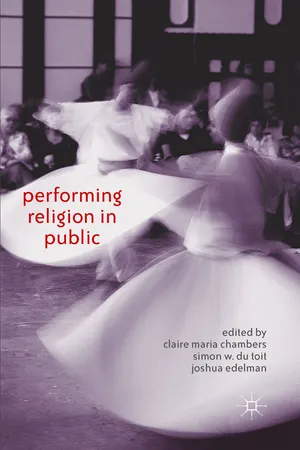
Religious life and public life are both passionately performed, but often understood to exclude one another. This book's array of voices investigates the publics hailed by religious performances and the challenges they offer to theories of the democratic public sphere.
Information
Publics and the Non-Democratic State
1
The Market for Argument
Significant cultural changes in England in the early modern period produced what Victor Turner calls a ‘social drama’1 that endured for centuries. Those changes created the conditions for the emergence of publics long before the print culture associated with eighteenth-century coffeehouses contributed to the construction of democratic nations. In this chapter I want to trace how the performance of religion in public became a crucial aspect of the struggle to control the politics and religious culture of early modern England. The public performance of private religious identity was the crux of a struggle between radical puritan2 reformers and supporters of Queen Elizabeth’s via media, the middle road between Catholic and Protestant that seemed necessary to avoid civil war. The increasing political and social significance of performance in shaping civic order in early modern England emerges clearly in the puritan determination to assert its religious efficacy. That determination was expressed, in part, as antitheatricality. As puritans developed performance strategies as the central means of constructing a puritan counterpublic,3 antitheatricality emerged in the 1570s as a marker of their effort to shape a reformed, new England. This struggle between kinds of performance demonstrates the power of performance to reciprocally order both interiority and social space in early modern England.
The recent, ambitious Making Publics project4 has offered a rich reading of those cultural changes. Among them were the growth in power of a centralized government, a new understanding of publicity and privacy, the increasing commodification of theatre performance, and a religious revolution. Torrance Kirby’s contribution to Making Publics weaves those threads into a fabric he calls the ‘culture of persuasion’ that developed out of the newly Protestant national church in England. As a person’s private convictions were increasingly at stake in religious practices, Kirby suggests, the locus of faith shifted from a sacramental tradition towards an evangelical interiority.5 Paul Yachnin’s analysis of Hamlet, for example, points out that Shakespeare’s play includes both Catholic and Protestant elements. Hamlet has returned from Wittenberg, which many in the early modern audience would have recognized as the site of Luther’s Protestant university; and Hamlet’s ghostly father has returned from purgatory, a distinctively Catholic space, to charge the young prince with a new task. The play, and Shakespeare’s theatre, therefore contributed by means of performance to the production of a new English public, by providing a space in which the decisive issue dividing the nation could be approached in a less threatening, fictional space. As Yachnin points out, that space is ‘attenuated’ by its fictional nature.6 And there lies the rub: it was precisely the theatrical attenuation of the authority of public speech to which puritans, beginning in the late 1570s, vociferously objected. The Vestiarian Controversy of 1566, the first significant public conflict involving the puritan movement, seemed on the surface to have been about whether or not ministers had to wear a surplice during services. It was in fact a struggle over the limits of the authority and efficacy of religious speech; the puritans were unwilling to concede that any aspect of worship could be described as adiaphora, or ‘thinges indifferent’. The puritan body revealed in early modern religious politics is, above all, a body that performs a resistant refusal to be silenced. It claims the right to speak about any matter it views as having ritual significance, and to circulate that speech in public.7 This chapter will explore puritan performance through a brief glance at the work of Rev. Richard Greenham, and a more careful reading of a sermon performed by Rev. John Stockwood. Greenham was a pioneering practitioner of puritan ‘practical divinity’8 whose ministry in Dry Drayton, Cambridgeshire in the 1570s and 1580s offered leadership to the puritan movement. Stockwood’s sermons have been most widely known as antitheatrical pamphlets. Through a discussion of Greenham and Stockwood’s performance methods, I hope to show the contribution of public religious performance to the emergence of a counterpublic in early modern England.
Rev. John Stockwood delivered two sermons at Paul’s Cross, London, on 24 August 1578 and 10 May 1579. Later antitheatrical pamphlets used the Paul’s Cross sermons of Stockwood and Thomas White as authority and precedent; the sermons circulated and re-circulated in print. I will suggest, however, that Stockwood’s sermons can be read as resistant political action whose embodied performance, delivered with the fire of passionate preaching for which many puritans were notorious, produced his social status. Stockwood’s preaching contributed to the construction of a puritan counterpublic, and the circulation of a resistant order of both private interiority and public space. Consumption, digestion, and circulation of discourse that shaped bodily order produced performances such as Stockwood’s, and contributed significantly to the market value of prophetic performative speech.9 The evidence presented below suggests that the performative authority puritans accorded to ritual speech placed ritual performance into circulation in distinctive ways in early modern London. Consumers sought it out because of its perceived efficacy, and therefore protecting its efficacy was of paramount importance.
To attend to Stockwood’s deployment of performance strategies I will examine three important aspects of place in performance: the bodily, the geographic, and the textual. Paul’s Cross blended church, state, and discursive authority in early modern London, as it was at once the seat of the Bishop of London, the pulpit from which official state policy was often announced, and the centre of London’s bookselling trade. I will anatomize the role of embodiment in Stockwood’s assertion of a proper social order, in both its public and its private aspect. The proper order of the affections in the humoral body emerges, in Stockwood’s view, as a crucial aspect of preaching efficacy. Finally, I will trace the patterns of circulation that enabled Stockwood to participate in the construction of the resistant power constituted in the puritan poetic world.
Performance in puritan culture
In early modern English puritan culture, preaching was connected to many other practices structured around the consumption and performance of prophetic speech. As Michael Warner notes, ‘embodied sociability’ often troubles or displaces the ‘ideology of reading’ that marks a public.10 Prophetic speech was a marker of puritan social status, and was intended to circulate across parish and other social boundaries into the marketplace. Puritan ritual practices such as the establishment of lectureships, outdoor fasts, and regional ‘prophesyings’11 offered varieties of preaching, differing from sermons in that they were held on market day and were open to a general public, and their focus was more overtly educational than hortatory. Domestic practices – conferring with others, Sabbath exercises, daily devotions in the home, and repetition (the practice of repeating back the key points of sermons) – were constructed by means of prophetic speech.12 Puritan speech practices were so distinctive and effective as social markers that playwrights of the day were able to caricature puritans on the stage by only slightly exaggerating their idiom, as is shown perhaps most famously in Ben Jonson’s Bartholomew Fair. Patrick Collinson has even suggested that what has come to be thought of as puritanism was in fact an invention of the early modern theatre.13
The connection between embodiment, performance, and social order in puritan culture is evident in the privileging of speech as an aspect of the interiorization of religious authority to which Kirby alludes. The social order of the family was central to the uptake of prophetic speech in puritan culture, as was suggested, for example, by the puritan preacher Richard Greenham: ‘If ever wee would have the church of god to continue long among us, wee must bring it into our housholds, and nourish it in our families.’14 The male head of the puritan family took up and reiterated the edifying authority of the preaching minister, and included everyone in the household, including children and servants, in daily devotions, repetitions after church, and catechism training.15
The ordering action of prophetic speech was perceived as a physiological aspect of interiority. The performance of prophetic speech had to be sustained continuously if it was to maintain order and efficacy. For example, the citation below from Greenham’s ‘Treatise of the Sabboth’, which is given the marginal note ‘Preparation to the Sabboth’, warns of the consequences of failing to pray properly before worship:
For what is the cause why in the prayers of the Church wee so little profit? what causeth the word to be of so small power with us? whereof commeth it that the Sacraments are of such slender account with us? Is it not because we draw neere to the Lord with uncatechised hearts, and uncircumcised eares, without prepared affections, and unschooled senses: so that we come unto and depart from the house of God with no more profit, then wee get at stage-playes, where delighting our eyes and eares for a while with the view of the pageants, afterward we vainly depart?16
For Greenham, the inability of ‘stage-playes’ to produce any ‘profit’ has little to do with any inherent quality of their own, but rather has to do with the proper ordering of the body. If ‘wee’ are to profit from preaching, if the ‘Sacraments’ and the prayers of the faithful are to have any authority and efficacy, the place for them within the interiority of the ordered humoral body must be prepared. Greenham carefully anatomizes the loci of interior order in this passage: hearts, affections, and the senses particularly of eye and ear. These must be ‘schooled’ and ‘circumcised’ in preparatory prayer if the Word is to resound in our mouths; and the responsibility for any failure of its efficacy is therefore human rather than divine. Greenham’s statement locates the authority of acceptable ritual in the full process of prophetic performance exercised upon puritan interiority. He distinguishes that process from unacceptable ritual in which the process of interior ordering is incomplete. Vain church attendance is just as empty as the vanity of ‘stage-playes’. Although they might delight the eyes and ears for a while, ‘stage-playes’ lack the authority to rightly order the ritualized godly body. Delight of the unschooled senses and affections occurs in a place from which we vainly depart. Interior order, expressed in the humoral vocabulary of the body, gave authority to puritan speech; understanding, affection, and memory replaced statues, chalices, and stained glass windows as the places that marked ritual practice. By means of a distinctive cultural disposition to produce, market, and consume prophetic performance, Greenham’s view of puritan speech strove to map interiority among the faithful. In the antitheatrical sermons of John Stockwood, the reciprocal correspondence between interiority and public space may be clearly seen.
The sermon performances of John Stockwood
Stockwood’s preaching performance was an effort to re-inscribe the civic space of the city – a performance that resisted the force of sovereign authority in order to make and market what Warner calls an ‘alternative poetic world’. The public preaching of the English Reformation initiated a genealogy of preaching performance, surrogated in future Protestant Christian preaching performances, within which puritans used preaching to construct a counterpublic. Puritan preaching challenged the boundaries between public and private, and by doing so effectively politicized interiority. I will suggest that the mapping of the body performed in puritan public preaching functioned by means of a ‘market for argument’, a reflexively circulating body of public discourse t...
Table of contents
- Cover
- Title
- Copyright
- Contents
- List of Figures
- Acknowledgements
- Notes on Contributors
- Introduction: The Public Problem of Religious Doings
- Part I: Publics and the Non-Democratic State
- Part II: Visceral Publics
- Part III: Publics and Commodification
- Part IV: Ephemeral Publics
- Index
Trusted by 375,005 students
Access to over 1.5 million titles for a fair monthly price.
Study more efficiently using our study tools.
Frequently asked questions
Yes, you can cancel anytime from the Subscription tab in your account settings on the Perlego website. Your subscription will stay active until the end of your current billing period. Learn how to cancel your subscription
No, books cannot be downloaded as external files, such as PDFs, for use outside of Perlego. However, you can download books within the Perlego app for offline reading on mobile or tablet. Learn how to download books offline
Perlego offers two plans: Essential and Complete
- Essential is ideal for learners and professionals who enjoy exploring a wide range of subjects. Access the Essential Library with 800,000+ trusted titles and best-sellers across business, personal growth, and the humanities. Includes unlimited reading time and Standard Read Aloud voice.
- Complete: Perfect for advanced learners and researchers needing full, unrestricted access. Unlock 1.5M+ books across hundreds of subjects, including academic and specialized titles. The Complete Plan also includes advanced features like Premium Read Aloud and Research Assistant.
We are an online textbook subscription service, where you can get access to an entire online library for less than the price of a single book per month. With over 1.5 million books across 990+ topics, we’ve got you covered! Learn about our mission
Look out for the read-aloud symbol on your next book to see if you can listen to it. The read-aloud tool reads text aloud for you, highlighting the text as it is being read. You can pause it, speed it up and slow it down. Learn more about Read Aloud
Yes! You can use the Perlego app on both iOS and Android devices to read anytime, anywhere — even offline. Perfect for commutes or when you’re on the go.
Please note we cannot support devices running on iOS 13 and Android 7 or earlier. Learn more about using the app
Please note we cannot support devices running on iOS 13 and Android 7 or earlier. Learn more about using the app
Yes, you can access Performing Religion in Public by J. Edelman, C. Chambers, S. du Toit, J. Edelman,C. Chambers,S. du Toit,Kenneth A. Loparo,Simon du Toit, J. Edelman, C. Chambers, S. du Toit, Simon du Toit in PDF and/or ePUB format, as well as other popular books in History & Social History. We have over 1.5 million books available in our catalogue for you to explore.