eBook - ePub
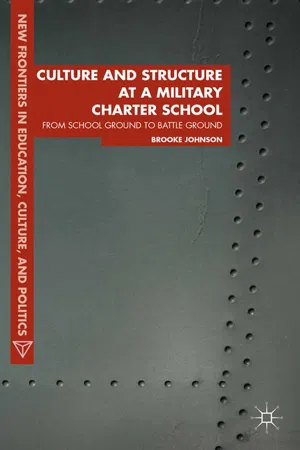
Culture and Structure at a Military Charter School
From School Ground to Battle Ground
- English
- ePUB (mobile friendly)
- Available on iOS & Android
eBook - ePub
Culture and Structure at a Military Charter School
From School Ground to Battle Ground
About this book
Taking military charter schools as her subject, and drawing on years of research at one school in particular, Brooke Johnson explores the underpinings of a culture based on militarization and neoliberal educational reforms and probes its effects on individual identity and social interactions at the school.
Information
Topic
EducationSubtopic
Education Administration1
Introduction
It is almost 8 a.m.; cadets are picking their way across the dew-covered grass toward the back courtyard for morning formation. Backpacks and lunchboxes are discarded as cadets step off the grass onto the cement square to shuffle toward their platoons where they stand huddled together, sleepily awaiting commands. Teachers mill around the courtyard with clipboards, checking uniforms, taking note of who has arrived while keeping the more spirited students in line. Several cadets carrying four dark brown show rifles arrive with the US and California flags. The rifles are dispersed among the color guard at the top of the courtyard. A young campus aide, Sarah, struggles to pull the mobile speaker system across the field despite its small plastic wheels catching in the wet grass. A few mothers stand on the grass near the color guard, discussing school events and swapping information about the cheapest place to buy the required school uniforms. Their arms folded as they keep one eye trained on their child. The school’s commandant strides across the field wearing a bright yellow polo with the school’s insignia embroidered in black on the left breast, pressed black pants, and shined shoes. As he approaches, the students gather together; platoon leaders shout commands that ring out across the courtyard. The group of huddled students snaps to attention in perfectly aligned blocks, staring ahead, unflinching. The commandant nods to the color guard and to Sarah. The flags are presented, rifles slide through gloved hands, and a solemn military march sputters from the depths of the mobile speaker system.
US culture is filled with the images, values, and overtones of the military: surveillance, cell phone tapping, live television broadcasts of invasions and bombings, bumper stickers that read “Support the Troops” and “Got War?,” metal detectors, bullet-shaped cologne dispensers, boot camp–style fitness classes, the National Rifle Association, Troops-to-Teacher programs, camouflage-clad brides, air shows, urban warfare video games, and the War on Poverty, Crime, Drugs, and Global Terrorism. Our public spaces are being booby-trapped, and our private lives bombed by a culture of violence and war inline with military ideologies and values. Schools such as Virginia Tech and Sandy Hook Elementary have become the public spaces for the enactment and media spectacle of societal violence in the form of mass shootings and nonstop media coverage. As we lay prone in front of our TV sets and watch the latest invasion unfold and the latest scenes of domestic and global violence, neoliberalism churns our public lives into private supersized profits.
The connection between militarization and neoliberalism is not a recent phenomenon as the US military has long been the trailblazer of US neoliberal policies, deploying the US military in defense of US global financial and corporate interests. However, the trend toward the privatization and corporatization of public education and the implementation of neoliberal values into the public education system is heralded as a quick and easy fix for low test scores, underperformance, and violent city schools. The privatization and corporatization of public education runs parallel with the increasing militarization of the education of US children, where metal detectors, bag searches, security officers, uniforms, and military personnel are standard in US public schools. Local schools are being transformed into publicly funded, privatized militarized zones with no one questioning the rapid transformation from public to private, from civilian to enlisted, and from learning ground to battleground. The militarization and invasion of a culture of militarism into public education could not have occurred without the simultaneous advancement of neoliberal policies and ideals.
Neoliberalism is a political economic theory premised upon the argument that free markets, free trade, and private property rights are avenues to human prosperity and freedom. One outcome of neoliberal educational reforms is publicly funded charter schools. The first charter school in the United States opened its doors in 1992. As of the 2011–2012 school year (most recent data available at the time of publication), there were 5696 charter schools nationwide (US Department of Education 2013b), with the state of California leading with 985 charter schools followed by Texas with 581 and Arizona with 531 (US Department of Education 2013c). Charter schools are exempt from some of the curricular and structural requirements of regular public schools and an emerging trend among charter schools across the United States is the increasing number of militarized charter schools—the Military Educational Institute (MEI) is one such school. How did the US public education system get to this point, where militarized educational institutions are viewed as a solution to failing US schools? What effects will schools like the MEI have on communities and students they serve?
This book highlights the nexus of neoliberal school policies and the militarization of US public education through a qualitative study of a fully militarized charter school in Southern California. Specifically, this book examines militarization and the interactions of race, class, gender, and sexualities in the lives of students enrolled at the MEI, their parents, and teachers. The questions addressed in this book are: How does a militarized school affect student lives and their families? How do school practices at a militarized charter school promote neoliberal goals and values? How do school personnel and students promote the mission of a militarized charter school? Does militarization affect the construction of gender and sexualities at the school? Finally, is there resistance to militarization, and if so how is it enacted? To explore these connections, I utilize theories of education, sociological theories on gender, and cultural studies including discourse analysis and queer theory. I specifically utilize queer theory and cultural studies to extend the theoretical framework of reproduction and resistance theories of education. I conclude with ways in which to discursively and materially resist militarization of youth across personal, community, institutional, and global levels.
In order to fully grasp the everyday lives and choices of the cadets and parents at the MEI, it is important, I argue, to have a complete understanding of the intricacies between neoliberalism, militarization, and public education. Thus, in this chapter I set the theoretical context for the remainder of the book. I begin with a brief overview of militarization and how it differs from militarism. A section in which I outline neoliberal ideology and its application to public education follows. I argue that neoliberal reforms exploit and exacerbate social inequality and are concentrated in poor communities and schools of color coinciding with the militarization of public education. This book not only examines the everyday culture and practices of militarization at the MEI but also how MEI students resist and challenge these practices. To that end, a overview of theories of education, including reproduction and resistance theories, precedes a general overview of the organization of this book.
Militarism, Militarization, and Education
Enloe (2000, 3) defines militarization as the “step-by-step process by which a person or a thing gradually comes to be controlled by the military or comes to depend for its well-being on militaristic ideas.” Militarization is both a discursive and a material process involving the ongoing process of aligning cultural, institutional, and economic forms with militaristic values, beliefs, and practices. What is particularly powerful about militarization is its subtlety in that as institutions, practices, and people become militarized, the transformation and outcomes are viewed as acceptable, valuable, and, more importantly, normal (Enloe 2000). For example, in a militarized society or community, it becomes acceptable and thus normalized that the effective solution to any number of social issues, such as failing pubic schools or inner city crime, is militarized discipline such as on-campus surveillence video and city police raiding homes with flash grenades. Even the media is militarized as war and imagery of war are considered a genre of entertainment and highly profitable (Mann 1992).
Although militarism and militarization are often used interchangeably, they are quite separate terms with quite disparate theoretical explanatory power. Militarism is a much narrower concept referring to a cultural project in which ideologies and priorities are inline with martial values. Militarism often resides in the political realm and refers to moments of heightened military frenzy as in times of war preparation. Militarization, on the other hand, “draws attention to the simultaneously material and discursive nature of military dominance” (Lutz 2002, 725) to shape society. Thus, militarization makes sense of how institutions and practices are defined and valued though the dominance of the military and ongoing and subtle process of societal transformation. The importance of militarism should not be dismissed, however, as a culture of militarism allows for or assists with the acceptance and naturalization of militarization (Adelman 2003).
When examining militarization and its impacts and effects on social institutions such as education, it is important to employ an intersectional lens. Doing so illustrates how the process and effects of militarization vary across and within groups as well as how militarization intersects, interacts, and fuels inequalities, privileges, and power. Social structures of inequalities as well as racist, sexist, and homophobic ideologies can be employed to further militarization and violence. For example, Saltman and Gabbard (2003, 2011) examine how public schools are sites for the enforcement of neoliberal ideologies and corporatization of education through the strong arm of militarization. In Sexual Decoys: Gender, Race and War, Eisenstein (2007) illuminates how the militarization of gender, race, sexuality, and feminist principles further US neoliberal imperial politics. Smith (2005) examines the link between militarization and environmental racism highlighting the extensive and almost exclusive practice of nuclear testing on indigenous lands. Finally, Stephen (2008) contends that the militarization of the US-Mexico border has had deadly and gendered consequences on those who live and cross through these border zones. Taking a critical and intersectional approach to understanding militarization illustrates how power is wielded across institutions (like public education) and structures of inequalities and fans the flames of continued militarization. In the following sections, I will examine the application of neoliberal ideology to public education across two broad neoliberal ideological concepts: choice and accountability.
Neoliberalism: Roots and Emergence in US Education
Public education reform, since the 1980s, is predicated upon neoliberal economic doctrine and includes trends such as militarization, privatization, and corporatization of US schools (Giroux 2009; Robbins 2008; Saltman and Gabbard 2011). Coupled with neoliberal ideals and policies, these trends are presented as solutions for a failing US public education system. Most of these failing schools are underfunded, overcrowded, and located in poor and working-class communities of color (Saltman 2000) and few students who attend these schools “make it.” It is the failing or crisis of public education in the United States that creates the allowance for neoliberal reform, which usually takes place as privatization of public education in the form of vouchers, charter schools, and corporate control and oversight of testing.
Milton Friedman, the ringmaster of free-market capitalism, argued that moments of crises—actual or perceived—are the only times when significant change can occur (1962, ix). In The Shock Doctrine: The Rise of Disaster Capitalism, Naomi Klein (2007) examines how neoliberalism rose to prominence through the exploitation of disaster. That is, when societies are experiencing shock due to a disaster (wars, natural disasters, economic crashes), the societal disorientation can be exploited to impose neoliberal economic doctrines. This is what Klein (2007) terms “disaster capitalism” or the corporate reform of societies in shock, and this began with the reforms and privatization that took place with the Pinochet regime (based on Friedman’s advisement) in the mid-1970s in Chile. While Klein’s work looks specifically at the neoliberal aftermath and greed of actual disasters, such the 2004 tsunami in the Indian Ocean, Friedman himself argued that there only has to be a perceived crisis in order to implement neoliberal reforms. Low reading scores of city schools (Banchero 2010b), below-average competency in math of US students since 2000 (Layton 2013), and the raced and classed portrayals of violent poor schools (Giroux 2009; Robbins 2008) are examples of such an opportunity of crisis in public education.
Similarly to Klein, Harvey (2005) describes it as “accumulation by dispossession,” and Saltman (2007) argues that current privatization initiatives and neoliberal ideology in education reform are part of “smash and grab” capitalism that aims to destroy public schools in order to privatize them and must be understood as the intersection of neoliberalism with neoconservative ideology. Neoliberal ideology contends that public control of public resources (education, health care, social security) is inefficient and overly bureaucratic, while private control is efficient through the discipline of the market. As many scholars have pointed out (Klein 2007, Saltman 2007), there is no starker example of accumulation by dispossession than New Orleans post–Hurricane Katrina. Local and national business interests took advantage of the chaotic aftermath of Hurricane Katrina to outright plunder and privatize the city’s public housing and education system. For example, just weeks after the hurricane the state dismissed all public school teachers, took over a hundred public schools, and began turning them over to private organizations (Saltman 2007). Prior to the hurricane, there were five charter schools, and in the 2012–2013 school year 72 of 90 schools in New Orleans were charter schools (Cowen Institute 2013).
An important and disturbing aspect of neoliberal logic is that capitalism is equated with democracy. Within neoliberal ideology, democracy is defined not through a political or social context but rather as the unchaining of markets from state control. Democracy under neoliberalism is an economic form of corporate control, increasing consumerism, the ability to accumulate profit, and the turning over of public holdings to private interests. The role of the state is to ensure that the right conditions are in place to sustain such practices—to ensure economic freedom. Thus, freedom is defined as freedom from the oversight and control of the state and has led to the dismantling of the welfare state. The laws and health of the marketplace take precedence over the public good, and the social state, through neoliberal values and goals, is transformed into a corporate state, serving the interests of the marketplace. Thus, public resources are converted into resources for corporate gain and control through privatization schemes. This is particularly true for public education as public schools are increasingly defined as a source of private profit (rather than a public good) through privatization schemes such as vouchers and corporate-run charter schools.
Although proponents argue that neoliberalism is democratic, it is directly opposed to democracy and democratic ideals. Neoliberalism exacerbates social inequalities (Navarro 2006), as social inequalities and social problems are economically defined and constructed as another market for profit accumulation (the privatization of prisons is a great example see Selman and Leighton 2010). Additionally, those citizens who cannot or do not consume (such as those victimized by historical social processes of racism, sexism, homophobia, or inequalities of class) are in need of control by a disciplinary and surveilling state. In Discipline and Punish, Foucault (1977) sets forth that the modern society (modern neoliberal state) controls people through the imposition of norms (normalization). The ability or inability of people to meet normative standards is used to justify reforms or “disciplinary” measures of control. The “disciplinary” aspect of modern society, inherent in neoliberal theory, is pervasive and extends to a variety of aspects of social life and social institutions. For education this translates to the discipline of accountability measures such as standardized testing and merit pay for teachers, as well as disciplinary policies of zero tolerance and militarization of public schools to control “violent” raced and classed students.
Chubb and Moe (1990) recommended a new system for US public education in their book, Politics, Markets and America’s Schools. Their proposal was heavily influenced by Friedman and based educational reform and success upon free markets and four related concepts of neoliberal ideology: competition, choice, accountability, and efficiency. They argue that market choice–based education allows the clientele (parents and students) the power to switch from school to school in order to find a school that best meets their needs and expectations. Schools are, then, in competition with one another and are accountable to please parents and students, as parents and students always have the choice to switch schools. Schools are also accountable to the state in regard to minimum educational criteria, nondiscrimination laws, standardized test scores, and “anything else that would promote informed choice among parents and students” (Chub and Moe 1990, 224–225). According to the theory, schools that are unable to satisfy a large enough population or market share will fail and close. The schools that survive, however, do so because they are not only able to effectively compete for the business of parents and students, but they are also successful by performing as efficiently as possible and stripping away the “dysfunctions” of bureaucracy (Chubb and Moe 1990). According to Chubb and Moe, US education as a whole will improve as noncompetitive (read “bad”) schools will fail, while competitive (read “good”) schools will prosper. This will simultaneously raise the educational performance and standards of US students. One of the most successful neoliberal “choice” reforms, is charter schools and they are examined in the following section.
Choice and Charter Schools
Charter schools are public, as they are funded with state tax monies, but are exempt from most state laws governing school districts.1 Charter schools are an alternative to traditional public schools and viewed as a way out of failing schools. Additionally, charter schools are unique in that they are not held to many state controls (teacher unions, teacher credentials, curriculum, for example) and are allowed to build curriculum and structure the schools under a variety of models including but not limited to science, art, college prep, vocational, and militarized.
Although charter schools have been quite popular across the United States, they are not without drawbacks. First, charter schools drain off already scarce district and statewide resources. There is limited money available for financing public education, and charter schools redirect portions of this money away, thus limiting the finances available for struggling schools. Additionally, most charter schools locate in areas where schools are failing because competition from these schools is low (Henig and MacD...
Table of contents
- Cover
- Title
- 1 Introduction
- 2 Schools in the Crosshairs: Neoliberalism, Militarization, and Public Education
- 3 Sending Good Kids to Military School: Why Parents Choose the MEI?
- 4 Reading, Writing, Arithmetic, and War: Militarized Pedagogy and Militarized Futures
- 5 A Few Good Boys: Masculinity at the MEI
- 6 Ask, Tell, Talk Back: Queering Resistance to Gendered Heteronormativity
- 7 Conclusion
- Notes
- References
- Index
Trusted by 375,005 students
Access to over 1.5 million titles for a fair monthly price.
Study more efficiently using our study tools.
Frequently asked questions
Yes, you can cancel anytime from the Subscription tab in your account settings on the Perlego website. Your subscription will stay active until the end of your current billing period. Learn how to cancel your subscription
No, books cannot be downloaded as external files, such as PDFs, for use outside of Perlego. However, you can download books within the Perlego app for offline reading on mobile or tablet. Learn how to download books offline
Perlego offers two plans: Essential and Complete
- Essential is ideal for learners and professionals who enjoy exploring a wide range of subjects. Access the Essential Library with 800,000+ trusted titles and best-sellers across business, personal growth, and the humanities. Includes unlimited reading time and Standard Read Aloud voice.
- Complete: Perfect for advanced learners and researchers needing full, unrestricted access. Unlock 1.5M+ books across hundreds of subjects, including academic and specialized titles. The Complete Plan also includes advanced features like Premium Read Aloud and Research Assistant.
We are an online textbook subscription service, where you can get access to an entire online library for less than the price of a single book per month. With over 1.5 million books across 990+ topics, we’ve got you covered! Learn about our mission
Look out for the read-aloud symbol on your next book to see if you can listen to it. The read-aloud tool reads text aloud for you, highlighting the text as it is being read. You can pause it, speed it up and slow it down. Learn more about Read Aloud
Yes! You can use the Perlego app on both iOS and Android devices to read anytime, anywhere — even offline. Perfect for commutes or when you’re on the go.
Please note we cannot support devices running on iOS 13 and Android 7 or earlier. Learn more about using the app
Please note we cannot support devices running on iOS 13 and Android 7 or earlier. Learn more about using the app
Yes, you can access Culture and Structure at a Military Charter School by Brooke Johnson in PDF and/or ePUB format, as well as other popular books in Education & Education Administration. We have over 1.5 million books available in our catalogue for you to explore.