eBook - ePub
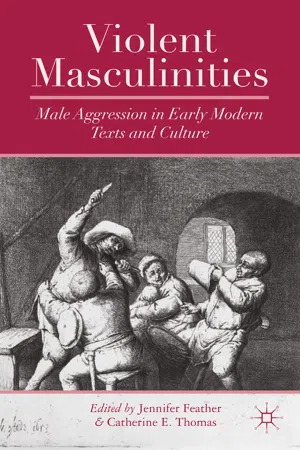
Violent Masculinities
Male Aggression in Early Modern Texts and Culture
- English
- ePUB (mobile friendly)
- Available on iOS & Android
eBook - ePub
Violent Masculinities
Male Aggression in Early Modern Texts and Culture
About this book
During the early modern period in England, social expectations for men came under extreme pressure - the armed knight went into decline and humanism appeared. Here, original essays analyze a wide-range of violent acts in literature and culture, from civic violence to chivalric combat to brawls and battles.
Information
PART I

“DISPUTE IT LIKE A MAN”: MILITANT MASCULINITIES
CHAPTER 1
MILITANT PROLOGUES, MEMORY, AND MODELS OF MASCULINITY IN SHAKESPEARE’S HENRY V AND TROILUS AND CRESSIDA
Susan Harlan
In The Pleasure of the Text, Roland Barthes invokes “the children’s game of topping hands” as a figure for the textual layering of significance: “the excitement comes not from a processive haste but from a kind of vertical din (the verticality of language and of its destruction); it is at the moment when each (different) hand skips over the next (and not one after the other) that the hole, the gap, is created and carries off the subject of the game—the subject of the text.”1 This formulation interests me for two reasons: first, because Barthes understands the process to be one of skipping over rather than succession, and second, because he locates “the subject of the text” in this gap, in a voided space that exists between. This chapter is about the speaking position of the militantly masculine Shakespearean chorus, a figure that occupies a liminal temporal and spatial position, a position between.2 The Oxford English Dictionary defines “liminal” as pertaining to a threshold; a liminal space is transitional or indeterminate, and a subject occupies it only temporarily. During this circumscribed time and in this circumscribed space, the choral figure transmits the subject of the play—or the “necessary question of the play,” (3.2.42) as Hamlet puts it—by directly addressing his audience. He helps his audience to skip over the temporal and performative gap between present and past, stage and nonstage, actor and audience, but he also draws attention to this gap as real.
Two of Shakespeare’s war plays, Troilus and Cressida (c. 1602) and Henry V (c. 1599), associate the liminal figure’s responsibility of skipping over with anxieties about the audience’s memory of models of militant masculinity.3 Both plays engage with their audience’s collective memory of past wars, both real and mytho-poetic. But the memory of war is also “prosthetic” rather than lived, and of course, the plays must create this memory even as they figure themselves as activating a mode of memory that already exists.4 By exposing the difficulties inherent in the performance of a violent national past, the plays complicate the performance of chivalric and heroic masculinity. These liminal or framing figures point to a crisis in translating past models of masculine militancy across time; they establish these models as out-of-date, moribund. In this sense, the plays are in dialogue with the medieval and early modern rhetorical tradition of the exemplum, illustrative anecdotes with moral points. As Francois Rigolot notes, “In the Renaissance the uplifting reading of ancient exemplars was closely related to the doctrine of imitation, the sacrosanct recourse to inherited cultural models.”5 Troilus and Cressida voids out the possibility that the participants in the Trojan War could serve as models of military valor or values, and Henry V stages the problematic exploits of a strong king and his fractured “band of brothers” only to undercut his expansion of empire in the epilogue. The plays’ framing figures embody conflicts between present and past that mirror and anticipate the military conflicts in their respective plays.
Early modern English choruses encounter their audiences and offer mediated access to the past. This encounter and this “past” are unique in the performance of war. Memory and ethics are intimately linked; to remember is not a politically or ethically neutral act. Jonathan Baldo has noted of Henry V that “nationalist ideology and resistances to it take the form of collisions over memory.”6 Choral figures occupy a space of ethical “reckoning” with past military violence, to borrow a term from Jacques Derrida, even as they hold this past at a distance from their theatrical audience. They do not simply recount—they also evaluate and judge.7 In these war plays, this reckoning takes the form of an encounter with past models of militant masculinity. Of course, the humanist education by which one encountered epic and national narratives of military history was, crucially, masculine. As Alan Stewart notes, early modern English humanist education fostered “relations between men.”8 These choral figures foster fraught relations between men across time.
They also stand close to their audiences, and this proximity enables the “skipping over” that largely defines their theatrical role. This ethical mandate underscores their status as multitemporal: they forge connections between the theatrically represented past and the present moment of performance. Both gesture to the future, as well. The Chorus in Henry V compares himself to a prologue and is present only in the Folio version of the play. Unlike the prologue to Troilus and Cressida, he reappears before each act and in the form of an epilogue. He situates himself in the moment of the war and in the moment of performance, encoding himself as a surveyor of both. In his opening speech, he makes a conventional appeal for audience approval: “Admit me Chorus to this history: / Who prologue-like your humble patience pray, / Gently to hear, kindly to judge, our play” (1.0.33–5). The audience allows him to perform in the history—they “admit” him or allow him access—and he, in turn, places the burden of judgment on his auditors and allows them to evaluate the play. The prologue in Troilus and Cressida is dressed in armor, seemingly prepared to take part in the conflicts he narrates, but he also surveys the war at a distance. He both anticipates the play’s actions and looks back on them as a preserved masculine body of war, a body unharmed, a powerful body capable of transcending and negotiating time. In this sense, he is the equivalent of the returned soldier Henry V imagines in his speech before the battle of Agincourt: the armored prologue narrates the past at a future moment and participates in what Nick de Somogyi refers to as the “folklore of military afterlife.”9 He also appeals to the audience in his final lines: “Like or find fault; do as your pleasures are; / Now good or bad, ‘tis but the chance of war” (1.0.30–1). By aligning the chance of war with the chance of audience approval or disapproval, he suggests that aesthetic judgment is the means by which the audience will engage, and reckon, with the performance of past models of militant masculinity.
REMEMBERING AND FORGETTING MODELS OF MILITANT MASCULINITY
By remembering past events and ethical systems, history plays engage with present ones; the past is always a mirror of the present. What the Chorus remembers informs what, and how, his theatrical audience remembers. These plays thus perform an ethics of memory by way of choral figures that occupy a threshold between audience and play and between past and present. The liminal position of the Chorus enables it to intervene in the performance of the past by commanding and manipulating the audience. As Douglas Bruster and Robert Weimann note of prologues, they are both “before and apparently ‘outside’ the world of the play,” and, as such, they “negotiated charged thresholds between and among, variously, playwrights, actors, characters, audience members, playworlds, and the world outside the playhouse.”10 David Wiles argues that the collective Greek chorus had access to, and transmitted, a body of knowledge to the audience: “The chorus embody the collective wisdom of the community, for they refer allusively in their odes to a body of mythology familiar to the ancient audience.”11 The choral figure is also located in a liminal space, a space that is bound up in cultural understandings of the sacred and the social.12
Henry V and Troilus and Cressida are not often read together, although they were performed in close proximity to each other: Henry V was performed in 1599, and Troilus and Cressida was likely performed around 1602, although it was not published in quarto form until 1609. Henry V stages a central “charismatic” authority figure, to use Raphael Falco’s Weberian term, in relationship to his soldiers.13 The play foregrounds masculine militant homosociality—or what the king famously refers to as his “band of brothers”—but it also undercuts this cohesive vision by staging myriad conflicts between these so-called brothers. Henry’s yeoman army comprises men of many “nation[s]” (2.2.224) as MacMorris says, and the conflicts within the army mirror those that are anticipated with the French. Troilus and Cressida presents a group of petty participants in a debased and travestied version of the Trojan War, staged by way of an intervening chivalric tradition.14 As Andrew Hadfield reminds us, “the Tudors made extensive use of Geoffrey of Monmouth’s History of the Kings of Britain, in order to trace their ancestry back to the Trojan Brutus, descendant of Aeneas, and so record a translatio imperii from Greece/Troy to Rome to England/Britain.”15 Troilus and Cressida is self-conscious about the limitations of this nationalist undertaking.
In some ways, the two plays offer a Janus-faced treatment of militarism: Henry V is primarily an English history play, and Troilus and Cressida is now generally read as a comedy or dark satire that systematically debases the high seriousness of the participants in, and goals of, the Trojan War.16 But they also have much in common, generically. Critics have deemed both plays’ treatment of genre, nationalist attitude, and military ethos ambivalent. Norman Rabkin applied the term to Troilus and Cressida in 1967.17 And more recently, Claire McEachern has noted that “[t]he ambivalent practice and effect of Shakespeare’s Henry V is by now a critical commonplace.”18 The plays also share an investment in comedy. Henry V has comedic elements: it ends as comedies end, with a scene of wooing and the promise of marriage, and it stages a tremendous number of vocal and disruptive comedic characters—disruptive both within the play and to the genre of the English history play. Troilus and Cressida is a history of sorts, for although it was grouped among the tragedies in the First Folio, the title page of the quarto deems it “The Historie of Troylus and Cressida,” and the title page of the second “state” of the Quarto deems it “The Famous Historie of Troylus and Cressida.”
Militantly masculine liminal figures appear in English war plays of the 1580s and 1590s, and the choral figures in Henry V and Troilus and Cressida recall these earlier theatrical types, which are themselves already old fashioned. Jonathan Gil Harris notes:
Shakespeare’s second Henriad repeatedly palimpsests its characters with oriental despots, such as Cambyses of Persia, Tamburlaine of Scythia, Amurath of Turkey, and Herod of Jerry. These doublings not only conjure historical figures from the east; they also rehearse primitive acting styles from England’s theatrical past in a display of histrionic versatility designed to suggest a new theatrical future.19
Thomas Kyd’s The Spanish Tragedy (c. 1582–92) and Christopher Marlowe’s Tamburlaine the Great (c. 1587–88) both use liminal figures to explore the fraught relationship between present and past masculine values in war: Don Andrea in The Spanish Tragedy and the Prologue in Tamburlaine the Great, Part 1. Both plays remember, and complicate, models of militant masculinity by staging characters that insist on the centrality of memory to militantly masculine subjectivity. These liminal characters struggle to inculcate their theatrical audiences with outdated militant models, but their anxiety about remembering belies the limitations of this project. In Part 1 of Tamburlaine, the prologue rejects the “conceits” of comedy in favor of certain objects of war—namely a tent. This shift is imagined in generic and spatial terms. He announces: “From jigging veins of rhyming mother wits / And such conceits as clownage keeps in pay, / We’ll lead you to the stately tent of war” (1–3).20 His rejection of effeminate “rhyming mother wits” promises a future defined by a masculine aesthetic and located in a masculine space: the “stately tent of war.” The tent is a temporary space and an emblem of the play’s martial subject matter as well as the values of this new masculine militancy.21 It is also a figure for the theater itself: a circumscribed space not unlike the “wooden O” the Chorus in Henry V invokes. The theater is thus encoded as a masculine space, a s...
Table of contents
- Cover
- Title Page
- Copyright
- Contents
- Acknowledgments
- Notes on Contributors
- Introduction: Reclaiming Violent Masculinities
- Part I: “Dispute It Like a Man”: Militant Masculinities
- Part II: “The Faith of Man”: Religion and Masculine Aggression
- Part III: “Feel it as a Man”: Male Violence and Suffering
- Afterword
- Bibliography
- Index
Trusted by 375,005 students
Access to over 1.5 million titles for a fair monthly price.
Study more efficiently using our study tools.
Frequently asked questions
Yes, you can cancel anytime from the Subscription tab in your account settings on the Perlego website. Your subscription will stay active until the end of your current billing period. Learn how to cancel your subscription
No, books cannot be downloaded as external files, such as PDFs, for use outside of Perlego. However, you can download books within the Perlego app for offline reading on mobile or tablet. Learn how to download books offline
Perlego offers two plans: Essential and Complete
- Essential is ideal for learners and professionals who enjoy exploring a wide range of subjects. Access the Essential Library with 800,000+ trusted titles and best-sellers across business, personal growth, and the humanities. Includes unlimited reading time and Standard Read Aloud voice.
- Complete: Perfect for advanced learners and researchers needing full, unrestricted access. Unlock 1.5M+ books across hundreds of subjects, including academic and specialized titles. The Complete Plan also includes advanced features like Premium Read Aloud and Research Assistant.
We are an online textbook subscription service, where you can get access to an entire online library for less than the price of a single book per month. With over 1.5 million books across 990+ topics, we’ve got you covered! Learn about our mission
Look out for the read-aloud symbol on your next book to see if you can listen to it. The read-aloud tool reads text aloud for you, highlighting the text as it is being read. You can pause it, speed it up and slow it down. Learn more about Read Aloud
Yes! You can use the Perlego app on both iOS and Android devices to read anytime, anywhere — even offline. Perfect for commutes or when you’re on the go.
Please note we cannot support devices running on iOS 13 and Android 7 or earlier. Learn more about using the app
Please note we cannot support devices running on iOS 13 and Android 7 or earlier. Learn more about using the app
Yes, you can access Violent Masculinities by J. Feather, C. Thomas, J. Feather,C. Thomas in PDF and/or ePUB format, as well as other popular books in Literature & European Literary Criticism. We have over 1.5 million books available in our catalogue for you to explore.