- English
- ePUB (mobile friendly)
- Available on iOS & Android
eBook - ePub
Empire, Religion and Revolution in Early Virginia, 1607-1786
About this book
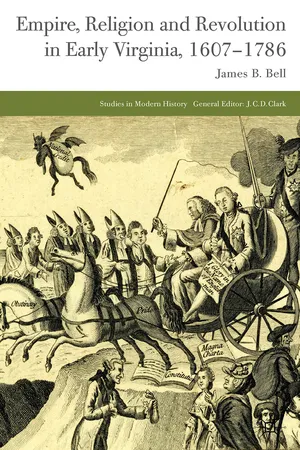
The book is a new study that examines the contrasting extension of the Anglican Church to England's first two colonies, Ireland and Virginia in the 17th and 18th centuries. It discusses the national origins and educational experience of the ministers, the financial support of the state, and the experience and consequences of the institutions.
Information
1
England’s Early Imperial Interests: Ireland and Virginia
The origin of the establishment of England’s first colony in the western hemisphere at Jamestown, Virginia, in 1607 is intimately linked to the nation’s long historical interest and extra-territorial venture in Ireland. For nearly a thousand years before the reigns of the first two Tudors, Henry VII and Henry VIII, in the fifteenth and sixteenth centuries, Ireland had been a land of notice for English monarchs. It was an attraction that began about 684 A.D. when an expeditionary force under the ealdorman Berht was sent to the Celtic Isle by the Northumbrian King Ecgfrith. England’s early historian Bede recorded that Berht ‘wretchedly devastated a harmless race that had always been most friendly to the English and his hostile bands spared neither churches nor monasteries. The islanders resisted force by force so far as they were able, imploring the merciful aid of God and invoking His vengeance with unceasing imprecations’.1 Five hundred years later, in 1155, Henry II requested authorization from the newly elected Pope Adrian IV to invade Ireland.2 Henry II acknowledged that the kingdom of Ireland belonged to the dominion of the church and could not, therefore, be subjected to any new ruler without the pope’s approval. Born Nicholas Breakspear and the only native-English pope, Adrian IV issued the Papal Bull Laudabiliter that granted authority to Henry to invade Ireland for the purpose of bringing its church under a closer association with the Roman Church, and conduct a general reform of governance and society throughout the land.3 It is a grant made in and for a world that preceded the emergence of strong nation states, one that was organized and governed by regional families holding claim to land in a defined geographical area. The authenticity of Laudabiliter is one of the great questions of history, but 860 years ago the instrument launched English overlordship on to Ireland. It is notable that decisions of Pope Alexander III confirmed Henry’s claim, as did those made by his successor, Pope Lucius III, and that Henry VIII‘s proclamation of the Crown of Ireland Act of 1542 was predicated on this document.4
Tudor King Henry VIII and his chief minister Thomas Cromwell forcefully applied the civil and ecclesiastical reforms established in England to Ireland. Seventy years later, at the dawn of the seventeenth century, the Stuart King James I under different circumstances, in an action that was to change drastically the course of imperial policy, granted a charter for a settlement in the western hemisphere to the Merchant Adventurers of the Virginia Company of London, and a colony was founded at Jamestown, Virginia in 1607.
The origin of a proposal to establish a colony in the New World lies in the last twenty years of the reign of Queen Elizabeth I. It was not an impulsive or whimsical idea but was grounded in the new knowledge of the region drawn from the recent Spanish and Portuguese voyages of exploration and settlement. A long debate flourished at court during the late reign of Elizabeth regarding the prospects for a second colony to be established in the western hemisphere that would act as a buffer to Spain’s presence and unknown intentions in the area. Spain’s perceived ambitions raised political and diplomatic alarms for the nation, signals that were proclaimed by Sir Humphrey Gilbert (1539–83), his half-brother, Walter Raleigh (1554?–1618), and the geographer Richard Hakluyt the Younger (1552 or 1553–1616).5
It is probable that knowledgeable advisors at Elizabeth’s court were not of one mind regarding another overseas colony. Many questions must have been raised regarding how the new overseas circumstances would affect and transform England’s national and international position. A primary concern must have been how England’s half-century of military and administrative experience in Ireland could shape the founding and development of a second colony. Presumably a range of alternatives were offered and debated by rival court factions. Perhaps one strongly supported continuing the forceful Irish military policy of subjugation of the population while another group advocated a less confrontational course.
Gathering, distilling, and broadcasting for an English audience the details of the recent international voyages, Hakluyt was a passionate student of the history of geography and a highly placed churchman. Single-mindedly, he collected, edited, and published narratives of the trailblazing mariners. His tracts were influential among highly placed courtiers and contributed substantially to shaping England’s national interests as an emerging political, commercial, and sea power. Raleigh and Hakluyt were the ideological advocates at the Queen’s court for an English imperial policy designed to foil Spanish ambitions and counter Spain’s settlements in Florida and elsewhere. It was in England’s interest to establish a presence in North America. The problem for England in the mid-1580s, as understood by Hakluyt and Raleigh, was that Spain blocked the path to North America. In fact, the whole American continent was closed by Spain to English settlers, goods, and religion. Thus, Hakluyt’s bold national policy risked war with Spain.6
For England’s national interests colonization was strategically vital: occupation of North America could command the Newfoundland fishing banks and the Spanish homeward route from the Indies.7 War against Spain was necessary in part as a religious act, to bring salvation to thousands, if not millions, of Native Americans who had been subjugated to popery and Spanish cruelty.8 Because of Spanish oppression, Hakluyt assumed that the Native Americans – ‘a poor and harmless people created of God’ – would offer willing allies against Spain. To minister to the conversion of the natives Hakluyt proposed settling the colonies with clergymen underemployed and restless at home.9 His comprehensive vision for England’s overseas settlements also recognized that the national church was an element of the expansion of the empire.10 Raleigh and Hakluyt’s intention was to replace the Spanish Empire with an English empire.11 They advocated a national policy that offered something to all sections of the community: underemployed Puritan ministers within the Church of England eager to extend true religion, City merchants and county manufacturers, discontented younger sons of the landed class, all, it seemed, had something to gain.
Accounts of the recent overseas voyages of exploration and discovery prompted Raleigh, Hakluyt, and Captain John Smith to plead with the government to counter the influence of Spain in the western hemisphere. While it was incumbent for England to shape a policy that would counter Catholic Iberian influence in the New World, the distance from the homeland, coupled with the memory of the Irish experience, may have reduced enthusiasm for expansion overseas. For two generations the champions for a second colony persistently tried but failed to convince successive governments of its expediency and viability. Their grand imperial design encountered little interest: not Elizabeth, nor James I, nor Charles I had any use for a new imperial policy. In fact neither James I nor Charles I ever sent a ship across the Atlantic. But to many merchants and government ministers, and to a large group in the House of Commons over the years, the strategy was compelling. Rather than a department or agency of the English government undertaking and implementing the extension and development of an overseas settlement, a new policy was introduced that drastically revised the system for English overseas expansion and settlement.
A new imperial policy emerged in 1600 that provided a framework for England’s seventeenth-century extra-territorial interest. Beginning as early as 1407 merchants in London and other major ports engaged in trade exporting cloth to the Netherlands, originally to Bruges and, by 1446, to Antwerp.12 Depots were established in several continental cities and flourished throughout the sixteenth and seventeenth centuries. Merchant adventurers were risking their money in speculative commercial opportunities in Europe13 and their great innovation, the new channel for overseas expansion and development, was the London merchant adventurer companies, to whom the opportunities for commercial colonial ventures were delegated. In contrast to the long Irish experience, the English government was not responsible for providing civil and ecclesiastical personnel to undertake the establishment, administration, and development of the American colony. It was the Virginia Company’s burden to govern the settlement, dispatch military forces to protect it, quell opposition from Native Americans, and maintain a steady, regular flow of ships to support the outpost 3700 miles distant from London.
Elizabeth inaugurated the model for the new system on 31 December 1600 when she granted a charter to the merchant adventurers of the East India Company.14 The company was formed initially for pursuing trade with the East Indies, but ended up trading mainly with the Indian sub-continent and China. The company acted as the primary agent for colonization. The Queen’s grant of the charter to the company set a precedent for settlement in America for the next three decades. Elizabeth’s successor, James I, granted a charter to the merchant adventurers of the Virginia Company of London in 1606, and the company undertook the colonization at Jamestown under Captain John Smith in 1607. A comparable charter was granted by the crown to the Somer Isles Company in 1615 as a commercial venture to operate the English colony of the Somer Isles, also known as Bermuda. Two decades later James I granted charters for the New England settlements established by the Plymouth Company (1620), and the Dorchester Company (1627), and his brother, Charles I, followed with a charter to the Massachusetts Bay Company (1629) at Salem and in Boston. Later, individual proprietors such as Charles Calvert in Maryland (1634) and William Penn (1680) in Pennsylvania received charters and grants of land to undertake their proposed colonies.
King James I’s decision in 1606 to delegate to the Virginia Company of London the responsibility to undertake an English settlement liberated the crown from the expense of governing and supplying a far distant territory. The king did not apply in America the forceful and comprehensive program of governance applied in Ireland in the 1530s and 1540s and embraced by Elizabeth throughout her 45-year reign. James recognized that Ireland had not proved to be the source of a steady stream of revenue for the English crown over 70 years, and he saw that it was necessary to control the ever-increasing expense of maintaining a civil, military, and ecclesiastical establishment in the country. Ireland had been a costly project for the government, and a drain of funds between 1534 and 1572 with expenditures of more than £1,300,000. The revenues extracted did not offset the expenses, nor did their collection diminish violence or increase civil order.15
Unlike Pope Adrian’s IV’s determination that Henry II should attempt to encourage a closer association between the Celtic church and the church of Rome, there was no design to draw the peoples of America into a link with the English church or the Archbishop of Canterbury. Relentlessly promoted by Raleigh and Hakluyt, the Virginia colony differed significantly in structure and authority from the firmly administered and controlled state enterprise that was Ireland. Virginia’s founding was shaped by the commercial, economic reforms that were a concomitant of the religious reformation and marked the politics and church in Europe and England during the sixteenth and seventeenth centuries.16 The policies, procedures, and administration of England in Ireland were emphatically not a template for the settlement of Virginia: the crown and its associated bureaucracy faced contrasts in every aspect of the culture and politics of the two early colonies.
The account of England’s imperial forays to Ireland and America is defined by complicated characteristics of culture, peoples, geography, and church. The reformed Church of England under the aegis of Henry VIII was the institution extended in full form to Ireland and in a partial and abbreviated manner to the first English colony in America: the cross followed the crown and flag to the outermost edges of the emerging empire. The church that appeared in both colonies represented one aspect of a nation in search of an imperial policy in a changing world. In both civil and ecclesiastical affairs the chronicle represents a national quest that remained tentative and unresolved for successive monarchs and governments until at least the second decade of the eighteenth-century. Henry VIII’s vigorous interest in Ireland was a policy that displayed a full exercise of the power of the national government, whereas the venture in Virginia was an enterprise that captured the imagination and application of a merchant adventurers’ company seeking commercial profit.
Both the Church of Ireland and the English Church in Virginia were legatees of the ecclesiastical revolution led by Henry VIII, Thomas Cromwell, and Thomas Cranmer, the Archbishop of Canterbury. The institutions were imperial expressions rather than indications of missionary enterprise by a modern-day evangelist of the status of St Patrick, St. Alban, or the medieval St Dunstan. Theirs is a chronicle of political and religious institutions of the Old World transformed by the ideas of the age of reformation. It must be underscored that the effort to extend the English Reformation to Ireland in the sixteenth century was in the hands of civil rather than ecclesiastical officials, the church was de facto an agency of the State. Yet the reformed Church of Ireland does not indicate any influence or participation in the task by successive archbishops of Canterbury during the period between 1541 and 1633: Thomas Cranmer (1533–55), Reginald Pole (1556–58), Matthew Parker (1559–75), Edmund Grindal (1576–83), John Whitgift (1584– 1604), Richard Bancroft (1604–10), and George Abbot (1611–33).17 The Irish and Virginia churches were linked by a common monarch, a common language, and the use of the Book of Common Prayer. Absent was a broadly formulated and applicable imperial policy for the governance of the two colonies. The king’s Irish venture continued without significant modification during the reigns of his successors and children Edward VI (1547–53), Catholic Queen Mary (1553–58), and Elizabeth I (1558–1603).
Bishops were appointed to diocesan jurisdictions, and their names and years of service are known; however, other basic details about the Church of Ireland and its practices are elusive. We may ask how frequently were services of worship held, weekly, monthly, quarterly, or occasionally? Were services held in existing pre-Reformation churches, or in the houses of local members? By decade, how many men served the church during the sixteenth century in each diocese?18 Were the men primarily English-born and educated at Cambridge or Oxford? Were any sixteenth-century Irish natives ordained by the prelates to the ministry, if so, in which dioceses and how many? Were the sacraments of baptism, marriage, and communion observed regularly, quarterly, or annually in the churches? How were the ministers paid and how much in cash or provisions? What was the range of their salaries, say, high, low, average, and median?19 In common with the extension of the Anglican Church to Virginia in the seventeenth century, few details survive regarding the experience of the Church of Ireland during the previous century. There are few if any answers to these questions. A more complete understanding of the extension of the reformed Church of Ireland during the sixteenth and seventeenth centuries is needed and would be enhanced with the compilation of biographical and professional details similar to the resources available for the Anglican Church in England and America of the period.20
The new national Church of Ireland adopted the use of existing pre-reformation church buildings that were formerly used by the Catholic Church. It was not necessary for Irish imperial officials to develop plans and secure funds to construct new buildings. Yet only a few Irish priests are known to have shifted their allegiance from the Catholic to the reformed church. It was possible to recruit addition...
Table of contents
- Cover
- Title Page
- Copyright
- Contents
- List of Tables
- Acknowledgements
- Some Useful Dates
- Prologue
- Part I
- Part II
- Part III
- Appendix I. Clergymen who arrived in Virginia between 1607 and 1699
- Appendix II. Clergymen who arrived in Virginia by decade between 1607 and 1699
- Appendix III. Universities and colleges attended by seventeenth century Virginia clergymen
- Appendix IV. A list of early Virginia parishes and seventeenth-century ministers
- Notes
- Select Bibliography
- Index
Trusted by 375,005 students
Access to over 1.5 million titles for a fair monthly price.
Study more efficiently using our study tools.
Frequently asked questions
Yes, you can cancel anytime from the Subscription tab in your account settings on the Perlego website. Your subscription will stay active until the end of your current billing period. Learn how to cancel your subscription
No, books cannot be downloaded as external files, such as PDFs, for use outside of Perlego. However, you can download books within the Perlego app for offline reading on mobile or tablet. Learn how to download books offline
Perlego offers two plans: Essential and Complete
- Essential is ideal for learners and professionals who enjoy exploring a wide range of subjects. Access the Essential Library with 800,000+ trusted titles and best-sellers across business, personal growth, and the humanities. Includes unlimited reading time and Standard Read Aloud voice.
- Complete: Perfect for advanced learners and researchers needing full, unrestricted access. Unlock 1.5M+ books across hundreds of subjects, including academic and specialized titles. The Complete Plan also includes advanced features like Premium Read Aloud and Research Assistant.
We are an online textbook subscription service, where you can get access to an entire online library for less than the price of a single book per month. With over 1.5 million books across 990+ topics, we’ve got you covered! Learn about our mission
Look out for the read-aloud symbol on your next book to see if you can listen to it. The read-aloud tool reads text aloud for you, highlighting the text as it is being read. You can pause it, speed it up and slow it down. Learn more about Read Aloud
Yes! You can use the Perlego app on both iOS and Android devices to read anytime, anywhere — even offline. Perfect for commutes or when you’re on the go.
Please note we cannot support devices running on iOS 13 and Android 7 or earlier. Learn more about using the app
Please note we cannot support devices running on iOS 13 and Android 7 or earlier. Learn more about using the app
Yes, you can access Empire, Religion and Revolution in Early Virginia, 1607-1786 by J. Bell in PDF and/or ePUB format, as well as other popular books in History & British History. We have over 1.5 million books available in our catalogue for you to explore.