The book addresses managerial attitudes regarding globalization and international business, often referred to as a global mindset. A global mindset is not enabling managers to be most effective in all situations. Alongside the structure and culture of their working environment, this leads to consequences for both managers and their organization.

- English
- ePUB (mobile friendly)
- Available on iOS & Android
eBook - ePub
Global Mindset and Leadership Effectiveness
About this book
Information
1
Introduction
1.1 Leadership in a globalizing world
For centuries, the business environment of a great number of managers was shaped by only local market demands, local distribution, and domestic sales. Consequently, formulating the company’s strategy, organizing decision-making processes, and implementing control systems originated from a managerial scope that did not cross the national borders of their countries. However, as a result of globalization processes, today’s business environment increasingly becomes the whole world or at least the sum total of the environments of every nation in which the manager’s company operates. This simultaneous presence of worldwide business and the specific environment of every nation in which the multinational company operates determine the complexity of a manager’s contemporary business environment. Globalization processes force managers to scan the market from a global perspective and to develop a thorough understanding of where worldwide business is heading. At the same time, managers need to be aware of business developments within specific countries. These local market demands, as with differences in customer needs, distribution channels, market structures, and host governments, force managers to also be responsive to national business developments.
As companies globalize, managers need the capacity to understand increasingly complex patterns in the global business environment and the ability to build and maintain organizational networks on the global and local levels simultaneously. Companies generally lack a sufficient number of managers who are able to lead their organizations into the global business environment. When leading globally, and working effectively across cultural and geographical distances, managers need the capacity to formulate and communicate a shared vision and the ability to inspire a multicultural and often worldwide dispersed workforce. They are also required to develop an integrative perspective on cultural diversity and local and global business developments. This notion of interconnected worldwide and domestic developments in the context of globalization can be labeled as “transworldism.” People aware of this globalization logic are “global aware,” that is, they have an awareness of what is going on in the world and an ability to expand their “frame of reference.” This frame of reference, or “state of mind,” is often referred to as a global mindset (e.g., Govindarajan & Gupta, 2001; Levy et al., 2007a; Rhinesmith, 1996). Many authors (such as Levy et al., 2007b) include in their definition of a global mindset elements as complex cognitive structures, openness, a simultaneous global and local perspective on culture and strategy, and the ability to integrate these elements from an integrative perspective. Although this idea of “worldmindedness” is not new (Sampson & Smith, 1957), Aharoni (1966) and Kindleberger (1969) were the first who related managerial cognitive abilities to organizational performance, while Perlmutter (1969) was the first to describe the mindset of senior executives using his typology of multinational companies.
A global mindset can be described as a set of positive attitudes regarding doing worldwide business based on global standardization and local customization; structuring a company’s worldwide operations reflecting the interests of global head office and local subsidiaries’ concerns; integrating perspectives on ways of working stemming from differences in people’s cultural backgrounds; and considering the world’s time zones as a consequence of geographically dispersed resources.
Hence, global mindset is a multidimensional concept characterized by cognitive structures that shape the cognitive abilities of individuals and guide their behavior. However, global mindset is not the only property of an individual required to ensure appropriate multicultural and multilevel business behavior. Bird and Osland (2004) propose a conceptual model in which knowledge, traits, and mindset are fundamental to interpersonal and system skills and translate into effective managerial behavior. A global mindset is often related to global managers because they set the company’s strategic direction and influence the globalization of the business and human resources (Adler & Bartholomew, 1992; Aycan, 2001; Conner, 2000; McCall & Hollenbeck, 2002). This set of managerial attitudes toward globalization processes is considered an essential quality for global managers not only in the late 1960s through the early 1980s but also in today’s business (Den Dekker et al., 2008; Maisonrouge, 1983; Pucik & Saba, 1998). There is increasing recognition that developing managers with global mindsets is important for companies’ global competitiveness. Managers with global mindsets who formulate a competitive global business strategy, design an effective worldwide organization, align the corporate culture so as to support this strategy, and mobilize geographically dispersed and multicultural workforces are often called “global leaders.” The major corporate challenge then is to select managers with the appropriate qualities and to build new programs of leadership development. At the same time, the scientific challenge is to conduct research to explore and understand this concept and to build new theories on global mindset and leadership development.
Companies differ in this degree of internationalization and in this developmental stage of international human resource development (Adler & Ghadar, 1990; Sullivan, 1994). Consequently, they differ in the degree to which they offer cross-border and cross-cultural experiences to their managers. The literature on repatriation indicates that companies often lack suitable opportunities to appoint expatriates into attractive positions after foreign assignments (e.g., Forster, 2000; Stroh et al., 2005). Nevertheless, these global assignments provide managers with opportunities to learn global leadership competencies that would enable them to take on more demanding roles in the company’s senior hierarchy. As global experience is considered essential for executive leadership, there is, from an organizational perspective, a tension between short-term global staffing problems and long-term global leadership development. At the individual level, there is a tension between domestic career success on the short term and global leadership effectiveness on the long term. Therefore, we propose the term “global career paradox” to reflect the dilemma of global leadership development. Related to this “global career paradox” is the cultivation of a global mindset at both the corporate level and the level of individual managers. Although there is evidence of successful companies that are “born global” (Harveston et al., 2000), more often the global experience of a company’s top management is essential to increase foreign sales and to expand the company’s worldwide business activities (e.g., Carpenter et al., 2000; Reuber & Fisher, 1997; Sambharya, 1996). Therefore, managerial attitudes toward globalization and global mindsets are increasingly important in a globalizing world.
1.2 Why this book?
Managerial behavior, attitudes, and effectiveness have been the subject of many studies (e.g., Bass, 1990; Yukl, 2002). Studying the relationship among managerial attitudes, behavior, and effectiveness in the context of globalizing companies is a relatively recent development. As companies globalize, there is an increasing need for leadership capabilities to set a worldwide competitive corporate strategy, to communicate a shared vision that inspires a multicultural and distant workforce, and to integrate global and local business developments. Managerial behavior is often evaluated in terms of the consequences for the organization with respect to performance, sales, market share, productivity, and so on. Yukl (2002) distinguishes three types of variables that are relevant for understanding leadership effectiveness: characteristics of the manager, characteristics of the followers, and characteristics of the situation. Leadership effectiveness is related to characteristics of the manager in relation to contextual factors such as followers and situations and refers to how a manager copes with demands, overcomes constraints, and recognizes opportunities (Stewart, 1982). The situational approach emphasizes the importance of those contextual factors that influence leadership processes. The situational variables of managers working in a transworld environment shaped by globalization processes are assumed to be (1) the characteristics of the multicultural followers, (2) the nature of the transworld business environment, (3) the type of worldwide organization, and (4) the nature of the cross-border work. Research on situational determinants has been somewhat unsystematic, which makes it difficult to examine the variables that shape aspects of the leadership situation. Therefore, we elaborate on the situational approach of managerial behavior and leadership effectiveness. More specifically, we set out to examine managerial attitudes shaped by globalization processes. We call this set of managerial attitudes, as a consequence of globalization processes, the “global mindset.” In the literature, there is a clear knowledge gap on managerial beliefs and attitude formation in the context of globalizing companies. Academics and people working in companies have studied global mindset to uncover the concept, its dimensions, its antecedents, its operationalization and how it relates to managerial behavior. However, these studies are often conceptual and vary in their theoretical underpinnings. Consequently, empirical research has reported inconsistent and conflicting findings. Authors also differ on the level on which they conceptualize the construct (i.e., individual, group, or organization) and on the question whether the global mindset should be studied from a one-dimensional or multidimensional perspective. We examine the concept of the global mindset and its dimensions on the individual level of analysis. We also operationalize the construct by determining appropriate measures. Finally, we relate global mindset to leadership effectiveness by formulating objective and subjective criteria. Although situational determinants are considered to be important determinants of managerial beliefs and attitude formation, determining the relative importance of all the influencing factors on global mindset is beyond the scope of this research. Our main objective is to examine the concept of the global mindset and its dimensions under conditions of rapid change, uncertainty, and complexity that characterize the transworld business environment. As research and theory on beliefs and attitude formation are well documented, it is possible to examine global mindset and its dimensions based on this body of knowledge. Companies recognize that developing global leadership competencies and building global mindsets are essential to their competitive strategies (e.g., Bartlett & Ghoshal, 1989; Rhinesmith, 1996). However, what a global mindset is, how it relates to leadership effectiveness, and how it can be measured and developed remain unclear. Therefore, we aim to bridge this gap in both theory and practice.
1.3 Approach
This book addresses managerial attitudes and effectiveness in the context of globalizing companies. Although performed in a business environment, this book has a social and organizational psychological nature and takes the individual manager as the unit of analysis. After an extensive literature research, we describe three field studies that explore the global mindset and its relationships empirically.
The primary objective of this book is to examine and measure the concept of global mindset and its dimensions and to explain the expected relationship with leadership effectiveness. Therefore, the first step is to conduct interviews to identify global mindset, at the individual level, as the personal views of managers will be useful in determining global leadership capabilities (Bingham et al., 2000; Black et al., 1999; McCall & Hollenbeck, 2002). The second step is to operationalize the global mindset dimensions and find appropriate measures at the individual level based on literature and the results of the first empirical study. In order to test the validity of the measures, we collected quantitative data using the survey research method in a second field study. The third step is to relate global mindset to leadership using a number of effectiveness criteria. For this, a third empirical study was necessary to examine the nature of this relationship. The results of the three field studies will be described in the context of globalizing companies. Finally, we reflect on the results of the three empirical studies in order to describe the theoretical contributions and business implications in more detail.
To achieve our research objective, we developed and tested an instrument called the “Global Mindset Questionnaire” to measure managerial attitudes toward globalization processes and relate these to leadership effectiveness. Following the above, the general research problem is formulated as: what is the relative influence of the individual global mindset on leadership effectiveness in the context of globalizing companies? The central questions derived from this general research problem are as follows:
1.What is an individual’s global mindset?
2.How can an individual’s global mindset be measured?
3.What is the relationship between an individual’s global mindset and the criteria for leadership effectiveness?
The criteria for leadership effectiveness will be formulated at the individual level. More specifically, a manager’s individual performance will be examined rather than organizational performance. In Figure 1.1, the research model is presented. Although the main research objective is to examine the concept of global mindset, and its relationship with leadership effectiveness, we have also included personal factors and person-in-job factors as the literature suggests that these factors may explain the formation of a global mindset. As the managers who participated in our research worked in a globalizing environment, we also took in organizational factors as background information while studying the research results.
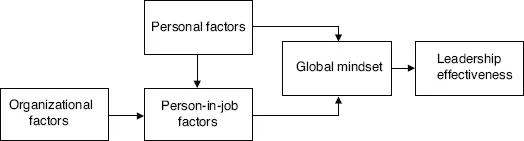
Figure 1.1 The research model
We consider concepts such as “organization,” “company,” “firm,” and “corporation” equivalent. Furthermore, a line between leadership and management is not strictly drawn. Although managers and leaders are sometimes considered as different entities, following Mintzberg (1973), we conceptualize leadership as one of the managerial roles. Therefore, a global mindset is exclusively attached neither to leaders nor to managers, but conceived as an essential quality of the leadership role of a person. Subsequently, we consider global leadership to be one of the global manager’s role. Finally, in this thesis, concepts such as “perspective,” “state of mind,” “frame of reference,” and “mindset” are considered interchangeable.
1.4 Who will benefit from this book?
1.4.1 Research and theory
Why are managerial behaviors and attitudes important for management theories? There are four reasons. First, contributing to theory building and knowledge accumulation is a reason for doing research in itself. Second, as managers coordinate and control increasingly varied and massive resources, analyzing the nature of managerial activities becomes an important scientific activity. Third, although a global mindset is considered an essential global leadership quality, its concept and how it relates to effective managerial behavior is unclear. A deeper understanding of how global mindset influences effective global leadership next to domestic and expatriate leadership may contribute to global leadership development programs. Additional research may provide new perspectives to the characteristics of this relationship and development methods. Fourth, elaborating on the relationship between managerial attitudes and leadership effectiveness, and developing a theoretical framework to explain this relationship, is a useful scientific project. The theoretical importance of this book may be seen in the advancement of theoretical developments and empirical findings in the areas of managerial attitudes and leadership in the context of globalizing organizations. Until now, there has rarely been any empirical evidence relating the individual global mindset to global leadership effectiveness. Conceptual studies on global competencies indicate that effective managerial action in a global context has its foundations in the possession of adequate knowledge and an appropriate set of personality traits. Relevant global knowledge, along with the prerequisite traits, allows one to develop a global mindset. These building blocks of global competencies translate into interpersonal and system skills that make managerial behavior observable. This resembles those attitude theories in which personal factors such as personality traits and belief formation influence attitude formation (Fishbein & Ajzen, 1975), while one of the functions of attitudes is to guide managerial behavior (McGuire, 1969). However, general models of attitude formation and behavior are only rarely applied to frameworks of global mindsets because of the various understandings of the con...
Table of contents
- Cover
- Title
- 1 Introduction
- 2 Globalization and Leadership Effectiveness
- 3 Global Mindset: Theoretical Backgrounds
- 4 Identifying Global Mindset at the Individual Level
- 5 Instrument Development
- 6 Global Mindset and Leadership Effectiveness
- 7 Discussion
- References
- Index
Trusted by 375,005 students
Access to over 1.5 million titles for a fair monthly price.
Study more efficiently using our study tools.
Frequently asked questions
Yes, you can cancel anytime from the Subscription tab in your account settings on the Perlego website. Your subscription will stay active until the end of your current billing period. Learn how to cancel your subscription
No, books cannot be downloaded as external files, such as PDFs, for use outside of Perlego. However, you can download books within the Perlego app for offline reading on mobile or tablet. Learn how to download books offline
Perlego offers two plans: Essential and Complete
- Essential is ideal for learners and professionals who enjoy exploring a wide range of subjects. Access the Essential Library with 800,000+ trusted titles and best-sellers across business, personal growth, and the humanities. Includes unlimited reading time and Standard Read Aloud voice.
- Complete: Perfect for advanced learners and researchers needing full, unrestricted access. Unlock 1.5M+ books across hundreds of subjects, including academic and specialized titles. The Complete Plan also includes advanced features like Premium Read Aloud and Research Assistant.
We are an online textbook subscription service, where you can get access to an entire online library for less than the price of a single book per month. With over 1.5 million books across 990+ topics, we’ve got you covered! Learn about our mission
Look out for the read-aloud symbol on your next book to see if you can listen to it. The read-aloud tool reads text aloud for you, highlighting the text as it is being read. You can pause it, speed it up and slow it down. Learn more about Read Aloud
Yes! You can use the Perlego app on both iOS and Android devices to read anytime, anywhere — even offline. Perfect for commutes or when you’re on the go.
Please note we cannot support devices running on iOS 13 and Android 7 or earlier. Learn more about using the app
Please note we cannot support devices running on iOS 13 and Android 7 or earlier. Learn more about using the app
Yes, you can access Global Mindset and Leadership Effectiveness by Kenneth A. Loparo,Wim Den Dekker in PDF and/or ePUB format, as well as other popular books in Business & Business Communication. We have over 1.5 million books available in our catalogue for you to explore.