eBook - ePub
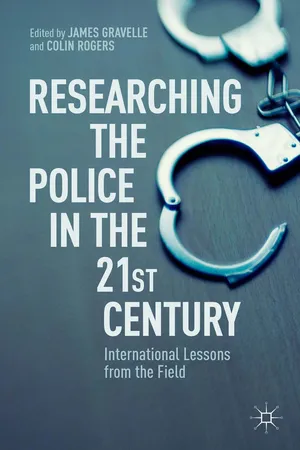
Researching the Police in the 21st Century
International Lessons from the Field
- English
- ePUB (mobile friendly)
- Available on iOS & Android
eBook - ePub
Researching the Police in the 21st Century
International Lessons from the Field
About this book
This unique collection explores the importance of undertaking police research, using a range of international examples from USA, UK and Germany. Focusing on practical challenges and difficulties, the volume offers solutions and reflections to assist in overcoming the barriers which might be encountered whilst carrying out research of this nature.
Information
Topic
Scienze socialiSubtopic
Criminologia1
Research on Policing: Insights from the Literature
Garry Thomas, Colin Rogers and James Gravelle
1.1 Introduction
Policing in England and Wales is facing challenges and undergoing significant changes as a drive for professionalisation of police and the creation of a body of police knowledge to support the concept of policing as a profession is under way. In support of these changes, such institutions as the College of Policing are attempting to inculcate into the police force the concept of evidence-based practice, founded on quality research, including academic and practitioner-based research and evaluations.
However, research on policing remains an emotive subject, particularly when discussing what should be researched. Initiated in the United States in the early 1950s and in the United Kingdom in the 1960s, research on policing has gone through many stages of development and has been undertaken and supported by a variety of different institutions (Reiner, 1989; 1992; 2010). Researching the police is particularly interesting due in part to the unique position, power and privilege the state bestows on the organisation. The unique culture that exists within the police organisation makes the challenge of research even greater, offering commentators and researchers a rare opportunity to investigate and get in close to this powerful institution. The political landscape in which the police operate also adds to the sense of importance and as policing does not exist within a political vacuum, this makes the topic of policing a dynamic and sensitive area for research. Additionally, in the context of the increasing financial problems, combined with finite resources and ever-growing demands on the public police, issues surrounding expenditure, budgets, costing and performance targets play an integral part in today’s police services across the globe. This remains a primary concern for many senior police officers, politicians and others involved in policy making and service delivery. This chapter considers lessons and insights from police research undertaken in the past and also that being currently undertaken, in order to provide some idea of where this topic will lead us to in the future.
1.2 Past developments in the research on policing
Reiner (1989; 1992; 2010) suggests that research on policing practically commenced in the United Kingdom at the start of the 1960s with a change in the politics associated with the police and theoretical developments in disciplines such as criminology, sociology and law. He credits Michael Banton with being the first British academic to carry out empirical research on policing in his study entitled ‘The Policeman in the Community’ (Banton, 1964). Reiner (1992: 439–441) gives Banton’s (1964) research numerous plaudits, including a ‘significant starting point’, a ‘pioneering sociological study’, a ‘central research strategy’, the ‘study was ahead of its time’ and ‘path breaking’. Banton’s (1964) research was quite rare not only in being the first empirical research, but also as it provided a comparison between policing in the United Kingdom and the United States.
Research on policing in the United States was already being pioneered by sociologist William Westley (1953; 1956; 1970), with his studies on police occupational culture, which focussed on police violence and secrecy (McLaughlin, 2007; Greene, 2010). Further, between 1965 and 1967 President Lyndon B. Johnston (1908–1973) established the Commission on Law Enforcement and the Administration of Justice (under Executive Order 11236) (Katzenbach, 1967) to extensively research all aspects of crime and law enforcement in the United States and to provide funding for future research (Rojek et al., 2012). As Punch (2010: 155) points out, at this time all eyes were on the United States, as the United States was seen as ‘the land of research, publications, and innovation – but also of violence, discrimination, and corruption in policing’, and thus all aspects of policing ‘good and bad’ were open to research.
Reiner (1989; 1992; 2010: 11–12) suggests that there have been four stages in the development of the research on policing since the 1960s, namely consensus, controversy, conflict and contradiction.
The consensus stage commenced in the 1960s, when research such as Banton’s (1964) tended to support the police, emphasised what was good about policing and what could be learned from the successes in policing. Banton (1971; 1973; 1975) was also responsible for organising three seminars in the 1970s at the University of Bristol on ‘The Sociology of the Police’, which were influential in evaluating the research of the time and deciding on the future themes for academic sociological research on policing in the United Kingdom.
The controversy stage appeared during the late 1960s and early 1970s when the research became more critical of police practices (and malpractices), and academic researchers began to take a greater interest in policing, particularly in its limitations. Smith and Morgan (1989: 235) argue that ‘research has cast serious doubt on the effectiveness of traditional policing strategies’. However, Greenhill (1981) suggests that research of an organisation’s practices adds a degree of professionalism to that organisation and increases its status. Brogden and Shearing (1993) and Chan (1996; 1997) support this view and suggest that professionalism changes organisational culture and has a positive impact on accountability.
The conflict stage occurred during the late 1970s and early 1980s, as policing and politics merged, and critical and radical criminology as well as Marxist academic research flourished. This period also saw resurgence in the quest for police accountability and governance. Morgan (1989a; 1989b) argues that research on policing is an important function in holding the police to account. However, MacDonald (1987: 5) advises that the drive for accountability has ‘forced research back onto the organisational agenda’. Brown (1996) suggests that the findings of the research undertaken during the controversy and conflict stages resulted in the development of some hostility between the police and academic researchers, and difficulties in researchers’ gaining access to police staff and data. A problem also highlighted by MacDonald (1987) and Laycock (2001: 1), who maintain that ‘Practitioners and researchers have operated in different universes for a long time’.
The contradiction stage of the late 1980s coincided with the growth of realism, and in particular, ‘left realism’ as advocated by Lea and Young (1984). Left realism contradicted the view of the Home Office’s preference for ‘administrative criminology’ (Cornish and Clarke, 1986) and the ‘right realism’ of Wilson (1975). Since the 1980s, the concept of realism has changed the focus on policing towards greater police effectiveness and crime control, and seen the introduction of policing initiatives such as problem-oriented policing and intelligence-led policing (Reiner, 2010). Brown (1996) suggests that in contrast to the previous two stages, academic research was now required by police managers to ensure that the service they provided was efficient, effective and economical. Research was also seen as a useful tool to challenge reform and to stimulate innovation (Weatheritt, 1986). Therefore, it was also important that the research was valid, reliable and objective (Hibberd, 1990). In the current era, Reiner (2010: 13) argues that ‘The driving paradigm for most police research now is clearly crime control’.
Reiner (1992: 444–456) initially suggested that there were ‘eight distinct types of institutions supporting research on policing in Britain’, namely, Academic Institutions, Research Councils and Foundations, Government Organisations, Internal Police Research, Independent Research Organisations, Pressure Groups, Journalists and Private Enterprise. However, Reiner (2010: 9–11) later reduced this to four sources of police research, namely, Academic Research, Official Police Research, Think Tanks and Independent Research Organisations and Journalists.
Academic Research was generally undertaken by academics at Academic Institutions such as universities and other higher education establishments. During the 1980s, centres specialising in police studies appeared within these institutions offering undergraduate and post-graduate degree courses in criminal justice and police studies. Reiner (1992; 2010) observes that up until the 1980s, nearly all the published research on policing was undertaken by academics from disciplines such as criminology, sociology, psychology and law.
Official Police Research includes research undertaken by Government Organisations and Internal Police Research. Government Organisations historically involved in research on policing include the Home Office Research Unit, the Home Office Research and Planning Unit (HORPU), the Home Office Police Research Group (PRG), the Home Office Research, Development and Statistics (RDS) Directorate and the Home Office Science Group. Reiner (1992: 448) suggests that during the conflict stage in the development of research mentioned above, there was an ‘extensive development of local government research on policing’. The period after 1981 saw the creation of a number of local authority police monitoring groups whose attention was focussed on researching the activities of their local police, particularly in relation to police accountability. This research brought some local authorities into direct conflict with the chief constables for their areas. However, after the introduction of the Crime and Disorder Act, 1998 (Home Office, 1998), most of the local government research on policing has been undertaken in conjunction with the police and focussed on partnership policy issues (Reiner, 2010). Other statutory organisations such as the Audit Commission (1990a; 1990b; 1993) have also conducted research on policing, particularly in relation to performance management and efficiency.
Internal Police Research generally falls into two main categories: national and local research. National internal police research is normally undertaken by bodies affiliated to the Home Office, such as the Scientific Research and Development Branch (SRDB), which was formed in 1963 as a direct result of Recommendation 44 from the Royal Commission on the Police: Final Report: ‘We recommend the establishment of a central unit, under the general direction of the chief inspector of constabulary, with responsibility for planning and research (paragraph 241)’ (Willink, 1962: 144). The SRDB was mainly staffed by seconded police officers and scientists, who conducted research on operational policing issues and technical equipment, and liaised with police forces around the country. The seconded officers were later to form the Police Research Services Unit (PRSU), whose role was to act as a liaison between the scientists of the SRDB and the police service (Weatheritt, 1986). More recently the National Policing Improvement Agency (NPIA), Research, Analysis and Information (RAI) Unit (now part of the College of Policing), has carried out research nationally on behalf of police forces throughout the United Kingdom. Local internal police research is normally undertaken by small research and planning units, which are generally staffed by police officers and police support staff. Their role was mainly administrative and involved evaluation of certain police initiatives. The research they produced was rarely critical of their force and was used to ‘support a preferred course of action rather than analysing the necessity for it and the results of it’ (Weatheritt, 1986: 19). However, Weatheritt (1986) does concede that improvements have been made, as internal staff gained more research expertise and advice was sought from external experts. The Government’s New Public Management (NPM) initiative (Barton and Barton, 2011) of the early 1980s, with its emphasis on economy (value for money), efficiency and effectiveness, also encouraged the police service to undertake good-quality research to improve its performance (Weatheritt, 1986). More recently, research undertaken by internal police research units follows current academic research principles and produces objective, valid and reliable research findings (Dawson and Williams, 2009; Stanko, 2009).
Think Tanks and Independent Research Organisations also include Reiner’s earlier ‘Research Councils and Foundations’, ‘Independent Research Organisations’ and ‘Pressure Groups’ (1992: 444–456). Research Councils and Foundations appeared during the 1980s and were funded either by the government or by charitable organisations interested in undertaking research on policing. The Economic and Social Research Council (ESRC) is one of seven government-funded research councils in the United Kingdom and supports research on policing and the wider criminal justice system. The Nuffield Foundation is an example of a charitable trust that is financially and politically independent, financed from its own investment portfolio and supports research on policing.
Independent Research Organisations such as the Police Foundation was established in 1980 as a self-funding independent charity. ‘The Police Foundation is the only independent think tank focused entirely on developing knowledge and understanding of policing and crime reduction and challenging the police service and the government to improve policing for the benefit of the public’ (Police Foundation, 2013). Other independent research organisations that undertake research on policing include the Policy Studies Institute (PSI) and the influential Policy Exchange (Loveday and Reid, 2003; Boyd, 2012).
Pressure Groups concerned with political issues and, in particular, civil liberties, have been involved in monitoring and researching the police since their inception, mainly focussing on po...
Table of contents
- Cover
- Title Page
- Copyright
- Contents
- List of Figures and Tables
- Preface
- Acknowledgements
- Notes on Contributors
- About This Book
- 1. Research on Policing: Insights from the Literature
- 2. Researching the Police – Zero Tolerance and Community Safety
- 3. Researching the Police: Personal Insights and Reflections
- 4. Research Methodology, Methods and Design
- 5. Collaboration in Crime Prevention Partnerships: Research with a Multilevel Mixed Design
- 6. Researching across Nations: The Anglo-American Experience
- 7. Hard to Reach Groups
- 8. Researching Vulnerable Children, a Multi-agency Perspective
- 9. Summary
- Appendix A1: Preamble – An Interpretation of the Brief
- Appendix A2: List of the Six Research Categories and 27 Subject Sub-categories
- Index
Trusted by 375,005 students
Access to over 1.5 million titles for a fair monthly price.
Study more efficiently using our study tools.
Frequently asked questions
Yes, you can cancel anytime from the Subscription tab in your account settings on the Perlego website. Your subscription will stay active until the end of your current billing period. Learn how to cancel your subscription
No, books cannot be downloaded as external files, such as PDFs, for use outside of Perlego. However, you can download books within the Perlego app for offline reading on mobile or tablet. Learn how to download books offline
Perlego offers two plans: Essential and Complete
- Essential is ideal for learners and professionals who enjoy exploring a wide range of subjects. Access the Essential Library with 800,000+ trusted titles and best-sellers across business, personal growth, and the humanities. Includes unlimited reading time and Standard Read Aloud voice.
- Complete: Perfect for advanced learners and researchers needing full, unrestricted access. Unlock 1.5M+ books across hundreds of subjects, including academic and specialized titles. The Complete Plan also includes advanced features like Premium Read Aloud and Research Assistant.
We are an online textbook subscription service, where you can get access to an entire online library for less than the price of a single book per month. With over 1.5 million books across 990+ topics, we’ve got you covered! Learn about our mission
Look out for the read-aloud symbol on your next book to see if you can listen to it. The read-aloud tool reads text aloud for you, highlighting the text as it is being read. You can pause it, speed it up and slow it down. Learn more about Read Aloud
Yes! You can use the Perlego app on both iOS and Android devices to read anytime, anywhere — even offline. Perfect for commutes or when you’re on the go.
Please note we cannot support devices running on iOS 13 and Android 7 or earlier. Learn more about using the app
Please note we cannot support devices running on iOS 13 and Android 7 or earlier. Learn more about using the app
Yes, you can access Researching the Police in the 21st Century by J. Gravelle, C. Rogers, J. Gravelle,C. Rogers in PDF and/or ePUB format, as well as other popular books in Scienze sociali & Criminologia. We have over 1.5 million books available in our catalogue for you to explore.