- English
- ePUB (mobile friendly)
- Available on iOS & Android
eBook - ePub
About this book
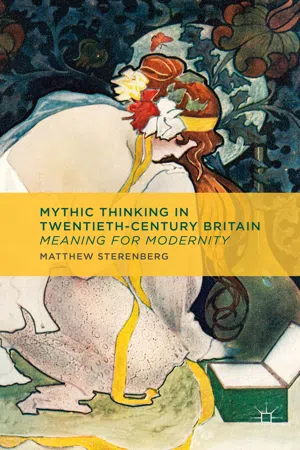
A variety of thinkers used the concept of myth to articulate their anxieties about modernity. By telling the story of mythic thinking in Britain from its origins in Victorian social anthropology to its postwar cultural mainstreaming, this book reveals a yearning for transcendence in an age long assumed to be disenchanted.
Information
Topic
PhilosophySubtopic
British History1
Myth and the Modern Problem
Auden’s assessment
The chief problem of modernity was an absence of meaning. That was W.H. Auden’s conclusion as he reflected on the challenges of modern life in 1948. He explained that inhabitants of the twentieth century were
faced with the modern problem, i.e., of living in a society in which men are no longer supported by tradition without being aware of it, and in which, therefore, every individual who wishes to bring order and coherence into the stream of sensations, emotions, and ideas entering his consciousness, from without and within, is forced to do deliberately for himself what in previous ages has been done for him by family, custom, church, and state, namely the choice of the principles and presuppositions in terms of which he can make sense of his experience.1
Auden’s assessment was correct: there was a “modern problem”—or at least many of Auden’s contemporaries were convinced that there was. Cultural observers of the time in Britain noted a disorienting absence of given meaning-creating structures, a situation that had ushered in a host of distinctly modern ills. Though catalogs of these ills described the problem in varying terms, assessments of modernity’s faults nevertheless tended to emphasize the same family of complaints: science’s epistemological pretensions, the spiritual barrenness of modern life, a lack of shared values and traditions, the excesses of consumerism, the banality of mass culture, the alienating effect of contemporary urban existence, and the emotional estrangement produced by the mass media. By the early years of the interwar period, there was a widespread sense in Britain that “modernity” or “the modern age” had eroded a shared set of, to use Auden’s terms, “principles and presuppositions.” It is no coincidence, for instance, that 1922 saw both the publication of T.S. Eliot’s The Waste Land and the founding of the BBC. Both endeavors were expressions of a desire to re-establish or replace a cultural unity—based on common principles and presuppositions—believed to have been lost in the transition to modernity.2
Much of Britain’s intellectual history in the twentieth century can be understood as a series of attempts to come to grips with the modern problem. The responses it provoked were varied. Some, such as G.K. Chesterton or the historians J.L. and Barbara Hammond, longed for a return to a simpler era and hoped to recover a social and moral cohesion that had vanished. Such thinkers imagined a lost golden age that could be recaptured if the right steps were taken. Others, such as the novelist Evelyn Waugh and the historian Christopher Dawson, converted to High Church Anglicanism or Roman Catholicism, seeing such traditionalist forms of Christianity as bulwarks against modernity. And still others, such as the literary critic F.R. Leavis and his epigones, believed that the proper response to modernity entailed replacing Christianity with the humanities as the primary source of cultural values. Even those who launched the BBC were inspired by visions of a cultural unity made possible by modern technology. These responses to the modern problem were all alike in that they developed their interpretations of and responses to modernity by drawing inspiration from the past, whether in the form of an imagined bygone golden age of social cohesion, an ancient faith, or a “great tradition” of literature. They were also alike in sensing that the modern problem was at bottom a problem of meaning and of how to find or construct it in the modern world.
There was, however, a very different, remarkably prevalent, and largely overlooked response to the modern problem that did not look to the past for guidance, but that did place a premium on the question of meaning. This response can be termed “mythic thinking,” because it was defined by the belief that myths—explanatory narratives of perennial relevance that deal with ultimate questions—were vital sources of meaning, indispensable frameworks for interpreting experience, and essential tools for coping with modernity. The purpose of this book is to describe the origins, nature, and impact of mythic thinking in the cultural and intellectual life of twentieth-century Britain.
Mythic thinkers tended to view modernity as a rupture in history. They therefore thought that ways of coping with the modern problem that aimed to resurrect the past were obsolete and doomed to failure. This belief marked them as part of a broader twentieth-century reaction against historicity that was also reflected in, for example, literary modernism and analytic philosophy. This sense of a radical break in history that rendered old ways of thinking obsolete connected all mythic thinkers, whether the arch-modernist Eliot in the 1920s, the fantasist J.R.R. Tolkien in the 1930s, the avant-garde novelist J.G. Ballard in the 1960s, or the theologian John Hick in the 1970s. What was needed, mythic thinkers held, was a new way of making meaning that took into account the unique nature of modernity, and they believed that this need could be fulfilled by myth—a concept that was at once conveniently vague and rich with significance. Indeed mythic thinkers defined the modern problem precisely as a debilitating lack of myth. Auden himself expressed this view when he noted how modern culture was characterized by “the disappearance … of a common myth,” and Eliot voiced a similar assessment when he described the modern condition as being “barren of myths”—a condition he sought to rectify with his myth-infused poetry.3
This study, Mythic Thinking in Twentieth-Century Britain, aims to provide a cultural and intellectual history of myth as a mode of thought in order to explain its significance as a recurrent pattern within British culture. Taking a cue from Raymond Williams’ insight that cultural analysis begins with the identification of cultural patterns, Mythic Thinking in Twentieth-Century Britain sets out to trace the dimensions and salient manifestations of mythic thinking from roughly 1900 to 1980. The central argument of the book is that mythic thinking emerged in the early twentieth century as a way for a variety of thinkers and key cultural groups to frame and articulate their anxieties about a modern era that seemed bereft of transcendent meaning. Mythic thinking is thus best understood as a response to the modern problem identified by Auden. At the same time, mythic thinking was itself a modern project that took place within, depended upon, and existed in fruitful tension with fundamental institutions, features, and tenets of modernity. Its prevalence in twentieth-century British culture is therefore a challenge to the notion that modernity is fundamentally disenchanted and inhospitable to transcendent concerns.
Throughout the period 1900–1980, mythic thinking took the form of works of literature, art, cultural criticism, philosophy, psychology, and theology designed to show that both ancient myths and more recently created mythic narratives had revelatory power for modern life. Most fundamentally and most importantly, mythic thinking constituted a new mode of making meaning that appealed to the imagination by making the claim that myths communicate timeless truths that cannot be apprehended through reason or science. Myth therefore signified what its advocates found lacking in both modernity and the alternative responses to it: myth was rooted neither in the past nor in the present but was timeless, it offered wisdom rather than knowledge, unity instead of fragmentation, order in place of chaos, spiritual solace instead of unbelief, and meaning rather than confusion. If, as Auden contended, the modern problem stemmed from an absence of given or inherited presuppositions and metanarratives that imposed coherence on the flow of experience, then mythic thinking was a novel, audacious, and in many ways successful attempt to fill that vacuum.
The domain of myth
The London School of Economics (LSE), the citadel of British social science, is an unlikely place to begin tracing the outlines of the mythic thinking phenomenon. Yet in 1952, the Cambridge don W.K.C. Guthrie, a respected historian of ancient Greek philosophy and religion, took to the dais there to argue that the empirically grounded knowledge produced in the halls of the LSE needed to be balanced by a very different kind of knowledge—the kind that came only from myth. Taking as his subject “Myth and Reason,” Guthrie argued that Greek mythology was more relevant now than ever because of the timeless wisdom that it conveyed. Because “Mythical thinking never dies out completely,” it was crucial to find ways to make proper use of myth’s resources.4 This entailed eschewing “bad myth”—in the form of contemporary “isms”— which served only to legitimate irrationality by masking it in “woolly and abstract language.” However, he continued:
Good myth is the opposite. It consists in apprehending the profound and universal truths symbolically conveyed by simple stories and images which, just because their mode of expression is concrete, individual and imaginative, are apt to be brushed aside by the devotee of “scientific method” or the latest non- existent –ism.5
Guthrie’s address neatly encapsulates two key features of twentieth-century mythic thinking: (1) the belief that myth offered access to universal metaphysical truths that were deeply relevant to the modern condition and (2) the conviction that these truths complemented, rather than conflicted with, scientific truths.
The year before Guthrie’s address at the LSE, Ted Hughes began his studies at Cambridge. It is entirely likely that as an undergraduate Hughes heard Guthrie lecture on mythical thinking. Moreover, it is quite clear that Hughes’ fascination with myth deepened over the years, fed by a fascination with Robert Graves’ The White Goddess, an interest in the theories of Carl Gustav Jung, and other sources. It is thus not surprising to find Hughes commending the value of myth to the attendees of a conference on children’s literature in words that would become widely anthologized:
The myths and legends, which Plato proposed as the ideal educational material for his young citizens, can be seen as large-scale accounts of negotiations between powers of the inner world and the stubborn conditions of the outer world, under which men and women have to live. They are immense and highly detailed sketches for the possibilities of understanding the two … .
Their accuracy and usefulness … depend on the fact that they were originally the genuine projections of genuine understanding …. They gave a true account of what happens in that inner region where the two worlds collide. This has been attested over and over again by the way in which the imaginative men of every subsequent age have had recourse to their basic patterns and images.
But the Greek myths were not the only true myths. The unspoken definition of myth is that it carries truth of this sort.6
In claiming that “every subsequent age” was marked by recourse to myth’s resources Hughes was agreeing with Guthrie’s contention that “mythical thinking never dies out completely.” For both, emphasizing myth’s perennial significance was a way of underscoring myth’s ongoing relevance as a means of coping with the challenges of modern life.
Guthrie and Hughes were thus drawn to myth because of their yearning for a kind of truth and meaning that seemed to have been displaced in the modern world. Their studies and personal experiences had convinced them that myth somehow possessed a unique power to provide such truth and meaning by appealing to the imagination. It is worth noting the strong and even categorical language that each uses to underscore this connection. For Guthrie myth apprehends “profound and universal truths” that are expressed in an “imaginative” mode. For Hughes, myths offer “genuine understanding” that has always been appreciated by “imaginative men.” They came to this conclusion in part through their contact with late nineteenth- and early twentieth-century anthropological work on myth. Guthrie had both personal and professional connections to the group known as the Cambridge Ritualists, whose work blended classics, archaeology, and anthropology in order to raise new questions about the role of myth in ancient Greek culture and its possible role in modern culture. Hughes switched from studying English to anthropology while at Cambridge, a move that facilitated his increasing fascination with mythology. In being led to a deeper consideration of myth through contact with anthropology, Guthrie and Hughes were by no means atypical; rather they were representative of a common pattern in twentieth-century Britain. Neither were they atypical in thinking that ancient myth had a unique epistemological validity that made it crucially relevant to modern life.
Astute cultural observers began to notice the ubiquity of such mythic thinking by the 1950s. Some, like the American critic Philip Rahv, were implacably opposed to the trend. Rahv, a convinced Marxist, denounced mythic thinkers as “mythomaniacs” who irresponsibly retreated from history.7 A more equitable observer was the British literary critic Frank Kermode. No one captured the appeal of myth—and the extent of this appeal—better than Kermode, one of the most attentive and incisive observers of British intellectual life during the post-Second World War period. Confronted with a host of thinkers and writers who like Guthrie and Hughes extolled the virtues of myth, Kermode concluded: “our literary culture is saturated with mythological thinking.” This state of affairs was a source of both fascination and ambivalence for him, and he devoted much of his attention to the topic during the 1960s. He understood well myth’s appeal in a modern age, which he tried to capture in words that could almost be a gloss on Guthrie and Hughes:
In the domain of myth we can short-circuit the intellect and liberate the imagination which the scientism of the world suppresses … . Myth deals in what is more real than intellect can accede to; it is a seamless garment to replace the tattered fragments worn by the modern mind.8
Kermode’s assessment goes to the heart of the mythic thinking phenomenon by highlighting its recurrent emphases: myth’s appeal to the imagination, its capacity to communicate a higher kind of truth, and the notion that the modern mind is desperately in need of such truth.
“Mythic thinking” is the central concept of this project, yet it is not a familiar term in the historian’s lexicon. In order to justify its use, therefore, a more detailed explanation of it is perhaps necessary. The term is admittedly nebulous, in large part because the term “myth” is itself nebulous. I make no attempt to offer a normative definition of myth or to enter debates about myth’s status as a genre of unique power or authority. There is a vast and fascinating body of interdisciplinary literature devoted to defining the category of “myth” and to categorizing the myriad theories, examples, and uses of it.9 As useful as such scholarship may be in some contexts, this study steers clear of the ongoing attempts to validate, quantify, or extol what has been called “myth’s abiding power.”10 The focus here, rather, is on explaining why so many in twentieth-century Britain believed that myth had such abiding power. Consequently, instead of offering my own definition of myth, I use the term as it tended to be used by the figures I examine: an explanatory narrative of perennial relevance that deals with ultimate questions. To develop this definition a bit further, most mythic thinkers would have agreed that a myth is a sacred, foundational or archetypal narrative dealing with gods, heroes, cosmology, or the transcendent, which serves to answer perennial questions, reconcile antinomies, guide action, express transcendent truths, diffuse psychological pressures, or legitimate cultural values.
This clearly is an elastic definition and one that allowed for considerable leeway as to what qualified as myth. Indeed, the very vagueness of the concept was part of its appeal. It was commonly thought, for instance, that contemporary writers could create fictions that functioned as myths. Such thinking is one reason the myth scholar Robert Segal has noted that “[Myths] may not even go backward in time but may instead go forward, as in science fiction, or go sideways, such as to other cultures around the world.”11 Mythic thinking thus did not necessarily entail primitivism or an idealization of the archaic cultures that had produced ancient myths.
Instead, mythic thinking was essentially an attempt to exploit myth’s supposed unique properties by thinking with or through myth in order to create meaning that was otherwise lacking. Myth became the framework for interpreting experience that Auden claimed moderns needed to construct for themselves. The endeavors of mythic thinkers were premised on the assumption that myth was a narrative genre or a mode of thought that had an indefinable but undeniable gravity, and that it communicated truths that could not be apprehended by any other means. One mythic thinker who tried to put this into words described “myth as profound and suggestive of meanings beyond my grasp.”12 Because this sense of myth’s power was widely shared, the term “myth” had significant force as a rhetorical weapon, which contributed to its effectiveness as an instrument in twentieth-century cultural politics. Use of the term, whether in scholarly or non-scholarly discourse, tends to be unavoidably polemical. As historian of religion and myth scholar Bruce Lincoln has observed, someone who uses the term “myth” is making potent assertions about its validity and authority relative to other types of discourse.13 These assertions can be approving, by associating myths with, for example, primordial truth or the source of cultural unity. They can also be pejorative, by characterizing myth as, for example, primitive worldview. The mythic thinkers examined in subsequent chapters dealt only in approving assertions about myth: debunking myth or characterizing it pejoratively as merely false story was not part of their project.
Mythic thinking manifested itself mainly in two forms, which often overlapped with each other. First, as Guthrie and Hughes’s words above indicate, it often took the form of literary, artistic, and philosophical attempts to show that ancient myths had relevance to modern life. However, it was also manifested in attempts to create new myths and mythic narratives. This second type of mythic thinking was thus largely the province of writers of fiction. The outstanding example of this strain was Tolkien’s self-confessed attempt to create a coherent body of mythology for England with his novel The Lord of the Rings. Tolkien believed that England’s lack of its own ancient mythology was somehow a serious deficiency, a belief that illustrates the very essence of mythic thinking. The notion that British culture needed to maintain contact with myth in order to be stable and healthy was not held by Tolkien alone; it was a fundamental presupposition underlying mythic thinking throughout the period.
For mythic thinkers, then, myth was not one narrative genre among others. It was, rather, a uniquely potent form of discourse that conveyed resources not accessible in other ways. These resources were often revealed by what myth was rhetorically opposed to in cultural criticism. Depending on the particular historical moment and context, the cultural critiques devised by mythic thinkers targeted scientism, excessive rationalism, secularization, mass culture, and the alienation of contemporary urban life. The turn to myth was justified with claims that myth gave access to deeper truths than historical or scientific explanation, and that it offered a unique means of coping with the psychological pressures that modernity brought to bear on the individual. Mythic thinking, then, was in part an idiom through which anxieties about modernity could be articulated and ideas for redressing modernity’s deficiencies proposed. Mythic thinkers thus used myth to construct modernity even as they criticized it: for them myth represented all that had been repressed, erased, or fragmented in the transition t...
Table of contents
- Cover
- Title Page
- Copyright
- Contents
- Acknowledgments
- 1. Myth and the Modern Problem
- 2. Golden Boughs, Fairy Books, and Holy Grails: The Making of a Myth-Saturated Culture
- 3. “The Grail Is Stirring”: Modernist Mysticism, the Matter of Britain, and the Quest for Spiritual Renewal
- 4. “The Mythical Mode of Imagination”: J.R.R. Tolkien, C.S. Lewis, and the Epistemology of Myth
- 5. Coping with the Catastrophe: J.G. Ballard, the New Wave, and Mythic Science Fiction
- 6. Myth and the Quest for Psychological Wholeness: C.G. Jung as Spiritual Sage
- 7. Minding the Myth-Kitty: Myth, Cultural Authority, and the Evolution of English Studies
- 8. Making a Modern Faith: Myth in Twentieth-Century British Theology
- Epilogue
- Notes
- Selected Bibliography
- Index
Trusted by 375,005 students
Access to over 1.5 million titles for a fair monthly price.
Study more efficiently using our study tools.
Frequently asked questions
Yes, you can cancel anytime from the Subscription tab in your account settings on the Perlego website. Your subscription will stay active until the end of your current billing period. Learn how to cancel your subscription
No, books cannot be downloaded as external files, such as PDFs, for use outside of Perlego. However, you can download books within the Perlego app for offline reading on mobile or tablet. Learn how to download books offline
Perlego offers two plans: Essential and Complete
- Essential is ideal for learners and professionals who enjoy exploring a wide range of subjects. Access the Essential Library with 800,000+ trusted titles and best-sellers across business, personal growth, and the humanities. Includes unlimited reading time and Standard Read Aloud voice.
- Complete: Perfect for advanced learners and researchers needing full, unrestricted access. Unlock 1.5M+ books across hundreds of subjects, including academic and specialized titles. The Complete Plan also includes advanced features like Premium Read Aloud and Research Assistant.
We are an online textbook subscription service, where you can get access to an entire online library for less than the price of a single book per month. With over 1.5 million books across 990+ topics, we’ve got you covered! Learn about our mission
Look out for the read-aloud symbol on your next book to see if you can listen to it. The read-aloud tool reads text aloud for you, highlighting the text as it is being read. You can pause it, speed it up and slow it down. Learn more about Read Aloud
Yes! You can use the Perlego app on both iOS and Android devices to read anytime, anywhere — even offline. Perfect for commutes or when you’re on the go.
Please note we cannot support devices running on iOS 13 and Android 7 or earlier. Learn more about using the app
Please note we cannot support devices running on iOS 13 and Android 7 or earlier. Learn more about using the app
Yes, you can access Mythic Thinking in Twentieth-Century Britain by M. Sterenberg in PDF and/or ePUB format, as well as other popular books in Philosophy & British History. We have over 1.5 million books available in our catalogue for you to explore.