- English
- ePUB (mobile friendly)
- Available on iOS & Android
eBook - ePub
About this book
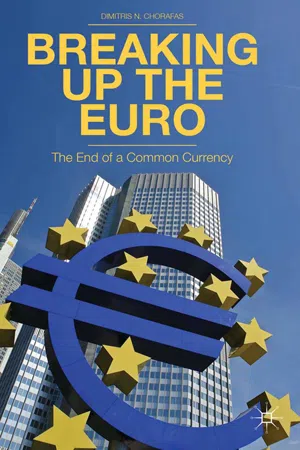
The drama of the common currency is a hot topic. The Euro was planned for the European Union's member states, bringing economically strong nations like Germany and Holland and weaker nations like Greece, Spain and Italy under one set of currency rules.
A dozen years of its implementation has shown that the planning was incomplete at best. Add to this the weight of a deepening debt crisis among western nations, which continues unabated, and Europe has a very deep financial hole to climb out of. In this work, Dimitris N. Chorafas provides the reader with evidence to poor political judgment, then delves into preparation for the foreseeable Euro breakup and confronts the redenomination risk associated to it.
Information
1
The Breakup of the Euro Is a Probable “Impossibility”
1. The Start of Deglobalization
Globalization has been both a process and a state of mind. In the course of the last three decades, global markets opened greater perspectives than regional or local markets for raw materials, agricultural produce, manufactured goods and services—and, to a more limited extent, for labor. Countries in a relatively early stage of development saw their gross domestic product grow. Some, by adopting tools and methods from developed countries, established themselves as manufacturing powerhouses.
The downside of the ascent of less developed countries to development status is that it has come at the expense of the developed countries, which found it more convenient (and cheaper) to import from abroad than to manufacture locally. As globalization grew, it hit its limits.1 Over the last three decades, Western countries:
•Deindustrialized,
•Lost their competitive skills, and
•With few exceptions, they let their current account balance deteriorate till the West got deeply indebted to the East.
The words spoken by the prince in Giuseppe di Lampedusa’s Leopard as he observed his own situation, perfectly describe the aftereffect on the Western economy: “Fire and flames for a year, ashes for thirty.” In the case of globalization, largely because of their own mistakes, the developed countries have experienced 30 years of fire and flames. We simply don’t know how long the time of ashes will last.
It is far from easy to reindustrialize. This requires not only strategic objectives, an ingenious plan, tight cost control (including labor and entitlements), price competitiveness, flexibility, adaptation, and marketing wizardry—but also difficult-to-recreate specialist manufacturing skills. Countries and companies that cannot meet the latter challenge remain deeply hurt by globalization.
In my book Globalization’s Limits (2009), I have shown that globalization poses requirements and constraints; it is not a free lunch. As with any other complex and demanding process, if these requirements are not met and the limits are exceeded, globalization turns from friend to foe, and those who thought they would gain from it encounter a very rough weather. Two questions come up:
•Is this adversity an anomaly or the course of things? Without hesitation I would say that it is the new normal.2
•Which are the main worries now emerging, and why? The answer to this query is this chapter’s goal, taking Euroland as an example.
The issue raised by the second question is part of a more general query on whether globalization’s woes are the aftereffects of focusing too much on manufacturing and trade, with too little consideration of how it affects the people and the economy of Western countries. The answer to this query is that Japan, America, and the European countries have badly wounded themselves by relegating their future to globalization as if it were:
•The penicillin for every social pain, and
•The door to a permanent Nirvana.
One of the generally more acceptable idiosyncrasies of globalization is that it brings together the different cultures of those who outsource and those who insource. Better trade than war. But at the same time, the globalized world’s uncertainties destabilized both common people and decision-makers in a way reminiscent of Goethe’s “Faust” who, frustrated by the limits to his learning, makes a pact with the devil.
If two words could be sufficient to describe this pact with the devil made by Western countries they would be abandonment and déclinisme. In the developed world, only a few countries did not accept this curse and did what it takes to stand on their own—Germany, Norway, Sweden, and Switzerland. Unwisely, and in the most cowardly fashion, the self-wounded countries turned against them (particularly against the first and the fourth).
Switzerland is a small nation and so far it has only suffered a barrage of attacks by the US focused on its big banks (therefore on money) and on its banking laws. In contrast, Germany got demands for direct handouts to the profligates running into trillions of euros.
In a concentrated effort to get lots of money from the better-off countries in any way they could, the profligates attacked Germany for more and more funds via the ECB and in other ways, without even reading the statistics that talk volumes about who is responsible for their current plight:
•German unit labor costs rose by only 7 percent in the decade of the euro.
•By contrast, they soared by 30 percent in Italy, 35 percent in Spain, 42 percent in Greece, and so on and so forth.
To whom can we attribute this failure of control as money became cheap and debt spiralled during the days of the euro?Critics say that because of easy money and “the good life,” the monetary union achieved the opposite of what was intended. Socialist and populist governments opened wide their financial gates, probably counting on a future bailout, even though they knew that the Stability and Growth Pact had no bailout clause.
The question that now arises is: What does all this have to do with globalization? The answer is simple: Globalization and regionalization in motion—Euroland being an example of the latter—provided the grounds and the excuse for a change in the Western work culture for the worse. Globalization is not only the different commercial treaties like the “rounds” of the World Trade Organization (WTO); it is much more than that.
Globalization and regionalization have evolved into a spirit that says: What is mine is mine, what is yours is mine because we share it. That’s how to interpret the American and British pressure that the European Central Bank should do much more quantitative easing till it destroys the euro, just like the Fed did to downsize the dollar. Or the request by Spain for €100 billion for its banks without any supervision on how the amount is spent,3 as well as the French push for eurobonds (another aberration).4
That is also how the attack on the city of London as a financial center by American lawmakers and regulators, who characterized it as a source of financial crises, must be interpreted. The accusation came in the wake of $6 billion of trading losses in one bet from the London operations of JPMorgan Chase. Gary Gensler, chairman of the US Commodity Futures Trading Commission (CFTC), said at a congressional hearing on JPMorgan’s trading losses that the US was vulnerable to risky activity in London. Gensler added that AIG, too, had been hit by its financial products unit in London, Citigroup had been harmed by special purpose investment vehicles, and the list goes on.5
Till the crash of 2008, the globalization of financial services was heralded as the jewel in the crown of globalization at large. With huge losses came doubts. Now we hear that there are definitely clear flaws in the regulatory set-up in London that harm the operations of big US banks because they take too many risks—forgetting, of course, that the crisis we have been in for over five years started with subprimes in continental United States.
The covert call for deglobalization is not only an American-British affair but also French-British. David Cameron, the British prime minister, invited the French high-income earners to take residence in Britain rather than pay the 75 percent tax that François Hollande, the French president, has implemented. This enraged Hollande. Other Byzantine deals, too, are being discussed, not as jokes but in all seriousness.
Rather than calming the global financial market, François Hollande fuelled speculation when he bemoaned the fact that Spain was being targeted by markets in spite of the planned €100 billion bailout of its banks and its tough austerity measures, which in the end were not as tough as promised. Hollande also said the interest rates being paid by Spain and Italy on their debts were “not acceptable” because Italy’s public finances were improving.
These statements were not made in London, Paris, or Brussels, but in Los Cabos, Mexico, during the G20 meeting. Why did all these gentlemen go all the way to Los Cabos (at taxpayers’ expense) to talk about issues that should be treated in Europe is unclear. And the reason they did so in front of all the other G20s is even more obscure. Unless, of course, they wanted to provide hardcore proof that the EU’s regionalization has frayed at the seams, and, consequently, it would not be long before globalization, too, falls apart.
2. Every Economy Is Sick in Its Own Way
Turning back the clock by 55 years allows us to take a closer look at the most important reason that motivated the Treaty of Rome. The reason was to reconcile France and Germany after nine decades of strife that had led to 30 years of devastating European civil wars from 1914 to 1918 and from 1939 to 1945. Examined under this objective, the Treaty of Rome, and therefore the European Union (not only Euroland), has failed.
The most deadly mistake has been that of the Common Market’s expansion without end. Left to their own devices, the original six—France, Germany, Italy, and the Benelux countries—might have cemented a solid basis of integration, first with fiscal union, then with budgetary and current account policies, as well as a banking union, and in the end with monetary union.
The priorities, however, have been unwisely reversed and, as a result, instead of European integration we are contemplating the consequences of a breakup. It’s bad policy to target out-of-reach goals, for instance, a banking union, when the prerequisites are ill-defined and at a time when banking and finance are becoming more national and breakup forces are gaining momentum, even if the economies share a common currency.
Two conflicting schools of thought confront one another. According to one, the fiscal compact, jointly devised by the EU, the ECB, and IMF and first applied to the rescue of the Greek, Portuguese, and Irish economies, is the right step toward permitting greater control at European level. This is by no means an idle statement.
•Ireland decided to wor...
Table of contents
- Cover
- Title
- 1 The Breakup of the Euro Is a Probable “Impossibility”
- 2 The Lack of Leadership Is Deeply Felt in Western Countries
- 3 The Nineteenth “Summit’s” Miracle Weapons: June 28–29, 2012
- 4 ECB, EFSF, ESM, Eurobonds, and Political Horse Trading
- 5 Throwing Money to the Four-Letter Wind: LTRO
- 6 Fiscal Compact and Outright Monetary Transactions
- 7 TARGET2: The Creeping Risk of a Financial Nuclear Bomb
- 8 Redenomination Risk Following a Euro Breakup
- Appendix
- Notes
- Index
Trusted by 375,005 students
Access to over 1.5 million titles for a fair monthly price.
Study more efficiently using our study tools.
Frequently asked questions
Yes, you can cancel anytime from the Subscription tab in your account settings on the Perlego website. Your subscription will stay active until the end of your current billing period. Learn how to cancel your subscription
No, books cannot be downloaded as external files, such as PDFs, for use outside of Perlego. However, you can download books within the Perlego app for offline reading on mobile or tablet. Learn how to download books offline
Perlego offers two plans: Essential and Complete
- Essential is ideal for learners and professionals who enjoy exploring a wide range of subjects. Access the Essential Library with 800,000+ trusted titles and best-sellers across business, personal growth, and the humanities. Includes unlimited reading time and Standard Read Aloud voice.
- Complete: Perfect for advanced learners and researchers needing full, unrestricted access. Unlock 1.5M+ books across hundreds of subjects, including academic and specialized titles. The Complete Plan also includes advanced features like Premium Read Aloud and Research Assistant.
We are an online textbook subscription service, where you can get access to an entire online library for less than the price of a single book per month. With over 1.5 million books across 990+ topics, we’ve got you covered! Learn about our mission
Look out for the read-aloud symbol on your next book to see if you can listen to it. The read-aloud tool reads text aloud for you, highlighting the text as it is being read. You can pause it, speed it up and slow it down. Learn more about Read Aloud
Yes! You can use the Perlego app on both iOS and Android devices to read anytime, anywhere — even offline. Perfect for commutes or when you’re on the go.
Please note we cannot support devices running on iOS 13 and Android 7 or earlier. Learn more about using the app
Please note we cannot support devices running on iOS 13 and Android 7 or earlier. Learn more about using the app
Yes, you can access Breaking Up the Euro by D. Chorafas in PDF and/or ePUB format, as well as other popular books in Economics & Business General. We have over 1.5 million books available in our catalogue for you to explore.