- English
- ePUB (mobile friendly)
- Available on iOS & Android
eBook - ePub
About this book
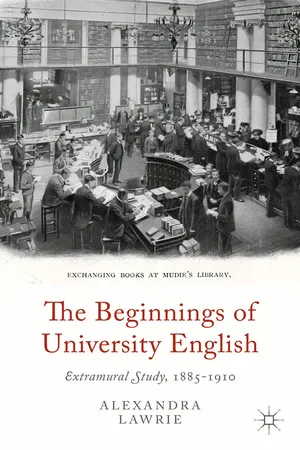
Drawing on previously unseen archival material, The Beginnings of University English explores the innovative and scholarly ways in which English literature was taught to extramural students in England during the fin de siècle, and sheds new light on the modern roots of tertiary-level English teaching.
Information
1
Early developments: English literature as a subject of study from the seventeenth to the nineteenth century
While the four main chapters of this book each stay within the time frame 1885 until 1910, this opening section reveals that English texts had been discussed and taught beyond Oxbridge at least as far back as the mid-seventeenth century, and that extramural endeavours after 1885 can therefore be seen as an intensification, or concretion, of these previous developments. Nonconformists, Scots, and the industrial working classes had each understood the value of literary texts variously as instruments of instruction; as a counter-balance to technical, scientific studies; and as a means to gain access to the cultural mainstream. This chapter therefore traces the development of literary studies in various settings beyond Oxbridge before and during the late nineteenth century, in chronological order: coffeehouses, Dissenting Academies, Edinburgh University, Literary and Philosophical Societies, Mechanics’ Institutes, University College London, Owens College in Manchester, the Settlement Movement (specifically Toynbee Hall), and Ruskin College in Oxford.
Coffeehouses
Some of the earliest literary pedagogical endeavours took place in locations not affiliated to a university, or indeed any other obviously educational institution: reading societies and book clubs had long been a means through which groups of people could read and discuss literary texts with varying levels of formality, and coffeehouses had, since the mid-seventeenth century, provided an informal environment for the discussion of literature. Although these were later established all over London, the first coffeehouse was in fact founded in 1650 in Oxford, where students were drawn to this dynamic discussion space that was set apart from university life. In contrast to the rigid theological or scientific curriculum at Oxford, as Brian Cowan has identified, the coffeehouse was ‘a place for like-minded scholars to congregate, to read, as well as to learn from and to debate with each other’, without the burden of ‘church or state patronage’ (2005, p. 91). The coffeehouses, or ‘penny universities’, became synonymous with the new Spectator-reading public in the early eighteenth century, but from the beginning they had been a forum for men1 of all social classes to discuss literature, often in the company of the actual writers: ‘A man on entering was free to take any vacant seat and to engage his neighbour in conversation. If unable to read, he was able to hear the news read out aloud … or he could listen to the poets as they read and discussed their work, or hear the informed opinions on the latest play’ (A. Ellis, 1956, p. xv).2 Some coffeehouses also offered lectures, sold books, or had libraries of their own, but all of them enabled men to read and to talk about literature in a relaxed setting, learning from each other, and formulating ideas on contemporary writing; they therefore served an important function as early, informal, and non-institutional classrooms, where the emphasis was on open-ended literary discussion and lively, uninhibited debate.
Dissenting Academies
Dissenting Academies were set up following the Test Acts in the seventeenth century, which barred Nonconformists from holding public office or from entering Oxbridge.3 These Academies provided education for the sons of commercial businessmen and also the gentry who were concerned by the ‘notoriously extravagant and undisciplined’ life at Oxbridge, but they also offered training for Nonconformist clergy (Palmer, 1965, p. 7). The prominence of the sermon in the Dissenting service, in comparison to the marginal role it played in the Anglican church, meant increased emphasis on inculcating skill in composition, elocution, and rhetoric, and illustrative examples and quotations from secular texts were often used in sermons. Herbert McLachlan, historian of Nonconformity and principal of Manchester Unitarian College, reflected in the 1950s on ‘the homiletic use of English Literature’, a traditional feature of Dissenting sermons; he noted that ‘Prose and verse may alike serve our purpose, and no form of literature from the drama to the novel need be excluded’ (1950, pp. 270, 272). Taking Shakespeare as an example, he remarked that ‘The characters of Macbeth and his wife are not unlike those of Ahab and Jezebel, and a psychological study of the two pairs may be instructive as a lesson in greed and ambition’ (p. 284).
Warrington Academy was one of the most prominent and influential Dissenting Academies. Founded by John Seddon, a graduate of Glasgow University, and in existence from 1757 until 1786, the academy became an educational powerhouse through the work of tutors such as John Aikin, Joseph Priestley, and William Enfield. Enfield put together a collection of English literary texts, called The Speaker, which was first published in 1774. Here excerpts, generally of around three or four pages in length, were organised into a series of sections: Select Sentences, Narrative Pieces, Didactic Pieces, Argumentative Pieces, Orations and Harangues, Dialogues, Descriptive Pieces, and Pathetic Pieces. Sources included Pope, Shakespeare, Dryden, Milton, Gray, Mrs.Barbauld, Sterne, the Spectator, and the Rambler. Thus Gray’s ‘Hymn to Adversity’ and Shakespeare’s ‘The Entry of Bolingbroke and Richard into London’ featured in the Descriptive category; ‘Yorick’s Death’, taken from Sterne, was a Pathetic Piece; and two Spectator articles, ‘On Modesty’ and ‘On Cheerfulness’, were included among the Didactic examples. Alater-appended essay, ‘On Reading Works of Taste’, offers us some insight into Enfield’s objective in producing this anthology. He argued for the merits of contemporary English prose and verse, which he felt should not be overlooked ‘in favour of antiquity’, since writing by Addison, Sterne, Gray, Thomson, and Pope could, ‘with some degree of confidence, be respectively brought into comparison with any examples of similar excellence among the ancients’ (Enfield, 1790, p.xli). One of the benefits of studying exemplary works by English authors was ‘to produce [in the reader] a general habit of dignity and elegance’ which would improve his character and ‘diffuse a graceful air over his whole conversation and manners’ (p. xlii). Further advantages to the study of literary texts, Enfield argued, included sharper judgement in ‘determining the degree of merit in literary productions’, and thereafter the development of one’s own powers of ‘elegant expression’, both in writing and in speaking (p. xliii). For these reasons, he felt that ‘the study of polite literature’ deserved to be ‘made a principal branch of liberal education’ (p. xliii).
Enfield was more specific, later in the essay, about his actual approach to studying texts; these comments offer an insight into how English lessons at Warrington were constructed. Alongside knowledge of the language and source for each text, Enfield advocated an emphasis on close reading, in order to reach an understanding of excellence in ‘Thought, Arrangement, and Expression’ (p. xlviii) by learning to appreciate, among other aspects, variety in image and ideas, accuracy of language, and a melodious rhythm (pp. xlvi–lix). Providing students with this ‘acquaintance with Polite Literature’ (p. lix) would, Enfield believed, be sufficient to guard them against ‘the intrusion of idleness and spleen’, as well as furnishing them with ‘innumerable topics of conversation’ (p. lx). Enfield’s priority here was to prepare the Dissenting student for social success: the conversational fluency one could gain from exposure to certain well-written literary texts was privileged over issues relating to characterisation, for instance, or plot-driven interpretation.
Within the confines of these non-establishment educational institutions (where English literature was already included on the curriculum, as we have seen), additional societies existed to promote the reading habit among students and staff. Jan Fergus has conducted some research into the records of the Daventry Dissenting Academy (attended by Priestley and Enfield), and reveals that students and teachers together ‘formed a book club sometime before 1765, called the “Academical Society”, which bought at least twenty novels among other works in 1765 and between 1771 and 1779’ (2006, p. 190). By comparing these records with those at an English public school, Fergus indicates the more progressive attitude towards literature within non-elite educational institutions: ‘Academy students appear to be impressive customers for prose fiction. Their appetite for novels was proportionally much greater than that of the Rugby boys present in the ledgers – from one perspective, five times as great’ (pp. 189–90). Dissenting Academies were therefore an example of early educational (yet non-establishment) institutions that offered instruction on literary texts, while also encouraging their students’ interest in contemporary reading.
Edinburgh University
While acknowledging the contribution made by Dissenting Academies, Robert Crawford suggests that Scottish universities should be afforded greater prominence in any study of the growth of English literature: they ‘matter most’, he argues, ‘because they were universities, the dominant, established, mainstream (not dissenting) channels of higher education’ (2000, p. 22). Crawford is of course relaying the pedagogical beginnings of English literature with a Scottish-centred cultural agenda in view; nevertheless, he builds a compelling argument in identifying the beginnings of English literature in eighteenth-century Scotland as part of a move towards ‘linguistic propriety’ by promoting a discourse ‘purged of Scotticisms’, as the post-Union Scottish context suggested to urban professionals that their commercial and social success depended upon their ability to converse elegantly in polite English (p. 18). The study of literary texts thus became a means of inculcating correct speech and manners at a time when ‘Language, the most important of bonds, must not be allowed to hinder Scotland’s intercourse with expanding economic and intellectual markets in the freshly defined British state’ (p. 18).
In Edinburgh, English literature, or ‘belles lettres’ as it was termed at this stage,4 was included within the university curriculum after it had been developed within a broader civic context. Scottish economist Adam Smith gave a lecture series in Edinburgh from 1748 until 1751. Underpinned as they were by Smith’s theoretical concerns about a ‘self-regulating market’ where ‘self-interest’ and ‘public interest’ could meet, the lectures held particular appeal for non-establishment citizens, ‘the sons of the newly emerging mercantile class’ (Court, 1992, p. 20). They therefore reflected the emphatically civic, commercial context in which they were conceived, rather than one of academic esotericism, and offered functional lessons on behaviour and speech that Smith’s audience could utilise. Some brief examples from the lectures illustrate this point well.5 In lecture eight, for instance, when Smith sought to define stylistic excellence, he singled Jonathan Swift out for special praise. Swift’s uncomplicated style, Smith noted, ‘is despised as nothing out of the common road; each of us thinks he could have wrote as well; And our thoughts of the language give us the same idea of the substance of his writings’ (1983, p. 42). Smith warned his audience that ‘it does not appear that this opinion is well grounded’; a more astute examination reveals that Swift in fact possessed ‘a complete knowledge of his Subjects’; the ability to ‘arrange all the parts of his Subject in their proper order’ and ‘describe the Ideas … in the most proper and expressive manner’ (p. 42). Smith’s lecture audience, we can assume, were being asked to emulate Swift’s type of writing, and not imagine that an elaborate, convoluted style necessarily equated to a sophisticated set of ideas. Later in this lecture, during Smith’s discussion of Swift’s ‘talent for ridicule’ (p. 43), he illustrated this with reference to Gulliver’s Travels, before a comparison with The Rape of the Lock and Pope’s later work, The Dunciad. Smith drew examples from other writers in subsequent lectures; in lecture 12, for example, the focus was on different approaches to composition. He stated that ‘The Idea <of> a fact that is grand may be conveyed in two ways, either by describing it and enumerating various particulars that concern it or by relating the effect that it has on those who behold it’ (Smith, 1983, p. 64). Milton and Shakespeare were brought in to highlight these differences: ‘Milton makes use of the first method in his description of Paradise, and of the 2d [2nd] in the account Adam gives the angel of the effect Eves [sic] presence had on him’ (p. 64). Shakespeare ‘uses the 2d [2nd] Manner in the description of Dover Cliff in King Lear’ (p. 64).
Hugh Blair had been in the audience for Smith’s lectures, and his own series was delivered to the city in 1759; thereafter he took the chair as Edinburgh University’s first Professor of Rhetoric and Belles Lettres in 1762, institutionalising the study of literary texts within the university, having first trialled his lectures in the city at large. The first half of Blair’s lectures to Edinburgh students considered ‘Taste, Criticism, and Genius’ (1783, vol. 1, p. 36); the ‘Sublime in Writing’ (vol. 1, p. 57); and ‘Style, and the rules that relate to it’ (vol.1, p. 183), such as ‘Perspicuity and Ornament’ (p. 184). In order to ‘illustrate the subject’ of ‘Language and Style’ (p. 408), Blair drew examples from (among others) Addison, Swift, and Milton. In the second volume of his published lectures, Blair’s stated aim was to ‘ascend a step higher, and to examine the subjects upon which Style is employed’ (1783, vol. 2, p. 1). He therefore set out to teach eloquence in ‘the three great Scenes of Public Speaking’, which he listed as ‘Parliament’ (p. 42), ‘the Bar’, and ‘the Pulpit’ (p. 43).
Later lecture topics included pastoral poetry, where Blair gave long consideration to Allan Ramsay’s The Gentle Shepherd; and ‘Epistolary Writing’ (1783, vol. 2, p. 298), with examples drawn from Pope, Swift, and Dr. Arbuthnot (p. 301). Sustained consideration was given to Paradise Lost in a subsequent lecture; Macbeth and Othello were listed elsewhere as the ‘two masterpieces’ (p. 524) of ‘the great Shakespeare’ (p. 523), where ‘the strength of his genius chiefly appears’ (p. 524); and, in the forty-seventh and final lecture, on ancient, French, Spanish, and English comedy, Blair identified Shakespeare and Ben Jonson as the main exponents of the ‘first age … of English Comedy’ (p. 542), which was followed by the ‘licentiousness’ of Restoration comedy (p. 543), and, finally, the post-Restoration comedies written by Dryden, Congreve, Cobber, Vanburgh, and Farquhar (pp. 544–6). Leaving aside some of the unfortunate choices of professor,6 English remained prominent in the Scottish university curriculum throughout the nineteenth century; the popularity of W. E. Aytoun’s Edinburgh course, which he taught between 1845 and 1865, led the 1858 Regulatory Act to require that each of the other Scottish universities should appoint professors of English. Aytoun’s successor David Masson, Regius Professor between 1865 and 1895, and also George Saintsbury, from 1895 until 1915, both proved to be impressive and popular lecturers at Edinburgh.
Literary and Philosophical Societies
These mainly middle-class institutions aimed to propagate scientific and literary knowledge among the general public. They became widespread in the late eighteenth and early-nineteenth centuries, with most large towns and cities boasting at least one,7 offering subscribers access to regular weekly lectures, a library, and (in the larger societies) a laboratory and sometimes a museum. Scientific discussion, and particularly chemistry, tended to dominate the agenda, although papers were given on an eclectic range of topics: the Literary and Philosophical Society of Manchester, which was founded in 1781 and had close links to Warrington Academy, had laws stipulating that the weekly 30-minute papers should be on ‘Natural Philosophy, Theoretical and Experimental Chemistry, Polite Literature, Civil Law, General Politics, Commerce, and the Arts’ (Memoirs, 1785, pp. xii–xiii). Other regulations included the formation of a library for the use of members, the award of a medal worth seven guineas for ‘the Author of the best Experimental Paper on any subject relative to Arts and Manufactures’, and the requirement that ‘the Society shall publish a volume of miscellaneous papers, every two years’ (Memoirs, 1785, pp. xv, xiv). The emphasis in these lectures was on ‘usefulness’; one early paper offered ‘A Plan for the Improvement and Extension of Liberal Education in Manchester’, while another was entitled ‘On the Nature and Utility of Eloquence’. Some more obviously literary-themed papers included ‘Comments on Sterne’, ‘On the Impression of Reality attending Dramatic Representations’, and ‘On the Nature and Essential Characters of Poetry, as distinguished from Prose’.
Among the most notable early nineteenth-century literary lectures in London were Coleridge’s course of lectures to the London Philosophical Society in 1811, and thereafter his and also William Hazlitt’s (later published as Lectures on the English Poets in 1818, Lectures on the English Comic Writers the following year, and Lectures Chiefly on the Dramatic Literature of the Age of Elizabeth in 1820) at London’s Surrey Institution. Elsewhere and a couple of decades later in 1833 and 1834, the Literary and Philosophical Society of Chichester hosted three lectures comparing the work of Shakespeare and Walter Scott. These papers set out to ‘bring into view the general characteristics of Scott, as compared with those of Shakspeare, and afterwards to glance at some particular points of resemblance; and to shew how much the novelist had his dramatic prototype in view, though, perhaps, not always sensible of it’ (Parallel, 1835, p. 6). Various points of similarity between the two writers were touched on, including the ‘appropriative power’ through which each writer has ‘subdued all things to his use, from the sterling gold of history, to the merest dross of popular tradition and superstitious ignorance’ (p. 31); also the ‘delicacy’, ‘propriety’, and ‘freedom’ (p. 29) with which they both write about love; and their analogous flashes of humour: ‘we are let into the character of Falstaff as much by what he refrains from doing as by what he does … by the bare recital of his tavern-bill as by his speech in praise of “good sherris sack”’; ‘These ludicrous situations’ also ‘abound in Scott’ (p. 48). The comic characters of each writer, the speaker claimed, never strayed too far into ‘buffoonery’; rather, ‘Shakspeare’s clowns have a touch of gentility; and his rude mechanicals, in their silliest moods, have nothing of a revolting coarseness about them’, just as ‘we are never offended with obtrusive vulgarity’ in Scott’s novels; ‘his most ludicrous situations never shock our delicacy; and the language of his humorous, as well as serious rustics, displays – like their sentiments – an elevation and propriety seldom to be met with in similar walks of literature’ (p. 50).
Literary lectures did have to jostle for space within ...
Table of contents
- Cover
- Title
- Copyright
- Dedication
- Contents
- Acknowledgements
- Introduction
- 1 Early developments: English literature as a subject of study from the seventeenth to the nineteenth century
- 2 ‘Barbarian war-cries on every side’: John Churton Collins and the dispute over university English studies in the fin de siècle
- 3 The University Extension Movement
- 4 ‘A novel education’: Richard G. Moulton’s inductive criticism in extramural adult education during the fin de siècle
- 5 Developing a taste for literature: Arnold Bennett, T. P.’s Weekly, and the Edwardian clerk
- Coda: the Newbolt Report and university English studies in the twentieth century
- Conclusion
- Notes
- Bibliography
- Index
Trusted by 375,005 students
Access to over 1.5 million titles for a fair monthly price.
Study more efficiently using our study tools.
Frequently asked questions
Yes, you can cancel anytime from the Subscription tab in your account settings on the Perlego website. Your subscription will stay active until the end of your current billing period. Learn how to cancel your subscription
No, books cannot be downloaded as external files, such as PDFs, for use outside of Perlego. However, you can download books within the Perlego app for offline reading on mobile or tablet. Learn how to download books offline
Perlego offers two plans: Essential and Complete
- Essential is ideal for learners and professionals who enjoy exploring a wide range of subjects. Access the Essential Library with 800,000+ trusted titles and best-sellers across business, personal growth, and the humanities. Includes unlimited reading time and Standard Read Aloud voice.
- Complete: Perfect for advanced learners and researchers needing full, unrestricted access. Unlock 1.5M+ books across hundreds of subjects, including academic and specialized titles. The Complete Plan also includes advanced features like Premium Read Aloud and Research Assistant.
We are an online textbook subscription service, where you can get access to an entire online library for less than the price of a single book per month. With over 1.5 million books across 990+ topics, we’ve got you covered! Learn about our mission
Look out for the read-aloud symbol on your next book to see if you can listen to it. The read-aloud tool reads text aloud for you, highlighting the text as it is being read. You can pause it, speed it up and slow it down. Learn more about Read Aloud
Yes! You can use the Perlego app on both iOS and Android devices to read anytime, anywhere — even offline. Perfect for commutes or when you’re on the go.
Please note we cannot support devices running on iOS 13 and Android 7 or earlier. Learn more about using the app
Please note we cannot support devices running on iOS 13 and Android 7 or earlier. Learn more about using the app
Yes, you can access The Beginnings of University English by A. Lawrie in PDF and/or ePUB format, as well as other popular books in Literature & European Literary Criticism. We have over 1.5 million books available in our catalogue for you to explore.