The concept of dynamic capabilities, especially in terms of organizational knowledge processes, has become the predominant paradigm for the explanation of competitive advantages. However, major unsolved - or at least insufficiently solved - problems are first their measurement and second their management by concrete managerial options, such as design options of organizational structures. Dynamic Capabilities provides an integrated descriptive model of both dynamic capabilities and organizational structures that allows characterizing, classifying and a comparison. It develops a logic system of a multitude of combinatorial possibilities between their variables, and it develops a complex and integrated system of associated empirically based and qualitatively deduced hypotheses. Therewith, it serves as a terminological and analytical foundation for the identification of knowledge-based dynamic capabilities in organizations and for a targeted design of organizational structures that enable and foster dynamic capability processes such as knowledge transfer and knowledge absorption.
eBook - ePub
Dynamic Capabilities
How Organisational Structures Affect Knowledge Processes
- English
- ePUB (mobile friendly)
- Available on iOS & Android
eBook - ePub
Dynamic Capabilities
How Organisational Structures Affect Knowledge Processes
About this book
Information
1
Introduction
1.1 Problem: Evolvement of dynamic capabilities through the configuration of organizational structures?
A common explanatory approach for organizational success or failure addresses the necessity for organizations to achieve and maintain a so-called ‘system-environment fit’.1 However, environments are changing – sometimes drastically and fast.2 Hence, a variety of research streams argue that social systems such as organizations are required to adapt to these changes.3 Otherwise, a fit between the organization and the environment cannot be maintained and organizational performance fails to appear. For example, evolutionary theory-based implications for corporate management are, inter alia, that the first priority to strive for is not profit but adaptation and survivability.4 Building on this insight, Teece, Pisano and Shuen (1997) stated that the long-term prosperity of organizations can only be achieved if they are capable of proactively adapting to their changing environments through generating and exploiting internal as well as external firm-specific competences.5 Accordingly, organizations need dynamic capabilities.6
The dynamic capabilities approach picks up the main assumptions of the resource-based view7 and the competence-based view.8 These trace competitive advantages (as well as organizational performance) back to organizational resources and capabilities of using and combining these resources.9 With special consideration of the volatility and uncertainty of today’s organizational environments, the dynamic capabilities approach shifts the focus from a static to a dynamic perspective.10 Therefore, in order to maintain the system-environment fit even in rapidly changing environments, organizations are required to develop such dynamic capabilities.11 Consequently, it is of decisive importance for organizations to learn how the evolvement of dynamic capabilities can be explained in order to identify associated mechanisms that can be addressed by managerial decisions. Hence, an overarching research aim that needs to be fulfilled in order to enable organizations to achieve and maintain system-environment fits in highly dynamic environments is the development of a holistic explanatory model of the evolvement of dynamic capabilities.
Ahead of the original thought of a necessity to create a fit between organizations and their environments are several different approaches12 that can be assigned to contingency theory.13 Accordingly, it is necessary to create a fit between the situation of an organization and its organizational structure,14 which is constituted by the interplay of instrumental variables for the (re)structuring of organizations such as degrees of decentralization, functionalization, delegation, participation, standardization or decomposition of organizational activities.15 Every organizational structure consists of parameter values of each of these variables on a continuum between 0 and 100 per cent, which reflects a continuum between absolute order and total chaos. The interplay of such variables in turn leads to an overall organizational order configuration. According to Remer (2005), the associated strength of organization determines the degree to which the behaviour of organization members is steered through organizational regulations.16 A fit between the organization’s situation and the actual manifestations of these variables of organizational structures in turn leads according to contingency theory to organizational performance – for example, economic or social success.17
Consequently, if dynamic capabilities enable the maintenance of a fit between organizational configurations and their situations, and if the antecedents of dynamic capabilities can be found – beside others – somewhere in the organizations’ structures,18 it stands to reason that organizational structures might influence the evolvement of dynamic capabilities. Following this thought, organizational structures can be seen as a potential determinants of dynamic capabilities, which is additionally approachable by organizations’ management through the configurations of the abovementioned variables of organizational structures.19 Whereas in contingency theory organizational structures are the dependent and the organizations’ situations are the independent variables,20 the above line of thought reverses this logic: organizational structures as the independent variable influence dynamic capabilities. By providing the foundations for competitive advantages,21 dynamic capabilities in turn influence the competitive situation to which competitors need to adapt in order to survive.
Therefore, the research focus of this work is the relation between organizational structures as one determinant of dynamic capabilities and the evolvement of dynamic capabilities. Figure 1.1 provides a schematic illustration of influencing factors (determinants) of dynamic capabilities that are approachable by organizations’ management, which reveals the associated management problem.
The overarching research question follows this research focus:
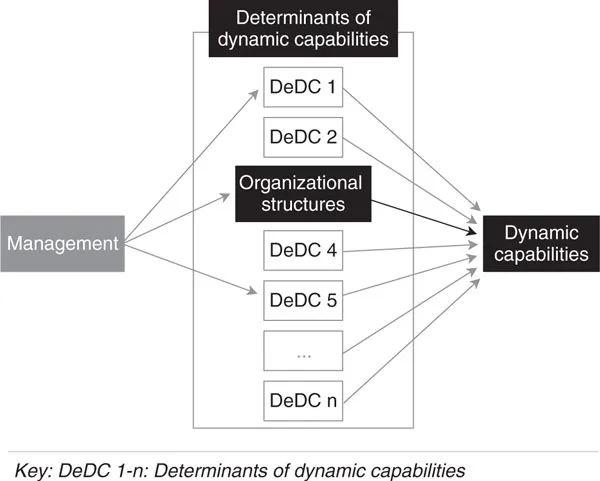
Figure 1.1 Schematic illustration of the research focus within the set of determinants of dynamic capabilities.
How do organizational structures between chaos and order affect the evolvement of dynamic capabilities?
However, it is neither unambiguously clear which variables organizational structures between chaos and order refer to, nor what exactly can be understood by dynamic capabilities. Due to this lack of a consistent terminological basis at this stage of the research, it is not even clear which areas of organizational realities are addressed and, hence, what exactly the context of discovery is.22 Hence in order to link both constructs – organizational structures and dynamic capabilities – with each other, it seems necessary to develop a consistent terminological system.
An extensive use of different understandings and hence different variables of dynamic capabilities exacerbates compiling the state of the art in research on their antecedents,23 including organizational structures. Therefore, the first subquestion of this research is:
Which variables of dynamic capabilities reflect a terminological system that provides an operationalization that is as holistic as possible and that is consistent with determinants of dynamic capabilities?
The independent variable of this research – organizational structures – is subject to the same methodological problem: a multitude of individual and sometimes eclectically selected variables, such as centralization or specialization, result necessarily in the risk of ignoring potentially important ‘adjusting screws’ of organizational structures. Therefore, the second subquestion is:
Which variables of organizational structures reflect a terminological system that provides an operationalization that is as holistic as possible and that is consistent with that of dynamic capabilities?
Having answered these two subquestions, both terminological systems have to be combined in order to reveal associated effects emanating from manifestations of variables of organizational structures between chaos and order on variables of dynamic capabilities. Hence, the third subquestion is:
How do the manifestations of the variables of organizational structures affect the manifestations of the variables of dynamic capabilities?
1.2 Relevance: Theoretical gaps of relations between organizational structures and dynamic capabilities
To show the theoretical relevance of the research question, according to Chmielewicz (1979), it is necessary to identify a research problem.24 Therefore, a lack of scientific explanations regarding the respective causal interrelations has to be revealed in order to deliver the causal foundations that are necessary to solve the management problem raised in Section 1.1. Hence, it is necessary to show a lack of knowledge regarding the cause-and-effect chains between organizational structures and the evolvement of dynamic capabilities. The theoretical relevance of the research question is based mainly on two research gaps:
• the lack of a holistic understanding of knowledge-based dynamic capabilities;
• the lack of knowledge about the relations between holistic understandings of both organizational structures and knowledge-based dynamic capabilities.
These research gaps are closely intertwined with each other because the latter cannot be closed before addressing the former gap.
An overview of existing creation and development mechanisms of dynamic capabilities is given by Barreto (2010). Accordingly, the main commonality that has been drawn on to explain an evolvement of dynamic capabilities is organizational learning.25 Organizational learning has in turn been analysed also from a variety of different perspectives.26 However, there is a unified understanding, neither of dynamic capabilities and organizational learning nor of their antecedents. For example, Eisenhardt and Martin (2000) mention as drivers for successful organizational learning a repetition of individual practices that contribute to a development of more effective routines, or the way in which experiences are codified into technology and formal procedures in order to enable an effective application of former experiences to new situations.27 Corresponding to that, Zollo and Winter (2002) emphasize the importance of deliberate cognitive processes – for instance, via knowledge articulation or codification that lead to deliberate mechanisms for a development of dynamic capabilities.28 Burmann (2005) instead shows that organizational learning is dependent on the degree of decision decentralization.29 These examples show that there are explanatory approaches that address partial aspects of dynamic capabilities but no holistic explanation of their evolvement. Since even the understanding of dynamic capabilities is not unified, it is not possible to ...
Table of contents
- Cover
- Title Page
- Copyright
- Contents
- List of Figures and Tables
- Acknowledgements
- Foreword
- 1. Introduction
- 2. Dynamic Capabilities – Drivers for Organizational Success
- 3. Organizational Structures – Configurations between Chaos and Order
- 4. Effects of Organizational Structures on Dynamic Capabilities – A meta-analysis
- 5. Conclusions
- Appendix
- Notes
- Bibliography
- Index
Trusted by 375,005 students
Access to over 1.5 million titles for a fair monthly price.
Study more efficiently using our study tools.
Frequently asked questions
Yes, you can cancel anytime from the Subscription tab in your account settings on the Perlego website. Your subscription will stay active until the end of your current billing period. Learn how to cancel your subscription
No, books cannot be downloaded as external files, such as PDFs, for use outside of Perlego. However, you can download books within the Perlego app for offline reading on mobile or tablet. Learn how to download books offline
Perlego offers two plans: Essential and Complete
- Essential is ideal for learners and professionals who enjoy exploring a wide range of subjects. Access the Essential Library with 800,000+ trusted titles and best-sellers across business, personal growth, and the humanities. Includes unlimited reading time and Standard Read Aloud voice.
- Complete: Perfect for advanced learners and researchers needing full, unrestricted access. Unlock 1.5M+ books across hundreds of subjects, including academic and specialized titles. The Complete Plan also includes advanced features like Premium Read Aloud and Research Assistant.
We are an online textbook subscription service, where you can get access to an entire online library for less than the price of a single book per month. With over 1.5 million books across 990+ topics, we’ve got you covered! Learn about our mission
Look out for the read-aloud symbol on your next book to see if you can listen to it. The read-aloud tool reads text aloud for you, highlighting the text as it is being read. You can pause it, speed it up and slow it down. Learn more about Read Aloud
Yes! You can use the Perlego app on both iOS and Android devices to read anytime, anywhere — even offline. Perfect for commutes or when you’re on the go.
Please note we cannot support devices running on iOS 13 and Android 7 or earlier. Learn more about using the app
Please note we cannot support devices running on iOS 13 and Android 7 or earlier. Learn more about using the app
Yes, you can access Dynamic Capabilities by Kenneth A. Loparo,Philip Cordes-Berszinn in PDF and/or ePUB format, as well as other popular books in Business & Business Strategy. We have over 1.5 million books available in our catalogue for you to explore.