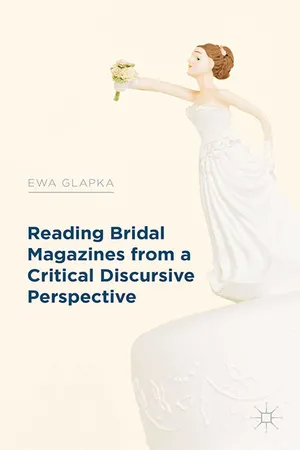
Bridal magazines have become increasingly popular in Western society, proliferating the idea of a 'princess bride' on her 'big day'. Yet little has been written on how the ever-expanding wedding media and the popular wedding culture constructs gender and affects the ways women live and experience their weddings. Offering a critique of contemporary wedding discourse, this book marries together analyses of media texts and their reception to propose a new approach to media discourse. The analysis richly illustrates how women are invited to embrace not only the stereotypical idea of bridal femininity but also a consumptive way of experiencing it. Through examination of brides' accounts of their 'big days', the book observes the imprints of the popular gender imagery on their self-portraits and self-narratives, and describes the women's diverse approaches to them. Based on insights from gender and critical discourse studies, sociology and audience research, this exploration illuminates the ongoing debate on 'media and gender' and its methodological approaches.
- English
- ePUB (mobile friendly)
- Available on iOS & Android
eBook - ePub
Reading Bridal Magazines from a Critical Discursive Perspective
About this book
Information
1
Discourse and Power
Critical Discourse Analysis
As outlined in the introduction, the primary consideration in this volume is that societies are organized first and foremost by texts. Language regulates social life in ways that people are usually unaware of. This viewpoint requires a conceptual framework informed by the theories of both discourse and power. Because this book is centrally involved with the media-based reproduction of the consensual understanding(s) of femininity, specific questions that follow from this interest should be addressed by means of this framework as well. The aim of the current chapter is to briefly introduce the basic theoretical tenets of this study and to explain reasons behind applying specific analytical concepts. As will be seen from the discussion below, in its explorations of the intricate connections between discourse and gender, this volume draws centrally on the theory of discourse developed within Critical Discourse Analysis (CDA).
Recognizing the theoretical and methodological diversity of the extended field of discourse analysis, Litosseliti and Sunderland (2002: 18–19) make an emphatic distinction between critical discourse analysis (that is, adopting a critical disposition to language) and “doing Critical Discourse Analysis”. This distinction enunciates the general agreement among linguists to consider CDA as a specific school of language. At the same time, although ‘formalized’ as an already established and self-recognized program of discourse analysis, CDA continues to develop and include new methodological solutions. In keeping with its transdisciplinarity (see Kellner 1989; Chiapello and Fairclough 2002; Fairclough 2005a; van Leeuwen 2005b), CDA has remained open also to other, not necessarily purely linguistic, ideas to strengthen its exploratory and explanatory potential.
The underlying aim of CDA-based studies has been to explore the “non-obvious ways in which language is involved in social relations of power and domination” (Fairclough [2001] 2009: 229). The role of a careful, linguistically informed analysis is to expose the opacity and intricacy of the relations:
Language indexes power, expresses power, and is involved where there is contention over and a challenge to power. Power does not derive from language, but language can be used to challenge power, to subvert it, to alter distributions of power in the short and long term. (Wodak and Busch 2004: 109)
Consequently, despite its linguistic character, Fairclough (2001: 229) emphasizes that “[t]he starting point for CDA is social issues and problems”. Following van Dijk (1993: 280), CDA is “primarily interested and motivated by pressing social issues, which it hopes to better understand through discourse analysis”. This social and political engagement is clearly manifested in CDA’s research agenda, which has so far included racism and nationalism (van Leeuwen 1996; van Dijk 1997; van Leeuwen and Wodak 1999; Arnott 2010), mass media (Fairclough 1995b; Flanagan 2010; Marling 2010; Shirazi 2013), education (Lee 1997; Ivanic 1998; Lemke 2003; Lim 2014), and institutional and workplace discourse (Sarangi and Slembrouck 1996; Iedema and Wodak 1999; Krzyżanowski 2010). Gender issues have also been pursued within CDA (Caldas-Coulthard 1993, 1996; Wodak 1997; Litosseliti and Sunderland 2002; Cameron 2003, 2005; Lazar 2005; Jeffries 2007; Annandale and Hammarström 2010; Chinwe and Osakwe 2013). Gender has become one of the objects of CDA research because it has been regarded within the paradigm as “an idea, or set of ideas, articulated in and as discourse” (Sunderland 2004: 18). Clearly, if mediated by discourse, of which CDA is fundamentally mistrustful, gender needs to be scrutinized for its potential involvement in power relations.
The programmatic engagement with the issues of power means that research steps necessary in any critical project may be reproached as value-laden. Therefore, such investigations require more than any other that analysts “take an explicit sociopolitical stance: they spell out their point of view, perspective, principles and aims, both within their discipline and within society at large” (van Dijk 1993: 252; see also Jeffries 2007: 16). When outlining the theoretical assumptions informing this piece of research, I will thus also seek to explain why the discursive mediation of bridal femininity is explored here as potentially involved in the reproduction of specific ideologies. At the same time, because CDA is not the only model of discourse analysis informing this project, the formulation of its theoretical premises and ‘sociopolitical stance’ will have been completed upon the end of the subsequent chapter.
Discourse, language and text
CDA has been engaged with both analyzing and conceptualizing language. Critical discourse analysts share an interest in the linguistic surface of social phenomena and present their own, but usually alike, understandings of ‘discourse’ and of its relation to the concept of ‘language’.1 Discourse, in very basic terms, means language used in context. As Gouveia (2003: 51) notes:
CDA may well prove to be the catalyser of a new model of understanding what happens when one uses language. In order to understand this, language has to be seen as a set of multilevelled layers of meaning in interconnection, which may only be defined by the interconnections they establish with yet other interconnections. As in physics, linguistic events do not occur according to deterministic laws but according to a set of probabilities in different dimensions.
Based on that, discourse can be more specifically defined as socially embedded and socially meaningful uses of language. For example, Jäger, following Link (1983: 60), regards discourse as “an institutionally consolidated concept of speech inasmuch as it determines and consolidates action and thus already exercises power” (Jäger 2001: 34). Wodak proposes to see discourse as “a complex bundle of simultaneous and sequential interrelated linguistic acts, which manifest themselves within and across the social fields of action as thematically interrelated semiotic, oral or written tokens, very often as ‘texts’, that belong to specific semiotic types, i.e. genres” (Wodak 2001a: 66). Chouliaraki and Fairclough (1999: 38) refer to ‘discourse’ as “semiotic elements of social practices. Discourse therefore includes language (written and spoken and in combination with other semiotics, for example, with music in singing), nonverbal communication (facial expressions, body movements, gestures, etc.) and visual images (for instance, photographs, film).”
In the same way CDA analysts share their basic understanding of discourse, they seem unanimous in allowing for a broad and inclusive definition of ‘text’. In contrast to the popular notion of ‘text’, they point out not only its written but also oral forms, as well as its increasingly multisemiotic nature. The visual analysis in the book’s exploration of bridal magazines demonstrates that, indeed, texts (although primarily linguistic) blend with other semiotic forms in ways that necessitate methodologies which respond to those other forms. Vitally, while text is usually defined in rather broad terms within CDA, it has been guided by a particularly specific understanding of textual analysis as one that is centrally involved with ‘texture’. The “textural properties of texts”, Fairclough (1995a: 4) explains, are valuable indices of the sociocultural contexts in which they originate. Both the linguistic and intertextual features of texts are therefore no less important for CDA researchers than their content.
Constructivist structuralism
Acknowledging the intricately social nature of language, this book considers it to be both socially constructive and socially constricting. This logic has been incorporated into CDA from structuration theory (Giddens 1984) and constructivist structuralism (Bourdieu and Wacquant 1992). When proposing his understanding of the dialectic between structure and agency, Bourdieu resuscitated the philosophical concept of habitus and conceptualized it as embodied ideology (Bourdieu 1990). People, he suggested, act by relying on mental, internalized schemes. These dispositions to action and thinking are standardized within a given social field and structured by the field’s fixed properties. Accordingly, habitus can be understood as the routine sense- and self-making practices, what people take for granted, the lifeworld experience in which individuals follow what they consider natural and most sensible. Importantly, however, although structured by the local conditions of living, habitus is not determined by them. Likewise, Giddens (1984: 25, 169) proposes that structure is “always both constraining and enabling”.2
Clearly, this book distinguishes between the discursive and the social practices by treating them as distinct parts of the socio-semiotic dialectic. Language use leads to either construction or reproduction of discourses, with specific social implications; the production of language is however conditioned by social structures and practices. An important caveat as regards the ‘structures and practices’ is added here from the poststructuralist tradition of discourse analysis (see Chapter 2). Namely, this volume considers ‘reality’ as available in the form of multiple realities – subjective, emerging from contexts, mediated by socially located discourses. In other words, both the social structures and the changes made within them by social agents are part of individuals’ subjective experiences. This does not mean that the extra-discursive is denied in this study. Following the critical realist epistemology (Bhaskar 1986; Archer 1995; Archer et al. 1998; Sayer 2000; Fairclough 2005b), the study acknowledges that any knowledge about the extra-discursive depends on the researcher’s position but interest in the material level of discursive practices is nonetheless maintained in this book.
This understanding of the relations between the discursive and the social is elaborated on in reference to the book’s view of identity. The book regards discourse as “an array of enabling potentials ... [and] a set of constraining boundaries beyond which selves cannot be easily made” (Shotter and Gergen 1989: ix). In other words, although people’s creative and self-determining abilities are not denied, their thoughts and actions are shaped by the objective structures of society, culture and language, that is, the socioculturally available discourses. Following the constructivist-structuralist perspective, this volume seeks to address these socio-semiotic intricacies empirically in the investigation of the public and private discourses of gender, as found in British bridal magazines and in women’s talk about them. The analysis of the magazines is intended to give some insight into “the way we are spoken about” (Jaworski and Coupland 1999: 412), while the interviews with magazine readers present “the way we speak both to and about others” (and, in the current investigation, about ourselves) (Jaworski and Coupland 1999: 412). The former concerns “various private and institutional discourses [that] are constitutive of us (and others) as social subjects” (Jaworski and Coupland 1999: 412–3). The latter is related to the practices by which people negotiate their identities, or subject positions. In these practices, the book considers, individuals are capable of shaping their social realities.
Struggle over meaning
In this book’s elaboration of its critical perspective on language, it proposes to see language as the site of ‘struggle over meaning’. While language is the site of the struggle, and meaning is at stake, the struggle takes place during the practices of discourse. Following Bakhtin ([1935] 1981: 272), discourses operate centrifugally and centripetally:
Every concrete utterance of a speaking subject serves as a point where centrifugal and centripetal forces as brought to bear. The processes of centralization and decentralization, of unification and disunification, intersect in utterance.
Centripetal forces are the normalizing, stabilizing and prescriptive pressures to subject language to arbitrary conventions. They “produce the authoritative, fixed, inflexible discourses of religious dogma, scientific truth, and the political and moral status quo” (Maybin [2001] 2009: 65). Centrifugal forces represent the opposite directions by pulling language to diversity and creativity, and making it a vehicle of resistance. A discourse that emerges from this dynamic is “open and provisional in the way it produces knowledge and is often swayed by other people’s inwardly persuasive discourses and by the authoritative discourses which frame people’s everyday actions” (Maybin 2009: 65).
This underlying dynamic of language explains why gender, which is understood here as ‘set of ideas articulated in discourse’, needs to be scrutinized in terms of power hidden behind the relations of meaning. Both femininity and masculinity are centrally involved in the processes discussed here because the formation and contestation of gender takes place in the practices of discourse – what it means to be a woman or a man is usually the effect of some form of ‘struggle’. As will be demonstrated in this volume, the media discourses of gender propose definitions of femininity that they subsequently normalize and stabilize through, for instance, repetitions, consensual tone, stylistic coherence, modality and genres. However, these apparently conventional and non-negotiable meaning structures can be challenged. They can be undermined or subverted by the centrifugally organized ‘private discourses’ in which people articulate their lived experience. Accordingly, in terms of Bakhtin’s insights, research presented in this volume confronts the normalizing media discourses of gender with the potentially subversive, ‘inwardly persuasive’ discourses of embodied speakers.
Explanatory critique
CDA has been recognized in the field of discourse studies as a research tradition that “openly professes strong commitments to change, empowerment, and practice-orientedness” (Blommaert and Bulcaen 2000: 449). Namely, apart from exposing the indirect links between language and power, a critical discourse study is supposed to provide “the basis for political action to bring about radical and emancipatory social change” (Hammersley 1997: 238). From the very beginnings of CDA, its main theorists and practitioners have underscored the importance of providing people with the knowledge of the power-related processes, that is, ‘critical language awareness’ (Fairclough 1995a: 217ff.). CDA’s explanatory critique (Bhaskar 1986) is intended to play an auxiliary role in identifying the power relations and proposing the discursive resources for resistance.
Following Smith (1992: 93), this book considers that “in ... contemporary societies, the functions of organization and control are increasingly vested in distinct, specialized, and (to some extent) autonomic forms of organization and relations mediated by texts”. The ‘relations of ruling’, as Smith calls the textually mediated regulation of social life, reproduce specific understandings of gender. The ‘explanatory critique’ that this volume hopes to offer is its contribution to a better understanding of the ways in which the prevailing conceptions of femininity circulate in media discourse. Nevertheless, neither it is this study’s goal to ‘prove’ that popular media (such as wedding magazines) inferiorize women by presenting them with depreciative definitions of femininity, nor does it assume that women do not have their own ways of contesting hegemonic discourses. Firstly, the aim of this book is to analytically connect the mechanisms of meaning construction and the ideologically or economically motivated processes behind them. Secondly, this study seeks to explore the dynamic between the media and the reader by looking into how the predominant understandings of bridal femininity are negotiated in women’s encounters with media texts.
Regarding the latter, although this piece of research takes an openly critical approach to discourse and believes that media discourses reproduce gender-based inequality, it does not claim that women are completely unaware of it. Such an assumption, this book posits, implies ignoring the “knowledgeability of social actors” (Giddens 1984: xxxvii). Even though this does not necessarily mean patronizing them as unthinking and passive recipients of media content, the appearances of such a presumptive approach, I propose, might emerge from the investigation of media discourse reduced to one (academic, feminist) perspective. Far from denying the value of CDA’s approach to media discourse, this book will take the opportunity to enrich the critical examination of bridal magazines with interviews in which readers individually related to the magazines’ discourses. In its critical engagement with interview data, the study will explore how the women’s identities were encoded in their language use. The texture of the spoken data is intended to cast some light on the dynamic between the reader, media texts and, perhaps, on how those texts tap into her sense- and self-making practices.
Analysis
Because of the undeniable complexity of the processes of meaning construction, any arbitrary conventions of data analysis would unnecessarily decrease the research potential of critical discourse studies. As van Leeuwen (1996: 33) cogently explains, “[t]here is no neat fit between sociological and linguistic categories, and if Critical Discourse Analysis ... ties itself too closely to specific linguistic operations or categories, many relevant instances of agency might be overloo...
Table of contents
- Cover
- Title
- Introduction
- 1 Discourse and Power
- 2 Women as Subjects of Discourse
- 3 Bridal Femininity in Wedding Magazines
- 4 Reading a Magazine: Methodological Considerations
- 5 Reading a Magazine: The Interviews
- 6 Reading a Magazine: Discussion
- Conclusion
- Notes
- Bibliography
- Index
Trusted by 375,005 students
Access to over 1.5 million titles for a fair monthly price.
Study more efficiently using our study tools.
Frequently asked questions
Yes, you can cancel anytime from the Subscription tab in your account settings on the Perlego website. Your subscription will stay active until the end of your current billing period. Learn how to cancel your subscription
No, books cannot be downloaded as external files, such as PDFs, for use outside of Perlego. However, you can download books within the Perlego app for offline reading on mobile or tablet. Learn how to download books offline
Perlego offers two plans: Essential and Complete
- Essential is ideal for learners and professionals who enjoy exploring a wide range of subjects. Access the Essential Library with 800,000+ trusted titles and best-sellers across business, personal growth, and the humanities. Includes unlimited reading time and Standard Read Aloud voice.
- Complete: Perfect for advanced learners and researchers needing full, unrestricted access. Unlock 1.5M+ books across hundreds of subjects, including academic and specialized titles. The Complete Plan also includes advanced features like Premium Read Aloud and Research Assistant.
We are an online textbook subscription service, where you can get access to an entire online library for less than the price of a single book per month. With over 1.5 million books across 990+ topics, we’ve got you covered! Learn about our mission
Look out for the read-aloud symbol on your next book to see if you can listen to it. The read-aloud tool reads text aloud for you, highlighting the text as it is being read. You can pause it, speed it up and slow it down. Learn more about Read Aloud
Yes! You can use the Perlego app on both iOS and Android devices to read anytime, anywhere — even offline. Perfect for commutes or when you’re on the go.
Please note we cannot support devices running on iOS 13 and Android 7 or earlier. Learn more about using the app
Please note we cannot support devices running on iOS 13 and Android 7 or earlier. Learn more about using the app
Yes, you can access Reading Bridal Magazines from a Critical Discursive Perspective by E. Glapka in PDF and/or ePUB format, as well as other popular books in Social Sciences & Linguistics. We have over 1.5 million books available in our catalogue for you to explore.