eBook - ePub
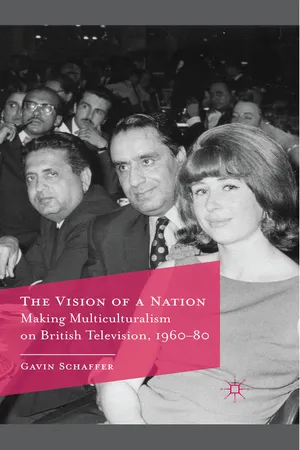
The Vision of a Nation
Making Multiculturalism on British Television, 1960-80
- English
- ePUB (mobile friendly)
- Available on iOS & Android
eBook - ePub
About this book
Telling the stories behind television's approaches to race relations, multiculturalism and immigration in the 'Golden Age' of British television, the book focuses on the 1960s and 1970s and argues that the makers of television worked tirelessly to shape multiculturalism and undermine racist extremism.
Information
1
The Vision of a Nation: Introduction
In 1978, an argument erupted at the BBC about illustrations in some of the books that accompanied children’s education programmes. Writing to a host of high-ranking BBC officials, John Robottom, from the Midlands division of the Educational Broadcasting Council, complained that ‘all these are portrayals of white adults and children when it would have been so easy to vary this’.1 Giving short shrift to Robottom’s concerns, Geoffrey Hall, the Head of Schools Broadcasting on Television, responded that he would ‘certainly oppose’ any decision not to recommend literature simply because ‘none of the cartoon faces in the teacher’s notes have been shaded in’. Focusing on the quintessentially English cartoon versions of Arthur English and Jack Wild in teachers’ notes for Everyday Maths, Hall flippantly argued: ‘Perhaps we should have blacked them up!’2 Far from finding this response amusing, Robottom continued to make his case.
in most urban areas, a disproportionately high part of the audience for this series will be black or Asian. This does surely constitute some case for considering the images projected on the screen and in the broadcasts. Yes, I think you should have shaded in some of the faces.3
While ostensibly the most modest of arguments about representation, this dispute was one of many among broadcasters about how to reflect British multiculturalism. As was graphically illustrated in this case, these debates were very much about ‘making’ in the most conscious sense of the term, so that making multicultural television in the 1960s and 1970s could boil down to discussions between white executives about whether or not to ‘shade in’ the faces of cartoon characters. In this way, television debated how best to respond to what was perceived to be going on in Britain, discussions about race relations, immigration and multiculturalism that were often highly politicised and fractious. The output that emerged, which characterised television in this period, is illexplained as a simple reflection of what was happening in British society writ large.4 It was instead a manufactured model of multiculturalism, television’s own visions of a nation, which looked to create impact as much as reflect it.5
This book will argue that television production in the 1960s and 1970s, taken as a whole, attempted to create specific visions of multiculturalism, immigration and race relations, and that these had an enduring impact across and beyond the British broadcast media. It builds on pioneering research by Sarita Malik, Darrell Newton, Stephen Bourne and Karen Ross (among others), who have done much to tease out the complex and often contradictory constructions of black and Asian people on British television, as well as to give voice to these under-represented histories.6 Across this body of scholarship, the idea that the broadcast media should be treated as a ‘causal agent’,7 an active generator of social meaning, has been paramount.8 Malik, for example, has argued that ‘to assume that television simply reflects what is going on “out there” overlooks the fact that representation does not merely reflect, but is an active part of society’.9 Scholarship on race and the media has thus emphasised the ability of television to serve as both a ‘barometer’ of race relations and an ‘accelerator’, to gauge the mood of the population and to shape it.10 Above and beyond the shaping of opinions, the media played a key role in defining what racial issues were perceived to entail, informing the public about race as a concept, about what racial difference may or may not mean. As Stuart Hall explained, ‘the media construct for us a definition of what race is, what meaning the imagery of race carries, and what the “problem of race” is understood to be’.11
Reading television as a protagonist in social thinking about race, The Vision of a Nation probes the history of television production in the 1960s and 1970s with the dual aim of unpicking some of the thinking that underwrote the representation of race relations, immigration and multiculturalism, and of gauging some of the impacts of these televisual strategies.12 Ultimately, this is a book which sets out to show that television’s presentation of multiculturalism, immigration and race relations has played a significant role in shaping the way these issues came to be understood in Britain. This is not, to be clear, because television held up a mirror to the nation’s views or could tell people what to think, but because television became a clear ‘site of struggle’ in this period for a whole host of social actors.13 From local community groups to the upper echelons of the British government, political protagonists obsessively engaged with television in the 1960s and 1970s, believing in the power of the medium to intervene and instruct in broader social affairs.14 The relationship between the state and the broadcast media will come under particularly close scrutiny in this analysis. Building on a body of research which has emphasised the limitations of broadcasting independence in Britain,15 The Vision of a Nation will question the role of governments in shaping the race relations strategies of the BBC and ITV in this period, and the ways in which broader political interest groups have tried to channel what was perceived as a powerful instrument of public opinion to their own ends.
Widespread belief in the power of television was rooted in the meteoric rise of the technology in the 1950s and 1960s, a rise which made television, in Marwick’s words, ‘a ruling component in the spending of leisure everywhere’.16 In 1951, fewer than 10 per cent of Britons possessed a set, a figure which had risen to 75 per cent by 1961 and 91 per cent by 1975.17 Donnelly has described this rise in television ownership as ‘the most important cultural transformation of the sixties’, and it was a change matched by the evolution of the medium into a provider of increasingly sophisticated and wide-ranging news and entertainment output.18 In the wake of the competition which followed the birth of independent television in 1955 and driven by its ‘near universal presence’ in the nation’s homes by the 1960s, television developed from a peripheral leisure activity to the main source of Britain’s news and entertainment. As Curran and Seaton have argued: ‘In the 1960s and 1970s television came of age.’19
This rise in television ownership and use caused considerable political and social anxiety. In July 1960, the government commissioned industrialist Sir Harry Pilkington to consider the future of British broadcasting amid what one scholar has described as a growing ‘moral panic’ about the influence of television.20 The findings of the Pilkington Committee were indeed underpinned by a ‘crude view of the power of the media’,21 which assumed that television could have ‘profound and far-reaching effects’ and could be ‘a potent factor in influencing the values and moral standards’ of British society.22 This anxiety was focused not only on the idea that television could have a deleterious impact on public morality but also in concern that it could alter the public’s political beliefs. Certainly, Harold Macmillan’s government, and even more so Harold Wilson’s Labour government after 1964, became extremely anxious about television’s ability to influence public opinion and sway voters,23 a worry magnified by the idea that this could happen subliminally.24 Labour’s George Brown told the Party Conference in 1968 of his concern about the extent to which ‘those who control the media … influence and impact on people’s thinking and people’s attitude without their even being aware of it’.25 Of course, this fear was epitomised by the long-standing campaign of Mary Whitehouse and the National Viewers’ and Listeners’ Association.26 Typically, Whitehouse wrote to the Home Secretary in 1968 expressing her anxieties about the power of television and the way it was being managed. She told him: ‘There is an apparent lack of understanding amongst television professionals of the power of television to accentuate problems, to harden attitudes and even create public opinion.’27
In reality, audiences were, of course, never simply receptacles for any messages or ‘codes’ that television might have wanted to put over about race relations, multiculturalism or anything else. As Barthes explained, television ‘work’ (the construction of meaning in production) became something altogether different when it was interpreted as a ‘text’ by viewers at home.28 Stuart Hall famously described this process as ‘encoding’ and ‘decoding’,29 and scholars have long argued about the power of viewers to make their own meanings from what they see on television.30 Hall himself felt a degree of confidence that many viewers would receive codes from television broadly in the manner which was intended in production (‘the dominant or hegemonic code’), although he retained a belief that some viewers would negotiate or even develop oppositional readings to the messages that were put over.31 Subsequently, other scholars have argued more stridently about the ability of audiences to shape television messages. Fiske, for example, described television according to ‘its ability to devolve the power to make meanings to audiences’, while Bignell has highlighted the power of viewers to ‘recognise, sidestep and reject’ television codes.32
Hall’s reluctance to present television coding as ultimately open to viewer interpretation, as an uncontrollable myriad of competing meanings, was rooted in his awareness that power, in the process of meaning creation, was not evenly distributed. Put simply, television in Britain was controlled by a broadcasting elite, reflecting what Raymond Williams described as a ‘pre-existing cultural hegemony’.33 While ostensibly politically impartial, this elite mostly shared the core ideologies of Britain’s political elite and was highly susceptible to political pressure.34 In this environment viewers at home were not equal, Ellis reminding us that it was an unusual ‘honour for anyone outside that elite to be invited to appear on the screen’.35 Set against varying degrees of elite consensus and control, viewers were at least to some extent susceptible to the worldviews which flowed from the screen. Indeed, to argue otherwi...
Table of contents
- Cover
- Title Page
- Copyright
- Contents
- Acknowledgements
- 1. The Vision of a Nation: Introduction
- 2. ‘The First Bridge’: Programmes for Immigrants on British Television
- 3. Race in News and Current Affairs: Principles and Practice
- 4. Dealing with Racial Extremes: News and Current Affairs under Pressure
- 5. What’s Behind the Open Door? Talking Back on Race in Public-Access Broadcasting
- 6. The Rise and Fall of the Racial Sitcom: Laughter and Prejudice in Multicultural Britain
- 7. Struggling for the Ordinary: Race in British Television Drama
- 8. Conclusion
- Bibliography
- Index
Trusted by 375,005 students
Access to over 1.5 million titles for a fair monthly price.
Study more efficiently using our study tools.
Frequently asked questions
Yes, you can cancel anytime from the Subscription tab in your account settings on the Perlego website. Your subscription will stay active until the end of your current billing period. Learn how to cancel your subscription
No, books cannot be downloaded as external files, such as PDFs, for use outside of Perlego. However, you can download books within the Perlego app for offline reading on mobile or tablet. Learn how to download books offline
Perlego offers two plans: Essential and Complete
- Essential is ideal for learners and professionals who enjoy exploring a wide range of subjects. Access the Essential Library with 800,000+ trusted titles and best-sellers across business, personal growth, and the humanities. Includes unlimited reading time and Standard Read Aloud voice.
- Complete: Perfect for advanced learners and researchers needing full, unrestricted access. Unlock 1.5M+ books across hundreds of subjects, including academic and specialized titles. The Complete Plan also includes advanced features like Premium Read Aloud and Research Assistant.
We are an online textbook subscription service, where you can get access to an entire online library for less than the price of a single book per month. With over 1.5 million books across 990+ topics, we’ve got you covered! Learn about our mission
Look out for the read-aloud symbol on your next book to see if you can listen to it. The read-aloud tool reads text aloud for you, highlighting the text as it is being read. You can pause it, speed it up and slow it down. Learn more about Read Aloud
Yes! You can use the Perlego app on both iOS and Android devices to read anytime, anywhere — even offline. Perfect for commutes or when you’re on the go.
Please note we cannot support devices running on iOS 13 and Android 7 or earlier. Learn more about using the app
Please note we cannot support devices running on iOS 13 and Android 7 or earlier. Learn more about using the app
Yes, you can access The Vision of a Nation by G. Schaffer in PDF and/or ePUB format, as well as other popular books in Social Sciences & British History. We have over 1.5 million books available in our catalogue for you to explore.