eBook - ePub
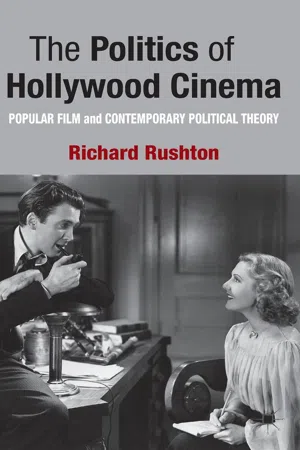
The Politics of Hollywood Cinema
Popular Film and Contemporary Political Theory
- English
- ePUB (mobile friendly)
- Available on iOS & Android
eBook - ePub
About this book
The Politics of Hollywood Cinema radically transforms our understanding of cinema's potential to be politically engaging and challenging. Examining several films from Hollywood's classical era, including Marked Woman, Mr Smith Goes to Washington, Born Yesterday, On the Waterfront and It Should Happen to You, alongside contemporary theories of democracy advanced by Ernesto Laclau, Chantal Mouffe, Claude Lefort, Étienne Balibar and Jacques Rancière, Richard Rushton argues that popular films can offer complex subtle, relevant and controversial approaches to democracy and politics.
Information
Subtopic
Film & Video1
What Is a Politics of Cinema?
There is one overarching reason for writing this book. It is to argue that some examples of classical Hollywood cinema tackle politics and issues relating to democracy in ways that deserve to be explored. The films I discuss, The Sound of Music (1965), Marked Woman (1937), On the Waterfront (1954), Mr Smith Goes to Washington (1939), Born Yesterday (1950) and It Should Happen to You (1954), are ones that made democratic politics something worth thinking about, worth debating and worth considering in some detail. For too long film scholars have been taught to denigrate Hollywood films as politically naïve or backward, or if such films could be said to have anything to do with politics, then those politics must necessarily be of a conservative, reactionary kind. Perhaps this is an argument born out of the emergence of film studies as an academic discipline, for during the 1960s and 1970s, under the influence of the kinds of Marxism being espoused by journals like Cahiers du cinéma in France and Screen in the UK, what came to seem important to many film scholars was that Hollywood films be criticized on the basis of their bourgeois, capitalist-based conservatism. Other modes of film making – independent films, new wave cinema, ‘counter cinema’, art cinema, alternative cinema, even documentaries or government-funded modes of filmmaking, for example – might then have the opportunity to pit themselves against the Hollywood juggernaut. ‘Good’ films had to be pitted against the politically conservative norms of Hollywood; such were the stakes of the arguments which founded academic film studies.1 It is this kind of argument, very common even today in film studies, that I aim to counter in this book. What I argue is that, if we look closely at some films from classical Hollywood, we can discover a wealth of arguments about politics and democracy, and these arguments deserve to be fleshed out in some detail.
The book is therefore about arguments. It is not a history. There are a number of excellent histories of ‘political films’ in America – Brian Neve’s breakthrough study Film and Politics in America remains the finest of them (Neve 1992). What I am offering here is not a history. Instead, I am looking closely at a small selection of films to try to discern what these films can tell us. I relate what these films can tell us to what certain political theorists of the last 40 years or more have also been telling us. The theorists upon whom I rely – Ernesto Laclau, Chantal Mouffe, Jacques Rancière, Étienne Balibar, Claude Lefort and perhaps one or two others – are theorists of democratic politics. They might all be said to be asking one question: what is democracy? If there is a central question for this book then it too might be: what is democracy? But alongside this question – or in conjunction with it, conjoined in such a way that I would not want it to be separated – can run another question: what is cinema? I am certainly not the first to suggest that film might be a democratic art (see Jowett 1976), but in this book I aim to investigate the connection between cinema and democracy in a very detailed way.
The Politics of Hollywood Cinema is also a chance to take up some of the arguments from my book The Reality of Film (Rushton 2011). That book had a straightforward aim: to offer an alternative to the discourse of ‘political modernism’ in film studies. I claimed there that political modernism prides itself on dividing films into the categories of good and bad. Those films deemed ‘good’ are politically progressive while those deemed ‘bad’ are politically reactionary and negative. (My further claim there was that political modernism divides films along the lines of the good-real versus bad-illusory dichotomy.) This division has provided many film scholars with a very powerful programme of rhetoric which has come to define the stakes of a ‘politics of cinema’. According to the logic of political modernism, one writes politically about films – or defines political films – by demonstrating what the attributes of a ‘good’ film are by way of contrast with what a ‘bad’ film is. A good film is a political one, while a bad film is one that eschews politics or has a hidden ideology which is conservative. Much of this programme is very strongly indebted to Brecht’s writings on theatre, for the conviction amongst political modernist film scholars was, and is, that certain formal and storytelling qualities which distance a viewer from the film being shown (or, for Brecht, the play being performed) provide the only environment in which a film (or play) can in any way be political. The task for a film scholar who is trying to define a politics of cinema is therefore to define which formal qualities are being espoused by a film, how those qualities distance a viewer from what they are looking at and which, therefore, allow the opportunity for a politics of some sort to be engaged.
My arguments here reject the political modernist dichotomy. My aims here are not to tell people what a political film is – how a political film might look or feel or what such a film might do – and nor is it to demonstrate what kinds of films fail the test of the political, that is, which ones are deceiving us or feeding us propaganda and so on. Rather, more modestly perhaps, my aim is to demonstrate that films can explore – and that they have explored in the past – debates about politics and democracy in subtle and challenging ways. I do not want to pit myself entirely against political modernism, for the breakthrough years of film studies as an academic discipline were, for me, guided by brilliant thinkers who set in place an impressive programme – the names are formidable: Jean Narboni, Jean-Louis Comolli, Jean-Pierre Oudart, Pascal Bonitzer, Jean-Louis Baudry, Peter Wollen, Laura Mulvey, Colin MacCabe, Stephen Heath, Brian Henderson, Charles Eckert … I could go on (and I will grapple more closely with these writers in later chapters). What is perhaps most impressive about these scholars is that defining something called politics, a cinematic politics or politics of film, really mattered, and it mattered in the context of one significant political philosopher who inadvertently propelled film studies for a short period of time onto the centre stage (or somewhere near the main stage) of humanities scholarship: Louis Althusser. Political philosophy was integral to the birth of film studies as I understand it and I demonstrate in some of the early chapters of this book what an impressive influence Althusser had on film studies.
If Althusser’s influence was so impressive during the 1960s and 1970s, why have virtually no political philosophers been taken on board in debates on film studies since then? This is not a question I can answer simply; it will take much of the book to flesh out an answer. But I can anticipate that many film scholars will dismiss my claims straight up and their retorts might be something along the lines of: ‘Of course film scholars have engaged with questions of politics since the time of Althusser and, more to the point, the ways in which film scholars have engaged more recently with politics has been far more subtle, relevant and challenging than anything that was offered by Althusser and his followers.’ This point might be granted, but much of what might be argued depends on what one is prepared to call ‘politics’. If an Althusserian politics can be defined by and large by a Marxist framework, then the kinds of politics which have ‘moved on’ from Althusser have, for film studies, mainly been those associated with cultural studies: the politics of gender, race and sexuality. Are the questions feminist theorists have asked of cinema political ones? What about the many brilliant analyses of race and cinema – aren’t these political? And gay, lesbian and queer theory has created spaces for a politics of cinema, haven’t they? My answer to all of these positions is No. Or at any rate, that is a simple answer. And readers might have to content themselves with a simple answer (it would take an altogether different book for me to confront these issues): if class was the issue for Marxist approaches to film and cinema, then for cultural studies the stakes have remained much the same, except that issues of class have been replaced by a range of other subalterns: race, gender, sexuality. In other words, if Marxist critics derided the absence of voices for the lower classes in Hollywood film, then the task of the cultural studies critic has been to point out, in much the same way, how African Americans, women, lesbians, gays, and so on have all been denied voices. Against that oppositional framework, I am instead here trying to articulate a somewhat different approach to the question of politics. And readers should not get me wrong: just as I am fully in favour of championing the voices of the lower classes, then so too am I an advocate of the voices of other minorities associated with race, gender and sexuality. However, the political framework which can allow such voices to be heard is precisely a democratic one, and Hollywood cinema need not be seen as an enemy of such a politics. That, at any rate, is a starting point for my argument in this book.
Cinematic political thought
Let me at least go some way further towards pointing out what The Politics of Hollywood Cinema is not. One recent engagement with the question of the relationship between politics and cinema has been posed by Michael Shapiro (Shapiro 1999). In his ambitious book on Cinematic Political Thought Shapiro argues that, although his position is indebted to the writings of the philosopher Immanuel Kant, there is also a need to go beyond Kant’s claims. Kant aimed to provide ‘a universalistic basis for experience’, a common sense or sensus communis, and he did this against the backdrop of immense political events (the French Revolution being paramount) (see Shapiro 1999:15). But against a Kantian claim for universality or common sense Shapiro wants to defend politics in terms of an uncommon sense, a sentiment he attributes to French philosopher Gilles Deleuze. Above all this means, for Shapiro, privileging the virtual over the actual. If actual things can be said to exist or take place, then this means such things or events are placed in prescribed, determinate categories. Such categories of the actual, Shapiro contends, can only ever ‘emerge as a result of an imposition’ (22), and it is this kind of imposition that Shapiro wants to get away from in order to affirm his vision of the political. To be properly political thus means accepting the virtuality of events, for emphasizing the virtual deflects any imposition of actual meaning and therefore results, for Shapiro, in ‘a virtual structure that is never captured in any particular determination’ (21). Shapiro thus wants to loosen events and occurrences from any predetermined fates so that the meaning and potential of events and actions can be set free. The result of the affirmation of the virtual is that any claim to ‘the truth’ is undermined – and this is a good thing, Shapiro argues. Any claim to the truth can only ever subject the world to pre-determined categories and judgements. Against this, the privileging of the virtual can open us to the opportunity of ‘experiencing the world differently’ (22). To experience the world freely and differently goes to the core of what Shapiro here wants to call ‘politics’.
The stakes of Shapiro’s argument are important. Against a modernist trend towards normalization and conformity, that is, the imposition of ways of being, modes of conduct, of ‘discipline’ in the manner so brilliantly described by Michel Foucault (the other master thinker central to Shapiro’s formulations; see Foucault 1977), a postmodern view of things rejects and negates that universalization. Instead, much contemporary thought – and film studies along with it – has affirmed difference, non-conformity, anti-universality and exceptions to the norm. If the ‘normal’ or universal has for too long been the white heterosexual male, then postmodernism has tried to break down this dominance by advocating the non-white, non-heterosexual and non-masculine. If for so many years the only ‘proper’ experiences and events have been those determined by white heterosexual males so that any other events or objects are seen as lesser or inauthentic shadows of such privileged things – ‘virtual’ happenings – then contemporary thought has restored the dignity of those other spaces, events and objects (see Foucault 1986).
And yet, against these postmodern arguments, might something be gained by designating and determining some things as ‘actual’? One of the boldest claims I defend in this book is that universalism is a goal worth aspiring to and that any politics worthy of being called a politics will stake a claim for the universality of its propositions. It is not so much that a universality will ever be achieved (and Kant knew as much as this) but that it might be seen as a goal (or, as with Kant, as a transcendental foundation). A politics, in simple terms, might be described as what a group of people affirm about themselves as being ‘in common’, the sense of aspiring to something in common, a sensus communis no less. Of course, this can pertain to out-of-work, unskilled African Americans who in one way or another affirm their sense of being downtrodden and shut out of mainstream politics – this is a way to discover what they have in common. But a similar sense of being in common will also pertain to a few billionaires chatting on their yachts in Martha’s Vineyard about how they pay too much in taxes – both of these groups might be seen to be defending what they have ‘in common’. But that is what politics is about: finding a common sense, discovering something one has in common with others and articulating that sense, making something at stake in it: making it actual.
The most universal claim for a democratic politics is the claim for equality (much of the present book will be devoted to exploring that proposition, especially Chapters 7 and 8). It is also the most radical and difficult claim. For Shapiro, a concept like equality is solidly outweighed by the defence of difference and freedom. Much contemporary thought has been dedicated to defending anyone’s ability to be different (to be non-white, non-heterosexual, non-masculine) with the result that in defending one’s difference one also affirms one’s freedom. Such claims form the core of what most contemporary thinkers believe is ‘political’: the freedom from constraints, the freedom to be who I want to be, the freedom to never be told what to do. For these thinkers, freedom is paramount and must be staunchly defended. On the other hand, or from the other side of the fence, the concept of equality is much more difficult to sustain for contemporary sensibilities. To claim equality with another is in some way to rein in your difference from that other person, to curtail your difference and thus in some way to cut short your ability to be free. My argument is one that defends a concept of equality as one that cannot be separated from freedom.
On the subject
Such are the kinds of arguments this book defends. I want to defend universality and equality as categories central to politics. But I also want to defend the category of the subject. Here again Kant is a haunting spectre, for his search for a ‘universalistic basis for experience’ (as Shapiro puts it) led him to posit nothing less than a ‘transcendental subject’ or at the very least, he gave certain universal aspects of human subjectivity a transcendental basis (Kant 1929). For Kant, subjectivity aspires to universality. Shapiro will have nothing of such designations. He therefore argues, again invoking Deleuze, that ‘Events have no determined actuality for Deleuze; they are formed neither in the world nor by the structures of subjectivity’ (Shapiro 1999: 21). What he means by this is that, along with a repudiation of actuality as anything that can be objectively determined (as something ‘in the world’), events cannot be considered as things created by subjects: subjects cannot be considered the origins of things that happen.
These arguments on the nature of the ‘subject’ go back at least as far as Althusser, and they were taken up by film studies scholars with great gusto during the 1970s. Shapiro, with his attempts to define an approach to film studies that resists the construction of subjects, is therefore adding to a long debate in film studies2: that in viewing a film I am made into a subject; that I am subjected to subjectivity. There is nothing simplistic in these declarations and, furthermore, as I have mentioned, they stem from Louis Althusser’s own analyses – ‘ideology interpellates individuals as subjects’ – especially insofar as those analyses were taken up by Jean-Louis Baudry in relation to the cinema (see Althusser 1972; Baudry 1985). I will condense these arguments here, for they have been well documented (I make a good deal more of these arguments in Chapter 2 of this book). Its basic treatment develops along the following lines: the fantasy that is fulfilled when I go to the cinema is that I become master of all I survey, I become a ‘master subject’ formed by the mirrored impression of what I perceive and apprehend. Perhaps such a goal might seem all well and good, but the critique of subjectivity is predicated on the argument that this so-called ‘mastery’ is merely an illusion of mastery: under the conditions of film spectatorship I might think I am master of all I survey, but in reality I am being mastered by the machine – the cinema machine – to which I am being subjected. The cinema machine is thus a machine of illusion, falsehood, duplicity, deception and so on. A film makes me think or believe I am having these visions (i.e. visions of that which is represented by the movie) and that they are my visions, but in reality I am being duped and fooled by the cinema apparatus. Even worse than this, the cinema machine makes me believe that being a master of all I survey – a subject – is something I should aspire to, when in reality ‘being a subject’ merely means that I am being constrained and restricted by the machine which captures me in its sights. What ‘being a subject’ means, therefore, is that, even though I think I am being an individual, being ‘me’, I am in fact being made into a subject who is subject to the same desires and aspirations as others. In short, I am being made ‘the same’ as others. In short, ‘being a subject’ means being subjected to the capitalist society which produces commercial feature films.
Trying to ‘escape from subjectivity’ has been one of the defining traits of a certain strand of film studies over the last 40 years, from Stephen Heath (1981a) through feminist critiques (see Silverman 1983) to Deleuzian approaches like those of Patricia Pisters (2003) or Shapiro. All have no doubt been influenced by Althusser’s critique of the bourgeois subject, but also by Foucault’s dramatic version of ‘man’s end’ from The Order of Things, if not others (see Foucault 1970: 387). Influenced by Brecht, most film scholars argued for strategies of distanciation as a way of opposing the construction of subjects: if I am distanced from myself and from what I see on the screen, then I will not be subject to what I see and thus will not be subject to myself (and will not, therefore, ‘be’ a subject). Many film scholars will be familiar with this strategy: commercial Hollywood films are typically those which do not distance their audiences – they are ‘transparent’ – and thus produce spectators as subjects, while radical or political films do employ distancing techniques in order to produce their spectators as alienated in one way or another (Brecht’s Verfremdungseffekt). Here, then, we clearly have set out for us a programme which divides ‘bad’ films from ‘good’ ones: bad films are transparent and produce subjects, while good films are estranging and produce senses of alienation (or some such distancing – whatever it is they do, they do not produce ‘subjects’).
This strategy of argument and classification still carries tremendous weight in film studies. For political modernist scholars of the 1960s and 1970s, however, there was a great deal at stake in making these arguments (as there was for Brecht’s arguments for Epic Theatre). There was a Marxist agenda; t...
Table of contents
- Cover
- Title Page
- Copyright
- Contents
- List of Figures
- Acknowledgements
- 1. What Is a Politics of Cinema?
- 2. Discovering a Politics of Cinema: The Influence of Althusser
- 3. The Politics of Cinematic Pleasure (with Some Reflections on The Sound of Music)
- 4. Politics and Hollywood Cinema: Marked Woman
- 5. Suture and Political Identity: On the Waterfront
- 6. Democracy and Totalitarianism: Mr Smith Goes to Washington
- 7. Égaliberté and Citizenship: Born Yesterday
- 8. Equality and Democracy: It Should Happen to You
- 9. Concluding Comments
- Notes
- Bibliography
- Index
Trusted by 375,005 students
Access to over 1.5 million titles for a fair monthly price.
Study more efficiently using our study tools.
Frequently asked questions
Yes, you can cancel anytime from the Subscription tab in your account settings on the Perlego website. Your subscription will stay active until the end of your current billing period. Learn how to cancel your subscription
No, books cannot be downloaded as external files, such as PDFs, for use outside of Perlego. However, you can download books within the Perlego app for offline reading on mobile or tablet. Learn how to download books offline
Perlego offers two plans: Essential and Complete
- Essential is ideal for learners and professionals who enjoy exploring a wide range of subjects. Access the Essential Library with 800,000+ trusted titles and best-sellers across business, personal growth, and the humanities. Includes unlimited reading time and Standard Read Aloud voice.
- Complete: Perfect for advanced learners and researchers needing full, unrestricted access. Unlock 1.5M+ books across hundreds of subjects, including academic and specialized titles. The Complete Plan also includes advanced features like Premium Read Aloud and Research Assistant.
We are an online textbook subscription service, where you can get access to an entire online library for less than the price of a single book per month. With over 1.5 million books across 990+ topics, we’ve got you covered! Learn about our mission
Look out for the read-aloud symbol on your next book to see if you can listen to it. The read-aloud tool reads text aloud for you, highlighting the text as it is being read. You can pause it, speed it up and slow it down. Learn more about Read Aloud
Yes! You can use the Perlego app on both iOS and Android devices to read anytime, anywhere — even offline. Perfect for commutes or when you’re on the go.
Please note we cannot support devices running on iOS 13 and Android 7 or earlier. Learn more about using the app
Please note we cannot support devices running on iOS 13 and Android 7 or earlier. Learn more about using the app
Yes, you can access The Politics of Hollywood Cinema by R. Rushton in PDF and/or ePUB format, as well as other popular books in Media & Performing Arts & Film & Video. We have over 1.5 million books available in our catalogue for you to explore.