- English
- ePUB (mobile friendly)
- Available on iOS & Android
eBook - ePub
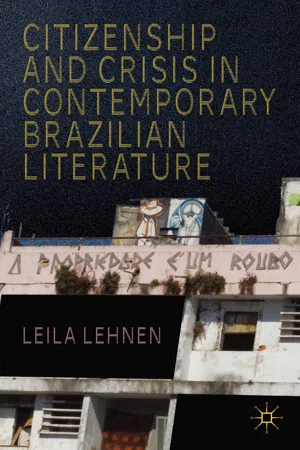
Citizenship and Crisis in Contemporary Brazilian Literature
About this book
Considering how literary texts address the transformations that Brazil has undergone since its 1985 transition to democracy, this study proposes that Brazilian contemporary literature is informed by the struggle for social, civil, and cultural rights and that literary production has created spaces for historically disenfranchised communities.
Information
Chapter 1
Luiz Ruffato
Landscapes of Disrepair and Despair in Inferno provisório
Não quero ser cúmplice da miséria nem da violência, produto da absurda concentração de renda do país. Por isso, proponho, no Inferno provisório, uma reflexão sobre os últimos 50 anos do Brasil, quando acompanhamos a instalação de um projeto de perpetuação no poder da elite econômica brasileira, iniciado logo após a Segunda Guerra Mundial com o processo de industrialização brutal do país, com o deslocamento impositivo de milhões de pessoas para os bairros periféricos e favelas de São Paulo e Rio de Janeiro.
—Ruffato, “Até aqui, tudo bem”1
In this chapter I discuss how Luiz Ruffato’s novelistic cycle, Inferno provisório, hones in on the differential construction of citizenship in Brazil through his portrayal of the nation’s working class. Inferno provisório’s five tomes2 express, from different angles, socioeconomic and civil inequalities that result from and perpetuate differentiated citizenship. The books that make up Inferno provisório span approximately five decades (1950s–2000) and concentrate on the history of the Brazilian working classes from the 1950s into the present. Inferno provisório encompasses five volumes: Mamma, son tanto felice (Mamma, they are so happy, 2005), O mundo inimigo (The enemy world, 2005), Vista parcial da noite (Partial view of the night, 2006), O livro das impossibilidades (The book of impossibilities, 2008), and Domingos sem Deus (Godless Sundays, 2012).
Inferno provisório’s initial volumes detail the transformation of Brazil from an agrarian to an industrialized and finally a globalized (in the neoliberal sense) nation, illustrating the diachronic development of differentiated citizenship in Brazil. In this way, Inferno provisório indirectly prefigures some of the expressions and consequences of the unequal distribution of rights—principally social and civil—that we will see in the following two chapters.
The working-class women and men that appear in the books are subject to the disparities in rights that make up differentiated citizenship. Though most of the characters struggle to counteract the inequities that they confront, Inferno provisório concentrates mainly on the failure of insurgent citizenship. The socioeconomic conditions depicted in the novels hinder productive expressions of agency. In this, Ruffato’s books resemble both Fernando Bonassi’s two novels (discussed in Chapter 2) and, to a degree, Ferréz’s rendering of Capão Redondo (analyzed in Chapter 3).
This chapter contains five analytic segments that follow a general discussion of Inferno provisório. Each section examines a different manifestation of differentiated citizenship. In the first segment, I contemplate how Mamma, son tanto felice compares and contrasts rural and urban spaces. The stories in this volume revolve around the transformation of social bonds within the familial sphere resulting from Brazil’s development from a rural to an urban nation.
The second segment considers the depiction of different modalities of violence in Vista parcial da noite. In this book, aggression occurs primarily in the domestic ambit. Nonetheless, domestic violence interfaces with the public context, specifically the oppressive conditions of Brazil’s latest military dictatorship. The private aggressions that appear in Vista parcial da noite prefigure public forms of violence that are showcased mainly in O livro das impossibilidades. As in O livro das impossibilidades, Vista parcial da noite establishes a connection between socioeconomic disenfranchisement and violence.
In the chapter’s third segment, I probe into the effects of differentiated citizenship upon Ruffato’s child characters, looking into how children are represented in Vista parcial da noite. In this book, children are not the “citizens of the future.” Their possibilities of entering the realm of citizenship are foiled by the legacy of differentiated citizenship. Through Inferno provisório’s child characters, Ruffato emphasizes the difficulty of insurgent citizenship, a theme that is taken up again in the discussion of Fernando Bonassi’s novels.
The chapter’s fourth segment continues to examine the problematization of insurgent citizenship in Inferno provisório. I concentrate on the story “Zezé e Dinim” (Zezé and Dinim) from O livro das impossibilidades. “Zezé e Dinim” reveals the at times violent intersection between differentiated and insurgent modes of citizenship. The story’s biographical structure, as opposed to the mostly fragmentary and/or incomplete accounts of Inferno provisório, serves as a genealogy of both social and personal failure that condenses many of the other story lines contained in Inferno provisório’s tomes.
Finally, the fifth segment discusses three narratives: “Era uma vez” (O livro das impossibilidades), “Amigos,” and “A demolição” (both from O mundo inimigo). All three stories suggest urban to urban migration (from Cataguases to larger metropolitan centers) as a potential way to counteract differentiated citizenship. The three narratives propose that it is possible to attain a measure of socioeconomic empowerment by becoming a consumer-citizen. But the material agency afforded by the mingling of social and consumer rights has a price—the erosion of sociability. Taken together, Inferno provisório’s books promise empowerment through insurgent citizenship but do not fulfill the promise. I contend that this failure reflects a specific time frame during which Brazilian society saw an erosion of social rights and, as a result, the intensification of differentiated citizenship.
Inferno provisório’s almost epic focus on the country’s working classes is somewhat idiosyncratic in Brazilian literature.3 Brazil’s literary tradition has not concentrated extensively on the country’s working classes. Rather, it tends to favor middle-class dramas and, more recently, has gravitated toward narratives dealing with the country’s most impoverished populace: its subaltern classes (and, more specifically, the criminal violence associated with these strata).4 For Ruffato, the literary silence that surrounds the country’s working classes indicates Brazil’s hierarchical social configuration, in which the middle-class perspective predominates. This point of view tends to favor either self-representation or the depiction of the destitute social sectors as alternately violent and/or exotic others (Ruffato, Interview by Eliane Brum).
Questioning the at times violent mechanisms of exclusion that permeate the Brazilian social fabric specifically in its urban centers, Inferno provisório broaches the issue of contingency within the lower social strata without, however, falling into the aesthetization of misery and social violence that is commonly observed in some of Brazil’s present-day cultural productions. For Ruffato, literature’s function is to denaturalize violence by both cloaking and heightening its representation. In Inferno provisório, poverty and the modalities of violence associated with it are not turned into a commodity to be consumed by a privileged reading public. Rather, the illustration of manifold expressions of need that composes Inferno provisório’s narrative kernel fuel a sense of melancholic unease as the reader is confronted with many characters’ lack of perspective.
Ruffato proposes literature as a means to denounce the country’s imbalanced socioeconomic makeup. For him, literary creation transcends the aesthetic dimension and is imbued with a political impetus that should challenge institutionalized power(s) while also having a utopian potential (Sanglard). This viewpoint is also shared by Fernando Bonassi and other writers of Brazil’s recent literary boom,5 as well as by marginal and/or peripheral authors such as Ferréz and Marcus Vinícius Faustini.
Inferno provisório is innovative not only in regard to its narrative focus on Brazil’s blue-collar and informal workers but also because it eschews the realist violence associated with narratives that deal with Brazil’s poorer social segments. Instead, Inferno provisório’s violence, though pervasive, is mostly implicit. It goes beyond the material realm and seeps into the sphere of interpersonal relations and subjectivity.
Similar to Histórias de remorsos e rancores (Stories of remorse and resentment, 1998) and (os sobreviventes) ([the survivors], 2000), most of Inferno provisório’s stories are set in Ruffato’s hometown of Cataguases, in the southeast of Minas Gerais. The books concentrate on the lives and travails of the working-class women and men that inhabit spaces where differentiated citizenship is prevalent. Many of the novels’ characters congregate around the low-income tenement of Beco do Zé Pinto (Zé Pinto’s Alley), which becomes the emblematic locus of differentiated citizenship.
The Beco do Zé Pinto resembles the cortiço (slum dwelling) portrayed in Aluísio de Azevedo’s homonymous naturalist novel O cortiço (1890). In Inferno provisório, the Beco do Zé Pinto serves as a microcosm of low-income Cataguases and, more generally, of proletarian6 and Lumpenproletarian7 Brazil. The Beco’s inhabitants are mostly low-level factory employees. But many are also occupied in the informal sector. They work as laundresses, popcorn vendors, or part-time laborers. Their existences, although generally not entirely outside the limits of citizenship, occur at its borders, its abject perimeters: low-income housing, low-level jobs, inadequate public education, and public health care. Due to their socioeconomic condition, their lives are circumscribed by the task of making ends meet. Only sporadically do the characters experience small pleasures, such as birthday celebrations or an occasional outing to the town square or the beach. There is no sense of futurity for the majority of the characters. When they attempt to transcend their constrained social and, consequently, existential milieu, or when they dream of overcoming it, they are generally disappointed. As a result, a sense of futility permeates Inferno provisório’s volumes, suggesting the ongoing lack of socioeconomic and civil agency that has affected Brazil’s lower-income bracket.
Inferno provisório continues and expands Ruffato’s project of documenting the lives of Brazil’s working class, which the author began with Histórias de remorsos e rancores. Indeed, both Histórias de remorsos e rancores and (os sobreviventes) are blueprints for Inferno provisório. Samantha Braga observes that some of the stories featured in the latter are rewritings of texts that appear in both books 122). Ruffato concedes and plays with this self-referential intertextuality. In the epilogue to Mamma, son tanto felice, he admits that he has reworked some of the stories of (os sobreviventes) and of Histórias de remorsos e rancores into some of the narratives of Inferno provisório (173).8
The reinsertion of previously published stories into Inferno provisório occurs in all but two of the volumes: Vista parcial da noite and Domingos sem Deus, which contain all new texts. For Ruffato, intertextuality and narrative fragmentation communicate the fractured present. The books’ structure is a sort of a “hypertext” (Interview by Eliane Brum). Hypertextuality, a signpost of our globalized, mediated sociohistorical moment, is juxtaposed not only to the present but also to a premodern and modern reality. In this sense, language and narrative structure allude to the books’ changing temporal contexts while also highlighting the increased splintering of both personal and public spheres. Fracture peaks in the cycle’s fourth volume, O livro das impossibilidades. The book’s last story’s (“Zezé e Dinim”) layout bifurcates in certain passages, dividing into either alternating or parallel columns. Each column tells the story of one of the title characters. The narrative splitting evokes two different subjectivities as well as the idea of coming apart. Fracture occurs here as a separation between the two childhood friends and finally as a rupture in their life cycles. It also indicates a coming-apart of traditional social networks that leads to existential fissures in the two main characters.
Bricolage also emphasizes the books’ polyphonic nature and its impetus to give voice to various faces/facets of working-class Brazil. Rewriting transforms the volumes of Inferno provisório into a palimpsest of sorts that endows the text with multiple meanings—social, historical, and cultural—that are intertwined. The reinsertion or rewriting of stories such as “A expiação” or “O segredo” (Mamma, son tanto felice) establishes a narrative genealogy9 between various stories in Inferno provisório, as well as between the cycle’s books and other of Ruffato’s texts.10 And yet, as suggested by Marisa Lajolo, all volumes can also be read independently as self-contained units.
Due to their analogous cyclical and fragmentary nature, the texts that compose Inferno provisório can be read in varying order. Intertextual elements string the books together without, however, necessarily creating a sequential order (neither temporal nor narrative). Although Inferno provisório’s volumes broach Brazil’s development since the 1950s, the books do not follow a linear chronology. Instead, the volumes intersperse different narratives with diverse historical time frames. Mamma, son tanto felice’s first story, “Uma fábula” (A fable), takes place around the mid-1950s. However, the volume’s second and third stories, “Sulfato de Morfina” and “Aquário,” occur in the present. Their contemporaneousness is indicated by present-day slang expressions such as galera (clique, posse). All three stories are connected by the shared themes of difficult familial relations and abandonment. In line with the novels’ fragmented, often elliptical structure, few narratives contain concrete dates. Rather, historical moments are mostly inferred from references to cultural icons (popular singers, hit songs, and soap operas and their stars) or from consumer goods (that also situate the volumes’ characters within specific socioeconomic contexts). Commenting on Mamma, son tanto felice’s first story—or chapter—Lajolo maintains that the seemingly haphazard events that mingle in the narrative resemble the mnemonic flow (100). Certain episodes reappear seemingly at random, often affording us a different viewpoint of a given episode. Thus, for example, “A expiação” (Mamma, son tanto felice) combines three different stories11 that, in nonchronological order, provide three different angles of one incident.
Inferno provisório’s occasional sense of déjà vu recreates and underscores the monotonous rhythms of everyday life and the grinding routines of industrial labor and its impact on the workers’ existences. But neither the narratives nor their characters are interchangeable. Rather, the individual tragedies, while remitting to a larger framework (both of working-class Cataguases and, by association, of working-class Brazil), personalize the social drama at hand, preempting the objectification of the characters into sociological “case-studies.”
With Inferno provisório, Ruffato creates a literary expression that mixes aesthetic innovation and social awareness. Its volumes mingle the short story and novel formats without being constrained by either genre.12 The amalgamation of different genres is combined with a predominately realist language that reproduces the oral register from southern Minas Gerais. Stories contain local idiomatic variations such as trabesseiro (travesseiro: pillow) or catchall terms such as trem (train, but also means “thing/s”). Often the narratives are written in the first person. The personal pronoun transmits an immediacy of experience and makes the protagonists both unique and paradigmatic of a specific geographic and socioeconomic Lebenswelt.13 Many characters use “incorrect” variations of words such as rádia, arrodeio, or quentando (instead of radio [radio], rodeio [circumlocution], and esquentando, [heating/warming up] respectively), which connote deficient or lacking formal education and posit the speakers within the fringes of the socioeconomic strata.14 Márcio Renato dos Santos indicates that the inclusion of regional or “incorrect” vocabulary inserts Inferno provisório’s speakers (even if fictitious) into the very sociocultural orbit from which they generally have been excluded. In this sense, linguistic and, more specifically, literary expression create a measure of sociocultural visibility for the subjects of differentiated citizenship that inhabit the pages of Inferno provisório.
Inferno provisório’s linguistic experimentation and fragmented narrative structure prompt an alternative look at the other side of Brazil’s “Order and Progress.”15 For Ruffato, the splintered account is a conscious choice. The fragmented narrative structure veers away from the traditional nineteenth-century novel that, for the author, represents a bourgeois worldview.16 In contrast, Inferno provisório communicates the underbelly of this viewpoint and of the project of modernity proposed by said bourgeoisie.
Like the narrative scaffolding of his books, the language Ruffato uses extrapolates specific definitions. Though apparently “realist,” Ruffato gives this narrative mode a twist. Marguerite Itamar Harrison points out that for the author, realist language becomes the springboard for linguistic and narratological innovation (155). Nonlinear temporality, abrupt spatial shifts, unorthodox syntax (that replicates spoken communication), and different fonts and typefaces disrupt Inferno provisório’s realist skeleton. Incomplete speech acts further disturb mimesis and offer fractional glimpses of quotidian existences. In a sense, Inferno provisório’s disjointed narratives gainsay the epic impetus of its books, signaling the complexit...
Table of contents
- Title Page
- Copyright Page
- Contents
- Acknowledgments
- Introduction
- Chapter 1
- Chapter 2
- Chapter 3
- Chapter 4
- Epilogue
- Notes
- Works Cited
Trusted by 375,005 students
Access to over 1.5 million titles for a fair monthly price.
Study more efficiently using our study tools.
Frequently asked questions
Yes, you can cancel anytime from the Subscription tab in your account settings on the Perlego website. Your subscription will stay active until the end of your current billing period. Learn how to cancel your subscription
No, books cannot be downloaded as external files, such as PDFs, for use outside of Perlego. However, you can download books within the Perlego app for offline reading on mobile or tablet. Learn how to download books offline
Perlego offers two plans: Essential and Complete
- Essential is ideal for learners and professionals who enjoy exploring a wide range of subjects. Access the Essential Library with 800,000+ trusted titles and best-sellers across business, personal growth, and the humanities. Includes unlimited reading time and Standard Read Aloud voice.
- Complete: Perfect for advanced learners and researchers needing full, unrestricted access. Unlock 1.5M+ books across hundreds of subjects, including academic and specialized titles. The Complete Plan also includes advanced features like Premium Read Aloud and Research Assistant.
We are an online textbook subscription service, where you can get access to an entire online library for less than the price of a single book per month. With over 1.5 million books across 990+ topics, we’ve got you covered! Learn about our mission
Look out for the read-aloud symbol on your next book to see if you can listen to it. The read-aloud tool reads text aloud for you, highlighting the text as it is being read. You can pause it, speed it up and slow it down. Learn more about Read Aloud
Yes! You can use the Perlego app on both iOS and Android devices to read anytime, anywhere — even offline. Perfect for commutes or when you’re on the go.
Please note we cannot support devices running on iOS 13 and Android 7 or earlier. Learn more about using the app
Please note we cannot support devices running on iOS 13 and Android 7 or earlier. Learn more about using the app
Yes, you can access Citizenship and Crisis in Contemporary Brazilian Literature by L. Lehnen in PDF and/or ePUB format, as well as other popular books in Literature & Literary Criticism. We have over 1.5 million books available in our catalogue for you to explore.