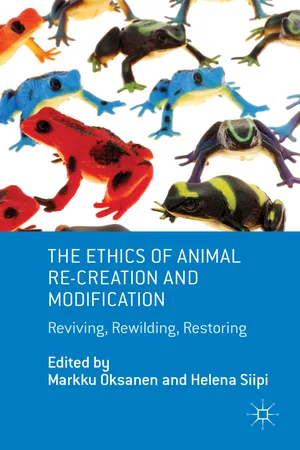
eBook - ePub
The Ethics of Animal Re-creation and Modification
Reviving, Rewilding, Restoring
- English
- ePUB (mobile friendly)
- Available on iOS & Android
eBook - ePub
The Ethics of Animal Re-creation and Modification
Reviving, Rewilding, Restoring
About this book
Would it be cool to see woolly mammoth alive one day? Disappeared species have always fascinated the human mind. A new discussion of using genomic technologies to reverse extinction and to help in conservation has been sparked. This volume studies the question philosophically.
Information
Topic
PhilosophySubtopic
Ethics & Moral Philosophy1
Can We Really Re-create an Extinct Species by Cloning? A Metaphysical Analysis
Introduction
During the last two decades, the idea that lost species could be re-created or resurrected from their fossil DNA with the help of adequate biotechnological machinery has become immensely popular. Even if all sorts of Jurassic Park fantasies, such as re-creating extinct dinosaurs, have been completely dismissed by scientific studies on the rate of DNA destruction, more realistic projects of fossil DNA sequencing are commonly conducted today. Indeed, depending on the conditions of conservation, it is generally accepted that, beyond a few tens of thousands of years, DNA strands are too degraded to be read – apart from the genomes of the many species which became extinct during the Holocene epoch (c.10,000 BC–present), more likely than not, as a result of anthropic pressures. Today the mammoth genome is almost completely deciphered (Miller et al. 2008) and other teams have chosen to sequence cave bear DNA (Noonan et al. 2005) or the Tasmanian tiger genome (Miller et al. 2009). And many more species will be added to the list in the coming years with the booming of ‘museomics’. As a contraction of ‘museum’ and ‘genomics’, museomics refers to the new area of research by large-scale analysis of the DNA sequences preserved in specimens from museum collections all around the world.
The scientific relevance of sequencing fossil DNA today remains purely of cognitive interest without direct practical applications, except in helping taxonomists, palaeontologists and anthropologists to make sense of past biological events. Even though many palaeogeneticists assert that they do not intend to resurrect species and fix limits to their knowledge and technical capabilities (Orlando 2005), other powerful interests may be driven by scientific, ecological or nationalistic ambitions (Fletcher 2008) and may lobby actively for the implementation of such projects. Therefore, it seems wise and timely to look into the future, to explore the epistemological, metaphysical and ethical implications of a possible technology that could change our conception of life and evolution, even if such were to remain unrealized forever.
The scope of this chapter does not include the ethical dimension; instead, it focuses on the metaphysical aspects of species re-creation that I conceive as a prerequisite for axiological enquiries. More specifically, I will show that the question ‘can we re-create an extinct species?’ amounts to resolving what I call the ‘resurrection paradox’ and asking ‘do organisms cloned from the DNA of an extinct species belong to this species?’. The answers will depend on the different metaphysical commitments about what species really are. I will begin by presenting the possible techniques for species re-creation and their scientific context.
How species go extinct and how they could be revived
A classification of species extinction
One cannot consider the possible re-creation of species without understanding firstly the different kinds of species extinctions. Usually, four different modalities of extinction are distinguished in an evolutionary context. In the first and the most obvious case, a species can purely and simply stop existing when no organism survives and reproduces: this is called ‘phyletic’ or ‘final’ extinction. A species can also vanish by hybridization with another interfertile species, and thus produce a new hybridogenous daughter species from the two mother species. This is for instance what happened to a fish species (the Whitefish) in Lake Geneva. The third way for a species to go extinct is that it transforms itself into a new species as a result of ecological or genetic modifications that produce an apomorphic trait; this kind of extinction is sometimes called – although inappropriately – ‘pseudoextinction’ (Van Valen 1973). Finally, a species can disappear by giving birth to two or more daughter species in a process of allopatric speciation.
It is worth noting from the outset that people get excited by the possible re-creation of totally extinct species, and not species that were only submitted to a process of anaphyletic change or speciation. The reason is that the return to life and the development of an additional phylum in the tree of life, the survival of an original process of evolution, and the transmission of certain genetic features and information are really valued from an ecological point of view.
However, although less spectacular and appealing to conservationists, the cloning of old specimens from a species still alive could be a very important, even a necessary preliminary, experiment before trying to achieve an authentic resurrection. It could be easier to achieve with greater chances of success and it could serve as a basis of comparison for complex interspecies cloning experiments. Ancient DNA sequences are of huge theoretical importance for inferring temporal changes in phyla and assessing the rate of genome evolution, as stated above. But the genome is not the mirror of the organism. Only a living organism can provide some of the precious pieces of non-reducible biological information such as certain behavioural or ecological interactions. These then become available for direct comparison with the species in the present.
Here, the difference between re-creating a species and resurrecting a particular organism becomes evident. Nobody really hopes – except during psychoanalysis – to re-create an eight-year-old murder victim, though everybody wishes that the child could be resurrected.
A biotechnological recipe for resurrecting species
The basic idea of biotechnological species resurrection goes like this. Re-create the full genome from one or several organisms that belong to a now extinct species; encapsulate it in a nucleus (natural or synthetic); inject it in an enucleated receiver ovum from a phylogenetically close species; let the new organism develop in the reproductive organs of a surrogate female from this close species. This kind of biotechnological manipulation was achieved in 2010 by a Craig Venter Institute’s team which created an artificial bacterial genome that was successfully introduced in a host bacterium whose own chromosome had been previously removed. But it is a long way from the creation of this artificial bacterium (called ‘Synthia’) to the cloning of a eukaryotic cell from an extinct species, such as a mammoth or a moa (Gibson et al. 2010).
Technically speaking, this clone is not a perfect reproduction of the dead organism belonging to the extinct species. Actually, it is a nucleo-cytoplasmic chimera, and the cellular machinery as well as the mitochondrial genome remain those of the bearing species. Hopefully, the descent of these clones could be improved to incorporate more features of the extinct species, beginning with its mitochondrial genome.
More generally, a recent paradigm change in the modern evolutionary synthesis toward the integration of what is called ‘soft inheritance’, as opposed to genetic heredity, forces us to consider the role of epigenetics in all its dimensions (chromatin structure, cellular composition and so on), including cultural evolution as well as niche inheritance, in the definition of what is transmitted by species membership (Danchin et al. 2011). If, in the long run, the main support of heredity is still considered to be DNA and the genes that are coded on it, in the short term, from one generation to the next, many different kinds of cultural, ecological as well as epigenetic variants are transmitted, so much so that evolution has been recently redefined as ‘the process by which the frequencies of variants in a population change over time’ (Bentley et al. 2004, p. 1443). Cloning an extinct specimen out of its genetic features only, with allo-genetic specifications concerning its ‘soft’ heredity, is clearly misleading with regard to the objective biological parameters of the populations and the organisms composing the species that became extinct. However, if their range of variation is maintained under certain limits, so that they do not trigger the development of new characters that could be considered as apomorphies, the cloned organism should presumably be considered as belonging to the same species as its genetic template.
I will not discuss in detail all the empirical obstacles standing in the way of the achievement of an effective cloning of an extinct species; the point is to underline the theoretical possibility of the re-creation of an organism belonging to an extinct species provided that the following technical requirements are satisfied:
• It is necessary to have a significant part of the genome of at least one individual from species S (or two, male and female, for two-sex species) and the biotechnologies allowing for the expression of this genome in an appropriate cellular machinery that is comparable to that of the extinct species S.
• Genetic information should be retrieved, sequenced, stored and transmitted without alteration.
• The artificial (biotechnological) and the natural expression of genetic information are equivalent.
The resurrection paradox and the metaphysics of species
The list of technical requirements is independent of the philosophical requirements for the re-created clone to belong to an extinct species. These are metaphysical arguments about the nature of species, of change, and of human technological action. The meaning of biotechnological modifications intrinsically depends on how we interpret events such as extinction, cloning, evolution and the relationship between genetic information and the identity of a species.
The question of species resurrection lies at the crossroads of many conceptual difficulties in biology, notably about the species problem. Thus, we start from a given product of the evolutionary history (an extinct species or an individual organism belonging to an extinct species) and we want to end up with a renewed evolutionary process, making the previous extinct species again a functioning, cohesive and evolving species. This being more than a technical difficulty, I call this the ‘resurrection paradox’.
Indeed, if one thinks in terms of products, the so-called extinction is just a temporal gap between the occurrences of two organisms (products) of the species, and which is not a real definitive extinction. This amounts to saying that there is no real resurrection either. Alternatively, if one goes with the process perspective, the species went definitively extinct at the end of the reproductive or living process, and so there is no resurrection at all: we only witness the results of a human modification on the living process of the bearing species, which is another stream of life than the extinct one.
In order to find a way beyond this resurrection paradox, we have first to go back to the origins of the two conflicting positions, the never-ending dispute between two unresolvable metaphysical positions in the philosophy of biology: the species-as-class (or natural kind) and the species-as-individual stances. Reydon (2008, p. 166) reminds us that this debate amounts to an ontological dispute regarding the relation between organisms and the species to which they belong: ‘on the class view this is a relation of membership, while on the individuals view organisms are parts of their species in the same way as my cells are parts of me’.
We should also subdivide each position into distinct currents. Following the literature on the subject (Okasha 2002; Stamos 2003; Reydon 2008), it is possible to distinguish at least two types of class depending on the nature of the property defining the characteristics of membership: the members of a given class possess a real essence; and the members of the class exhibit a relational essence with no necessary property, only some sufficient ones. On the other hand, it is now current to distinguish two concepts of individuality relative to change and time metaphysics: vertical and horizontal in biological terms or presentist/eternalist in metaphysical terms. In the first case, the existing material objects only exist in a three-dimensional space with time flowing independently; in the second case, objects fully exist in a four-dimensional space–time universe and are always ‘present’ in their past, present and future dimensions.
These slight nuances happen to be quite important when dealing with the question of extinction and biotech ecology because they introduce diverging positions when confronted with the identity of species through time as well as about the nature of processes, be they evolutionary, ecological or genetic, in the characterization of species.
Real essentialism
I will begin my review with the two simplest positions: the one that fully agrees with the possibility of species resurrection and the one that makes it conceptually impossible.
The one that fully permits ‘awakening the dead’, at least at the species level, is real essentialism, directly derived from Aristotelian metaphysics. This kind of classical essentialism states that all the members of a species are fully members of this species and only of this species because they all share a property or a set of properties, which is their essence. A horse is essentially a horse because it shares with all the other horses the property of ‘horseity’, something that Aristotle and his contemporaries equated with specie differentia, a difference affecting the four causes (material, efficient, formal, final) explaining the existence of horses. Although essentialism has had to face many rebuttals in biology, especially since Darwin and the demonstration that species are not fixed and immortal entities but evolving and even perishable lineages, it still enjoys great esteem among philosophers. For instance, Putnam (1975. p. 240) affirmed that ‘the essence of lemon-hood is having the genetic code of a lemon’, and more recently Oderberg (2007) goes back to a kind of literal Aristotelianism in equating ‘essence’ with ‘form’.
When Putnam equates the specific essence of an organism with its genetic code (‘genome’ would be the proper term), the question of species re-creation is resolved. Yes, extinct species can be re-created as long as biotechnologists can handle their genetic information. Even more far-fetched thought experiments support essentialist thinking. Imagine that an extra-terrestrial entity lands on earth and looks like a dog, behaves like a dog, possess the genome of a dog and reproduces like a dog. Why should it not be called a dog even if it has no common ancestor with our terrestrial dogs? If an alien dog possess the essence of a dog, surely a cloned thylacine is a real thylacine?
Aristotelianism has almost lost all serious support among biologists and philosophers of biology. Indeed, there is no empirical way, whether morphological, genetic or other, to define a set of non-ambiguous properties equivalent to an essence. Moreover, as the Darwinian theory of evolution emphasizes change and variety in the species itself, it seems radically at odds with essentialism. As Elliott Sober (1994, p. 163) says: ‘essentialism about species is today a dead issue’ – at least as far as real essentialism is concerned, as we will see below.
Species as individuals
The triumphant neo-Darwinian synthesis paved the way in the 1960s and the 1970s for a new metaphysical definition of species, the so-called species-as-individual thesis. As each member of a species is unique and participates in a unique contingent process leading to the evolution of the species to which it belongs, David Hull (1994) among others defended the ontological position that species should be understood as spatio-temporally limited entities (that is individuals) whose material parts are equated with the organisms they are composed of. If the species can be called an individual in a purely metaphysical sense, it remains nonetheless very different from an individual organism which is, from a biological point of view, highly integrated, organized, homeostatic, with a determinate developmental pathway from birth to death, and many other features.
According to this metaphysical stance, when a species goes phyletically extinct (succumbing to terminal extinction), one can make a straightforward analogy with the death of an organism. It ceases to exist both functionally, as there are no more vital relations (reproductive, ecological and so on), and even materially, as no spatio-temporal entity that was part of the species exists anymore. This is comparable to a dead organism which does not exhibit any vital physiological relation amongst its internal parts (such as organs or cells) and whose organs fall increasingly apart with time.
All attempts to resurrect it from a cell or from the genetic information taken from the dead organism is doomed to failure, as this would create a new organism, that is a new spatio-temporally delimited individual, although one very similar in many aspects to the dead organism. To take a dramatic example:
Hitler’s clone, an ind...
Table of contents
- Cover
- Title Page
- Copyright
- Contents
- Acknowledgements
- Notes on the Contributors
- Introduction: Towards a Philosophy of Resurrection Science
- 1. Can We Really Re-create an Extinct Species by Cloning? A Metaphysical Analysis
- 2. The Restorationist Argument for Extinction Reversal
- 3. What’s So Special about Reconstructing a Mammoth? Ethics of Breeding and Biotechnology in Re-creating Extinct Species
- 4. The Authenticity of Animals
- 5. Bioengineered Domestication: ‘Wild Pets’ as Species Conservation?
- 6. From Protection to Restoration: A Matter of Responsible Precaution
- 7. Just Fake It! Public Understanding of Ecological Restoration
- 8. Biodiversity and the Value of Human Involvement
- Epilogue
- Index
Trusted by 375,005 students
Access to over 1.5 million titles for a fair monthly price.
Study more efficiently using our study tools.
Frequently asked questions
Yes, you can cancel anytime from the Subscription tab in your account settings on the Perlego website. Your subscription will stay active until the end of your current billing period. Learn how to cancel your subscription
No, books cannot be downloaded as external files, such as PDFs, for use outside of Perlego. However, you can download books within the Perlego app for offline reading on mobile or tablet. Learn how to download books offline
Perlego offers two plans: Essential and Complete
- Essential is ideal for learners and professionals who enjoy exploring a wide range of subjects. Access the Essential Library with 800,000+ trusted titles and best-sellers across business, personal growth, and the humanities. Includes unlimited reading time and Standard Read Aloud voice.
- Complete: Perfect for advanced learners and researchers needing full, unrestricted access. Unlock 1.5M+ books across hundreds of subjects, including academic and specialized titles. The Complete Plan also includes advanced features like Premium Read Aloud and Research Assistant.
We are an online textbook subscription service, where you can get access to an entire online library for less than the price of a single book per month. With over 1.5 million books across 990+ topics, we’ve got you covered! Learn about our mission
Look out for the read-aloud symbol on your next book to see if you can listen to it. The read-aloud tool reads text aloud for you, highlighting the text as it is being read. You can pause it, speed it up and slow it down. Learn more about Read Aloud
Yes! You can use the Perlego app on both iOS and Android devices to read anytime, anywhere — even offline. Perfect for commutes or when you’re on the go.
Please note we cannot support devices running on iOS 13 and Android 7 or earlier. Learn more about using the app
Please note we cannot support devices running on iOS 13 and Android 7 or earlier. Learn more about using the app
Yes, you can access The Ethics of Animal Re-creation and Modification by M. Oksanen, H. Siipi, M. Oksanen,H. Siipi in PDF and/or ePUB format, as well as other popular books in Philosophy & Ethics & Moral Philosophy. We have over 1.5 million books available in our catalogue for you to explore.