- English
- ePUB (mobile friendly)
- Available on iOS & Android
eBook - ePub
About this book
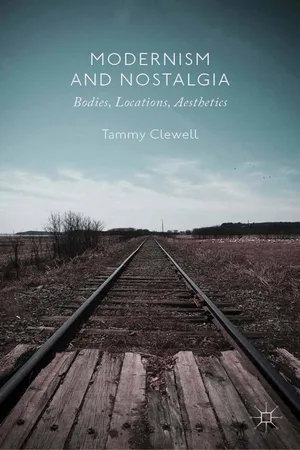
This book addresses the multiple meanings of nostalgia in the literature of the period. Whether depicted as an emotion, remembrance, or fixation, these essays demonstrate that the nostalgic impulse reveals how deeply rooted in the damaged, the old, and the vanishing, were the variety of efforts to imagine and produce the new—the distinctly modern.
Information
Bodies
1
Modernism and the Referendum on Nostalgia in Rebecca West’s The Return of the Soldier
In her study Nostalgia: Sanctuary of Meaning, Janelle Wilson claims that “there is no known antonym for nostalgia” (27). This may seem counter-intuitive at first sight. Indeed, while Alastair Bonnett points out that “throughout the last century nostalgia was cast as the antithesis of radicalism” (1), he also reminds us that anarchist thinking—not exactly a conformist ideology—had been a haven for nostalgia: “anarchism is the nostalgic counter-culture of orthodox radicalism” (32). Bonnett complicates the ostensible opposition between nostalgia and radicalism by demonstrating how the yearnings of nostalgia have paradoxically lodged themselves within the project of modernity itself: “Nostalgia has been . . . an integral part of the modern condition, something that is present whether or not we identify and engage it or repress and deny it” (169). And what is true of modernity in general is relevant for artistic modernism more specifically, suggesting the shortcomings of constructing modernism as an antithesis to nostalgia. As David Brooks put it, although modernist artists and their work endeavor to leave the past behind, “the past, and particularly the literary past, has a high and complex profile within them. Far from ignoring or defying tradition, they attempt to redefine it. . . . Finding their impulse in a creativity highly conscious of its own departure, they must also, as a consequence, constantly remind us of, and so paradoxically sustain, the very things they seek to jettison or modify” (125). Thus, we should not be surprised to find elements of nostalgia within literary modernism and to discover that nostalgia may function not only as a foil to delineate what modernism seeks (but unwittingly fails) to reject but also, more ironically, as a provocation to forestall any sentimental relationship with the past.
One of modernism’s key texts, Rebecca West’s The Return of the Soldier, is deeply imbricated in the complexities of nostalgia. In fact, the novel invites and rewards explorations about the nature of nostalgia and its role in modernist literary discourse. However, before discussing nostalgia in this text, it is instructive to clarify the historical vicissitudes of the term “nostalgia.” Despite its current conceptual multi-valence, the origins of the term are straightforward enough, as a number of contributors to this collection also address in varying contexts. Swiss physician Johannes Hofer, who is credited for coining the term “nostalgia” in his 1688 dissertation, defined it as a medical condition among Swiss soldiers who suffered from a painful and debilitating type of longing for home; however, over time the meaning of nostalgia altered significantly, changing from signifying a longing for a place to denoting a yearning for the past. Roberta Rubenstein clarifies this shift by noting nostalgia’s separation from its original meaning of homesickness: “while homesickness refers to a spatial/geographical separation, nostalgia more accurately refers to a temporal one” (4). Even while the meaning of nostalgia changed from a spatial to a temporal concept, it also gradually became de-medicalized, a process that played itself out in the nineteenth century. As Michael Roth has pointed out, “By the 1850s interest in the phenomenon as a disease had dropped considerably, and . . . would never again receive the sustained attention of the medical world. Of course, the phenomenon of nostalgia did not disappear when the doctors stopped looking at it” (27). Rather, the concept of nostalgia entered the cultural vocabulary as the sentimental longing for an idealized past. To return to Rubenstein, this general aspect of nostalgia appears to be “the existential condition of adulthood” (4). As a structure of feeling, nostalgia in this sense emerges from a sense of lost childhood and lost innocence. Nostalgia names an integral and perhaps inescapable part of adulthood; in the extreme, it registers a wish to return to childhood, which may even take on the symbolically virulent form of a wish to return to the womb.
West’s novel addresses a whole complex of questions related to nostalgia: the relationship between nostalgia and modernism, the causes of nostalgia, and the remedies for it. The novel focuses on Kitty and Jenny, the inhabitants of an aristocratic country estate in England, who receive news that Chris Baldry, Kitty’s husband and Jenny’s cousin, has been injured in Flanders while fighting in the trenches of World War I. As the details emerge, it is apparent that no wound can be detected, but that Chris is diagnosed as having “shell shock.” At the time of West’s writing, this was a relatively new diagnosis, and army doctors like W. H. R. Rivers and Richard Myers were still working out the exact aetiology of this condition and designing treatment plans for patients suffering from it. Chris, however, does not seem to conform to the typical patient profile of the shell-shocked soldier during the Great War: he does not have nightmares or hallucinations or suffer from spasms or speech impediments, the common symptoms of shell shock. Rather, like the Swiss soldiers observed by Hofer, Chris seems to be predominantly suffering from nostalgia. Though his most notable symptom is amnesia, the curious way this manifests itself is that he thinks he is still in love with his first girlfriend, Margaret, a working-class woman now in her forties, who has evidently lost the youthful appeal that once made her precious in the eyes of young Chris. But Chris insists that he is still in love with her. Because Chris cannot remember the last fifteen years of his life, he is deemed unfit for further military service and is discharged, pending further medical evaluation of his case. Instead of looking forward to being reunited with his upper-class wife, Kitty—and to Kitty’s considerable annoyance—he only talks about Margaret and declares he will die unless he can see his outwardly unremarkable and declassée lover from his past. Clearly, Chris’s mental illness is presented as a bout of nostalgic delusion.
Thus, bucking the trend of nostalgia’s progressive de-medicalization throughout the second half of the nineteenth century, West here vigorously re-medicalizes it. On some level, The Return of the Soldier validates the original meaning of nostalgia as homesickness among soldiers abroad. Indeed, we don’t know for sure whether Chris has indeed undergone a physical trauma on the front. All we can verify textually is that he is in the grips of a nostalgic impulse so powerful as to override common ties of kinship and undo his faculties of rational decision-making. Although we don’t learn about the circumstances that triggered Chris’s flight into the past, we do know that his nostalgic obsession is so powerful that it operates on several levels simultaneously: he is drawn to a place (a site of past happiness), to a chronological period (a time of great contentment before the loss of innocence), and to a character that unifies the spatial and temporal trajectories of nostalgia. As both Rubenstein and Roth have shown, the nostalgic impulse can be associated with an idealized time period and place, as much as with an idealized person. In Chris’s case, the place is Monkey Island, the time a magical summer fifteen years earlier, and the person, Margaret. The nexus among all three objects of nostalgia is love. As Janelle Wilson has pointed out, love is, of course, a common ingredient and contributor of nostalgia: “It makes sense that being nostalgic is similar to being in love; in particular, to the feeling state experienced after a love relationship ends. That which is presently unavailable is not only valuable, but idealized” (Wilson 24). This is precisely borne out in West’s story. During Chris’s brief love affair with Margaret, he knew life as a series of sunny days and experienced love as the pure efflorescence of mutual affection. Then came the disappointment, an ugly scene when Chris and Margaret fell out during a class-fuelled bout of jealousy that ended the relationship between them. In an act of selective repression, Chris’s amnesia extends to just before that event, excluding everything from that moment up to his supposed concussion in the war.
The fact that the spatial site of Chris’s nostalgia is a romantic spot on the Thames is significant within the larger cultural significance of nostalgia, particularly in the context of the novel’s depiction of the war-torn present. Monkey Island is clearly marked as an Arcadian idyll: “In this gentle jungle,” Chris reminisces, “was a rustic seat . . . and on it they [Chris and Margaret] sat until a pale moon appeared above the green cornfield on the other side of the river” (40). The portion of the novel dedicated to re-telling the story of Chris’s brief love affair with Margaret brims with Georgian motifs of nostalgia, notably the rural setting, the notion of a past “Golden Age,” and the theme of lost love. When contrasted with the destructive, heavily mechanized, and bloody experience of war from which Chris has escaped, the consolatory capacity of this rural locale lures the reader into a sentimentalized version of the past in a way that cordons off the brutality of the present.
Moreover, The Return of the Soldier not only develops nostalgia thematically but embodies it in its very textuality. In fact, chapter three is itself an extended exercise in pastoral Georgian literature: we have a simple country inn, blooming hawthorn bushes, a walnut-tree studded meadow, a glassy river, and animal husbandry in which rabbits and ducks are tended to by the rustic owners of the inn. As for the mock-Greek temple built at the center of Monkey Island, Debra Rae Cohen has argued that “Chris’s nostalgia is distinctively Georgian as well in the way it folds classical elements . . . into its version of the pastoral [since] Chris poses Margaret, in their moment of rapture, in ‘a small Greek temple’” (78). The novel’s narrator confirms this classicist association by commenting that this scene “had a grace and silliness that belonged to the eighteenth century” (36). During the short time of their courtship, Chris and Margaret are explicitly shown to be wrapped up in a pre-lapsarian idyll.
In The Great War and Modern Memory (1975), Paul Fussell has elaborated on the widespread use of pastoral elements in British World War I literature. In his well-known argument, Fussell claims that poets from Owen to Sassoon, from Rosenberg to Blunden had cause to conjure up scenes of pastoral peacefulness while serving on the front because of the powerful need to substitute a realm of lovely though wholly fictitious rural harmony for an unbearable present: “Recourse to the pastoral is an English mode of both fully gauging the calamities of the Great War and imaginatively protecting oneself against them. Pastoral reference, whether to literature or to actual rural localities and objects, is a way of invoking a code to hint by antithesis at the indescribable; at the same time, it is a comfort in itself, like rum, a deep dug-out, or a woolly vest” (Fussell 235). In this sense, the pastoral genre serves as a salvific contrast and consolatory escape in a time of war.
Chris’s craving for the restorative power of pastoral aesthetics not only guides his own feelings towards Monkey Island and its inhabitant; it also affects the discourse of Jenny, the novel’s narrator, who clearly relishes retelling Chris’s romance on Monkey Island. Since Jenny serves as an alter ego of the author herself, it follows that West was also invested in this notion, at least to some degree. In fact, as I have argued elsewhere,1 West was in some ways an incurable nostalgic who abhorred the idea of exile and even of voluntary expatriation. She considered exile the bane of authentic selfhood. She is quite literal in her understanding of nostalgia as homesickness when she sympathizes with the exile’s plight:
[H]e cannot open the shutters of his bedroom in the morning and look out on the field where the old white horse used to graze. He perhaps endures the most frustrating experience of all. As he gets into his seventies and eighties, he may long to go back to his own country, on any terms, making any submissions that are demanded, only that he may die in a particular house, which, however, may now no longer exist. It has been bombed or burned. (Survivors in Mexico 81)
In addition to expressing the seriousness with which West regarded exile and homesickness, the passage also gives voice to what she figures as the quandary of nostalgia. Notably, from the exile’s perspective, to give in to nostalgia by returning home is equated with physical death. It is also equated with the loss of principle (“making any submission”) and with ultimate disappointment, as she clearly represents the object of nostalgia and nostalgic homesickness as no longer existing. For West, nostalgia names an existential aspect of the characteristically modern experience of exile and rootlessness; nostalgic longing cannot be eliminated by returning to a place which has ceased to exist. West’s nostalgia, then, takes a temporal turn.
West’s nonfictional concerns are relevant to The Return of the Soldier; indeed, at issue in the novel is not so much the question of overcoming nostalgia by going “home,” but rather the more difficult proposition of giving in to nostalgia by attempting to go back in time. This Chris attempts to do through his amnesia, and West considers his condition carefully before giving her verdict on the situation. In the final analysis, the novel is set up as a referendum on the whole idea of nostalgia, both thematically and structurally. The two women who love and understand Chris, Jenny and Margaret, must decide what to do about Chris’s nostalgic self-delusion. They face a stark existential decision: whether to allow Chris to persist in his nostalgic delusion, which is presented as equivalent to puerile stagnation, or to shock him out of his pleasantly escapist fantasy and compel him to face the world as an adult, which is presented as his returning to the front and fighting a war he may not survive.
Characteristically, the referendum on nostalgia ends with an impasse. We soon realize that Chris’s problem is not just one of obsessive fixation on the past; it is one of a highly selective fixation on the past as a site of desire rather than the site of a loss that needs to be confronted. After all, Chris’s son, Oliver, who died mysteriously at age two, is just as much part of his past as is Margaret. But this loss Chris excludes from his memory as strenuously as he clings to the remembrances of his happy days with Margaret. To West, Chris engages in an understandable but wholly misguided handling of the relationship between past and present. The Return of the Soldier, in fact, may be read as an object lesson in the effects of any selective fixation on the past, which is shown to be pathological insofar as it robs its practitioner of what West called “process.” Indeed, life’s most sacred and elemental principle to her was process, be it temporal, historical, stylistic, or epistemological. For West, what is static is dead and what is processual breathes life.2 This emphasis on temporal unfolding speaks, of course, to nostalgia insofar as the nostalgic subject refuses to subscribe to process and, instead, seeks to fix the object either temporally or spatially. To West, this tendency towards fixation and stasis represents a personal pathology, and it would not be far-fetched to say that, collectively, the desire to seal the past off from informing and shaping the present represents a type of social pathology, hence her re-medicalization of nostalgia.
The novel’s medicalizing of nostalgia carries over from the level of thematic treatment, where Chris’s nostalgic longing is presented as a debilitating condition, into other spheres of narrative and textual presentation. In fact, one can argue that West implemented process equally on the level of literary form, notably in the novel’s conspicuous move toward and then away from literary nostalgia. It is as if the novel started out as an Edwardian “problem novel,” replete with social class conflict and feminist stirrings. Indeed, there are intimations of social class tension in the manner of E. M. Forster’s Howard’s End, as well as an awareness of patr...
Table of contents
- Cover
- Title
- Copyright
- Contents
- Acknowledgements
- Notes on Contributors
- Introduction: Past “Perfect” and Present “Tense”: The Abuses and Uses of Modernist Nostalgia Tammy Clewell
- Part I Bodies
- Part II Locations
- Part III Aesthetics
- Afterword: Nostalgia and Modernist Anxiety Elizabeth Outka
- Index
Trusted by 375,005 students
Access to over 1.5 million titles for a fair monthly price.
Study more efficiently using our study tools.
Frequently asked questions
Yes, you can cancel anytime from the Subscription tab in your account settings on the Perlego website. Your subscription will stay active until the end of your current billing period. Learn how to cancel your subscription
No, books cannot be downloaded as external files, such as PDFs, for use outside of Perlego. However, you can download books within the Perlego app for offline reading on mobile or tablet. Learn how to download books offline
Perlego offers two plans: Essential and Complete
- Essential is ideal for learners and professionals who enjoy exploring a wide range of subjects. Access the Essential Library with 800,000+ trusted titles and best-sellers across business, personal growth, and the humanities. Includes unlimited reading time and Standard Read Aloud voice.
- Complete: Perfect for advanced learners and researchers needing full, unrestricted access. Unlock 1.5M+ books across hundreds of subjects, including academic and specialized titles. The Complete Plan also includes advanced features like Premium Read Aloud and Research Assistant.
We are an online textbook subscription service, where you can get access to an entire online library for less than the price of a single book per month. With over 1.5 million books across 990+ topics, we’ve got you covered! Learn about our mission
Look out for the read-aloud symbol on your next book to see if you can listen to it. The read-aloud tool reads text aloud for you, highlighting the text as it is being read. You can pause it, speed it up and slow it down. Learn more about Read Aloud
Yes! You can use the Perlego app on both iOS and Android devices to read anytime, anywhere — even offline. Perfect for commutes or when you’re on the go.
Please note we cannot support devices running on iOS 13 and Android 7 or earlier. Learn more about using the app
Please note we cannot support devices running on iOS 13 and Android 7 or earlier. Learn more about using the app
Yes, you can access Modernism and Nostalgia by T. Clewell in PDF and/or ePUB format, as well as other popular books in Literature & Literature General. We have over 1.5 million books available in our catalogue for you to explore.