- English
- ePUB (mobile friendly)
- Available on iOS & Android
eBook - ePub
About this book
Foresight and Innovation is a guide for readers that are interested about the future. The book introduces a concept of futurist thinking, which includes anticipating, innovating and communicating about the futures. These concepts show how various organizations, all over the world are thinking, communicating and creating a better future.
Information
Part I
Anticipating the Future
There are two types of futurists: firstly, those who emphasize that we are living in a time of great changes. We are constantly surrounded by turbulence, and it is impossible to predict what will happen next. The Internet and social media have revolutionized our world: information travels with the speed of optical fiber and different new phenomena move independently from one continent to another. When a butterfly flaps its wings on one side of the globe, the other side suffers from an earthquake.
Secondly are those futurists who speak of our tendency to exaggerate change. People tend to set their own time period on a pedestal. We assume that the time we are now living is somehow the most significant in history. These futurists emphasize that recent inventions are insignificant in comparison to the great inventions that have been developed in the course of our history. Fire, writing, paper, the printing press, the wheel, the steam engine and electricity are examples of inventions that have been revolutionary in the past. Recent innovations are nothing compared to these great inventions that affect our lives even today.
With a closer look, we can distinguish a third class of futurists: those who have not yet decided to which category they belong. They sail between these two opinions and, when necessary, believe that there have been great changes in the recent past, and then again change their minds and talk about how there have always been great changes. According to them, in fact, change happens both quickly and slowly. I am one of this type of futurists.
I tend to believe that change is permanent. It happens constantly, in different doses, cycles, pulses, bursts. Constancy is also permanent. The challenge in anticipating the future is estimating the speed of change, its changing direction and those things that do not change even with wear and tear. When we think about change very carefully, we may conclude that predicting change is not even possible. However, there is something we can do when confronted by change: be prepared. In this context, we can talk about anticipating. This part of the book deals with anticipating the future, but I will nonetheless begin my story in the next few chapters by discussing different changes and the challenges and views related to them.
1
Change
Change interests everyone, not only futurists. There are different theories through which we aim to explain how change happens in our society. There are different professions whose task is to find out what happens next. Economists aim to predict economic changes to the dot by using different models. Strategic decision-making aims to foresee the future in order to ensure that the investment decisions made currently are also valid in the future. Meteorologists use their own models to forecast heavy rain or sunshine for the following days. Those working in the fashion industry try to obtain information on what would be cool in the next season. Estimation of the production volume for a product is dependent on the expected demand of the product in the future.
In this chapter, I will review different change theories from different disciplines. I will cover, among others, the different views of social sciences on change, Malcolm Gladwell’s views on change in his book The Tipping Point and Bohlen and Beal’s innovation adoption curve. In the field of technology, significant theories include path-dependence theory, which is closely connected with the network effect. Austrian John L. Casti speaks of how the mental state of the society, so-called social mood, can cause even radical events. According to him, these events can be foreseen through stock market prices. The world of fashion has its own perspectives on how mass fashion and life choices change. Psychology, of course, has its own views on how change begins. The magical number here is five. Furthermore, complexity and chaos theories bring their own piquant perspective on change, and serendipity or hazard, of course, creates its own bumps on the road to change.
I would like to emphasize, however, that even though examining change is the general idea in anticipation, too much emphasis should not be placed on things changing. The slow speed of change may sometimes be surprising. I once discussed this topic with a futurist from a German company. He told me that it was a part of his job to anticipate technology. His predictions had mainly been completely wrong. His predictions assumed new technology to overtake the masses earlier than it actually happened.
The futurist had his own reasons for why this happened: the majority of the Germans comprised the aging population. The older the population, the slower the adoption of new things can be. Indeed, a wise thinker has said that we tend to overestimate the speed of change in the short term but underestimate it in the long term.
Perspectives to change
Change happens all the time at a faster or slower pace; this we know already – but how change happens is a different question. Different fields of science and even different schools of thought have their own perceptions on how things change. Roman Krznaric has written an excellent report on change; he reviews how different disciplines – history, politics, social sciences, economics, geography, technology and philosophy, among others – view change.1 A futurist, of course, is extremely interested in change theories: if we can find the secret to change, then it is possible to make the future much better for all of us.
According to Krznaric, each discipline approaches the concept of change with different levels of emphasis and through different glasses: the field of history alone may view change from different perspectives, for example through the main agent. What changes were brought about by Gandhi, or Napoleon? On the other hand, the history sciences agree that common people may also bring about significant changes. In addition to the human-centered perspective, we can assume that the changes in the past have taken root from changes in the society or economy.
From the point of view of history, cyclic changes are also interesting: some researchers think that the society operates in the same way as nature, in cycles. In this manner civilizations are born, grow and eventually collapse. Some historians emphasize the significance of specific crises or points of selection in change; others emphasize the significance of nature in change taking place. Hazard is also of significance when explaining changes. As we can see, perspectives to change are numerous within one area of science alone, history, not to mention examining change theories from the perspectives of different sciences.
Change itself is not a simple concept but contains a larger set of concepts. According to Krznaric, interesting perspectives in examining change are the following:
• Who or what is related to the change (e.g. an individual actor or a government institute)?
• Which strategies were used in order to initiate change?
• What content affected the happening of change (e.g. urbanization, power relations)?
• What was the change process itself like?
Before reviewing different change theories found in literature, I will draw attention to Krznaric’s list. I would add one more point to the list, which is interesting in terms of the anticipator: what is the nature of the change (cyclic, fast, slow, etc.)? Figure 1.1 lists different types of changes.
As the figure shows, there are very different kinds of changes. Some changes, such as wild cards, happen quickly and have a wide impact; others begin slowly but surely and eventually have a wide impact all over the world (megatrends) until they gradually fade as well. Some of the changes vanish quickly, some never quite amount to anything; they are dead from the moment they are born. Fashion, economy and nature live partly in cycles: spring is followed by summer, recession by upswing (e.g. the concept of Kondratieff’s cycles2 is related to this), narrow trouser legs by trumpet legs. Time will naturally reveal what kind of change we have been dealing with. The challenge in terms of anticipation is knowing the direction and speed of the change.
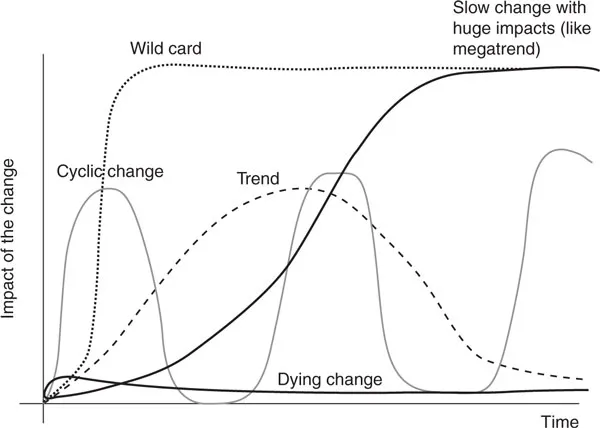
Figure 1.1 Examples of different types of changes
Theories related to political change
When conducting research for this book, I found a convenient summary of different theories related to social changes and political decision-making. This listing has been made by Sarah Stachowiak.3 There are six theories: punctuated equilibrium theory, advocacy coalition framework, agenda setting theory, prospect theory, power elites theory and community organizing theory.
According to the punctuated equilibrium theory, great changes in society happen when the right circumstances prevail. Change happens in “large leaps” rather than in small gradual phases.
According to the advocacy coalition framework theory, developed by Paul Sabatier and Hank Jenkins-Smith, individuals have core beliefs regarding the issues that are important and those that are problematic in our society. The people whose belief systems are similar (like political party) can create change by joining together to advocate a change in some specific issue. John Kingdon’s agenda setting theory claims that change can happen only in a certain window of possibility.
From the point of view of psychology, change can be examined through so-called prospect theory. According to this theory, the way that the alternatives have been framed or presented significantly influences the decision-making of an individual. This means that people may also make stupid decisions in practice – at least in the light of existing data.
The power elites theory that derives from social sciences proposes that change starts from those who have the possibility to influence decisions. Therefore, only a select few have the power to affect change. Decision-makers are in a key role in this theory, and by influencing them others also have the possibility to bring about change. The opposite of this theory is the community organizing theory, according to which political changes happen as a result of the community working together towards a problem that concerns them. In this theoretical view, power is seen as shifting and dynamic.4
The Tipping Point theory
In his magnificent book The Tipping Point, Malcolm Gladwell has depicted different societal changes and discussed the logic behind them.5 Gladwell compares the progress of change with an epidemic and its mechanisms: small things (one infected individual) may have great impacts on the change spreading. Furthermore, changes can start without warning, spread quickly and also fade out quickly.
In his book, Gladwell introduces examples on how different things spread in a society: Hush Puppies shoes became a surprising success, and crime in New York was reduced by paying attention to small things. The “tipping point” of the book refers to how, after reaching a certain point of prevalence, a certain critical mass in a population, the change “tips” so that it will be unleashed in a large scale. In order for something to be able to spread like an epidemic, Gladwell states that the following conditions have to be met:
• Law of the few: In order for a societal change to begin, a select few must start implementing the change. Their nature can be described with the following properties, or some of them:
◦ They effectively combine issues and people; they have strong networks through which they can advocate the issues at hand.
◦ They are experts in collecting information and problem-solving, and they have interest and ability to spread this new knowledge around them.
◦ They are good salesmen or women, charismatic and influential.
• “Catchiness” factor: there has to be an element in the change that an individual is likely to “catch” from another.
• The significance of context in change: the environment in which they live has a great impact on people changing and their ability to change. Even the smallest changes in this environment may bring about a significant change. As an example, Gladwell mentions the new criminal policy in New York: interfering with even the smallest things, such as vandalism. When the environment thus became more decent, crime rate reduced quickly and significantly.
The magical 5 percent
Gladwell’s view on change is, on its part, supported by an interesting study that I happened to come across in the Finnish version of Science Illustrated. The study focused on the collective behavior of large crowds and looked at the similarities in the behaviors of crowds of people and groups of animals, for example a flock of birds or a school of fish.6
The article stated provocatively: “People and fish have the same kind of herd mentality.” The article discussed different studies having to do with herd logic, whether it was a herd, a flock or a swarm of animals or a crowd of people. Researchers had reached the conclusion that the movements of crowds – animals or people – have their own rules. In a flock or a herd, there is a small group that makes the decision on where to go next based on either their instinct or knowledge. The rest of the herd always follow this group.
The article reviewed interesting psychological studies that examined the behavior of human crowds, and especially changes in the way the crowd behaved. In 2007, a German TV channel WDR and biologists John Dyer and Jens Krause ...
Table of contents
- Cover
- Title Page
- Copyright
- Contents
- List of Figures
- List of Tables
- Preface
- Acknowledgments
- About the Contents of the Book
- Part I: Anticipating the Future
- Part II: Innovating the Future
- Part III: Communicating the Future
- Notes
- Index
Trusted by 375,005 students
Access to over 1.5 million titles for a fair monthly price.
Study more efficiently using our study tools.
Frequently asked questions
Yes, you can cancel anytime from the Subscription tab in your account settings on the Perlego website. Your subscription will stay active until the end of your current billing period. Learn how to cancel your subscription
No, books cannot be downloaded as external files, such as PDFs, for use outside of Perlego. However, you can download books within the Perlego app for offline reading on mobile or tablet. Learn how to download books offline
Perlego offers two plans: Essential and Complete
- Essential is ideal for learners and professionals who enjoy exploring a wide range of subjects. Access the Essential Library with 800,000+ trusted titles and best-sellers across business, personal growth, and the humanities. Includes unlimited reading time and Standard Read Aloud voice.
- Complete: Perfect for advanced learners and researchers needing full, unrestricted access. Unlock 1.5M+ books across hundreds of subjects, including academic and specialized titles. The Complete Plan also includes advanced features like Premium Read Aloud and Research Assistant.
We are an online textbook subscription service, where you can get access to an entire online library for less than the price of a single book per month. With over 1.5 million books across 990+ topics, we’ve got you covered! Learn about our mission
Look out for the read-aloud symbol on your next book to see if you can listen to it. The read-aloud tool reads text aloud for you, highlighting the text as it is being read. You can pause it, speed it up and slow it down. Learn more about Read Aloud
Yes! You can use the Perlego app on both iOS and Android devices to read anytime, anywhere — even offline. Perfect for commutes or when you’re on the go.
Please note we cannot support devices running on iOS 13 and Android 7 or earlier. Learn more about using the app
Please note we cannot support devices running on iOS 13 and Android 7 or earlier. Learn more about using the app
Yes, you can access Foresight and Innovation by E. Hiltunen in PDF and/or ePUB format, as well as other popular books in Business & Business General. We have over 1.5 million books available in our catalogue for you to explore.