eBook - ePub
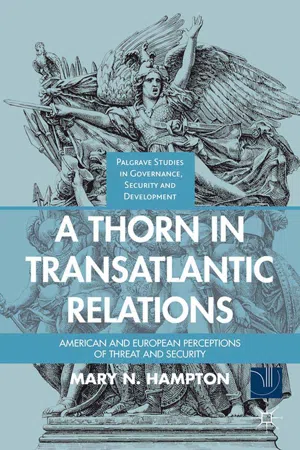
A Thorn in Transatlantic Relations
American and European Perceptions of Threat and Security
- English
- ePUB (mobile friendly)
- Available on iOS & Android
eBook - ePub
A Thorn in Transatlantic Relations
American and European Perceptions of Threat and Security
About this book
Americans and Europeans perceive threat differently. Americans remain more religious than Europeans and generally still believe their nation is providentially blessed. American security culture is relatively stable and includes the deeply held belief that existential threat in the world emanates from the work of evil-doers. The US must therefore sometimes intervene militarily against evil. The European Union (EU) security culture model differs from traditional European iterations and from the American variant. The concept of threat as evil lost salience as Western Europe became more secularist. Threats became problems to manage and resolve. The upsurge in anti-immigrant and anti-foreigner sentiment in the midst of economic crisis undermines this model.
Information
1
Introduction
I have fallen on my knees with great regularity since that moment—asking God for guidance not just in my personal life and my Christian walk, but in the life of this nation and in the values that hold us together and keep us strong. I know that He will guide us. He always has, and He always will.1
—President Barack Obama, February 2, 2012
We don’t do God.2
—Alastair Campbell, 2008
Despite more than a half century of constructing a democratic community in the transatlantic area, strong differences between the United States and its European allies exist in defining, interpreting, and responding to threats in the international system. Most Americans perceive threats in the world through very different lens than do many in the European Union (EU). For most Americans, existential threats exist because evil continues to lurk in the world. The EU security model that evolved over the last three decades largely ceased to address existential threats because the old belief in fundamental evil no longer obtained. For Americans, going to war for the just cause of combating evil remains an ever-present option. For Europeans in the EU, just war has been increasingly defined in much more restrictive contexts. Americans generally believe that their nation has played, and continues to play, a special historic and providential role in bringing light to a world darkened by evildoers. EU Europeans generally believe that if they have a special role to play in the world, it is through the spread of cosmopolitanism. When threatened, the United States often responds with mighty force. When faced with similar challenges, the EU tends to respond in a more guarded manner. Each perspective stereotypes the other at times. Americans have complained about “Euro-wimps”; Europeans have criticized the American “cowboy” approach to the world.
The purpose of this study is to examine and explain the underlying beliefs that shape the real differences in how American and European societies define threat and values about threats, security, and war-fighting. The vitriol that emerged during the transatlantic debate over the commencement and conduct of the Iraq War in 2002–2003 arose from diverging deep beliefs about the nature of the international system and the role of military force therein. James Der Derian observes: “People go to war because of how they see, perceive, picture, imagine, and speak of others; that is, how they construct the difference of others.”3 At the core, American and European perceptions of threat are shaped by beliefs about religion and the role of Providence, which in turn influence how “the other” in the international system is defined and perceived.
Favored or Not Favored: Contrasting Beliefs about Providence
Historically, the societal belief or lack thereof that Providence informs the nation’s mission and ensures its well-being influences a society’s interpretation of the nature of relations in the international system A direct attachment to Providence featured heavily in the European Empire-building period of the pre-Westphalian system, when conquistadors sailed the world in pursuit of “God, gold and glory.”4 The connection between national identity and Providence subsequently became an important historic feature of the Westphalian nation-state system, where the providentially chosen nation had God on its side. The perceived role of Providence and the life of the nation evolved in contrasting ways for the United States and Western Europe in the twentieth century, and has continued to diverge for the United States and the EU.5
Providence and National Mission
The catechism of American patriotism includes the belief that Providence helped found the Republic and has guided it since. Such beliefs were promoted before the American Revolution by the early religious founders of the colonies, were invoked to serve the aims of the Revolution, and have been appealed to over and again by elites straight through to the presidency of Barack Obama. Americans’ belief in the providential role of the United States in the world transcends time, party, and societal position. Blessed by Providence, the United States must lead, which sometimes has been through persuasion, and sometimes through force, but always with perceived “just” intention. Because of the influence of religiosity on America’s mission, it follows that “political science is accordingly obliged to consider the role of the religious dimension of the American mission.”6
The link between national identity and Providence has had a long tradition in the annals of European great power history. Continuing the saga from the age of empires, where the hand of Providence was often seen to be active, the relationship between the emerging European great powers of the Westphalian nation-state system and Providence emerged intact. Competition between European states in the age of nationalism was underwritten by beliefs that Providence played an active role. For example, and as was true with many patriotic British songs, Rule Britannia, written by James Thomson and put to music in 1740, expressed the providential favor believed to have been bestowed upon England:
When Britain first, at heaven’s command,
Arose from out the azure main,
This was the charter of the land,
And Guardian Angels sang this strain:
Rule, Britannia! Britannia, rule the waves!
Britons never, never, never shall be slaves.
But for European great powers, the link between Providence and the nation deteriorated via the devastation of the First World War. While providential guidance became part of the national rallying cry across Europe prior to the Second World War as well, it was most pronounced in Great Britain and Germany. While the British do still largely believe that they are historically blessed, the perceived role of Providential favor has diminished, and it completely collapsed in postwar Germany.
Providence and Religiosity
The connection between nation and Providence necessarily depends on the religiosity of the populace. Here again the United States and the EU have diverged over the course of the postwar period. The fact that Americans continue to be more religious than their EU counterparts also helps reinforce the perception that Providence plays a active role in American life. While a recent Pew poll finds a slippage in American religiosity, there is still a wide gap compared to Europeans.7 Most Americans self-identify as religious and predominantly Christian, and continue to value the role of faith in the conduct of earthly affairs; most people in the EU do not. The link between just war, morality, and belief in God is strong in the United States. According to Andrew Kohut and Bruce Stokes, American “majorities in every age category said belief in God is a prerequisite for morality,” while for respondents in Canada and Western Europe, “majorities in every age group said that belief in God was not a prerequisite for morality.”8 Many analysts have observed the inclination of Americans to believe in good and evil, in Satan and his activism on earth, and in the proclivity of Americans to find providential favor. Andrew Kohut and Bruce Stokes observe from their public polling of Americans and Europeans: “Satan and hell are religious conceptions that divide Americans from Europeans,” with Americans being “more than twice as likely as the British and nearly four times more likely than the French or the Western Germans to believe in the devil, the embodiment of evil.”9
The majority of Europeans living in the EU are not overtly religious, and have increasingly discarded affiliation with mainstream Christian churches. One effect is that existential threats cease to be addressed because the belief in fundamental evil no longer obtains. EU Europeans believe that they now have a special role to play in the world through cosmopolitanism. For the EU, going to war to counter “the other” with force has been increasingly perceived as uncivilized.
The actual consequences of war-fighting in turn has shaped and reshaped underlying beliefs. John Shy is instructive here:
The message is that war changes society . . . that the events and patterns of armed struggle help to shape the way people think about themselves and others, and so on through a catalogue of specific ways in which the impact of armed force may be felt.10
Because the United States has had a generally positive set of actual experiences in major wars, the persistent underlying beliefs concerning America’s providential mission in the world have been reinforced. American beliefs concerning national providential destiny were reconfirmed through two World Wars and the Cold War, as was the corresponding belief that evil exists but can be overcome, most especially under US leadership. This unbroken thread underwrites “the implications of American exceptionalism for world affairs.”11 Likewise, the belief that mortal threats to the nation are foreign and can be held away from the homeland, have remained intact though momentarily disrupted by 9/11.
In contrast, the catastrophic experiences of war-fighting in the two World Wars forced changes in the underlying beliefs about threat and the value of war-fighting in EU Europe. The experiences also helped shatter the perceived connection between nation and Providence, dissolving for the most part the belief that war was about good overcoming evil, as well as the belief that Providence assured national well-being. The recent emergent EU security culture model therefore has attempted to eradicate from its lexicon the beliefs and heavy language associated with war-fighting attached to nationalism, replacing it with a set of civilianized, cosmopolitan beliefs about the special role of Europe in the world. The decrease in religiosity accelerated in the 1960s throughout Europe, reinforcing the decline of national identity with Providence. This set of changing beliefs encouraged the interpretation that the Cold War was overcome mostly peacefully by emerging cosmopolitan values.
In sum, contrasted to EU Europe, the two world wars reinforced Americans’ belief that the United States was providentially chosen to be the light of the world and the corresponding belief that evil exists but can be overcome. Likewise, the belief that mortal threats to the nation could be defeated away from the homeland remained intact. Because of America’s comparatively positive major war-fighting experiences, then, persistent underlying beliefs were reinforced rather than eroded, whereas in Europe, upheaval forced changes to underlying beliefs that necessitated a reconceptualization of Europe’s place in the world.
After being ravaged a second time in World War II, many Europeans turned away from identifying the nation with Providence. As the postwar elite-driven transnational European integration project proceeded, the link was further broken. Guilt about the colonial legacy, the brutality of National Socialism, and the horrors of the Holocaust affected many in Western Europe. By the 1960s, religiosity dramatically diminished across Western Europe in the face of growing economic prosperity and the turn toward the rational welfare state. Secularist beliefs filled in the broken link between Providence and national identity to produce a redefinition of the nature of threat and to undermine values formerly held that war-fighting may be a moral enterprise.
Culture and Underlying Beliefs
To speak of the influence of underlying beliefs and values is to enter the realm of culture, and runs counter to a strict structural realist understanding of national interest. A basic definition of culture includes the “values, attitudes, beliefs, orientations, and underlying assumptions prevalent among people in a society.”12 Culture is the bedrock of identity. Culture and identity are multifaceted, and culture is always contested because there is diversity within culture and identity communities. Furthermore, culture is dynamic: always superficially changing yet persistent in its fundamental beliefs and values until moved by a shock to bedrock convictions. Focusing on dominant and persistent cultural and identity attributes allows for useful generalizations about core beliefs and the mechanisms for changing them. Political scientists like Peter Katzenstein, and historians such as Konrad Jarusch have shed much light on changing political culture.13 The focus of this book is on security culture in the United States and EU Europe, although connections to strategic culture will be made when appropriate.
At the center of the argument about culture here is the critical role played by religiosity or lack thereof. Recently, an upsurge of interest in what is perceived as the resurgence of religion across the globe has started to shine light on the possible influence religious beliefs might have on political and foreign policy behavior. Findings by the Religion Task Force for the Chicago Council on Global Affairs proclaimed in 2010: “Religion has been rapidly increasing as a factor in world affairs, for good and for ill, for the past two decades.”14 The influence of religion, which has been extant for much longer than two decades, has often been overlooked or undervalued in the international relations and social science literatures, but the trend is beginning to change as more analysts focus on the role religiosity can play in shaping beliefs that influence behavior.15
Contrasting Security Cultures
As sketched above, contrasting beliefs and values about the nature of threat and the morality of war have created divergent security cultures in the transatlantic area. Security culture refers to elite and societal beliefs and values about the nature of threat, and identifies the legitimacy or lack thereof of war-fighting as a means of dealing with threat.16 To discuss the concept within the constructivist framework, the concept of threat needs to be unpacked and examined because it does not have a universal definition. The focus on security culture typically belongs with constructivist analyses i...
Table of contents
- Cover
- Title
- 1 Introduction
- 2 “God Has Favored Our Undertaking”: Explaining American Security and Strategic Culture
- 3 Oasis or Mirage? EU European Security and Strategic Culture
- 4 Combating Communism “from the Abodes of Righteousness”
- 5 Naming Terror: US and European Counterterrorism Strategies since the 1970s
- 6 Conclusion: Transatlantic Security Cultures in Transition
- Notes
- Index
Trusted by 375,005 students
Access to over 1.5 million titles for a fair monthly price.
Study more efficiently using our study tools.
Frequently asked questions
Yes, you can cancel anytime from the Subscription tab in your account settings on the Perlego website. Your subscription will stay active until the end of your current billing period. Learn how to cancel your subscription
No, books cannot be downloaded as external files, such as PDFs, for use outside of Perlego. However, you can download books within the Perlego app for offline reading on mobile or tablet. Learn how to download books offline
Perlego offers two plans: Essential and Complete
- Essential is ideal for learners and professionals who enjoy exploring a wide range of subjects. Access the Essential Library with 800,000+ trusted titles and best-sellers across business, personal growth, and the humanities. Includes unlimited reading time and Standard Read Aloud voice.
- Complete: Perfect for advanced learners and researchers needing full, unrestricted access. Unlock 1.5M+ books across hundreds of subjects, including academic and specialized titles. The Complete Plan also includes advanced features like Premium Read Aloud and Research Assistant.
We are an online textbook subscription service, where you can get access to an entire online library for less than the price of a single book per month. With over 1.5 million books across 990+ topics, we’ve got you covered! Learn about our mission
Look out for the read-aloud symbol on your next book to see if you can listen to it. The read-aloud tool reads text aloud for you, highlighting the text as it is being read. You can pause it, speed it up and slow it down. Learn more about Read Aloud
Yes! You can use the Perlego app on both iOS and Android devices to read anytime, anywhere — even offline. Perfect for commutes or when you’re on the go.
Please note we cannot support devices running on iOS 13 and Android 7 or earlier. Learn more about using the app
Please note we cannot support devices running on iOS 13 and Android 7 or earlier. Learn more about using the app
Yes, you can access A Thorn in Transatlantic Relations by M. Hampton in PDF and/or ePUB format, as well as other popular books in Politics & International Relations & American Government. We have over 1.5 million books available in our catalogue for you to explore.