- English
- ePUB (mobile friendly)
- Available on iOS & Android
eBook - ePub
About this book
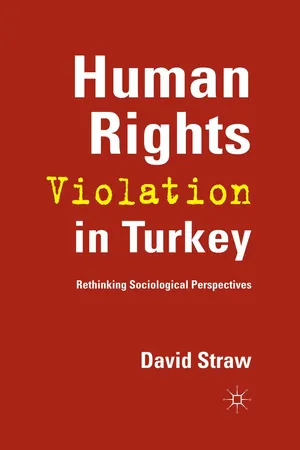
Sociological theory has veered between an insistence on understanding human rights as a genuine universal morality and far more cynical portrayals of human rights as a veil of bourgeois capitalist enterprise. This book criticizes, adapts and combines seemingly disparate elements of contemporary sociological theory within a new approach to human rights. The practicality of the approach is clearly demonstrated in its application to one of the most important, complex and vexing locations of human rights violation in the world: modern Turkey. While sociological analyses of Turkey have largely been limited to local perspectives on individual issues of human rights violation, this book expands sociological understanding of the broad swath of Turkey's human rights violations into a new global perspective of hope and resolution.
Information
1
The Sociological Portrayal in Context
This chapter has two aims. First, it introduces the contemporary problems faced by Turkey in its struggle to achieve acceptable human rights standards (typically judged in relation to the European Union and its Copenhagen criteria1). Here, the continued existence of Islamism in government, the Turkish ‘deep’ state, the nationalist and statist nature of Kemalism, and the irresolution of the Armenian and Kurdish issues are discussed and contextualized as part of the more general problem of the human rights record of this country.
Second, in considering the importance of a related sociological case study of human rights violation, the discussion moves on to look at the prominent sociological criticism relating to human rights in Turkey. Here, despite the broad range of issues outlined, an almost exclusive focus on the Armenian and Kurdish issues is seen to neglect the ‘global’ perspective influencing Turkish attempts to improve its human rights standards. The importance of accounting for this neglect is then underlined by the existence of a narrative recognizing the difficulties Turkey has faced in the resolution of these problems, and which can be identified within sociology’s wider, interdisciplinary context.
Consequently, the task of explanation, in regard to the empirical aspect of the study, is set out. It is identified that there is the opportunity to undertake a sociological study of human rights violations beyond the current sociological attention to the Armenian and Kurdish issues, and focus on the more general problem of human rights violation in Turkey. Given the current hiatus of sociological attention to the subject, the value of the present book as an attempt to fill this gap in understanding is made clear. The importance of this study is further underlined by the representative nature of Turkey as a departure point for the understanding of Western relations with the East, especially in terms of the Islamic world, more generally.
General background
Turkey is certainly not without a stated commitment to human rights. It was one of the first countries to sign up to the Universal Declaration of Human Rights in 1948. In 1954 Turkey signed up to the European Convention on Human Rights, which put it under the jurisdiction of the European Court of Human Rights. In 1988 it signed up to the European Convention for the Prevention of Inhuman or Degrading Punishment. Turkey has also regularly become the object of much praise as it improves its human rights record and is being seen by some of Europe’s foremost politicians as representing a potential benefit to the European Union expansion process (Kaleagasi 2008: 44). The country still struggles, however, with its poor human rights record.2
The secret, extra-judicial activity of state-related actors, often described as the ‘deep’ state (derin devlet), has been revealed by scandals exposing state and criminal links, and this has cast doubt over whether the strongly nationalist element of the Turkish elite will ever support a genuine democracy.3 The failure of Turkey’s secular but often corrupt governments has led to insecurities over the return of Sharia law on several occasions. With protests of unfair treatment and abuse, its minorities – especially in recent years, the Kurds – have seen representation by terrorist organizations, such as the PKK4 (which has threatened the territorial integrity of the country).
Armenian protests have, from the time of the 1915 massacres, been revisited through other terrorist organizations, such as the ASALA (Armenian Secret Army for the Liberation of Armenia), as well as constant accusations of genocide from world powers. Any possible admission of the Armenian Genocide has been seen as a clear threat to the identity of the Turkish state because it would label some of its founders as war criminals (Akçam 2007: xx). These concerns and others, such as the treatment of women, freedom of conscience and torture in state custody, continue to keep Turkey at a distance from the West and threaten prospects for Turkey’s accession to membership of the European Union.5
The apparent problems in the Turkish construction of a free society, meeting with European human rights standards, have arisen at the beginning of the 21st century through the criminal prosecution of the ‘deep’ state Ergenekon organization and the resurgence of Islamism as the ruling AKP (Justice and Development) party were taken to court in 2007 over allegations that the form of government they were attempting to construct ran against the basic principles of the Turkish Constitution.6 Whereas the Ergenekon investigation represents suspicions of the latest example of ‘deep’ state activity in Turkey, the AKP itself was formed by members of the Islamic Welfare Party, closed by the Turkish Constitutional Court in 1997. Indeed, the possibility of the resurgence of Islam, and the sometimes violent clashes between the religious and secular representation in the country, has been a characteristic of political unrest in Turkey since its foundation as a republic (Zürcher 2004).
‘Deep’ state activity is often seen as occurring when there is a fear of the government being rendered ineffective through the pursuance of legal means to its protection and the defence of its Constitution. This has been argued in some criticism of this problem both in Turkey (Kumkale 2007; Akan 2008) and in the West (Gunter 2011: 109) and has been often used as an explanation of specific events of human rights abuse such as the extra-judicial murder of business people supporting the Kurdish PKK during the time of Tansu Çiller (Human Rights Watch 1999: 42). The ‘deep’ state’s existence is something even recognized by the Turkish prime minister, Tayyıp Erdoğan, who said in an interview that ‘This is something that comes in any case from tradition. But to have its presence minimised or even eradicated is something we must achieve’ (Kumkale 2007: 18).7
If this is accepted as a background for a large part of the emergence of ‘deep’ state activity, it is perhaps unsurprising that, with Turkey on the verge of entering the European Union, under a government with suspicions of overly political Islamist intent, suspicions of the existence of the largest ‘deep’ state organisation known in Turkish history have emerged. Plans of the ultra-nationalist Ergenekon allegedly involved the assassination of the Turkish Nobel Prize winning novelist Orhan Pamuk and the destabilisation of the AKP government. It was also allegedly led by ‘die hard’ Kemalists, such as retired military figures, and consisted of ultra-nationalist lawyers such as Kemal Kerinçsiz, along with various sympathisers in the media, mafia and academia.8 In order to help legitimate a military coup to oust the AKP, a specific operation called Balyoz (‘sledgehammer’) is alleged to have involved plans to bomb two Istanbul mosques during Friday prayers and down a warplane over the Aegean Sea: an act which was later to be blamed on Greece.
Overtly secular reaction to the possibility of Islamism in government resurfaced in the 1990s with the closure of the Islamic Welfare Party after its success in gaining seats in the key Turkish cities of Istanbul and Ankara and the largest number of seats in the election of 1995. Its members held political interests from ‘social and economic reform to replacing the secular state system with one founded on Islamic law’ (White 2002: 3). Constitutional Court action against the Welfare Party was the result. However, widespread dissatisfaction with the corruption of the secular CHP party under Bülent Ecevit and the financial crisis of 2001 enabled some former members of the Welfare Party to advertise their new reformed party as the AK (in Turkish ‘pure’) party which capitalised on this dissatisfaction and led to a landslide victory in the 2002 elections (Yavuz 2006: 1). Again, sometime into its term of government, secularist insecurities were reawakened. The election of Abdullah Gül as the President of the Republic followed threatened military action to remove the AKP from power, a narrowly won court case to close down the party (but which led to reduced funding), and a re-election of the party in order to use the democratic process to gain justification for its advancement.
Indeed, beyond the military and ultra-nationalist ‘deep’ state organisations, it is possible to find widespread cynicism towards the Islamist revival in Turkey and the corruption of Islamic principles it has, for some, represented. Muammer Kaylan, former editor of the newspaper Hurriyet, describes Turkey at the time of the election in late 2002 as a country where the ‘the merchants of Islam, those exploiters of religion … used every means to manipulate the country’s future’ (2005: 21). More generally, from the time of the foundation of the republic in 1923, he sets out to explain in his book The Kemalists: Islamic Revival and the Fate of Secular Turkey ‘how through political irresponsibility and greed the nation’s clock was turned back’ (2005: 20). Indeed, Kaylan’s dissatisfaction with what he sees as the backwardness of Islamic political representation in Turkey is reflected to a greater extent by Ilhan Selcuk, the editor of Cumhuriyet, which also happens to be Turkey’s oldest Newspaper. Selcuk was arrested and taken to Court in 2008 as part of the ‘deep’ state Ergenekon investigations.
While there have been these suspicions awakened in the Turkish press about the long term plans of the AKP, there is also more positive criticism of this new Islamic revival which argues that ‘if an Islamic political movement actively hinders the articulation of arguments on the basis of Islamic values, it is no longer Islamic’ (Yavuz 2006: 2). In this sense, if there is a new Turkey emerging which is based more concretely on an Islamic identity, it is an identity which seems able to accommodate the requirements of the wider global political economy of human rights, democracy and the free market, rather than see itself tied to fundamentalist Islamic belief. This is a view which arguably sees some reflection in the work of Hasan Bülent Kahraman, a prominent political commentator in Turkey, who argues that to understand the AKP, ‘it is necessary to look at the development of the Turkish right generally’ (2007: vii). In The Turkish Right and the AKP Kahraman goes on to trace the history of the AKP as beginning with the 1950 elections and the success of the DP (Democratic Party). In other words, the first democratic challenge to Kemalism enabled the eventual formation of a party with Islamic roots. The democratic process is one alien to fundamentalist Islam, but Islamic parties in Turkey have been prepared to compete democratically.
Another reason for the resurgence of Islamism in Turkey is that the nationalist and laic foundation of the Republic has come under increasing criticism as a source of the problems of the advancement of Turkey towards Western standards of human rights contemporarily. Among the major criticisms raised are its continued failure to properly acknowledge the rights of minorities and its excessive and outdated focus on the importance of nationalism and the state. The six Arrows of Kemalism: Republicanism, Populism, Secularism, Nationalism, Statism and Revolutionism sought to consolidate the new Turkish Republic in 1923, but there have been problems caused by them ever since which have led to criticism that Kemalism cannot lead to a successful Westernisation process because it is simply too inward looking.
A prominent contemporary example of the problems inherent in Kemalist ideology is the situation of the Kurds, who are Turkey’s largest ethnic Muslim community after the Turks. The emergence of Turkish nationalism, which aimed to consolidate a new nationalist consciousness and hence Turkish identity, had a destructive effect on the Kurdish population. Indeed, there can be little doubt that it has done so ever since. Turkish nationalism led simply, in the words of Zürcher, to ‘a repressive policy towards Kurdish identity: the public use of Kurdish and the teaching of Kurdish were prohibited’ (2004: 170).
Despite the human rights enthusiasm expressed through desires to join the EU, the clear potential for human rights violation against ethnic minorities is still written into the Kemalist Turkish Constitution. Written in 1982 after a military coup, Article 66 of this Constitution dubiously states that ‘(1) Everyone bound to the Turkish state through the bond of citizenship is a Turk (2) the child of a Turkish father or a Turkish mother is a Turk’ (Gözübüyük 2009: 85, numbers in parentheses added). Allegations of torture have ensued as a result of policies of ‘Turkification’ where Kurdish children are sent to Turkish teachers for their education. Indeed, the societal manifestation of human rights violation in Turkey has arisen more recently in response to the Kurdish issue. The period since the outbreak of large scale fighting between the Turkish military and the PKK in the 1990s has seen the emergence of Kurdish human rights organisations such as the KHRP (Kurdish Human Rights Project). The Kurdish issue has been at the heart of many of the concerns over freedom of conscience, torture and the extrajudicial murder of journalists and businessmen which occurred most notably under the Premiership of Tansu Çiller. Solutions to the problem, in the simple phrase popularised by the Turkish Prime Minister Tayyıp Erdoğan, ‘ya sev, ya da terk et’ (‘either like it or leave’), may be seen as an expression of the continuing difficulty in finding a realistic and inclusive solution to the situation.
Kemalist nationalism is but one aspect of the damage that has been done to the prospect of genuine freedom for the Turkish citizenry, however. Statism is an aspect of Kemalism which is often seen as an overhang from the Ottoman period in which the state was almost deified – the term ‘the sacred state’ was used in Turkey until very recently. The valuation of statism seems self-contradictory in Kemalism, which also portrays itself generally as based on the implied ‘reduced state’ Western ideas of the Enlightenment, but which was even described by Adnan Menderes, one of the first Turkish Prime Ministers, who strongly advocated democracy, ‘as a discredited relic of fascism’ (Zürcher 2004: 215). While Turkish society is still largely under the grip of state control, this logically limits the freedom of its population and the chance to achieve the basic freedoms inherent in Western human rights standards. It has been argued that loyalty to the state exists in public ritual (especially in regard to military service which remains the responsibility of every Turkish male) to the extent that the state/society divide is not as clear as advocates of the Turkish democratisation process would have us believe (Navaro-Yashin 2002: 132).
At the same time, the nationalist concerns of the Kemalist elite and much of the insecurity in Turkey towards the Armenian Genocide, and Kurdish question especially, are not wholly unfounded insofar as they find some reflection in some identifiable modern day reaction to the prospect of entering the EU. This has some explanation in what is termed as ‘Sevres Syndrome’. This originates from the 1920 Treaty of Sevres, in which it was planned to divide up what is now much of modern Turkey between the main European powers after their victory in the First World War. The division of Turkish lands under the treaty represented the agreement between the victorious powers in the First World War – Great Britain, France and Italy – that Christian minorities were to be protected and that there was to be the founding of an independent Armenian state along with the separation of the Ottoman Empire’s former provinces such as Syria, Iraq (formerly Mesopotamia) and Israel and Jordan (formerly Palestine). It was a situation that has been variously seen as a clear demonstration of the level of callousness with which European powers are prepared to act in relation to the Turks.
This callousness has been explained in terms of the Treaty of Sevres being ‘simply lines drawn on a map by outsiders with little knowledge of the people or the territory they are separating’ (Wagner 2004: 9). This lack of sympathy for the Turkish predicament has also been commented on by McCarthy who explains that for the Turks ‘the significance of the Treaty of Sevres was the reinforcement of their will to resist their conquerors. The treaty showed in stark terms what awaited them if they failed’ (2005: 127). The fact that Atatürk was successful in the War of Independence and that the Treaty of Sevres was never enacted serves as a constant source of tension as ties with Europe are re-established. With Kurdish pressure held in regard to the grievances over their treatment at the hands of the Turks in the early 20th century, there is constant Turkish insecurity with regard to whether there may be some form of re-enactment of the treaty. Despite general Turkish enthusiasm for membership of the EU, there has already been evidence of Turkish insecurity that, in 2002 for example, ‘the EU was undermining Turkish interests in Cyprus and sponsoring secessionist activity in Kurdish-dominated south-eastern Turkey’ (Rumelili 2008: 114).
However, Turkish insecurities over Europe extend to accusations of genocide which occur not only among the Armenian population of the country but in Europe and beyond. France and America have been seen to take steps making it, in the French case in 1998, a crime to declare that this ‘massacre’ was not genocide and in the American case in 2007, the adoption of a resolution accepting these allegations. The enduring relevance of the problem is represented by the election of Barack Obama, where the visibility of his presidency’s position on the Armenian Genocide had relevance to the possibility of Turko-Armenian reconciliation.9 Indeed, the most long standing Turkish issue of human rights violation has been the Armenian Genocide.
The finer details of the problem can be summarised as follows: the Turkish state claim that this event cannot be labelled as ‘genocide’ and that 300,000 to 600,000 Armenians were killed in wartime circumstances (Akçam 2004: xii). On the other hand, there has been an almost international call for the acceptance of the Armenian deaths as genocide which means that the ‘Young Turk’ government at the time had clear intent in causing a crime. Some estimates put the figure of Armenian dead as a result of deportation into conditions where they were almost certain to meet death through starvation, massacre, rape and other degrading circumstances at up to 1.5 million, or even higher (Lewy 2005: 240).
Relatedly, there is the issue of Turkish emotional reaction if onesided settlement was found which meant that lands in Turkey were given up to the Armenians or the Kurds, ...
Table of contents
- Cover
- Title Page
- Copyright
- Contents
- Acknowledgements
- Note on Citations
- Introduction
- 1. The Sociological Portrayal in Context
- 2. The Emergence of Human Rights
- 3. A Theory of Human Rights
- 4. Transition to ‘Equality’
- 5. Responsibility
- 6. Resolution
- 7. Preservation
- Conclusion
- Notes
- Bibliography
- Index
Trusted by 375,005 students
Access to over 1.5 million titles for a fair monthly price.
Study more efficiently using our study tools.
Frequently asked questions
Yes, you can cancel anytime from the Subscription tab in your account settings on the Perlego website. Your subscription will stay active until the end of your current billing period. Learn how to cancel your subscription
No, books cannot be downloaded as external files, such as PDFs, for use outside of Perlego. However, you can download books within the Perlego app for offline reading on mobile or tablet. Learn how to download books offline
Perlego offers two plans: Essential and Complete
- Essential is ideal for learners and professionals who enjoy exploring a wide range of subjects. Access the Essential Library with 800,000+ trusted titles and best-sellers across business, personal growth, and the humanities. Includes unlimited reading time and Standard Read Aloud voice.
- Complete: Perfect for advanced learners and researchers needing full, unrestricted access. Unlock 1.5M+ books across hundreds of subjects, including academic and specialized titles. The Complete Plan also includes advanced features like Premium Read Aloud and Research Assistant.
We are an online textbook subscription service, where you can get access to an entire online library for less than the price of a single book per month. With over 1.5 million books across 990+ topics, we’ve got you covered! Learn about our mission
Look out for the read-aloud symbol on your next book to see if you can listen to it. The read-aloud tool reads text aloud for you, highlighting the text as it is being read. You can pause it, speed it up and slow it down. Learn more about Read Aloud
Yes! You can use the Perlego app on both iOS and Android devices to read anytime, anywhere — even offline. Perfect for commutes or when you’re on the go.
Please note we cannot support devices running on iOS 13 and Android 7 or earlier. Learn more about using the app
Please note we cannot support devices running on iOS 13 and Android 7 or earlier. Learn more about using the app
Yes, you can access Human Rights Violation in Turkey by D. Straw in PDF and/or ePUB format, as well as other popular books in Social Sciences & Civil Rights in Law. We have over 1.5 million books available in our catalogue for you to explore.