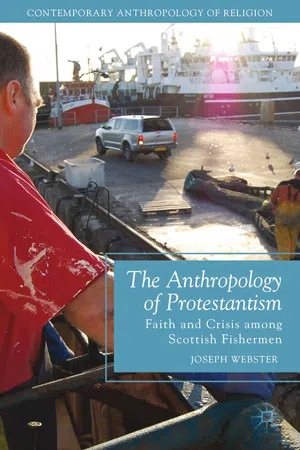
eBook - ePub
The Anthropology of Protestantism
Faith and Crisis among Scottish Fishermen
- English
- ePUB (mobile friendly)
- Available on iOS & Android
eBook - ePub
About this book
Through his ethnographic study of the fishermen and their religious beliefs, Webster speaks to larger debates about religious radicalism, materiality, economy, language, and the symbolic. These debates also call into question assumptions about the decline of religion in modern industrial societies.
Information
Part I
Gamrie
Chapter 1
Situating Gamrie
Gamrie’s history has been shaped by two dominant forces: religion and fishing. According to one of my informants, himself an amateur historian, the village of Powistown was renamed Gardenstown in 1721, founded by Peter Garden as a fishing village. While the village received its first mention in parish records in 1190 (the parish being called ‘Gamrie’), the land was initially developed when a church dedicated to St. John was constructed to mark the place where, according to legend, the Scots defeated an invading Danish army in 1004. At this time (and for the next 350 years) Scotland was under the religious control of the Roman Catholic Church with Christianity having been first brought to Scotland by St. Columba in 563 during his efforts to convert the native Picts.
After the construction of St. John’s churchyard, it was not until the mid-1500s that the official break with Rome was made during the Scottish Reformation. The religious and political upheaval of 1560 (which birthed the CofS in the same year) saw the rejection of the authority of the Pope, the outlawing of the celebration of the Mass, and the eventual instating of the (staunchly Calvinist) Westminster Confession of Faith. Yet, by 1582 the CofS was already experiencing its first internal fissure, with a section of the denomination leaving to set itself up as the Scottish Episcopal Church.
By the 1600s things began to change again (first in Europe, then nationally) with the development of Biblical Criticism. This form of thought was given its earliest voice in the Theologico-Political Treatise of 1670 in which Spinoza contended that the Bible was a natural text to be subjected to the rigors of intellectual reason and not interpreted through ‘faith’ via ‘revelation.’ Spinoza’s approach gained credence with two key eighteenth century Enlightenment thinkers in Germany—Reimarus (1694–1768) and Griesbach (1745–1812)—who further developed the concept that the Biblical text was the product of a long history of human religious tradition and not of divine authorship (see Schweitzer 2009). Such ideas sent shockwaves through the strongly Reformed theology of the CofS, and, at the point where these new creeds converged with the arrival of the Scottish enlightenment by the mid-1700s, the liberalization of Scottish religious life seemed largely irreversible.
These pioneers of Biblical Criticism, as well as key figures in the Scottish Enlightenment such as David Hume—although not the subject of conversation among the Christians of Gamrie—were responsible for clearing an intellectual path that latterly opened up the way for a much more famous (and locally infamous) nineteenth century naturalist, Charles Darwin, to expound his views on the genesis of the human race. With his publication of On the Origin of Species in 1859 came the (essentially reactionary) formation of the Protestant ‘fundamentalist’ movement in America in the twentieth century, with opposition to the theory of evolution (described by some as ‘the religion of the Antichrist’) as one of its central tenets.
The ‘Disruption’ of 1843 (birthing the Free Church of Scotland from a major split within the CofS) set the tone for a period of 150 years of schism and popular revivalism across Scotland. With the Disruption came a significant weakening in the power and influence of the CofS, the national Kirk, which had been dominant in the northeast since the Scottish Reformation of 1560, subject only to limited regional competition from the (more moderate, Anglican) Scottish Episcopal Church, and, to a lesser extent, from Methodism. With many CofS Parishes in the west highlands experiencing secession, it became easier for Aberdeenshire fishing communities to openly express long-standing resentments toward their national Kirk. Ministers serving in the CofS were seen by many Gamrics as ‘incomers,’ who, having received an overly intellectual (and insufficiently ‘spiritual’) theological training at a secular university in one of Scotland’s urban centers, came to their village with a misplaced sense of authority and superiority. Such men were resented for their educational background and scorned for being strangers to the physical labor of deep-sea fishing. The experience of being ruled over by a nonlocal Kirk minister was uncomfortable for many fishermen long accustomed to governing their own lives at sea. While the Scottish Episcopal Church retained supporters among the land owning gentry of inland Aberdeenshire, and the (staunchly Calvinist) Free Church grew rapidly among impoverished crofters in the highlands and islands, the fishermen of Scotland’s northeast coast—lacking the cultural capital of Episcopalianism and resisting the theological autarchy of the ‘Free Kirk’—was yet to find its own ecclesiastical ‘glass slipper.’
Extrapolating from local origin myths, in the eighteenth and nineteenth centuries, something very close to a ‘perfect fit’ occurred between Gamrie’s Christian fisherman and the (then new) Plymouth Brethren movement. Founded in Ireland in the late 1820s by John Nelson Darby (originally a curate in the Church of Ireland) and others, the group established their flagship church in Plymouth in 1831 (Coad 1968), arriving along the Aberdeenshire coast in the 1850s and 1860s (Dickson 1997). It took 70 years for this new millennialist sect—heavily influenced by Darby’s dispensationalist eschatology—to gain any real foothold in Gamrie. A breakthrough occurred in 1921 when herring shoals migrated away from Scottish waters. A poor fishing season resulted, bringing serious economic hardship to the village, forcing Gamrie’s fishermen to work English waters to fill their nets.
It was during what came to be called ‘the 1921 Herring Revival’ that Gamrics first came into contact with the ‘open air’ gospel preaching of the Brethren as they landed their catches in the harbors of Plymouth, Portsmouth, and Yarmouth. What they heard was a message of personal salvation and ecclesiastical separation, backed by an apocalyptic urgency that cast the present as ‘the last of the last days.’ Being Arminian, their salvationist message focused on the centrality of human volition—of choosing Christ’—thereby rejecting the Calvinistic predestinarian view of salvation by election proclaimed by their Presbyterian rivals, placing the onus instead onto each individual to respond to the ‘preaching of the gospel’ during these ‘end times.’
This eschatology was (and continues to be) closely akin to the (strongly futurist) premillennial and pre-tribulationist dispensationalism Harding (1994, 2000) describes in her work with fundamentalist Baptists. Indeed, it was J. N. Darby who invented dispensationalism—the view that all human history can be divided into distinct ‘dispensations,’ determined by God’s differential dealings with humankind on the basis of His establishment of different Biblical covenants. It is difficult to overestimate the importance of this theology locally; much of what makes life in Christian Gamrie ‘enchanted’ is the acute sense that not only is God immanent—spatially close at hand—but He is also imminent, that is, temporally soon to arrive. This combined assertion of the closeness and ‘soon-ness’ of divine (and demonic) forces made Brethrenism—and, over time, Gamrie—‘alive with a kind of magic.’
Other elements of Brethren theology were important. A fully lay ministry was required—having professional clergy was a sin against the Holy Spirit insofar as it failed to recognize that God spoke through all saved men. In further contrast to Presbyterianism, communion (‘Breaking Bread’) was to be celebrated not once or twice a year, but every ‘Lord’s Day’ morning, with anything less said to be willful disobedience to scripture. This ‘act of remembrance’ could be presided over by any ‘soundly saved’ Christian man; the elements being ‘purely symbolic’ required no liturgy, no consecration, and crucially, no minister. Yet, this symbolic view did not render materiality unimportant. The physical resurrection, for example, was stressed by all Brethren preachers, and cremation of the dead was condemned not only as a pagan practice, but also as a failure to properly anticipate the literal truth of ‘the raising of the dead’ on ‘the last day.’
The ‘doctrine of separation’ was also a central feature of the Brethren message. All other Christian denominations were rejected as apostate by those early preachers who stood in the fish markets proclaiming escape from the coming judgment. Other aspects of social life were similarly treated—converts were generally discouraged from working with non-Brethren, for example, and marriage outside the group was prohibited. Politics was rejected as evil, with many Brethren to this day choosing not to vote as a matter of conscience. Latterly, newspapers, radio, and television were all shunned as ‘worldly,’ as were, in practice, much of the arts (most especially dance and instrumental music). This deliberately exclusionist platform left little room for ambivalence; those Gamrics who encountered Darby’s followers were (rhetorically) presented with two choices—stay in the Kirk and burn or come out and be saved. It was after the ‘Herring Revival,’ during the 1930s, that many of Gamrie’s fishermen made their choice. Conversions often occurred in blocs, first within individual boat crews, then spreading to immediate and extended kin (Meek 1997: 138). With large numbers leaving the Kirk to join the Brethren, the movement quickly established itself as a major player on the local religious scene.
Yet, despite what some of my more zealous Brethren informants wanted me to believe, this fundamentalist spirit cannot simply be attributed to the divine revelation given to J. N. Darby. Indeed, it seems that everything that had occurred up until that point—internationally, nationally, and locally—had been building to provide ideal historical conditions for the Brethren to flourish. The Reformation, breaking with Rome, began to assert the need for mass Biblical literacy over and against the public performance of religious ritual. This promoted the validity of individual interpretations of the Bible. The Enlightenment carried this process of personal discovery of (in this case Biblical) knowledge even further, and began the process of combining the search for material evidences of (literal and historical) Biblical inerrancy with the theology of dispensationalism and the eschatological search for ‘signs of the end times.’
Nineteenth and twentieth century factors also played a part. The memory of the Ulster 1859 Revival ensured that spiritual awakenings were ‘programmed into the mind-set of many east-coast fishermen’ (Meek 1997: 138). It was through this same lens of religious fervency that the First World War—ending in the deaths of 15 million globally—was viewed as a sure sign of the coming apocalypse, sensitizing many to Darby’s dispensational vision of the ‘end times.’ This was matched with a more general swing toward fundamentalism: the urgent need to have a personal ‘born-again’ conversion experience joined with the establishment of scientific six-day creationism as the theological response to the claims that evolutionism (ironically, like dispensationalism, itself a product of enlightenment thinking) had ‘disproved’ the Bible (cf. Harding 2000: 217).
Yet historical factors do not give a full explanation for why Brethrenism flourished. The sociology of ‘elective affinity’ provides another perspective, especially in making sense of the relationship between theological ideas and economic livelihoods. The material world of science and nature (omnipresent in the lives of men working at sea) were embraced as indexes of divine presence; individual conscience and the primacy of personal conviction became the highest court of appeal in all matters of religion; a patriarchal system of church governance was combined with a highly devolved system of leadership that placed all men in positions of equal authority over each other (and over female members)—permitting every man within this ‘society of petty entrepreneurs’ (Dickson 1997: 161) to aspire to be ‘his own skipper’ not only at sea, but also in church.
With each man in authority over everyone, no man, in effect, had the power to tell any other man what to do. Men who had taken orders from nobody during their working week at sea, only to come back to shore to sit under years of autocratic preaching by a lettered ‘incomer’ at the Kirk not only resented formal, educated, professional, top-down church leadership (cf. Just 1988), but were now being told that such ecclesial structures were blasphemy, and that it was their duty, as Christian men, to lead a newly revived ‘body of believers’ in whatever direction the ‘Spirit of God’ prompted. So powerful was the ‘natural attraction’ between the cosmologies of Brethrenism and fishing, and so strong was their ‘tendency to combine’ (Howe 1978) that, between the 1860s and the 1940s, over 30 (Open and Closed) Brethren halls formed along the northeast coast alone (Dickson 1997: 164).
Religion in Scotland: Recent Social Themes
Over the last 50 years, churches in Scotland have moved from being one of the country’s most influential institutions, to one squeezed by fierce competition. One explanation might be that Scottish churches have been increasingly affected by moral and cultural liberalization, while also becoming more in favor of (and dependent upon) ecumenicalism as a method of sustaining their lifespan. Yet the ‘liberalization + ecumenicalism = secularism’ paradigm actually seems to work in the opposite direction. Brown (1997), Bruce (2001, 2002), Hillis (2002), McCrone (1992), and Voas (2006) have all suggested that liberalization and ecumenicalism can be seen as largely a reaction to, not a cause of, the ways in which Scottish society has, since the 1960s, become ever more ‘tolerant’ and ‘progressive’ while growing less interested in the ‘identity politics’ that characterized much of the Scottish Presbyterianism of the past.
For Brown, the issue was one of changing trends in popular culture rather than any complex shifts in the modern Scot’s cosmological outlook on life: ‘it was lifestyle rather than ideology that seemed to instigate religious decline in Scotland’ (Brown 1997: 3). For him, urbanization was the key social process that heralded the death of piety in Scotland, and, what better evidence of this than the unrivalled urbanity of Glasgow? ‘By the time Glasgow was “European City of Culture” in 1990, and the pubs stayed open until three o’clock in the morning all year long, nobody doubted that religious Scotland was dead’ (Brown 1997: 2). Further, urbanization brought with it ‘a vast new range of occupations . . . leading to great variation in standard of living, popular culture and religion’ (Brown 1997: 6). The argument is that ‘the very instability of modern society seemed to threaten the tradition of communal worship and the tranquility of the agrarian life upon which piety and faith were founded’ (Brown 1997: 8). Connell, commenting on rural life in interwar England, makes a similar point in his analysis of urban to rural migration in Surrey:
The slower pace of life is the only index of change for most new residents; they cannot adopt a traditional country life style since even its semblance has long since gone. . . . Village life has become suburban life and, for those who can afford the move, a pleasant rest from city life with just the merest hint of a lost country tradition [producing] . . . a new suburbia from which the simple life has gone. (Connell 1978: 214)
Brown and Connell’s arguments seem clear: the nineteenth century process of urbanization, the twentieth century suburban development of ‘new towns, and the liberalizing “modernity” that both of these processes brought with them’ led to a more general ‘undermining of the received role of religion’ (Brown 1997: 166. cf. Connell 1978: 28–31). In the 1930s Scotland got the radio, in the 1950s it was television, and in the 1960s it was Bingo. It is not hard to see how this ‘boom in . . . leisure’ (Brown 1997: 166) began to erode some key aspects of Scottish religiosity, perhaps most obviously the Scots’ willingness to adhere to the strictures of the Fourth Commandment.
Crucially, ‘with religious decline came ecumenicalism’ (Brown 1997: 7. emphasis added). The argument is again relatively straightforward—if your shack is falling over, you naturally begin to lean against the shack next door, and happily, no one has to sleep in the mud. Yet ecumenicalism had the effect of weakening religious identity in Scotland (Brown 1997: 7–8) by necessarily undermining denominational distinctiveness. Where church rhetoric tried hard to turn a necessity into a virtue, the shadow of decline was never far behind.
Further, liberalization in the wider culture did not go unnoticed by the churches. By the 1970s the Episcopal Church had stopped promoting the temperance movement, ceased its opposition to gambling, become more muted in its opposition to abortion, softened in its attitude toward homosexuality, and had become a leader in the antiwar movement. The Kirk followed and then overtook the Episcopal Church in its progressive politics, most notably in the decision in 1969 to ordain women, a policy that was not adopted by Episcopalians until 1992. The cumulative effect caused a ‘moral metamorphosis’ (Brown 1997: 169) in Scotland’s churches:
For those living through it, the impact of the cultural and then the lifestyle revolutions which started in the 1960s seem inescapably powerful for breaking religious sensibility and the ecclesiastical grip on everyday life. (Brown 1997: 174)
One way of understanding the radical transformation in the fortunes of Christianity in Scotland (and beyond) is to note the titles of some academic pieces written on the subject: ‘Christianity in Britain, R. I. P’ (Bruce 2001), ‘God is Dead’ (Bruce 2002), ‘The Haemorrhage of Faith’ (Brown 1997), ‘Religious Decline in Scotland’ (Voas 2006), and ‘Bleeding to Death’ (Brierley 2000).
The supporting evidence is strong. The 1851 census tells us that as many as 60 percent of the adult population attended church regularly at the time (Bruce 2001: 194). The figure, for England in 1998, had gone down to 7.5 percent (Bruce 2001: 195). Between 1900 and 2000 the number of clerics in Britain declined by 25 percent at a time when the population doubled (Bruce 2001: 199). In 1971, 60 percent of British marriages were conducted in churches; the figure in 2000 has almost halved (Bruce 2001...
Table of contents
- Cover
- Title
- Introduction Gamrie, Words, Signs
- Part I Gamrie
- Part II Words
- Part III Signs
- Notes
- Bibliography
- Index
Trusted by 375,005 students
Access to over 1.5 million titles for a fair monthly price.
Study more efficiently using our study tools.
Frequently asked questions
Yes, you can cancel anytime from the Subscription tab in your account settings on the Perlego website. Your subscription will stay active until the end of your current billing period. Learn how to cancel your subscription
No, books cannot be downloaded as external files, such as PDFs, for use outside of Perlego. However, you can download books within the Perlego app for offline reading on mobile or tablet. Learn how to download books offline
Perlego offers two plans: Essential and Complete
- Essential is ideal for learners and professionals who enjoy exploring a wide range of subjects. Access the Essential Library with 800,000+ trusted titles and best-sellers across business, personal growth, and the humanities. Includes unlimited reading time and Standard Read Aloud voice.
- Complete: Perfect for advanced learners and researchers needing full, unrestricted access. Unlock 1.5M+ books across hundreds of subjects, including academic and specialized titles. The Complete Plan also includes advanced features like Premium Read Aloud and Research Assistant.
We are an online textbook subscription service, where you can get access to an entire online library for less than the price of a single book per month. With over 1.5 million books across 990+ topics, we’ve got you covered! Learn about our mission
Look out for the read-aloud symbol on your next book to see if you can listen to it. The read-aloud tool reads text aloud for you, highlighting the text as it is being read. You can pause it, speed it up and slow it down. Learn more about Read Aloud
Yes! You can use the Perlego app on both iOS and Android devices to read anytime, anywhere — even offline. Perfect for commutes or when you’re on the go.
Please note we cannot support devices running on iOS 13 and Android 7 or earlier. Learn more about using the app
Please note we cannot support devices running on iOS 13 and Android 7 or earlier. Learn more about using the app
Yes, you can access The Anthropology of Protestantism by Joseph Webster in PDF and/or ePUB format, as well as other popular books in Social Sciences & Christian Denominations. We have over 1.5 million books available in our catalogue for you to explore.