- English
- ePUB (mobile friendly)
- Available on iOS & Android
eBook - ePub
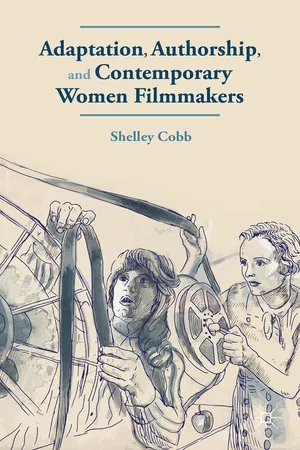
Adaptation, Authorship, and Contemporary Women Filmmakers
About this book
A lively discussion of costume dramas to women's films, Shelley Cobb investigates the practice of adaptation in contemporary films made by women. The figure of the woman author comes to the fore as a key site for the representation of women's agency and the authority of the woman filmmaker.
Information
Subtopic
Film & Video1
Envisioning Judith Shakespeare: Collaboration and the Woman Author
Judith Shakespeare, Virginia Woolf tells us, ‘died young and … never wrote a word’ (A Room of One’s Own, 13). As the figure of the woman author who was not allowed to express her creativity, her vision, or herself because of the patriarchal world she lived in, Judith still haunts us to this day. We know, of course, that cultural restrictions on the ideals of femininity have always been (and continue to be) used to hold back women’s ambitions. In the 1920 version of Careers for Women, the screenwriter and film director Ida May Park declared, ‘Unless you are hardy and determined … the director’s role is not for you … When the time comes I believe that women will find no finer calling’ (Filene, 335). Though feminist film historians of early cinema are continually discovering women working in key roles behind the camera much like Ida May Park, there is no doubt that cinema history is full of Judiths. We only have to look so far as the Annual Celluloid Ceiling Report to see that the contemporary period is little better; we might have hoped for more by now. The two directors of the films in this chapter have spoken, recently, about the absence of women filmmakers in interviews with Melissa Silverstein of the Women and Hollywood blog. In response to questions about the status of women directors in contemporary cinema, Sally Potter says, ‘Things have changed since I started. Look, I used to always be the minority of one, maybe two, the token and that was tiresome and difficult’ (Silverstein, 2012), and Patricia Rozema confesses, ‘When I first saw Jane Campion’s The Piano I realized that my top-ten list had all been men’ (Silverstein, 2008a). Both Potter’s and Rozema’s comments suggest the same thing: that being a female director often means being the only one (or maybe two). This chapter suggests that in making film adaptations of novels of Virginia Woolf’s Orlando and Jane Austen’s Mansfield Park, respectively, Potter and Rozema sought collaboration with the two most well-known women authors of the literary canon in order to have a conversation about women authorizing themselves, instead of waiting for confirmation from the patriarchy.
As Sonia Haiduc shows, the figure of the woman writer on screen often inhabits a narrative of ‘the successful life’, presenting the act of writing for the woman author in the films as ‘a self-authorizing strategy in male-dominated culture’ (Haiduc, 2013: 51). Both films in this chapter create female authors where there were none in the source text. Consequently, the superimposition of the female writer onto the narrative is a strategy for signalling the successful life of the characters on screen, and, more importantly in my view, it is also a self-authorizing strategy for the woman filmmaker. The two are intertwined in their textual and extra-textual constructions. Through analysis of the texts, the reception of the adaptations, and interviews with each director, I will show that the female author on screen, represents both the woman writer of the novel and the woman filmmaker of the adaptation, while simultaneously representing the differences between them. As I have shown elsewhere, male filmmakers who make adaptations can rely on the rhetoric of production and paternity over reproduction and filialness to establish their authority over the text and to reinforce their authorial originality (Cobb, 2012). In contrast, women do not have access to the language of paternity or an easy relationship with the language of production; for this, valid, reason feminist film critics have historically been wary of individualized authorship and auteursist approaches to cinema. Orlando and Mansfield Park complicate both the representation of authorship and the act of authorship in a way that sidesteps the masculinized discourses of authority. Both Potter and Rozema present their film adaptations as collaborations that move between identification and disidentification with the woman novelist, constructing authorship and authority as a relational process. Thus, this chapter can be seen as establishing the premise of this book – namely, that women filmmakers’ adaptations that include the figure of the woman author make a unique space for analysing women’s film authorship.
As I noted in the introduction, the early 1990s was a period in which the current postfeminist media landscape was developing from the backlash discourse of the 1980s. Susan Faludi’s book Backlash: The Undeclared War Against Women was published in 1991 and she appeared on the cover of Time magazine with Gloria Steinam for the story, ‘Fighting the Backlash against Feminism: Susan Faludi and Gloria Steinam Sound the Call to Arms’. This was also a period of high-profile chick flicks. In 1990, Ghost was the second-highest grossing film of the year and Pretty Woman the fourth. In 1991, Father of the Bride was ninth-highest grossing film and Fried Green Tomatoes the eleventh. In 1992, The Bodyguard was the seventh-highest grossing film and A League of Their Own the tenth. It was, as I note in the Introduction, also a time when some women filmmakers moved from the avant-garde to more mainstream film styles and some gained international recognition. The year that Jane Campion’s The Piano was nominated for Best Picture and Best Director Oscars, Orlando was also nominated for Best Costume and Best Art Direction. As Christina Lane points out, several media outlets declared 1993 the ‘Year of the Woman’ on the independent film scene. She also points out that the same had been said of 1989 and 1991, making the case that women filmmakers always seem exceptional in part because there are so few, but also because the few never turn into the many (2005). The comments by Potter and Rozema above are suggestive of the dichotomous experience of women filmmakers during that period, when the numbers were low, per usual, but a new level of exposure in the media and in a culture-making institution like the Academy Awards suggested change. When Campion was nominated, it had been 15 years since Lena Wertmuller was the first woman to be nominated in the Best Director category in 1976. Her film was nominated for Best Foreign Film, so Campion’s dual nomination of Best Director and Best Film was another kind of first, and the attention Campion’s film received was extraordinary. Ten years after Campion’s nomination, Sofia Coppola became the first American woman to be nominated for Best Director and her film Lost in Translation for Best Picture. Again, media outlets heralded change for women in film production.1 Six years later, in 2009, Kathryn Bigelow won Best Director and Best Picture for The Hurt Locker, and the media imagined that this could only mean change.2 To date, however, the Academy has not nominated another woman for Best Director, nor has a woman director won the Palme d’Or at Cannes since Campion shared it with Chen Kaige in 1993. Together, Potter’s and Rozema’s comments encapsulate the ‘status of women directors’ in the contemporary period: they are both inconspicuous by virtue of their low numbers and made conspicuous through any one woman’s success.
The period after Campion’s nominations and before Coppola’s is the context in which, according to Belén Vidal, several women made ‘literary films [that] invite the question of how authorship can be reimagined in relationship to literary culture, feminism and the popular in order to enable the repetition and variation of performance – and hence, the appropriation and “authoring” of the texts of the past’ (Vidal, 2005: 270). As I have argued elsewhere, through the example of Campion’s The Portrait of Lady, the ability of the filmmaker to translate that appropriation and authoring of the literary text into an act of self-authorizing is not always corroborated by the reception of the film, and the woman filmmaker is chastened by what is a distinctly gendered language of fidelity (Cobb, 2012). In the case of Campion and The Portrait of a Lady, the combination of fidelity criticism and women’s difficulties in appropriating masculine auteurist discourses made it seem ‘a perverse choice to adapt [Henry James’s] novel’ because she was accused of being both unfaithful to the novel and unfaithful to herself (McHugh, 2007: 108). Some similar criticisms were levelled at Potter and Rozema for their adaptations; this chapter explores how each filmmaker uses the identity of Woolf and Austen as women authors in a feminist tradition to create the figure of the woman author in the texts who embodies the directors’ authorial signatures on the adaptations. This collaboration with the women novelists not only creates a conversation about the history of women’s authorship but also authorizes the women directors as individual auteurs by inserting them into that history.
Sally Potter’s Orlando
The final sequence of Sally Potter’s Orlando (1993) begins with the intertitle BIRTH. It is the last of a series of intertitles that mark chronological and character development throughout the film – 1600 DEATH, 1610 LOVE, 1650 POETRY, 1700 POLITICS, 1750 SOCIETY, 1850 SEX. BIRTH begins with Orlando at a meeting with an agent who sets a large, disordered manuscript on his desk and says, ‘I think it’ll sell. Provided you rewrite it of course. You know, increase the love interest; give it a happy ending.’ He asks her how long it took her to write, and she does not respond to him but only turns her eyes to the camera, which fixates on her in close-up. The small turn of her eyes affirms a knowingness between character and audience that is a regular feature throughout the film as Orlando makes intermittent direct addresses (both verbal and non-verbal) to the camera. Orlando leaves the meeting on an early 1900s style motorcycle with a child in the sidecar and drives through early 1990s London.3
They arrive at the English estate where Orlando began his life and narrative. She lifts her child out of the sidecar and removes the helmet, revealing the long hair and face, of the girl child. The voiceover says, ‘She, for there can be no doubt about her sex …’ (a gender reversal of the voiceover at the beginning of the film which declares in reference to Orlando, ‘He, for there can be no doubt about his sex’) momentarily seems to refer to the child until it continues, ‘… is visiting the house she finally lost for the first time in over a hundred years.’ The house is now a part of the English heritage circuit, and inside, they join tourists looking at a portrait of an Elizabethan-era Orlando. The film then abruptly cuts to a black screen with static and then cuts again to a hand-held camera moving quickly and erratically through a dry grass field. In a long shot of the field we see Orlando’s girl child. She runs about with a video recorder, filming the countryside, and it becomes clear that the hand-held camera work had been the girl’s point of view. The long shot had been the point of view of Orlando at the tree; a close-up reveals a tear streaming down her face, and then the film returns to the girl’s point of view through the video camera. She shoots Orlando’s face in extreme close-up, her mother’s eyes, nose, and mouth filling the screen. The child asks, ‘Why are you sad?’ to which Orlando responds, ‘I’m not. I’m happy. Look. Look up there.’ And then the girl’s video camera points to the sky where an angel (played by Jimmy Somerville) sings about being free of the past and destiny and gender and mortality.4 The film cuts from the camcorder point of view to a close-up of Orlando, looking directly at the audience, nearly expressionless and yet serene.
Orlando has been analysed and interpreted many times, but by focusing on the figure of the author, I read the film, through its ending, as a cinematic vision of matrilineal legacy that not only connects women authors across time and history but also across media and disciplines by considering it through Virginia Woolf’s claim that, ‘For we think back through our mothers if we are women’ (Woolf, 1929: 76), and Potter’s own explanation of the ending:
I could be a mother, but I’m not. But many women are and will be, and there will be another generation of daughters, and so the issue is much more about the future and continuity and literally inheritance … At the end there is another kind of inheritance that becomes possible. I’m certainly well aware of how I’m standing on my mother’s shoulders and grandmother’s shoulders – what I was able to do that they weren’t able to do, what they gave to me, and what was taken from them. (Florence, 1993: 282)
Both Woolf and Potter use the mother-daughter metaphor, which has been a matter of much debate in feminist theory, to evoke a specifically matrilineal narrative of history and identity. Both use the metaphor in the context of thinking about women’s authorship and its possibilities as well as the limits history has placed on women. Woolf’s words and her own work in ‘making known the writing of women whose existence had previously been obscured, covered over by the weight of the masculine canon’, inspired in feminist literary theory and criticism an ‘industry on a large scale’ invested in continuing the work of making women authors known (Bowlby, 1997: 22–23). Seminal works in this area were produced during the growth in feminist theory’s incursion into academia in the late 1970s and through the 1980s and include Elaine Showalter’s A Literature of Their Own and Sandra Gilbert’s and Susan Gubar’s The Madwoman in the Attic. Feminist film theory and criticism also has worked to make women filmmakers known, and seminal works in this area are Claire Johnston’s ‘Dorothy Arzner: Critical Strategies’ and Annette Kuhn’s Women’s Pictures: Feminism and Cinema, amongst others.5 The stark difference between these works on women writers and women filmmakers is that the literary critics have written a narrative of tradition for their authors creating for them a clear, historical development; while, in contrast, film criticism has not written a parallel tradition for women filmmakers.6 There are multiple reasons for this, but for the period in which these books were written the most obvious and important and practical one is the historical lack of women directors during the classical Hollywood period (that period being the main focus of early film studies) and the marginalization of the few who did exist in auteur histories of Hollywood.7 In addition, many women filmmakers were lost, and some will be forever missing, from the historiography of cinema because of both sexist attitudes and the difficulties (and mismanagement by some studios) of archiving early film, a state of affairs that has only recently begun to change.8
Rachel Bowlby offers a reading of Woolf’s ideas on female traditions that I think is suggestive for thinking about how the adaptations, in this book, that foreground the figure of the woman author represent the possibilities and difficulties of women’s authorship in contemporary cinema:
Another turn to the process of thinking back through our mothers is suggested by Woolf’s fable of Shakespeare’s hypothetical sister Judith … The fictional reconstruction highlights the fact that it is impossible to know whether such a sister did or did not exist, since what it relates is nothing else than how she would have been prevented from doing anything worthy of historical ‘note’ … Women also think back, perhaps, through the very fact of having ‘no tradition behind them’: think back through the absence of mothers. (1997: 24, emphasis in the original)
Women filmmakers, to use Woolf’s words metaphorically, ‘have been prevented from doing anything worthy of historical “note”’, whether that was the prevention of ‘doing’ something (e.g. the severe lack of directors in the classical Hollywood period) or the disappearance of anything done because it was not considered worthy (e.g. the suppression of the many women directors, writers, and producers of the silent period or the way film history marginalizes ‘women’s jobs’ in filmmaking – hair/makeup/costume/casting). At the time of Orlando’s production in the early 1990s, the need to make fictional filmmaking foremothers might have been particularly strong because of the modest knowledge about women in the early period of film history and the extremely few women directing in classical Hollywood (and the lack of recognition for screenwriters at the time).9 By focusing on the end of Orlando, I want to suggest that Potter uses the adaptation process to fill the absences in her own tradition by making a connection to a prominent woman author of another tradition and to offer herself as a mother to future metaphorical filmmaking daughters.
However, like biological mother-daughter relationships, metaphorical matrilineal traditions can harbour tension. Foremothers, even those actively sought out by their daughters, may be examples of inspiration, but they can also be tough competitors and foster unattainable ideals, exemplified by Woolf’s Angel in the House: ‘when I came to write … she made as if to guide my pen … I did my best to kill her … had I not … she would have killed me’ (Woolf, 1979: 58–60). In regards to these contradictory images of relations amongst women Hermione Lee asks:
Should we think through our mothers, or kill them? Must we kill the ghosts for whom we feel … such a fatal attraction, who are always creeping back to life when we thought they were dead? And does ‘thinking through’ mean well or ill: Do we learn from our mothers, or react against and reject them? (1997: 79)
For Woolf, the Angel in the House created a kill or be killed situation. She describes the metaphorical Angel as ghost-like, haunting her with admonitions of how she should and should not write and cautioning other women to ‘never let anybody guess that you have a mind of your own’ (Woolf, 1979: 59). It is as if the Angel attempts to suck the air out of Woolf’s hard-won ‘room of her own’. She feels she has no choice but to enact violence in order to keep ‘a mind of her own’ – necessary to ‘review even a novel’, necessary to write, necessary for an author (1979: 59). Potter has also evoked a metaphor of violence in her process of authoring the adaptation of Woolf’s novel: ‘I learnt that you have to be cruel to the novel to be kind to the film’ (Donohue, 1993: 218). She does not describe Virginia Woolf, in particular, as the Angel in the House, haunting her, constricting her mind, tampering with her authority over the adaptation. And yet, the terms of her statement suggest that in the process of filmmaking she was haunted by the expectations of a ‘faithful’ adaptation. She says that, after reading the novel several times, researching its origins, and ...
Table of contents
- Cover
- Title
- Copyright
- Contents
- Acknowledgements
- Introduction: Agency, Adaptation, and Authorship
- 1 Envisioning Judith Shakespeare: Collaboration and the Woman Author
- 2 Adapt or Die: The Dangers of Women’s Authorship
- 3 Authorizing the Mother: Sisterhoods in America
- 4 Postfeminist Austen: By Women, for Women, about Women
- Conclusion: The Secret Life of Bees and Authorial Subversion
- Notes
- Bibliography
- Index
Trusted by 375,005 students
Access to over 1.5 million titles for a fair monthly price.
Study more efficiently using our study tools.
Frequently asked questions
Yes, you can cancel anytime from the Subscription tab in your account settings on the Perlego website. Your subscription will stay active until the end of your current billing period. Learn how to cancel your subscription
No, books cannot be downloaded as external files, such as PDFs, for use outside of Perlego. However, you can download books within the Perlego app for offline reading on mobile or tablet. Learn how to download books offline
Perlego offers two plans: Essential and Complete
- Essential is ideal for learners and professionals who enjoy exploring a wide range of subjects. Access the Essential Library with 800,000+ trusted titles and best-sellers across business, personal growth, and the humanities. Includes unlimited reading time and Standard Read Aloud voice.
- Complete: Perfect for advanced learners and researchers needing full, unrestricted access. Unlock 1.5M+ books across hundreds of subjects, including academic and specialized titles. The Complete Plan also includes advanced features like Premium Read Aloud and Research Assistant.
We are an online textbook subscription service, where you can get access to an entire online library for less than the price of a single book per month. With over 1.5 million books across 990+ topics, we’ve got you covered! Learn about our mission
Look out for the read-aloud symbol on your next book to see if you can listen to it. The read-aloud tool reads text aloud for you, highlighting the text as it is being read. You can pause it, speed it up and slow it down. Learn more about Read Aloud
Yes! You can use the Perlego app on both iOS and Android devices to read anytime, anywhere — even offline. Perfect for commutes or when you’re on the go.
Please note we cannot support devices running on iOS 13 and Android 7 or earlier. Learn more about using the app
Please note we cannot support devices running on iOS 13 and Android 7 or earlier. Learn more about using the app
Yes, you can access Adaptation, Authorship, and Contemporary Women Filmmakers by S. Cobb in PDF and/or ePUB format, as well as other popular books in Media & Performing Arts & Film & Video. We have over 1.5 million books available in our catalogue for you to explore.