- English
- ePUB (mobile friendly)
- Available on iOS & Android
eBook - ePub
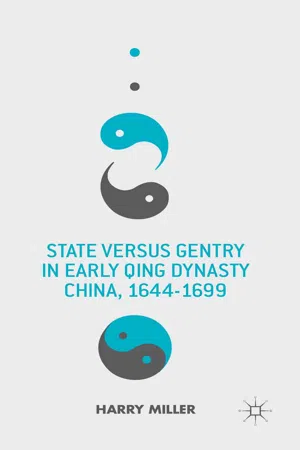
State versus Gentry in Early Qing Dynasty China, 1644-1699
About this book
Continuing the argument developed in the author's previous book, this exhaustively researched study describes the humiliation of the Chinese gentry at the hands of the statist Oboi regents in the 1660s and the Kangxi emperor's self-declared Confucian sagehood in the 1670s, which effectively trumped the gentry's claim to sovereignty.
Information
Chapter 1
The Dorgon Regency, 1644–1650
Dorgon entered Beijing through the Chaoyang Gate on June 6, 1644, with the old and the young offering incense and prostrating themselves as he approached. Eunuchs soon emerged from the imperial palace, surrendering the dead Chongzhen’s formal insignia and placing at Dorgon’s disposal the royal palanquin. Dorgon refused to ride in it, saying, “I follow the Duke of Zhou. It is inappropriate for me, merely the assistant of our Young Sovereign, to travel by palanquin.” Spokesmen for the multitude, however, replied, “The Duke of Zhou, while ‘merely assisting’ with affairs of state, sat with his back to the king’s silken screen. It is quite appropriate for you to ride.” Dorgon said, resignedly, “Having come to pacify the Empire, I can only accede to the people’s will,” and making obeisance also to Heaven, amid much ceremony, he rode in the palanquin to the Wuying Palace and ascended the throne.1
The Duke of Zhou, a storied personage of the early Western Zhou period (1046–770 BCE), was a tricky antecedent. Having ruled on behalf of his young nephew, the Duke of Zhou was the prototypical regent. The phrase she zheng, often associated with the Duke and used by the welcoming committee in the aforementioned exchange, formed part of Dorgon’s official title and is commonly rendered into English as “regent.” Beyond this simple occupational linkage, however, lay a more ambiguous philosophical one, for the Duke of Zhou was China’s original wielder of borrowed authority. Though of royal blood, he was not the true king and ruled with ritual and morality—helping to author, along the way, the concept of the Mandate of Heaven—and he was a great favorite of Confucius and his followers. The philosopher Zhu Xi (1130–1200), outlining the important Neo-Confucian doctrine known as the Succession to the Way (dao tong), traced knowledge of the kingly Way from the legendary sage kings to the Duke of Zhou, to Confucius, to Mencius, and ultimately to himself. The Duke was therefore an important conduit by which the sages’ moral authority came to be transferred from kings to scholars. Dorgon identifying himself so blithely as a devotee of the Duke (and his evident belief that doing so constituted a modest gesture) was a bit ironic, considering the complex notions of power embedded in the Duke’s story. Were there any Neo-Confucian scholars among Dorgon’s greeters, they were perhaps being a bit ironic in reminding the regent that he had the formal power of the throne behind him, as they held strongly to the conviction that moral power trumped it. Though they admitted that Dorgon possessed the one, they may have doubted his claim to the other.2
Quelling Faction or Suppressing the Gentlemen?
Feeding the Neo-Confucians’ skepticism, one of the first things Dorgon did in Beijing was to recruit a retired Ming official named Feng Quan (1595–1672). Feng was a controversial figure, having been an associate of the court eunuch Wei Zhongxian and an enemy of the upright Donglin faction in the disharmonious 1620s. Inheritors of the righteous Donglin tradition regarded Feng as a morally compromised man. Dorgon’s motive for elevating Feng is obscure. Ostensibly, Dorgon wanted Feng’s advice on court ceremonial and other matters. More strategically, Dorgon might have approached Feng for the broader purpose of signaling indifference to Feng’s Ming-era factional affiliation in order to remove such a thorny criterion from the process of personnel selection in general—to demonstrate neutrality, in other words—and thus to bring the sorry history of Ming factional strife to an end. Certainly, a neutralized bureaucracy would have been an object for Dorgon, who needed no persuasion, as he surveyed the wreckage in the capital, that faction could be fatal. At the same time, though, it is worthwhile to consider that the factions Dorgon sought to balance were not qualitatively alike. On the one side were the heirs of the Donglin coterie and the Restoration Society, who had endeavored to rule Ming China with their own righteousness and who were rather cool to the concerns of the state. On the other were the self-identified “true-hearted and for the state,” who were correspondingly skeptical of the pretensions of their righteous competitors, whom they often labeled “gentry.” While Dorgon may have reactivated Feng Quan to appear impartial, he may also have strongly preferred the statist faction, believing it more responsive and less recalcitrant than the righteous echelon. The latter, as Frederic Wakeman Jr. suggested, viewed Feng Quan’s rise with much alarm, for he was poised to exert great control over the process of bureaucratic selection and was unlikely to further their interests.3
It was immediately obvious that Dorgon had found his man. After a court audience on July 1, 1644, he remarked to Feng Quan and the other assembled officials, “Were I to perceive any fault on your part, I would certainly rebuke you; but ever since I became Regent, not one of you has ever remonstrated with me. Has my policy really never diverged from the Way, not even once?” Feng and company responded: “Everything Your Excellency does is benevolent and unimpeachable. And if ever Your Excellency proposed something that seemed at first to be inappropriate, we would still keep our silence.” Dorgon replied: “You are all talking nonsense. Not even the most sagely sovereign could be perfectly benevolent in every aspect of his governance. He would know to accept remonstrance. And as for me, there is no way everything I do is as beyond reproach as you say. You, skilled in government, who exerted yourself mightily on behalf of the Late Emperor, if in the future some aspect of our policy seems amiss, then you must lay out your objections. I am indeed counting on you all, in this respect.”4
Affecting not to appreciate his officials’ extending him the benefit of the doubt, Dorgon was probably pleased that at least he would not be subject to the condescending lecturing of Liu Zongzhou or Ni Yuanlu (1593–1644), much less the outright derision of Gu Xiancheng, which had plagued late Ming rulers. Dorgon’s subsequent reference to the “Late Emperor,” though primarily denoting the recently deceased Manchu leader Hong Taiji (1592–1643), might also have been an oblique invocation of Chongzhen and the Ming legacy of failed ministerial devotion, stingingly rehashed as an object lesson. Above all, Dorgon’s demand for remonstrance effectively anticipated it. Remonstration was now an obligation, a bureaucratic function. It was no longer to be considered a gentlemanly prerogative. Dorgon’s claim in an edict a few days later that “our country does not rely on military force; it is wholly concerned, rather, with moral power,” was a similar reclaiming of a kind of authority recently asserted by Neo-Confucian gentlemen. Perhaps Dorgon, in aspiring to moral power, understood the story of the Duke of Zhou more than might have been expected. Those from whom he claimed the power, however, never forgave him for elevating Feng Quan. When an official suggested at this time that candidates for office be more thoroughly screened—to weed out the corrupt as well as, implicitly, the unrighteous ones such as Feng Quan—Dorgon rejected the implied criticism of his policy (the kind of criticism he had just solicited), citing the need to recruit talent liberally. Dorgon liked the composition—and the amenability—of the “corrupt” bureaucracy just fine. Besides, Dorgon claimed the right to punish any official corruption himself, preempting once again any gentlemanly inclination to do so.5
Although Dorgon voiced no explicit suspicion of “gentlemen” or “gentry,” as he endeavored to manage the various officials in Beijing, he did use these terms disparagingly in his letter to the Southern Ming minister Shi Kefa, sent on August 28, 1644 (and previewed in the introduction of this book). “It’s amazing,” Dorgon chided, “how you gentlemen (junzi) of the south are whiling away the time, refusing to heed the import of this historical moment. In pursuit of meaningless fame, you seem ignorant of the true harm you are doing.” Again: “You gentlemen (junzi) supposedly are sensitive to changing situations and to the shifting of the Mandate. If you really cherished the memory of your late sovereign, if you really revered the Sages, then you would urge your prince to give up his imperial title, resume his proper status as fief holder, and so enjoy endless happiness.” Dorgon’s use of the term “gentlemen” (junzi), which for Confucius and Mencius had signified the moral prime movers of the world, was notably irreverent, placing him far outside the circle of Confucian fundamentalism that had recently inspired the Donglin and Restoration Society movements of the late Ming, whose adherents had veritably rhapsodized about the gentlemen’s power. It was, furthermore, common for the opponents of these groups to dismiss their righteousness, as Dorgon did, as part of a simple quest for fame. Continuing with a different word for the elite, Dorgon leveled another customary charge, that they were useless to the state: “The gentry (shi da fu) of recent vintage, enamored as they are of lofty eminence and celebrated righteousness, are oblivious to national emergencies. At every crisis, they can only deliberate endlessly.” By the end of his missive, treating his interlocutors almost entirely as caricatures, he traced their historical antecedents even further back in time to the Song dynasty (960–1279), the age that had given rise to Neo-Confucianism and that was in fact nearly synonymous with it. Plainly, Dorgon had left the simple issue of Ming versus Qing far behind and was speaking, in obvious, portentous phrases, of state versus gentry. His equation of gentlemen with southerners, furthermore, would set the tone of Qing administration for years.6
As much as Dorgon plainly enjoyed mocking the pretentions of southern gentlemen by addressing them as junzi, Qing authorities soon began referring to them as chen or chen zi, as though deciding on second thought to cut them down to size with literal precision rather than sarcasm. Chen means “minister” or “subject,” the inferior counterpart to jun, which properly means “sovereign” or “lord.” Confucius’s and Mencius’s use of the term junzi, which literally means “son of the sovereign,” to connote nonroyal moral leaders, or “gentlemen,” laid the enduring groundwork for the Chinese scholar-gentry’s claim to power. Resisting this lexicological coup, partisans of the state would often insist that jun could signify only the actual ruler and that the cultural elites were mere chen, emphatically subordinate to the former. Adopting this standard tactic, the young Shunzhi emperor (r. 1644–1661) proclaimed, on November 11, 1644, “For every generation of rulers (jun) responding to the exigencies of their times, there is a generation of subjects (chen) responding to their rulers.” In conformity with this nomenclature, subsequent warnings directed at the Southern Ming were addressed to the “various subjects (chen) of the south” and the “various civil and military subjects (chen, here meaning “minister” or “official” as well) of the south.” Armies were then heading southward to enforce the doctrine of submission implied by these words.7
Shifting connotations of this kind were taking place outside official pronouncements and interdynastic propaganda. The Zhi zhong tang ji is a miscellaneous set of short philosophical lessons from the transition era. Its anonymous author named it for the classical text known as the Zhong yong, or The Doctrine of the Mean, and many of its passages seem at least mildly condemning of the immoderate Confucian fundamentalism of the late Ming. The writer frequently used the words jun and chen, making very clear the proper subordination of the latter to the former. In one section, he equated the relationship between lord and subject to that between father and son. By employing the compounds “lord-father” (jun fu) and “subject- (or minister-) son” (chen zi), he left no room even for the word “gentleman” (junzi), which, in this context, would signify a monstrosity—literally, a “lord-son.” The passage in question reads as follows:
When the righteousness of the subject-son remains under the control of the lord-father, then order is the result. But when the honor of the lord-father becomes subject to the constraints of the subject-son, then chaos is the result. As it is said in the Book of Changes, “What is rooted in Heaven draws close to what is above; what is rooted in Earth draws close to what is below.” But drawing close to what is above is invariably difficult; drawing close to what is below is invariably easy. Distinguishing between the heavenly and the earthy is the essence of wisdom, and maintaining the distinctions is the essence of constancy. Eschewing the easy and embracing the difficult—only the real heroes are capable of it.8
These lines could be read as a postmortem on the Ming, when some of the subject ministers refused to harmonize with the emperors above and instead formed cliques with others of their kind below. By adopting the lord-minister or sovereign-subject paradigm then preferred in Beijing, the unknown compiler of the Zhi zhong tang ji showed a disciplined willingness to “embrace the difficult,” to take the path of philosophical and hence political submission, and to avoid the easy temptation of gentlemanly faction.
Others, however, even though they conformed to the ruler-minister scheme superficially, were slow to internalize its true meaning. On November 12, 1644, a supervising secretary in the Ministry of Revenue named Hao Jie (d. 1659) memorialized, “Since ancient times, rulers (jun) in possession of the Way bring lasting peace and enduring order. Rarely are they able to do so, however, without cultivating the true worthies and keeping a safe distance from the artful talkers. When considering civil officials, one must employ ministers (chen) of immutable virtue.” Although he used the word chen, Mr. Hao assigned them the leading roles in the civilizing process and limited the rulers’ responsibility to choosing the virtuous and banishing the crafty. With its stress on personnel selection, Hao’s memorial offered more factional strife and was probably another veiled attack on Feng Quan, supposedly an artful talker and not a true worthy.9
On December 17, Gong Dingzi (1615–1673), an official in the Ministry of Personnel, asserted the following in a memorial:
After a new country is established, it is advisable to be liberal and magnanimous. The ancients said, “Just as courtesy is inappropriate when dealing with commoners, so too are punishments inappropriate when dealing with the elite (da fu).” Publicizing the achievements of exceptional ministers (chen) is the best way to bring honor to the court. When the desire for fame prevails among the top ministers, they will be thoroughly bound by it, and even inferior officials will be enslaved by it. By comparison, the coercive power of criminal punishment is negligible, life itself being rated much more cheaply than fame; in fact, people will gladly exchange the former for the latter . . . I beg that Your Majesty enlist the talents of heroic men, as the best means to lay the foundation of our great project. Establishing sincerity and openness is the way to calm the fears of the gentry (shi da fu). It will secure for the Court the devoted loyalty of its various subjects (chen).
The loyalty Gong described was clearly conditional, and his request that “heroic men” be treated indulgently earned a crisp rescript. Dorgon admitted no special need to “calm the fears of the gentry,” which would have been deferring too much to their sensibilities.10
The State’s Tentative Accommodation with the Gentry in the Provinces
While the Qing state endeavored to subdue the gentry with words in the capital, Qing authorities in the countryside also encountered the gentry as part of their pacification effort. In some cases, especially in places where Li Zicheng had recently been active, it was easy to view the gentry as victims. In one town, Li’s men “murdered the innocent and took hostages from among the wealthy houses . . . The gentry (shen shi), military, and civilians cry out repeatedly for relief.” However, in Hebei Province, not yet surrendered to the Qing, the gentry were portrayed less sympathetically: “false officials (wei guan, presumably invested by Li Zicheng) still exert their pernicious influence, and gentry (shi shen) persist in their evil.” As the process of conquest wore on, it became conventional to refer to Qing-collaborationist gentry as “righteous gentry” (yi shen) and to recalcitrant, Ming-loyalist gentry as “ex-gentry” or “defrocked gentry” (fei shen). With these terms, the state was reasserting its role as the conferrer of gentry status.11
In other sections of China’s convulsed countryside, the gentry had taken more assertive roles to provide for their own security, presenting Qing administrators with dicey management problems. Sometimes the gentry’s local improvisations were seamlessly incorporated into Qing rule. On September 7, 1644, a military official named Wang Jing memorialized from Zhending Prefecture, near Beijing, describing how the inhabitants of that place had to fend for themselves in the interval between the departure of Li Zicheng and the arrival of the Qing army. Li’s plundering had been especially harsh, leaving the local elite—a retired official (xiang guan), a censor, and Wang Jing himself—no choice but to draft a militia and support it with personal contributions. The latter came from a retired official, a holder of the penultimate civil service degree (ju ren), registered students (sheng yuan), and a couple of merchant commoners (shang min). The money, the equivalent of some seven thousand taels of silver (a tael is a Chinese ounce), was managed by the censor who commanded the militia. Perhaps because he had been involved in their effort, Wang sympathetically effused: “The town and its people were kept safe and secure only by the contributions to the militia made by the gentry and commoners (shen min). Their merit should not be overlooked.” In addition to requesting that responsibility for the militia’s accounts be assumed by the government, Wang also asked Dorgon to bestow some form of official encouragement upon the contributors. Both of Wang’s wishes seem to have been granted. While the Ministry of Revenue (hu bu) was notified about the account book, Dorgon (or someone) called the militia sponsors’ actions “commendable,” though it is unclear how they were actually rewarded.12
Shandong Province posed a greater challenge, for it had been embroiled in brigandage for several years. Desperate for order, local gentry there had revolted against Li Zicheng’s rapacious minions in the summer of 1644, flirted with Southern Ming allegiance, and finally surrendered to the Qing. Governor Fang Dayou (d. 1660), in a September 24, 1644, memorial, was concerned with Shandong’s legacy of lawlessness. He...
Table of contents
- Title Page
- Copyright Page
- Dedication
- Contents
- Acknowledgments
- Introduction
- Chapter 1
- Chapter 2
- Chapter 3
- Chapter 4
- Epilogue
- Notes
- Bibliography
Trusted by 375,005 students
Access to over 1.5 million titles for a fair monthly price.
Study more efficiently using our study tools.
Frequently asked questions
Yes, you can cancel anytime from the Subscription tab in your account settings on the Perlego website. Your subscription will stay active until the end of your current billing period. Learn how to cancel your subscription
No, books cannot be downloaded as external files, such as PDFs, for use outside of Perlego. However, you can download books within the Perlego app for offline reading on mobile or tablet. Learn how to download books offline
Perlego offers two plans: Essential and Complete
- Essential is ideal for learners and professionals who enjoy exploring a wide range of subjects. Access the Essential Library with 800,000+ trusted titles and best-sellers across business, personal growth, and the humanities. Includes unlimited reading time and Standard Read Aloud voice.
- Complete: Perfect for advanced learners and researchers needing full, unrestricted access. Unlock 1.5M+ books across hundreds of subjects, including academic and specialized titles. The Complete Plan also includes advanced features like Premium Read Aloud and Research Assistant.
We are an online textbook subscription service, where you can get access to an entire online library for less than the price of a single book per month. With over 1.5 million books across 990+ topics, we’ve got you covered! Learn about our mission
Look out for the read-aloud symbol on your next book to see if you can listen to it. The read-aloud tool reads text aloud for you, highlighting the text as it is being read. You can pause it, speed it up and slow it down. Learn more about Read Aloud
Yes! You can use the Perlego app on both iOS and Android devices to read anytime, anywhere — even offline. Perfect for commutes or when you’re on the go.
Please note we cannot support devices running on iOS 13 and Android 7 or earlier. Learn more about using the app
Please note we cannot support devices running on iOS 13 and Android 7 or earlier. Learn more about using the app
Yes, you can access State versus Gentry in Early Qing Dynasty China, 1644-1699 by H. Miller in PDF and/or ePUB format, as well as other popular books in History & Asian History. We have over 1.5 million books available in our catalogue for you to explore.