eBook - ePub
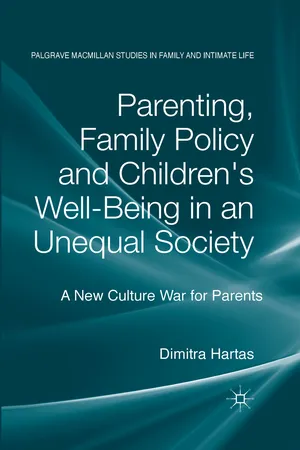
Parenting, Family Policy and Children's Well-Being in an Unequal Society
A New Culture War for Parents
- English
- ePUB (mobile friendly)
- Available on iOS & Android
eBook - ePub
Parenting, Family Policy and Children's Well-Being in an Unequal Society
A New Culture War for Parents
About this book
Western societies face many challenges. The growing inequality and the diminishing role of the welfare state and the rapid accumulation of the resources of a finite planet at the top 1% have made the world an inhospitable place to many families. Parents are left alone to deal with the big societal problems and reverse their impact on their children's educational achievement and life chances. The 'average' working family is sliding down the social ladder with a significant impact on children's learning and wellbeing. We now know that parental involvement with children's learning (although important in its own right) is not the primary mechanism through which poverty translates to underachievement and reduced social mobility. Far more relevant to children's learning and emotional wellbeing is their parents' income and educational qualifications. The mantra of 'what parents do matters' is hypocritical considering the strong influence that poverty has on parents and children. We can no longer argue that we live in a classless society, especially as it becomes clear that most governmental reforms are class based and affect poor families disproportionately. In this book, Dimitra Hartas explores parenting and its influence on children's learning and wellbeing while examining the impact of social class amidst policy initiatives to eradicate child poverty in 21st Century Britain.
Information
Part I
The Early Home Environment in an Unequal Society: Do Parents Matter?
The role that parents play in their children’s development and learning has attracted heated debates, with emotive views expressed about parents as lacking in competence and willingness to support their children’s learning, to views that some parents may actually hamper their children’s development through poor parenting and low educational aspirations. Within family policy, parenting is conceived as the most important influence on young children’s academic achievement and well-being, more important than poverty, school environment and peers. The research discussed in this part contests this position and provides evidence on the powerful ways in which socio-economic factors or, simply, social class, impact on young children’s academic, linguistic and social development.
Parents have long heeded the call to get involved in their children’s learning. However, few questions have been asked about how effective their support is and whether disadvantaged parents stand a chance of narrowing the United Kingdom’s notorious achievement gap between their children and the offspring of wealthier families. In the United Kingdom, at the start of the 21st century, by using a representative sample from the Millennium Cohort Study (MCS), I examined whether parental support is the key to language, literacy and social development of three-, five- and seven-year-olds (or whether other factors are of greater importance). Specifically, I examined the influences of parental behaviour, aspirations and educational practices and parents’ social class on children’s learning and well-being. Drawing upon the MCS findings, the links between young children’s language, learning and well-being and (i) parental learning support, emotional responsiveness and behaviour and aspirations at home (see Chapter 1) and (ii) parents’ social class (see Chapter 2) were discussed.
The research in this part examined the social ecology of early home environments to shed light on the ‘how’, ‘under what socio-economic and family circumstances’ and for ‘whom’ parenting takes place and to delineate the factors that mediate its contribution to child outcomes. The ‘how’ refers to the parenting practices and behaviours such as home learning, parental warmth and sensitivity, discipline and aspirations that have been found to contribute to the effectiveness of parental involvement (Grolnick, 2003; Pomerantz et al., 2005). Parenting occurs within diverse socio-economic contexts and is influenced by material resources and the human and intellectual capabilities that parents bring into family interactions. The influence of parents’ social class on child development was examined amidst policy initiatives in Britain to lift children out of poverty. Children who face socio-economic disadvantage have been found to fare less well academically (Burchinal et al., 2002; Gutman et al., 2010; Rouse and Fantuzzo, 2009) and socially (Foster et al., 2005). For ‘whom’ parenting takes place refers to child characteristics, behaviour and attributes (e.g. attitudes towards school, cognitive and linguistic abilities) which are likely to influence parenting considering that parent–child interactions are symbiotic (Collins et al., 2000). Parental practices and behaviours, child characteristics and family income and parental education can function as risk or protective factors in explaining children’s cognitive, social and academic outcomes individually and cumulatively (Mistry et al., 2010). Examining the interplay of these factors is invaluable because parenting and child development are dynamic processes shaped by a myriad of influences.
An ecological approach to understanding family processes and the home learning environment means that influences, both proximal and distal to children’s life, are accounted for. To this end, the influences of the immediate family context and parents’ social class on child outcomes as well as the wider social, ideological and cultural circumstances that surround parents’ and children’s life were examined. Ecological perspectives regarding the trajectories of academic, linguistic and social development in children have identified a complex pattern of child-related characteristics such as cognitive and language skills (Ayoub et al., 2009); parenting practices, parent–child relationships (Campbell, 2002; Keenan and Wakschlag, 2000) and parental psychological well-being (NICHED Early Child Care Research Network, 1999); and family income and parental employment and education (Dearing et al., 2001). The knowledge of either parental or socio-economic influences alone is not sufficient to understand children’s experiences of growing up and the role that parents play in shaping them. To capture this dynamic interaction, factors such as children’s cognition, language and behaviour; the physical, emotional and social aspects of the child’s early years’ environment (e.g. parent–child interactions, home learning, parental affection and discipline); and socio-economic factors such as parental employment, maternal education and family income, were examined.
The MCS findings illuminated the impact of social class on child development and offered evidence regarding the number of parents from diverse socio-economic and ethnic groups and the frequency with which they engaged with their children’s learning during preschool and the first years in formal education. The findings revealed family income and mother’s education and reading habits to be the strongest indicators of five- and seven-year-olds’ language and literacy. There was no significant association between parental support for learning at home and young children’s language, literacy and social behaviour. Moreover, over three-quarters of parents, from all socio-economic and ethnic groups, routinely helped their children with their schoolwork. Yet, the achievement gap was not challenged. These findings paint a complex picture of parental behaviour and practices, social class and child development at the start of this century. While they pointed to a form of intensive parenting, which was practised irrespective of socio-economic status and ethnicity, the impact of home learning on children’s language, academic and social outcomes was found to be negligible. The achievement gap between poor and wealthier young children was not challenged but widened as children moved through the first three years of primary school, suggesting that home learning and parental behaviours are not significant pathways through which poverty affects children’s language, literacy and social development. Most crucially, parents’ social class was found to have a moderate to strong impact on children’s cognitive and language skills as well as academic and social outcomes. Among all socio-economic factors, mothers’ educational qualifications made the largest contribution to children’s outcomes. While contesting deficit assumptions about parenting and questioning the effectiveness of home learning as a mechanism to reduce the achievement gap, the MCS findings showed that social class still matters and influences parenting and children’s outcomes.
1
Home Learning Environment and Children’s Learning and Well-Being
Researchers in child development and other related disciplines have long been concerned with factors, both proximal and distal, that promote good developmental, social and educational outcomes in children. Building on the traditions of Vygotsky (1978) and Bruner (1983) with their focus on the social nature of children’s learning and well-being, I examined parent–child interactions (e.g. reading, homework support, emotional closeness), especially with young children, and the parental influences on children’s language, literacy and social behaviour at home. How parents interact with their children forms a complex social and cultural ecology and attempts to examine their interactions from a single-discipline perspective are often misguided. Considering the interdisciplinary nature of scholarship on child–parent interactions, the MCS analyses presented in this chapter have drawn on both qualitative and quantitative studies from diverse fields such as social policy, psychology, education and sociology.
Most qualitative studies on parents’ interactions with children and their influences on children’s life have focused on school-age children with fewer studies involving preschool children. There is however a growing body of quantitative research that has filled this gap and complemented important qualitative findings on the experiences of children and parents in diverse families. In quantitative studies, parent–child interactions are conceived along typologies of parenting (e.g. authoritative or authoritarian parenting) that consist of parenting dimensions such as sensitivity, emotional closeness, affection or parental learning support. Parental sensitivity, cognitive stimulation and warmth have been seen as crucial elements in the interactions between parents and young children. Specifically, parenting sensitivity refers to parents’ responsiveness to their children’s cues, emotions, interests and capabilities in ways that balance children’s needs for support with their needs for autonomy. Cognitive stimulation refers to parents’ efforts to enrich their children’s cognitive and language development by engaging children in activities that are thought to promote learning. Parents’ warmth refers to parents’ expressions of affection and respect towards their children to support their evolving sense of the self and feelings of belonging (Barnett et al., 2010; Lugo-Gil and Tamis-LeMonda, 2008).
In the literature on parental influences on children’s learning, the capabilities that parents bring into supporting their children’s learning and education are thought to exist in three forms: personal dispositions (e.g. attitudes towards learning, aspirations, willingness to provide learning support); access to education resources and services; and access to education-related institutions (Lee and Bowen, 2006). With regard to parental involvement in children’s education, a broad distinction has been made between parental involvement with learning at home and at school. Home learning involves interactions between parents and children that focus on learning activities such as reading, talking about school issues (e.g. course selection, exams), homework support or engagement in intellectual pursuits not directly related to school (e.g. visits to museums, reading books, going to the library). In general, studies have shown that parental involvement with children’s education and learning has positive effects, being associated with children’s early linguistic and cognitive development and emergent literacy (Dickinson and Tabors, 2001). However, there is a lack of consensus with regard to the effectiveness of parental learning support at home, and questions are often raised as to whether more parental support is always better for children. Literacy-rich family contexts, where preschool children have access to books and other print materials and parents engage with them in age-appropriate learning opportunities, contribute positively to child literacy and language and well-being (Pomerantz, Moorman and Litwack, 2007). However, as discussed later in this chapter, literacy-rich homes should not only be equated with the frequency of home learning but also with its quality. The quality of home learning is a fluid concept, shaped by many factors and thus it is not simply a question of the more learning support the better.
Moreover, although the notion that socialisation is a parent-to-child process has been challenged long ago (Bell, 1968), there is still little research on the reciprocity in parent–child interactions, especially in the early years. Children’s characteristics and dispositions exert a significant influence on parents in that they evoke different responses in parents, which feed back into their reciprocal relationships. And the responses children evoke are also affected by parents’ well-being. For example, research has shown that mothers who experience depression (usually as a side effect of the toxicity of poverty and disadvantage) have more difficulties in interacting with their children (e.g. being less responsive) and are more likely to find child-rearing a challenge (Kiernan and Huerta, 2008). These studies highlight the importance of not only examining parenting dimensions but also focusing on children’s characteristics and views and parental well-being to understand the symbiotic nature of parent–child interactions.
In these studies on parenting, different models of child–parent interactions tend to converge into three central dimensions: parental involvement with children’s education and learning (e.g. home learning); parent–child affective experiences and parents’ emotional responsiveness (e.g. sensitivity, warmth, parental well-being; Lugo-Gil and Tamis-LeMonda, 2008); and behaviour control and modelling (e.g. discipline, expectations regarding behaviour and learning, maternal reading habits and aspirations; Barber et al., 2005). These theoretical models guided a large-scale examination of parent–child interactions by focusing on specific aspects such as parental warmth, parental support with reading and homework, parental aspirations and parental well-being. Although the quality of the home environment in terms of reading to children, helping with homework, being attuned to their emotions and bonding with them and having high educational aspirations for them has been defined narrowly, the MCS analyses illuminated interesting relationships between aspects of parenting and child outcomes and their wider socio-economic context.
While parenting is heralded as a key influence regarding children’s learning and well-being, not many studies have examined parenting within its wider social and economic context, especially in light of the widening inequality gap in the United Kingdom and other Western countries. In family policy discourses (a detailed discussion about Frank Field’s and Graham Allen’s reports is in Chapter 5), a disproportionate emphasis has been placed on parental learning support, behaviour, attitudes and aspirations as key mechanisms for reducing the achievement gap between poor and economically better-off young children. However, although literacy-rich home environments have been found to associate with positive educational outcomes in children, there is ambiguity with regard to the effects of parental learning support on children’s literacy, language and social competence. Parenting is only a small part of the story of widening inequality and the achievement gap, prompting debates about the role of social class in children’s development and life chances.
This chapter presents research based on MCS analyses on the links between aspects of parenting (i.e. home learning support, parental well-being, parents’ emotional responsiveness, parental educational aspirations and reading habits) and language, literacy and social competence in three-, five- and seven-year-olds. Parent–children interactions have been examined within their social ecology, drawing upon the Bronfenbrenner’s Ecological Systems Model (1986a). This is to provide a theoretical lens to examine the influence of the home learning environment, parental behaviour and practices in particular, on young children’s social competence, language and academic outcomes. Parental learning support and sensitivity and children’s learning and well-being are dynamic processes whereby child characteristics, attitudes and behaviour; parental behaviour and practices; and the social and economic circumstances that surround them vary over time and influence both parenting and young children’s learning and social and emotional competence. Much scholarship in family and childhood studies has focused on either children or parents; however, we know little about parent–child interdependence within its social and cultural context to delineate the myriad of factors that shape children’s well-being and the role of parents and children in mediating these factors. In their interactions, parents and children are active agents who influence each other and whose symbiotic relationship changes over time. Factors that promote or hinder children’s learning and social and emotional well-being are examined within these different social systems (e.g. individual child factors, parent–child interactions, socio-economic context) by also considering the current political and cultural climate to understand family policy and the relationship between the state and individual parents and children.
Home learning and child outcomes
Educators and family policy makers consider parents to play a key role in children’s acquisition of literacy and numeracy skills and social competence. It is often assumed that the link between parental learning support and children’s school performance is direct and causal, with the view that the more frequent the parental learning support is, the better children will perform at school. However, what is the evidence that involving parents in home learning, especially in early years, is associated with better academic and social outcomes for their children? And if parents’ involvement matters in this way, what kinds of home learning activities are associated with positive academic outcomes for children? Does the effectiveness of parent involvement with home learning depend upon: who the parents are, who the children are, how the parents get involved and what the social and family circumstances that surround parenting are? Although research on the effects of schoolbased parents’ involvement is fairly consistent in suggesting an overall positive contribution to children’s achievement, research on parental involvement with home learning yields less consistent findings, especially with regard to the effects of home learning that is directly related to school (see Pomerantz et al., 2007 for a comprehensive review).
On both sides of the Atlantic, there is little evidence to support the links between home learning and children’s academic functioning (Halle et al., 1997; Hill and Craft, 2003) and less consistent conclusions are drawn regarding the effectiveness of home learning support as a tool to reduce underachievement (Hartas, 2011; Lee and Bowen, 2006; Dearing et al., 2006; Hill and Taylor, 2004; Pezdek et al., 2002; Shumow and Lomax, 2002). Further, there has been little research on the contribution of routine home learning to young children’s social and emotional competence (Pomerantz et al., 2006). Although parents’ involvement with activities that promote children’s overall intellectual development (not directly related to school) has been linked with school achievement (Dickinson and Tabors, 2001), assistance with homework does not always appear to have such benefits. In fact, several studies of families from diverse backgrounds have revealed that parental involvement with homework is associated with poor performance in school in that parental assistance with homework is often a reaction to children’s low academic performance (Cooper et al., 2000). The lack of definitive conclusions about the effectiveness of parental involvement with home learning raises concerns, especially among low-income families because, for them, home learning is the most frequent form of involvement (Ritblatt et al., 2002).
In examining the relationship between home learning support and children’s outcomes through the analyses of the MCS, an important question was whether children’s language, literacy and social competence at ages three, five and seven were differentiated along routine learning support at home. Home learning activities included enrichment activities and those that were directly related to school to distinguish home learning for the purpose of creating a culture of learning at home from home learning as a reaction to school demands, with the latter having implications about parents’ and teachers’ roles. Specifically, home learning referred to parental support with emergent literacy (i.e. learning the alphabet, songs/rhymes, book reading) at age three; and support with homework (i.e. help with reading and writing) and enrichment activities (i.e. book reading, playing music, storytelling) at ages five and seven. Parental learning support was expressed in terms of the frequency of involvement which was rated by using a Likert scale, ranging from ‘every day’ to ‘not at all’.
The MCS children’s outcomes included measures of language, literacy and social competence obtained at ages three, five and seven. Children’s language measures were based on standardised scores obtained from sub-tests (i.e. Vocabulary Naming from the British Ability Scales II – BAS II) at ages three and five and teachers’ assessment of Speaking and Listening at age seven. Children’s literacy scores were based on teachers’ measures collected via the Communication Language and Literacy (CLL) component of the Foundation Stage Profile (FSP) assessment of children’s progress over the first year of formal education in England (age five), and teachers’ assessment of reading and writing plus a standardised reading score (i.e. Word reading from the BAS II) at age seven. The CLL contains Language for Communication and Thinking; Linking Sounds and Letters; Reading; and Writing. The FSP is thought to provide a more developmentally appropriate picture of social and academic progress within the school context for children of all abilities and children with English as an additional language (Qualifications and Curriculum Authority, 2000).
Finally, measures of social competence were obtained from teacher and parent ratings of the Strengths and Difficulties Questionnaire (SDQ) which included measures of positive/prosocial and negative behaviour at ages three, five and seven. The SDQ (Goodman, Meltzer and Bailey, 1998), consisting of five scales with five items each, Emotional Symptoms, Conduct Problems, Hyperactivity, Peer Problems and Pro-social, was employed. In each subscale, scores for each of the five items were summed, giving a range of 0–10, and the total difficulties score, which is the sum of all problem SDQ domains (i.e. Emotional Symptoms, Conduct Problems, Hyperactivity and Peer Problems), had a range of 0–40. Further behaviour measures were obtained via teacher ratings of Personal, Social and Emotional (PSE) development (i.e. Dispositions and Attitudes; Social Development; and Emotional Development) of the FSP.
Th...
Table of contents
- Cover
- Title Page
- Copyright
- Contents
- Series Editors’ Preface
- Acknowledgements
- Introduction
- Part I: The Early Home Environment in an Unequal Society: Do Parents Matter?
- Part II: Neoliberal Family Policy: Early Intervention and Parent Remodelling
- Part III: Parenting, Culture Wars and Civic Renewal
- Conclusion
- References
- Index
Trusted by 375,005 students
Access to over 1.5 million titles for a fair monthly price.
Study more efficiently using our study tools.
Frequently asked questions
Yes, you can cancel anytime from the Subscription tab in your account settings on the Perlego website. Your subscription will stay active until the end of your current billing period. Learn how to cancel your subscription
No, books cannot be downloaded as external files, such as PDFs, for use outside of Perlego. However, you can download books within the Perlego app for offline reading on mobile or tablet. Learn how to download books offline
Perlego offers two plans: Essential and Complete
- Essential is ideal for learners and professionals who enjoy exploring a wide range of subjects. Access the Essential Library with 800,000+ trusted titles and best-sellers across business, personal growth, and the humanities. Includes unlimited reading time and Standard Read Aloud voice.
- Complete: Perfect for advanced learners and researchers needing full, unrestricted access. Unlock 1.5M+ books across hundreds of subjects, including academic and specialized titles. The Complete Plan also includes advanced features like Premium Read Aloud and Research Assistant.
We are an online textbook subscription service, where you can get access to an entire online library for less than the price of a single book per month. With over 1.5 million books across 990+ topics, we’ve got you covered! Learn about our mission
Look out for the read-aloud symbol on your next book to see if you can listen to it. The read-aloud tool reads text aloud for you, highlighting the text as it is being read. You can pause it, speed it up and slow it down. Learn more about Read Aloud
Yes! You can use the Perlego app on both iOS and Android devices to read anytime, anywhere — even offline. Perfect for commutes or when you’re on the go.
Please note we cannot support devices running on iOS 13 and Android 7 or earlier. Learn more about using the app
Please note we cannot support devices running on iOS 13 and Android 7 or earlier. Learn more about using the app
Yes, you can access Parenting, Family Policy and Children's Well-Being in an Unequal Society by D. Hartas in PDF and/or ePUB format, as well as other popular books in Politics & International Relations & Educational Policy. We have over 1.5 million books available in our catalogue for you to explore.