- English
- ePUB (mobile friendly)
- Available on iOS & Android
eBook - ePub
About this book
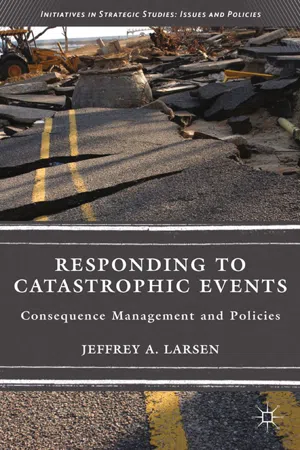
An introduction to the range of potential disaster scenarios, covering the issues and organizational relationships of importance to the student of consequence management. These include the roles, responsibilities, and coordination requirements of first responders, the Department of Homeland Security, the Department of Defense, and the military.
Information
PART I
BACKGROUND
1
DEALING WITH DISASTER
Jeffrey A. Larsen
All disasters are local.
On a hot, dry afternoon, typical of the American West in early summer, with bright sunshine and humidity levels in single digits, the people living along the Front Range of the Rocky Mountains were enjoying another beautiful day in the high altitude prairie of eastern Colorado—the kind of day that makes the region so popular among those who have discovered its secrets. But those conditions also made it a prime day for fire. The people of Colorado Springs, while enjoying the hot, lazy afternoon, also knew that the city was in the middle of a historic drought, with tinder dry conditions in the woods and grasslands of their city. Worse, for the fourth day in a row they could see a column of smoke rising from the mountains to their west. The smoke was not on the far horizon, nor was it a scene on their television sets beaming in from some distant land. They could smell it. Fire was in the foothills of their city. And life was about to get very serious very quickly for the people who lived near those mountains.
On that Tuesday afternoon of June 26, 2012, as the thermometer hit an all-time high for Colorado Springs, the Waldo Canyon fire was gathering strength as it burned unchecked in the ponderosa pine, scrub oak, and sage covered hills on the outskirts of the city. The spokesperson for the National Forest Service had just finished her daily 4 p.m. news conference, stating that while the fire was not yet contained, it had been a good day on the fire lines and nothing surprising was expected. Suddenly the winds picked up, the result of thunderstorms 50 miles to the north that affected the local atmosphere of the Pikes Peak region. The hot wind gained strength and changed direction, gusting to 65 knots and driving the fire over the ridge and down the slopes on the west side of Colorado Springs—directly into an upscale neighborhood of residential homes known as Mountain Shadows. The fire jumped two containment lines as the firefighters in the foothills dropped their equipment, put their hands on the shoulders of their comrades so as not to lose them in the smoke, and marched single file out of the woods, regrouping down below along city streets that were already burning. Meanwhile, the city government quickly ordered the evacuation of 35,000 people who lived in the path of the fire. In the false twilight of a city no longer recognizable in the heavy smoke, long lines of cars began heading out of the danger zone during the height of the evening rush hour. Interstate 25 was shut down in one direction so the evacuees could use all six lanes to get away—although where they were going, many had no idea. They had left the tangible manifestations of their lives behind as flames appeared in their rear view mirrors. And no one knew where or when this firestorm could be stopped.
Thus began a horrific night of burning houses, property triage, and valiant efforts by the combined forces of multiple local fire departments, plus the small number of Forest Service firefighters on the scene, to fight back against the flames. By the next morning, nearly 350 homes lay in ruins. The fire continued to burn north along the Front Range and threatened the US Air Force Academy, but the worst was over. Within days, the federal government had fully entered the fight, with nearly 1,600 firefighters on the lines and the entire national fleet of aerial firefighting aircraft involved. Colorado’s governor called out the National Guard to help the city police protect the remaining homes in the ravaged neighborhoods. Private organizations opened shelters and began collecting donations to help their displaced neighbors. Even US Northern Command, which had not formally been asked for help till that point, found it impossible to sit on the sidelines when the fire was clearly visible from windows in the headquarters building on Peterson Air Force Base, just across town. Partly in response to public and media questions asking “Where is the military?” Northern Command activated the entire Military Airlift Firefighting System (MAFFS) fleet, consisting of 8 C-130 aircraft especially equipped to dump 16 tons of fire retardant in a single pass. Three days after the disastrous firestorm, while the fire was still devouring Pike National Forest, President Barack Obama made a trip to Colorado Springs to see the devastation and declare it a disaster area, opening the path to more federal support and relief funds.
As this episode showed, all emergencies and disasters begin as local events. When the episode is complete, and things once again settle down, they end as local problems of mitigation, cleanup, lessons-learned studies, and rebuilding. From the local perspective, federal resources often seem to arrive too late and leave too early. But in the past decade the United States has significantly improved its plans for dealing with terrorist attacks or natural disasters, including the creation of US Northern Command to handle military support to civil authorities when necessary, and the development of a national incident management system, with associated national level documents to support that plan.
Natural disasters are not the only concern for the US government when thinking about consequence management. While uncommon, terrorist events and accidents or incidents involving the materials or agents found in weapons of mass destruction (WMD) are certainly a viable threat, as seen in incidents as widespread as the Aum Shinrikyo attacks using sarin gas in the Tokyo subway, anthrax letters mailed to key media personalities and legislators in the United States, mass bombings of the Madrid and London transport systems, and the threat of a radiological dispersal device in a Moscow park. With the global spread of technology and knowledge about these weapons and the ease of international travel, such threats are only going to increase. In addition, natural disasters such as Hurricane Katrina, which devastated New Orleans and the Gulf Coast in 2005, Hurrican Sandy in the northeastern United States in 2012, major blizzards that have hit the East Coast in recent years, spring tornado outbreaks that strike cities in the Midwest, and the annual onslaught of killer forest fires in the West will always be with us. As a result, we need government agencies and individuals that are not only prepared to deal with natural disasters and weather events, but who also understand WMD and what to do when an incident, accident, or natural disaster occurs. A WMD incident would have implications across the spectrum of communities found in modern society: medical, public health, policy, public affairs, and national security, among others. Cooperation is therefore necessary between the agencies in these arenas at all levels of local, state, and federal government. Local responders will be most crucial to managing the effects of such an incident, as well as the most vulnerable to the effects of the materials themselves. Law enforcement and military organizations are likely to be among those first responders. Many of the professionals in those organizations will pass through the DOD Joint Professional Military Education system, giving educators the opportunity to train and educate those groups prior to the next big surprise.
ABOUT THE PROJECT
The project that led to this book began as an effort to develop a reader on consequence management suitable for classroom use in the Joint Professional Military Education system. Such a book, the sponsors hoped, would highlight the challenges posed by WMD in executing consequence management operations, as well as other operations in the wake of catastrophic events. It would address the policy, organizational, and operational issues that confront local, state, and federal first responders and interagency members when they are faced with responding to a natural disaster or an incident involving chemical, biological, nuclear, radiological, or high explosive materials or weapons. Managing a WMD event requires cooperation and collaboration between multiple agencies across all layers of government, and possibly with foreign governments as well.
Such a volume would introduce students of consequence management to government plans and directives regarding WMD and consequence management, the National Incident Management System, the National Response Framework, the National Strategy to Combat WMD, the means employed to handle foreign consequence management, public affairs and media considerations, legal issues, homeland security, and US interagency considerations. There is a large body of literature available to the student of consequence management, from academically oriented, broad-based approaches such as Bruce Bennett and Richard Love’s Initiatives and Challenges in Consequence Management after a WMD Attack (Air University Press, 2004),1 to more narrowly defined government documents such as the US Department of Homeland Security’s “Command and Management,” a chapter in National Incident Management System (DHS, 2004).2 There are good reference materials, such as Roland Langford’s Introduction to Weapons of Mass Destruction (Wiley-Interscience, 2004)3 and Eric Croddy, James Wirtz, and Jeffrey Larsen’s Weapons of Mass Destruction: An Encyclopedia of Worldwide Policy, Technology, and History (ABC-Clio, 2005).4 And there are categories of books and articles in each of the subfields that make up the large realm of WMD and consequence management. What was missing, however, was a textbook for graduate level students who may find themselves actually dealing with a WMD disaster someday. This book addresses that need.
WHERE’S WALDO? A TALE OF INTERAGENCY RESPONSE
The Waldo Canyon fire was the single most expensive disaster in Colorado history. Total costs, including the firefighting effort itself, the cost of rebuilding homes, and lost personal property, was estimated to be close to $400 million. While that amount pales in comparison to the larger Oakland or San Diego fires in California, or the damage to New Orleans from Hurricane Katrina, or to New York and New Jersey from Hurricane Sandy, it was nonetheless a serious economic shock to the city, and is representative of the type of natural disaster that can befall nearly any community. Natural events such as fires, hurricanes, blizzards, tornados, tsunamis, earthquakes, and floods are regular occurrences in one part or another of our continent-size country nearly every year. But the United States is also concerned about the possibility of a major terrorist attack, perhaps one that takes place in a flashy way, such as an explosion, or more worrying, one that is unleashed in a more discrete form, such as a biological contagion. In many ways, the firestorm that rolled off the mountain into Colorado Springs that hot June evening was very similar to the effect on a city of a small nuclear explosion: vicious winds, blowing embers, thermal heat (at one point a firefighter radioed that he was witnessing “spontaneous structure to structure combustion”). The only thing missing was the radiation and fallout one would expect from an atomic explosion, although the remaining ash and debris in the basements of what were formerly homes was considered a potential health hazard due to the large amount of heavy metals and unknown chemicals remaining in the rubble. An atomic explosion would have hit more quickly, and been over much faster than a forest fire, with greater loss of life as a result. (The Waldo Canyon fire directly led to only two confirmed deaths.) And the psychological effect of a nuclear attack would certainly be far greater. Still, the fire turned nasty very quickly, with most people having less than half an hour’s notice to gather their valuables, pets, and whatever they could fit into their cars before evacuating. This represents the type of natural disaster that can come upon a community quickly and overwhelm even the most prepared and resilient local first responders.
The Waldo Canyon fire involved a host of players. It began with local firefighting departments from multiple jurisdictions, as well as police from city, county, and state bureaus. The Colorado Springs Office of Emergency Management activated its mandatory evacuation plan as the fire transitioned from a forest blaze to an urban catastrophe. Firefighters from the...
Table of contents
- Cover
- Title Page
- Copyright
- Contents
- List of Figures
- Foreword
- Preface
- Part I Background
- Part II Federal Response
- Part III Legal Issues, Communications, and Foreign Consequence Management
- Part IV Case Studies
- Part V Conclusion
- About the Contributors
- Index
Trusted by 375,005 students
Access to over 1.5 million titles for a fair monthly price.
Study more efficiently using our study tools.
Frequently asked questions
Yes, you can cancel anytime from the Subscription tab in your account settings on the Perlego website. Your subscription will stay active until the end of your current billing period. Learn how to cancel your subscription
No, books cannot be downloaded as external files, such as PDFs, for use outside of Perlego. However, you can download books within the Perlego app for offline reading on mobile or tablet. Learn how to download books offline
Perlego offers two plans: Essential and Complete
- Essential is ideal for learners and professionals who enjoy exploring a wide range of subjects. Access the Essential Library with 800,000+ trusted titles and best-sellers across business, personal growth, and the humanities. Includes unlimited reading time and Standard Read Aloud voice.
- Complete: Perfect for advanced learners and researchers needing full, unrestricted access. Unlock 1.5M+ books across hundreds of subjects, including academic and specialized titles. The Complete Plan also includes advanced features like Premium Read Aloud and Research Assistant.
We are an online textbook subscription service, where you can get access to an entire online library for less than the price of a single book per month. With over 1.5 million books across 990+ topics, we’ve got you covered! Learn about our mission
Look out for the read-aloud symbol on your next book to see if you can listen to it. The read-aloud tool reads text aloud for you, highlighting the text as it is being read. You can pause it, speed it up and slow it down. Learn more about Read Aloud
Yes! You can use the Perlego app on both iOS and Android devices to read anytime, anywhere — even offline. Perfect for commutes or when you’re on the go.
Please note we cannot support devices running on iOS 13 and Android 7 or earlier. Learn more about using the app
Please note we cannot support devices running on iOS 13 and Android 7 or earlier. Learn more about using the app
Yes, you can access Responding to Catastrophic Events by J. Larsen in PDF and/or ePUB format, as well as other popular books in Politics & International Relations & American Government. We have over 1.5 million books available in our catalogue for you to explore.